Dmitriy Sergeyev

315 posts

Dmitriy Sergeyev

Dmitriy Sergeyev

@d_sergeyev

Economist at Bocconi University, affiliate at CEPR and IGIER.

Milan, Italy Katılım Mart 2018
602 Takip Edilen1.1K Takipçiler
Dmitriy Sergeyev retweetledi

Jon Steinsson
Jon Steinsson@JonSteinsson·
Technical change often simplifies the tasks performed by labor. This raises productivity. But it can also erode the bargaining power of workers. My new paper “The Commoditization of Labor” (with Fukui and Nakamura) is about this. Some thoughts. (Link below) 1/
English

10
63
297
30.3K
Dmitriy Sergeyev retweetledi
Gita Gopinath
Gita Gopinath@GitaGopinath·
The UAE exploring a swap line with the US should give us pause that the consequences of the Iran conflict are far greater than what we see priced in markets. Such explorations do not arise lightly, even behind closed doors.
English
88
655
2.9K
329.4K
Dmitriy Sergeyev retweetledi
Bruno Pellegrino
Bruno Pellegrino@BPellegrino_CBS·
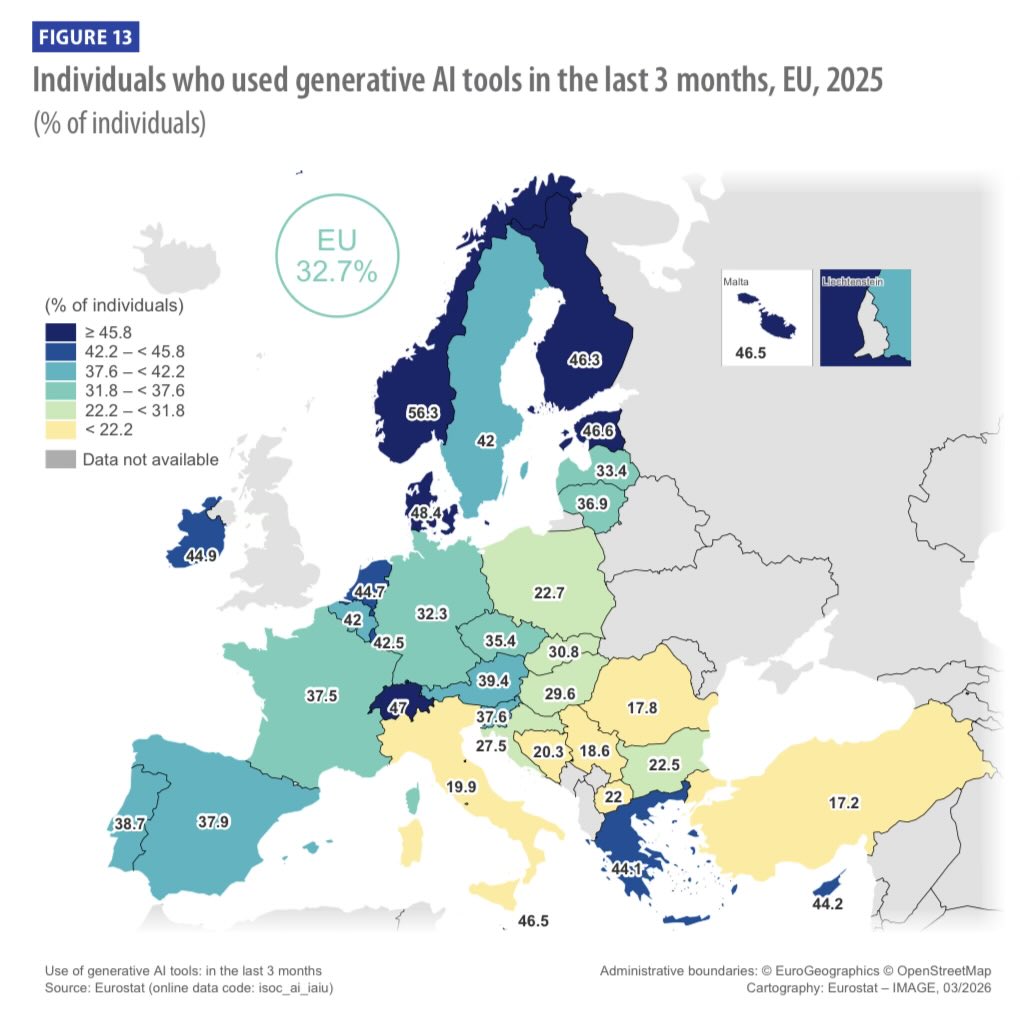
12 years ago Luigi @zingales and I wrote the first draft of our paper “Diagnosing the Italian Disease”, which linked the stalling of Italian productivity to its firms’ failure to effectively use ICT. Unfortunately, it seems it remains very much relevant today in the age of AI 🙁 #econtwitter #ai
Bruno Pellegrino tweet media
English
1
78
292
39.5K
Dmitriy Sergeyev retweetledi
Luca Fornaro
Luca Fornaro@LucaFornaro3·
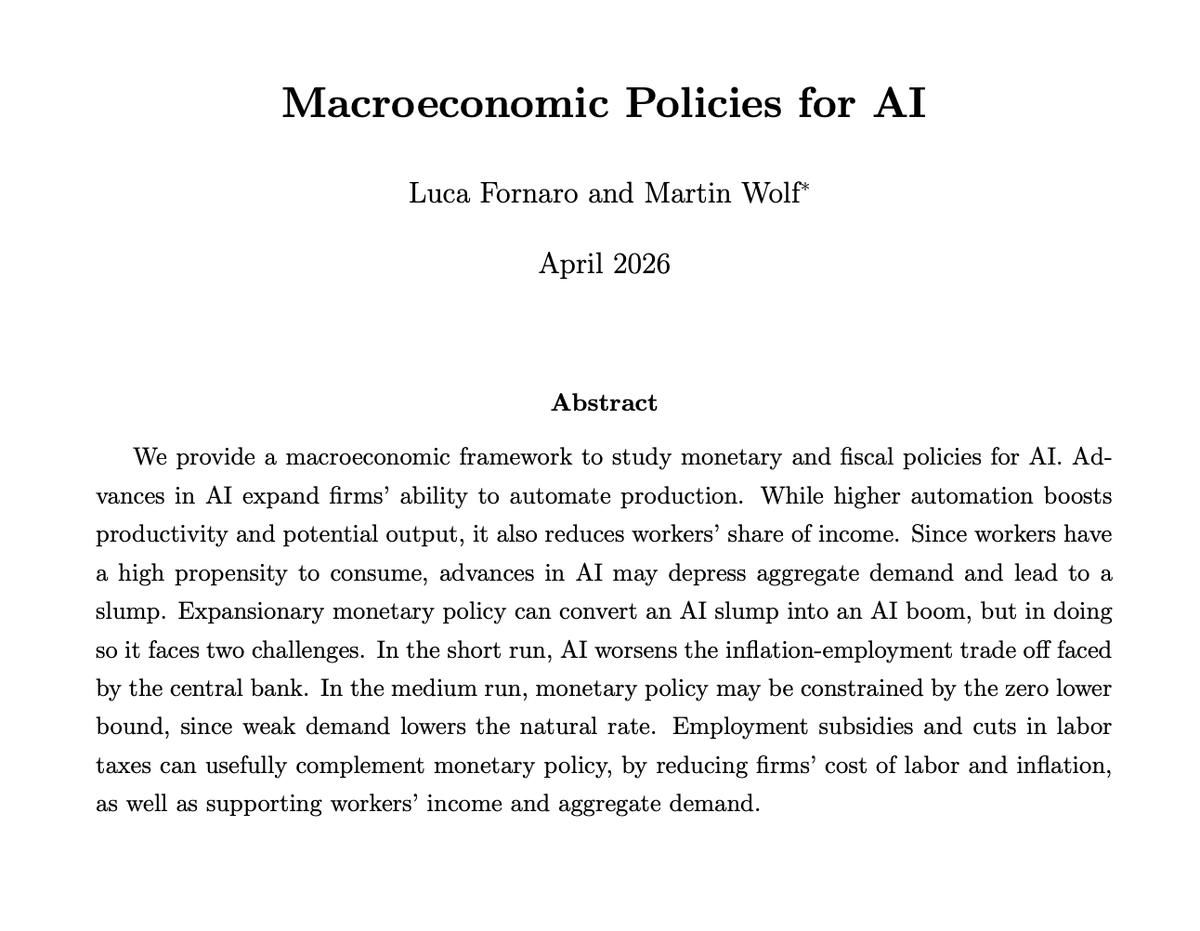
How will AI affect our economies? In this new paper, we argue that macroeconomic policies may determine whether we will face an AI slump or an AI boom. Spoiler: monetary policy alone may have a hard time sustaining an AI boom, employment subsidies/cuts in labor taxes can help.
Luca Fornaro tweet media
English
6
62
252
38.3K
Dmitriy Sergeyev retweetledi
Neil Mehrotra
Neil Mehrotra@neilmehrotra·
Core PCE inflation has been running about 1 percentage point above target. Many estimates say this can be explained by tariffs. In a note published tonight, @tradewartracker and I argue this is inconsistent with the pattern of inflation seen in core goods. 🧵 (1/9):
English
1
7
30
4.8K
Dmitriy Sergeyev retweetledi
Pontus Rendahl
Pontus Rendahl@pontus_rendahl·
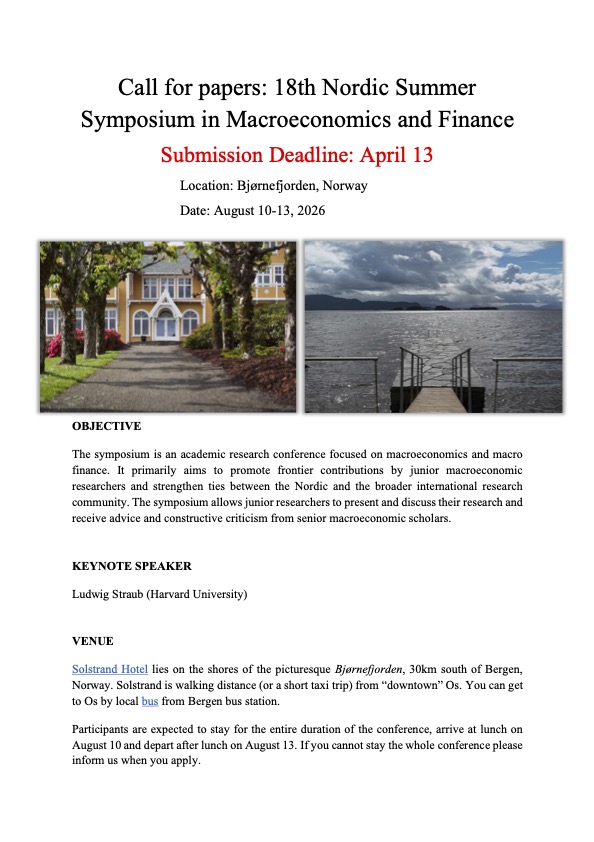
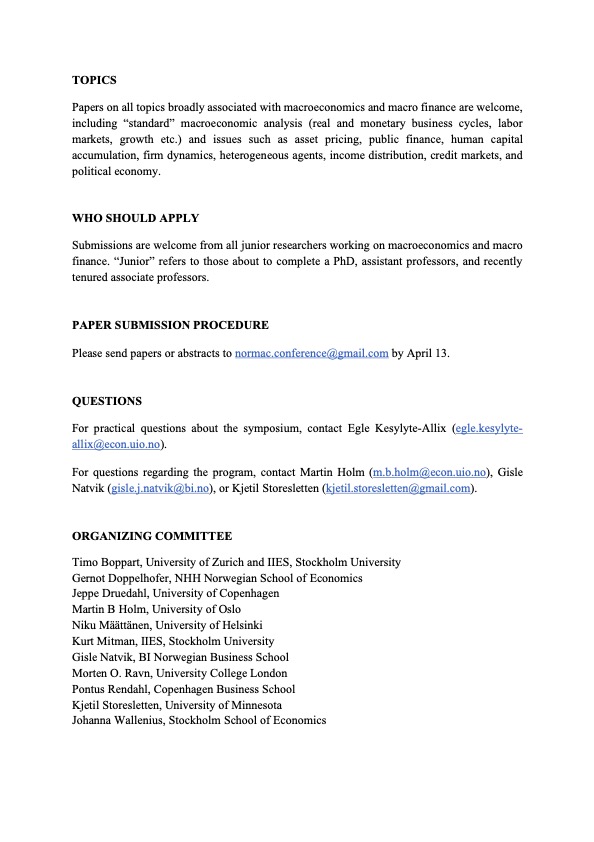
My favourite macro conference of the year just announced its call for papers! It's mainly intended for "juniors" (=PhD students, Assistant and recently Associate profs). Tight deadline, so apply before April 13. RT if you think someone else might be interested.
Pontus Rendahl tweet mediaPontus Rendahl tweet media
English
2
42
127
17.5K
Dmitriy Sergeyev retweetledi
Ricardo Reis
Ricardo Reis@R2Rsquared·
Is the Phillips curve useful to make sense of inflation? A.W.H. Phillips first postulated a negative empirical correlation between inflation and the level of economic activity. Looking at inflation in 2021-24---up and down---versus measures of unemployment---roughly unchanged---shows little correlation. Has the Phillips curve failed, yet again? No, it did not. Friedman and Phelps, almost 50 years ago, clarified that this correlation should only hold keeping expected inflation fixed. Almost every account of how firms choose prices or bargain wages with their workers predicts that expectations would show up in a Philips curve. Moreover, those models of behavior further add that increases in marginal costs (supply shocks) would further shift out this relation. The empirical Phillips curve has for many decades meant a negative relation between inflation and real activity, controlling for expected inflation and supply shocks. The left figure below shows on the vertical axis inflation, after controlling for expected inflation---mean and disagreement from a household survey---and for supply shocks---gas prices and global supply pressures. The horizontal axis shows a measure of slack in the labor market---the log of the ratio of unemployment to job vacancies. The Phillips curve held nicely and steadily throughout. A criticism of that figure is that its is looking in the rear view mirror: the measure of supply shocks and the measure of slack were developed in the last few years and the data has been revised. The right figure does instead an out-of sample exercise. Estimate a regression of inflation on (i) expected inflation, (ii) the difference between the unemployment rate and the CBO estimate of its non-cyclical component, and (iii) the PCE energy price index. Do it on data pre-pandemic: 1984Q1-2020Q1. Using that estimated equation, predict inflation in real time from then onwards using the data releases available at the time of the forecast. The Phillips curve was a pretty good predictor of inflation throughout. The Phillips curve was stable during the inflation surge, and it predicted well the movements in inflation, with expectations playing a key role in those predictions. Notes: it is important to include the right measure of expectations to understand inflation-activity dynamics at a business-cycle frequency: the short-horizon expectations of households and firms. (For instance, the long-horizon expectations from professionals, or the expectations from models in policy institutions, as in my previous two posts, are the wrong measure.) Sources: (i) Section 3 in Reis "Why Did Inflation Rise and Fall in 2021-24? Channels and Evidence from Expectations" (ii) The simple exercise on the left figure is inspired on the analysis of Bernanke and Blanchard “What Caused the US Pandemic-Era Inflation?” (iii) The simple exercise on the right figure is inspired on @jadhazell "Comment" in the NBER macro annual 2025, which in turn built on Beaudry, Hou, and Portier "The Dominant Role of Expectations and Broad-Based Supply Shocks in Driving Inflation"
Ricardo Reis tweet media
English
12
56
273
45.3K
Dmitriy Sergeyev retweetledi
Gita Gopinath
Gita Gopinath@GitaGopinath·
My op-ed in the @FT on the US net international investment position (NIIP) which is the trigger for Section 122 to deal with trade deficits. ft.com/content/bcf272…
Gita Gopinath tweet media
English
3
8
61
8.8K
Dmitriy Sergeyev retweetledi
ian bremmer
ian bremmer@ianbremmer·
after nearly four years of relentless war, ukraine continues not to target russian civilian casualties. russia continues to target ukrainian casualties day after day after day. we should not forget this.
English
361
2.3K
9.4K
275.7K
Dmitriy Sergeyev retweetledi
Tymofiy Mylovanov
Tymofiy Mylovanov@Mylovanov·
Putin fears Tomahawks. Proven in battles, they threaten Russia’s S-400s and can shift the war’s course. If Trump wants peace, he must give Ukraine Tomahawks. They pierce Russian air defenses and hit any target, recently proving effective against Iran — The Telegraph. 1/
Tymofiy Mylovanov tweet media
English
217
327
1.7K
33K
Adrien Auclert
Adrien Auclert@a_auclert·
I’m delighted to receive this award! Janet Yellen has been a great inspiration for me. Thank you to the @sffed for the honor and encouragement!
Adrien Auclert tweet media
Stanford Institute for Economic Policy Research@SIEPR

Congratulations to Adrien Auclert @a_auclert, SIEPR senior fellow and the recipient of the @ssfed's inaugural Janet Yellen Award for Monetary Research for his early-career work in monetary economics! Link 👇 on Auclert's path into #economics and about his work. #MonetaryPolicy

English
13
6
283
23.6K
Dmitriy Sergeyev retweetledi
Timothy Snyder
Timothy Snyder@TimothyDSnyder·
Please join me in raising funds for medical cargo buses and trucks with electric jamming capabilities for brigades of Ukraine's Khartiia Corps. These automobiles make the difference between whether people survive or not. We can do something very specific and very meaningful to help. help99.co/patches/timoth…
English
123
2K
5.2K
211.9K
Dmitriy Sergeyev retweetledi
Jesús Fernández-Villaverde
Jesús Fernández-Villaverde@JesusFerna7026·
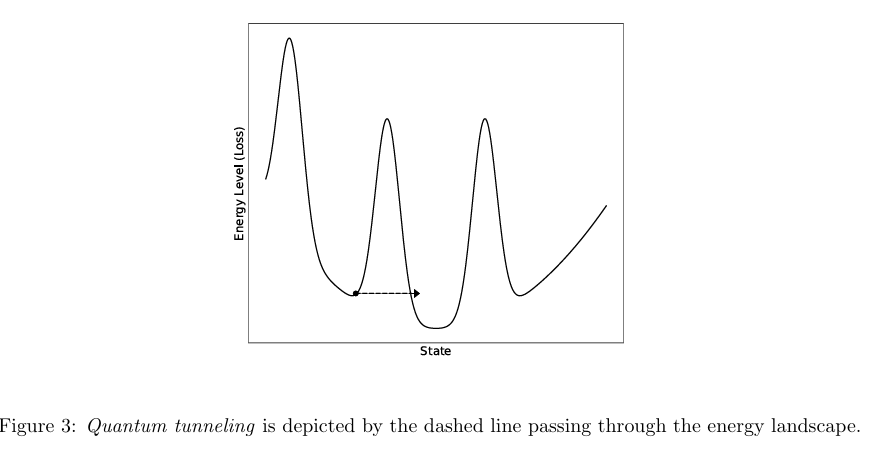
I was thrilled to learn this morning that John Clarke, Michel Devoret, and John Martinis have won the 2025 Nobel Prize in Physics “for the discovery of macroscopic quantum mechanical tunnelling and energy quantisation in an electric circuit.” Quantum tunnelling might sound distant from economics—but it isn’t. There’s a deep connection that I explore in my paper with Isaiah Hull, Dynamic Programming in Economics on a Quantum Annealer (forthcoming in Quantitative Economics): 🔗 sas.upenn.edu/~jesusfv/Solvi… 👉 Figure 3 in the paper (included here) shows how quantum annealers exploit tunnelling: a qubit passes through a barrier in the energy landscape (loss surface) instead of climbing over it, as classical algorithms must. Why does this matter? Some background: In economics, a central computational challenge is dynamic programming—solving intertemporal choice problems. Unfortunately, classical methods suffer from the curse of dimensionality: the cost of computation increases exponentially with the number of state variables. In practice, that means it’s nearly impossible to solve models with more than five state variables unless we can exploit very specific structure. Quantum phenomena—like tunnelling—open a radically new path. They allow us to design quantum algorithms that break this curse of dimensionality. The goal isn’t to “port” your classical code into a quantum machine (that’s impossible), but to create entirely new algorithms that harness quantum physics. That’s what we do in our paper: we propose what we believe is the first practical algorithm to solve dynamic programming problems in economics without suffering from the curse of dimensionality. Yes, current quantum annealers are limited, so we must apply our method to simple test cases—a criticism we've received a few times. But that’s immaterial. The algorithm exists, and future generations of quantum computers will utilize it fully. This is now the second year in a row that the Nobel Prize in Physics has been directly connected to my research. Last year’s award, of course, was for neural networks, a topic I’ve discussed extensively here on X. Just last week, a lively debate on X, led by @ben_golub, took place about whether economists should borrow ideas from physics. The answer is obvious: of course we should—and we already do. The real issue is that many critics pushing such methods don’t understand what economists actually do or why. It’s striking how few take the time to study what they criticize. If you want to make a serious argument, first make sure you can accurately represent the position you’re attacking. That’s the Turing test of intellectual honesty: unless you can “fake” being an economist to a neutral observer, you probably don’t understand the argument at all.
Jesús Fernández-Villaverde tweet media
English
7
49
270
35K
Dmitriy Sergeyev retweetledi
Trade Diversion (Jonathan Dingel)
Trade Diversion (Jonathan Dingel)@TradeDiversion·
PhD students underestimate the value of writing well. Faculty skim dozens of JMPs in a short time. If your contribution is unclear, you will get fewer interviews. Editing improves economics papers (RCT): doi.org/10.1016/j.jebo… I am happy to recommend amyedits.net
English
1
28
251
22.5K