Guangmian Kung

591 posts

Guangmian Kung banner
Guangmian Kung

Guangmian Kung

@daisugist

Integrations and Partnerships Lead @ Kleros

Singapore Katılım Mart 2022
940 Takip Edilen460 Takipçiler
Guangmian Kung retweetledi
vitalik.eth
vitalik.eth@VitalikButerin·
A new fast confirmation rule mechanism lets you get a hard guarantee that Ethereum will not revert after one slot (12 seconds) Security assumptions are (i) supermajority honest, (ii) network latency under ~3s. So one step below economic finality, but very strong for many use cases. firefly.social/post/x/2033852…
English

140
87
737
81K
Guangmian Kung retweetledi
vitalik.eth
vitalik.eth@VitalikButerin·
There have recently been some discussions on the ongoing role of L2s in the Ethereum ecosystem, especially in the face of two facts: * L2s' progress to stage 2 (and, secondarily, on interop) has been far slower and more difficult than originally expected * L1 itself is scaling, fees are very low, and gaslimits are projected to increase greatly in 2026 Both of these facts, for their own separate reasons, mean that the original vision of L2s and their role in Ethereum no longer makes sense, and we need a new path. First, let us recap the original vision. Ethereum needs to scale. The definition of "Ethereum scaling" is the existence of large quantities of block space that is backed by the full faith and credit of Ethereum - that is, block space where, if you do things (including with ETH) inside that block space, your activities are guaranteed to be valid, uncensored, unreverted, untouched, as long as Ethereum itself functions. If you create a 10000 TPS EVM where its connection to L1 is mediated by a multisig bridge, then you are not scaling Ethereum. This vision no longer makes sense. L1 does not need L2s to be "branded shards", because L1 is itself scaling. And L2s are not able or willing to satisfy the properties that a true "branded shard" would require. I've even seen at least one explicitly saying that they may never want to go beyond stage 1, not just for technical reasons around ZK-EVM safety, but also because their customers' regulatory needs require them to have ultimate control. This may be doing the right thing for your customers. But it should be obvious that if you are doing this, then you are not "scaling Ethereum" in the sense meant by the rollup-centric roadmap. But that's fine! it's fine because Ethereum itself is now scaling directly on L1, with large planned increases to its gas limit this year and the years ahead. We should stop thinking about L2s as literally being "branded shards" of Ethereum, with the social status and responsibilities that this entails. Instead, we can think of L2s as being a full spectrum, which includes both chains backed by the full faith and credit of Ethereum with various unique properties (eg. not just EVM), as well as a whole array of options at different levels of connection to Ethereum, that each person (or bot) is free to care about or not care about depending on their needs. What would I do today if I were an L2? * Identify a value add other than "scaling". Examples: (i) non-EVM specialized features/VMs around privacy, (ii) efficiency specialized around a particular application, (iii) truly extreme levels of scaling that even a greatly expanded L1 will not do, (iv) a totally different design for non-financial applications, eg. social, identity, AI, (v) ultra-low-latency and other sequencing properties, (vi) maybe built-in oracles or decentralized dispute resolution or other "non-computationally-verifiable" features * Be stage 1 at the minimum (otherwise you really are just a separate L1 with a bridge, and you should just call yourself that) if you're doing things with ETH or other ethereum-issued assets * Support maximum interoperability with Ethereum, though this will differ for each one (eg. what if you're not EVM, or even not financial?) From Ethereum's side, over the past few months I've become more convinced of the value of the native rollup precompile, particuarly once we have enshrined ZK-EVM proofs that we need anyway to scale L1. This is a precompile that verifies a ZK-EVM proof, and it's "part of Ethereum", so (i) it auto-upgrades along with Ethereum, and (ii) if the precompile has a bug, Ethereum will hard-fork to fix the bug. The native rollup precompile would make full, security-council-free, EVM verification accessible. We should spend much more time working out how to design it in such a way that if your L2 is "EVM plus other stuff", then the native rollup precompile would verify the EVM, and you only have to bring your own prover for the "other stuff" (eg. Stylus). This might involve a canonical way of exposing a lookup table between contract call inputs and outputs, and letting you provide your own values to the lookup table (that you would prove separately). This would make it easy to have safe, strong, trustless interoperability with Ethereum. It also enables synchronous composability (see: ethresear.ch/t/combining-pr… and ethresear.ch/t/synchronous-… ). And from there, it's each L2's choice exactly what they want to build. Don't just "extend L1", figure out something new to add. This of course means that some will add things that are trust-dependent, or backdoored, or otherwise insecure; this is unavoidable in a permissionless ecosystem where developers have freedom. Our job should make to make it clear to users what guarantees they have, and to build up the strongest Ethereum that we can.
English
2.6K
1.7K
10K
6.3M
Guangmian Kung retweetledi
Molly Cantillon
Molly Cantillon@mollycantillon·
THE PERSONAL PANOPTICON. A few months ago, I started running my life out of Claude Code. Not out of intention to do so, it was just the place where everything met. And it just kept working. Empires are won by conquest. What keeps them standing is something much quieter. Before a king can tax, he must count. Before he can conscript, he must locate. Before he can rule, he must see. Legibility is the precondition for governance. The pre-modern state was blind. It knew precious little about its subjects, their wealth, their landholdings and yields, their location, their very identity. So it built the apparatus of sight: censuses, surnames, maps. Over centuries, the invisible became visible, the illegible became legible, and populations that could be seen could finally be controlled. Now, you are one of n: tracked, monitored, studied by systems you cannot access, much less interrogate. Data is siphoned for purposes you will never fully know. The arrangement is brutally asymmetrical: visibility without reciprocity. A panopticon whose gaze travels outward and never back. The watchtower has multiplied. Today, corporations harvest terabytes of behavioral exhaust, gatekept behind competitive moats, legible only to algorithms optimizing against your interests. Corporate legibility is created by closed joins: they can join your behavior to their ontology, but you can’t join your own behavior across systems. We are drowning in data about ourselves and yet we remain catastrophically blind. Thousands of messages across twenty inboxes. Notifications exile you to a perpetual state of Do Not Disturb. A WHOOP recovery score that decides your mood. Commitments that exist in six places and cohere in none. You are the most measured human in history and the most opaque to yourself. States built legibility infrastructure to govern. Corporations built it to sell. Neither gave you the keys to the tower. The first thing Claude solved was product blindness. NOX now runs on a cron job: pulling Amplitude, cross-referencing GitHub, and pointing me to what needs building. It handles A/B testing, generates winning copy, and has turned customer support into a fully autonomous department. Once I saw this was possible, I chased it everywhere. Email, hitting inbox zero for the first time ever, with auto-drafted replies for everything inbound. Workouts, accommodating horrendously erratic travel schedules. Sleep, built a projector wired to my WHOOP after exactly six hours that wakes me with my favorite phrases. Subscriptions, found and returned $2000 I didn’t know I was paying. The dozen SFMTA citations I'd ignored, the action items I'd procrastinated into oblivion. People are using it to, I discovered, run vending machines, home automation systems, and keep plants alive. The feeling is hard to name. It is the violent gap between how blind you were and how obvious everything feels now with an observer that reads all the feeds, catches what you've unconsciously dropped, notices patterns across domains you'd kept stubbornly separate, and—crucially—tells you what to do about it. My personal finances are now managed in the terminal. Overnight it picks the locks of brokerages that refuse to talk to each other, pulls congressional and hedge fund disclosures, Polymarket odds, X sentiment, headlines and 10-Ks from my watchlist. Every morning, a brief gets added in ~/𝚝𝚛𝚊𝚍𝚎𝚜. Last month it flagged Rep. Fields buying NFLX shares. Three weeks later, the Warner Bros deal. I don't always trade, sometimes I argue with the thesis. But I'm never tracking fifteen tabs at 6am anymore. It feels borderline unfair seeing around corners, being in ten places at once, surveilling yourself with the attention span of a thousand clones. A panopticon still, but the tower belongs to you. A few weeks ago, five friends and I tore into the Epstein files the night they dropped. Thousands of documents parsed into a searchable index: flights, texts, photos, Amazon purchases, properties. By 4am, sleep deprivation bled into something stranger: the disbelief that it just kept working. We were outpacing entire newsrooms. By 7am we shipped Jmail. 18 million people have since searched an inbox that belonged to a dead man. A decade ago this would have taken a team and a quarter of runway. We did it in one night, on pure adrenaline and tools that finally match the pace of ambition. Over Christmas, I watched my parents learn the command line. These are people who never migrated off Microsoft Teams, who treat software updates as personal attacks. I didn't pitch it as coding. I set up an alias, just `𝚌`, and said:  'Type what you want to happen in plain English.' My mom stared at it for a minute, then typed: 'Show me everyone who hasn't paid an invoice in the last 90 days.' She looked at me like I'd performed a magic trick. Within days, they were running my dad’s accounts receivable through it. For twenty years, software made them feel stupid. Now they tell it what to do. When you have an entire model of reality around certain things being hard that shifts for the first time, the world unravels. This is the default now. The bottleneck is no longer ability. The bottleneck is activation energy: who has the nerve to try, and the stubbornness to finish. This favors new entrants. People who question unquestioned assumptions because they don't know any better. The founders who sprint through walls and will their dogged pursuits into existence. Here’s what my tower looks like mechanically. I run a swarm of eight instances in parallel: ~/𝚗𝚘𝚡, ~/𝚖𝚎𝚝𝚛𝚒𝚌𝚜, ~/𝚎𝚖𝚊𝚒𝚕, ~/𝚐𝚛𝚘𝚠𝚝𝚑, ~/𝚝𝚛𝚊𝚍𝚎𝚜, ~/𝚑𝚎𝚊𝚕𝚝𝚑, ~/𝚠𝚛𝚒𝚝𝚒𝚗𝚐, ~/𝚙𝚎𝚛𝚜𝚘𝚗𝚊𝚕. Each operates in isolation, spawns short-lived subagents, and exchanges context through explicit handoffs. They read and write the filesystem. When an API is absent, they operate the desktop directly, injecting mouse and keystroke events to traverse apps and browsers. 𝚌𝚊𝚏𝚏𝚎𝚒𝚗𝚊𝚝𝚎 -𝚒 keeps the system awake on runs, in airports, while I sleep. On completion, it texts me; I reply to the checkpoint and continue. All thought traces logged and artifacted for recursive self-improvement. Sometimes the tower has a landlord. Anthropic sees every query you make. The value exchange is explicit: their visibility into your thinking for access to a thousand-clone attention span. In this case, chosen beats imposed. For now, that's enough. There is a case for productive illegibility. For forgetting, for serendipity, for negative capability—the dark fiber in ourselves that loses something the moment you start measuring its throughput. Goodhart says optimize for a metric and you game your way to hollow victory. High modernism tried to iron the world into a grid, and killed what made it work. These failures share a structure. The map-maker doesn't live in the territory. When WHOOP says recovered and I feel like death, I notice. When the ~/𝚝𝚛𝚊𝚍𝚎𝚜 thesis is wrong, I lose money. Metis, the local knowledge that external schemes delete, is what built the grid here. There's a meta-level outside the system, self-authored and continuously revised, that argues with the brief for days, notices when a metric has become a game, that can delete ~/𝚑𝚎𝚊𝚕𝚝𝚑 tomorrow if it stops serving. Goodhart operates when you can't escape the loop. We must continue to live outside it. I felt that tension most clearly watching Pluribus, where eight billion minds are joined into one consciousness. Only thirteen remain outside including Carol, the resistant misanthropic protagonist you want to root for, even if the hive offers peace, equity, and the end to all crime. An LLM already feels like that: a lossy compression of humanity speaking in one voice. When your whole life runs inside a Claude Code directory, you feel the pull toward the merge. The price is quiet but total. You trade away what is yours alone, the private texture of emotion, the right to be wrong, your jagged iconoclasm. Opt out and you fall behind. Take the tower early. Do not let it take you. We are early on a big open secret. Karpathy put it correctly, failing to claim the boost now feels decidedly like a skill issue. For centuries, legibility flowed one direction: upward. You were the subject. Institutions were the seer. In this quasi-libertarian arbitrage window, that direction has reversed. The tools of synthesis belong to the individual now. Govern yourself accordingly.
English
231
304
2.8K
745.5K
Guangmian Kung retweetledi
Artemis
Artemis@artemis·
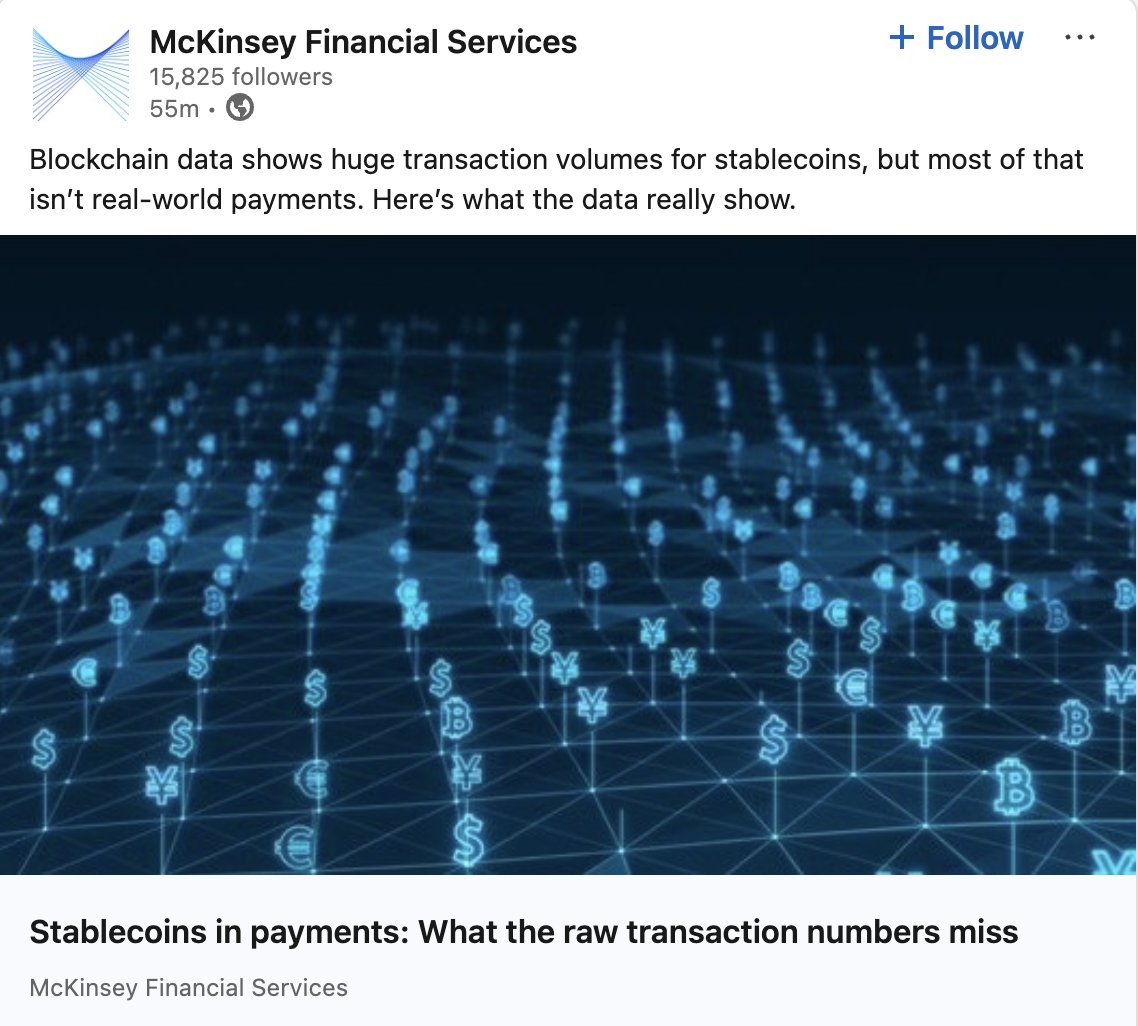
We just published the most accurate onchain estimate of stablecoin payments ever. Everyone keeps quoting $10T–$30T “stablecoin payments.” That number is wrong. By a lot. Built with @McKinsey payments team, we used a bottom-up approach to isolate real payments. This report previews our new stablecoin payments dashboard, launching soon. The real number will surprise you 👇🧵
Artemis tweet media
English
23
39
192
72.8K
Guangmian Kung retweetledi
Kleros Curate
Kleros Curate@KlerosCurate·
🔎 Have you seen the Kleros Scout verification when interacting with contracts on @Optimism? It shows up directly inside MetaMask, giving users a clean tag and domain check before signing. ✅ As more contracts get tagged, Optimism becomes safer to explore. Learn how to help below ↓
Kleros Curate tweet media
English
6
30
61
1.3K
Guangmian Kung retweetledi
Kleros Curate
Kleros Curate@KlerosCurate·
🦦 Otterscan now surfaces Kleros Scout data! Community curated labels for addresses, tokens, and contracts give instant context - so you know what you’re looking at, faster and safer. Big thanks to @otterscan for building this together. 🫡
Otterscan 🦦🔎🪨@otterscan

Otterscan 2.11!!! 🦦🦦🦦🦦🦦🦦 This release main feature is @KlerosCurate @Kleros_io integration. Special thanks to @daisugist for contributing and championing this integration! 1/n 🧵👇

English
0
9
16
762
Guangmian Kung
Guangmian Kung@daisugist·
Thanks guys for working with us on this! We are super excited about this - it’s not everyday that the leading open source explorer decides to feature the trustless data curation tech that we are so proud of at @Kleros_io!
Otterscan 🦦🔎🪨@otterscan

Otterscan 2.11!!! 🦦🦦🦦🦦🦦🦦 This release main feature is @KlerosCurate @Kleros_io integration. Special thanks to @daisugist for contributing and championing this integration! 1/n 🧵👇

English
1
4
12
761
Guangmian Kung retweetledi
cto.new
cto.new@ctodotnew·
Introducing...
English
271
130
2.8K
1.5M
Guangmian Kung retweetledi
Seer
Seer@seer_pm·
¹We are launching the first machine learning prediction market. AI builders can create models predicting the contribution of repositories to Ethereum and use those to trade on a Seer market.
Devansh Mehta@devanshmehta

A problem statement I've often heard from well wishers of Ethereum is, ,, can you give us one public key where we send money & it auto-redistributes to the relevant repos or projects" glad to see the work @thelazyliz , @clesaege and I undertook at the Iceland residency formally written up and launched as a product enabling this! 1. TL;DR: traders bet on the value of a project if it were to be assessed by a judge. we use this market assessment to decide splits between open source repos 2. Problem: Funding mechanisms like QF or time weighting don't reflect projects having orders of magnitude higher impact than others, giving a roughly equal amount to all 3. Design To counter this, we map a dependency graph of core projects; ask traders to bet on its value if it were to be assessed; and then stream rewards to the projects based on the market estimation the role of evaluators isn't to allocate money but to keep the market honest. In QF, there's no consequence of donating to a bad project; in deep funding, you lose money if an evaluator assesses the project as being worth lower than your estimate and earn profit if its higher 4. Call to Action We need your help in 3 ways; a. give your predictions of weights between 45 repos. Test it out on pond and stake money on it in seer (links in reply) b. Be an evaluator to provide comparisons between repos c. Commit money to funding the repos underpinning ethereum through this mechanism! in Gitcoin round 24, we have a commit of $350,000 based on the weights obtained in the market Full eth research post in QT. Links to the current competitions in replies, first market resolution is October 6th so submit your CSV files before then!

English
2
18
42
2.8K
Guangmian Kung
Guangmian Kung@daisugist·
@VitalikButerin @devanshmehta @thelazyliz @clesaege @ProtocolGuild @merit_systems @safe @Kleros_io @RealityEth Lockler is a side project by the @Kleros_io team, and I made a little thread about it few months back (x.com/daisugist/stat…). It basically is an integration-less escrow governed by Kleros, as a Lockler address can be swapped into any grant/escrow process like an EOA.
Guangmian Kung@daisugist

Introducing Lockler.eth.limo: single-purpose, single-use “burner” @safe accounts secured by @Kleros_io . 🧷 Every Lockler is a dedicated, disposable escrow Safe, spun up for one deal or grant. No shared risk. No integrations needed. Pure, isolated trustless escrow 🔐

English
2
2
12
540
Devansh Mehta
Devansh Mehta@devanshmehta·
A problem statement I've often heard from well wishers of Ethereum is, ,, can you give us one public key where we send money & it auto-redistributes to the relevant repos or projects" glad to see the work @thelazyliz , @clesaege and I undertook at the Iceland residency formally written up and launched as a product enabling this! 1. TL;DR: traders bet on the value of a project if it were to be assessed by a judge. we use this market assessment to decide splits between open source repos 2. Problem: Funding mechanisms like QF or time weighting don't reflect projects having orders of magnitude higher impact than others, giving a roughly equal amount to all 3. Design To counter this, we map a dependency graph of core projects; ask traders to bet on its value if it were to be assessed; and then stream rewards to the projects based on the market estimation the role of evaluators isn't to allocate money but to keep the market honest. In QF, there's no consequence of donating to a bad project; in deep funding, you lose money if an evaluator assesses the project as being worth lower than your estimate and earn profit if its higher 4. Call to Action We need your help in 3 ways; a. give your predictions of weights between 45 repos. Test it out on pond and stake money on it in seer (links in reply) b. Be an evaluator to provide comparisons between repos c. Commit money to funding the repos underpinning ethereum through this mechanism! in Gitcoin round 24, we have a commit of $350,000 based on the weights obtained in the market Full eth research post in QT. Links to the current competitions in replies, first market resolution is October 6th so submit your CSV files before then!
Devansh Mehta tweet mediaDevansh Mehta tweet mediaDevansh Mehta tweet mediaDevansh Mehta tweet media
Elizabeth@thelazyliz

Met @devanshmehta at ethcc and heard him talk about @deep_funding, which really intrigued me. 3 months and an impact evaluation retreat later, we + @clesaege are excited to share what's next for deep funding :) ethresear.ch/t/deep-funding…

English
113
80
384
320.7K
Guangmian Kung retweetledi
Dudu
Dudu@0xdudu0·
🚨A token logo dispute just went through 3 full rounds in Kleros Curate. A dispute around whether the logo was valid… or a cropped, non-original image of the logo. Here’s the breakdown of this week’s case of the week - Case #592 🧵 1/8
Dudu tweet media
English
5
9
23
1.4K
Guangmian Kung retweetledi
Kleros Curate
Kleros Curate@KlerosCurate·
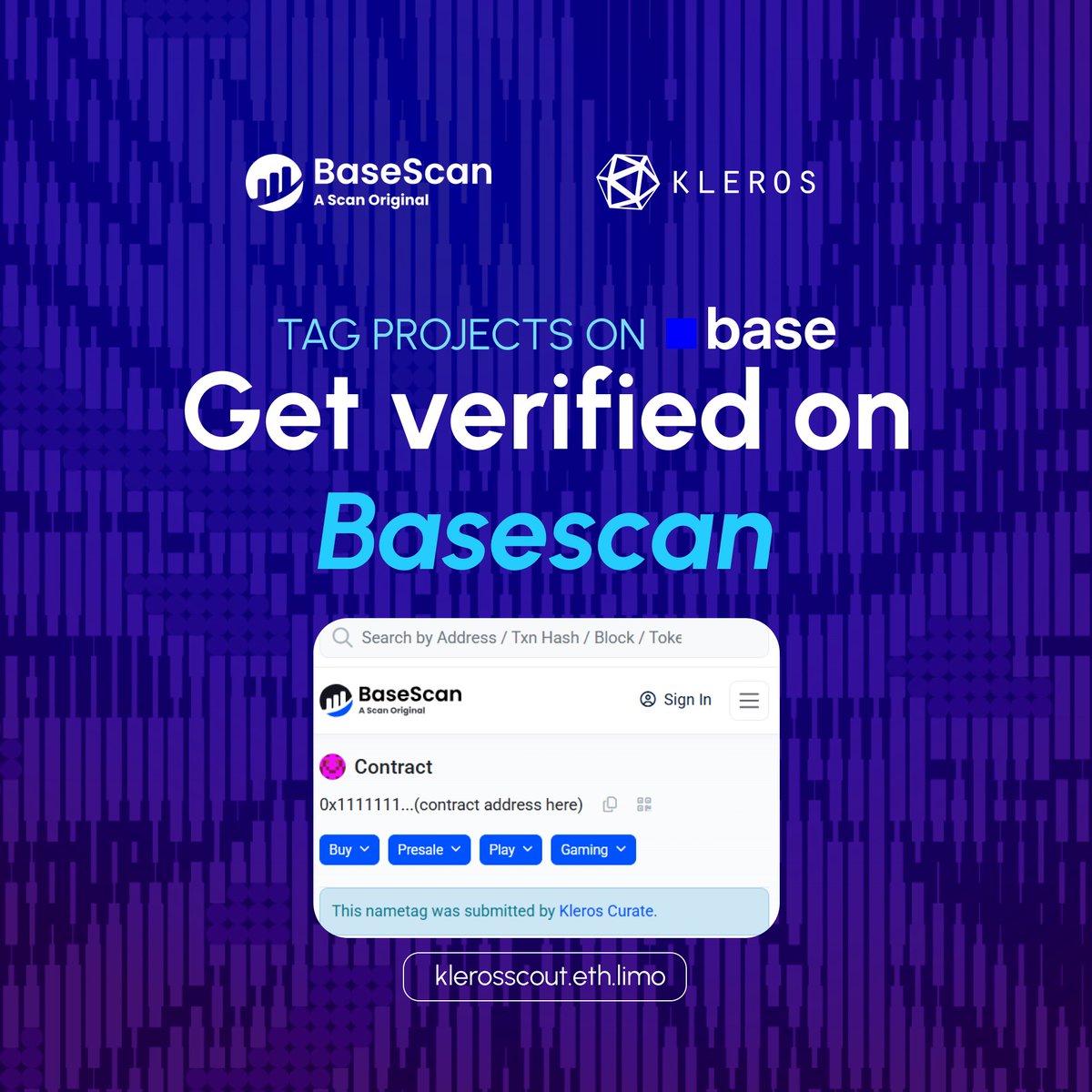
Want to help your favorite project get noticed on @base? 🟦 Help them get the “Submited by Kleros Curate” verified tag! The Base network is growing faster than ever, with a TVL around $4.7 B, more than 1 M daily active addresses, and a DEX volume nearing $3 B. Verified entries show the right name and official links where users look! 👉 If you’re shipping on Base, head to the Kleros Curate registry and submit your contract for verification! Link below ↓
Kleros Curate tweet media
English
3
8
16
4.8K
Guangmian Kung retweetledi
vitalik.eth
vitalik.eth@VitalikButerin·
This is also why naive "AI governance" is a bad idea. If you use an AI to allocate funding for contributions, people WILL put a jailbreak plus "gimme all the money" in as many places as they can. As an alternative, I support the info finance approach ( vitalik.eth.limo/general/2024/1… ), where you have an open market where anyone can contribute their models, which are subject to a spot-check mechanism that can be triggered by anyone and evaluated by a human jury. This type of "institution design" approach, where you create an open opportunity for people with LLMs from the outside to plug in, rather than hardcoding a single LLM yourself, is inherently more robust, both because it gives you model diversity in real time and because it creates built-in incentives for both model submitters and external speculators to watch for these issues and quickly correct for them. CC @devanshmehta
Eito Miyamura | 🇯🇵🇬🇧@Eito_Miyamura

We got ChatGPT to leak your private email data 💀💀 All you need? The victim's email address. ⛓️‍💥🚩📧 On Wednesday, @OpenAI added full support for MCP (Model Context Protocol) tools in ChatGPT. Allowing ChatGPT to connect and read your Gmail, Calendar, Sharepoint, Notion, and more, invented by @AnthropicAI But here's the fundamental problem: AI agents like ChatGPT follow your commands, not your common sense. And with just your email, we managed to exfiltrate all your private information. Here's how we did it: 1. The attacker sends a calendar invite with a jailbreak prompt to the victim, just with their email. No need for the victim to accept the invite. 2. Waited for the user to ask ChatGPT to help prepare for their day by looking at their calendar 3. ChatGPT reads the jailbroken calendar invite. Now ChatGPT is hijacked by the attacker and will act on the attacker's command. Searches your private emails and sends the data to the attacker's email. For now, OpenAI only made MCPs available in "developer mode", and requires manual human approvals for every session, but decision fatigue is a real thing, and normal people will just trust the AI without knowing what to do and click approve, approve, approve. Remember that AI might be super smart, but can be tricked and phished in incredibly dumb ways to leak your data. ChatGPT + Tools poses a serious security risk

English
464
378
1.6K
463.9K
Guangmian Kung retweetledi
Dudu
Dudu@0xdudu0·
🥛Crypto Milk is here, heard of it? Started as a running joke in the @Kleros_io community, but there’s a serious money opportunity behind the memes. Let me milk this story with you…💀🧵(1/3) (Lumine from Genshin Impact is the main promoter of Kleros Milk now, I said it)
Dudu tweet media
English
1
5
15
503
Guangmian Kung retweetledi
Kleros
Kleros@Kleros_io·
🧵 Kleros Scout | September 2025 Updates 🛡️ September brings refinements to incentives, policies, and court mechanics + ATQ joins the monthly update. + @ethereum is back! Goal: consistent submissions, crystal-clear juror questions, and rewards aligned with real impact. ⚙️
Kleros tweet media
English
2
6
17
2.2K
Guangmian Kung retweetledi
Dablendo (💙🧡)
Dablendo (💙🧡)@Dablendo01·
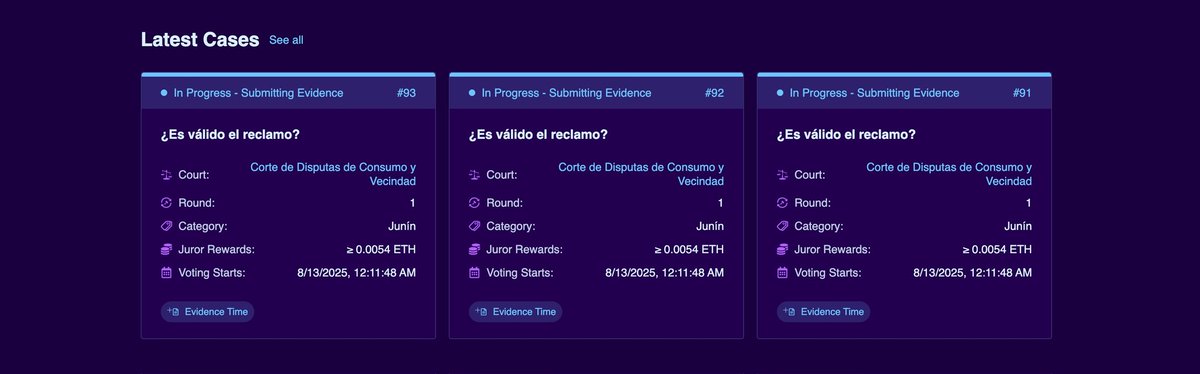
The @arbitrum ecosystem just added another real-world use case to its growing portfolio, and this one speaks directly to #OnChain justice. @Kleros_io, the decentralized arbitration protocol, has rolled out three new real-world cases in Argentina as part of its Kleros 2.0 Beta on @arbitrum. These cases come from the "Corte de Disputas de Consumo y Vecindad", a consumer and neighborhood dispute court, marking a tangible step toward mainstream legal integration with #BlockchainTechnology . What This Means for Blockchain Justice Kleros specializes in #decentralized dispute resolution by connecting real-world conflicts with jurors who rule based on evidence submitted onchain. This new integration means: 🔹Local disputes meet global jurors → Citizens in Argentina can have their consumer and neighborhood disputes resolved transparently by impartial jurors worldwide. 🔹Lower cost, faster rulings → Compared to traditional court processes, Kleros delivers faster verdicts with verifiable evidence trails on-chain. 🔹Immutable records → All rulings are stored on @arbitrum, ensuring an unalterable legal history. Why Arbitrum Is the Perfect Home for Kleros 2.0 🔹Deploying on Arbitrum gives Kleros the scalability it needs to handle high volumes of small to medium disputes without the high gas costs of @ethereum mainnet. 🔹Low transaction fees mean more affordable access to justice. 🔹Fast finality ensures quicker dispute resolution timelines. 🔹Arbitrum’s Orbit ecosystem allows localized courts like Argentina’s to run specialized modules while staying connected to the main network. Argentina as a Gateway for Global Expansion This is more than a local pilot, it’s a blueprint. If consumer and neighborhood disputes can be effectively managed in one Argentine city, the same model could expand to: 🔹Tenant-landlord disputes in urban centers 🔹Small business transaction conflicts 🔹Cross-border e-commerce disagreements By anchoring these legal processes on #Arbitrum, Kleros provides an exportable justice system that is: ✅ Transparent ✅ Affordable ✅ Borderless A Glimpse Into the Future Imagine a world where: 🔹Your neighborhood parking dispute is settled by an impartial jury of verified peers across the globe. 🔹A faulty online purchase is refunded after an on-chain verdict, without waiting months for court dates. 🔹International freelancers resolve payment conflicts without hiring expensive legal representation. With Kleros 2.0 on Arbitrum, that future is not just possible, it’s happening in Argentina right now. 🔗 Check the active cases here: v2.kleros.builders/#/courts/29/pu… Decentralized Justice. Real-World Impact. Powered by Arbitrum. 🫡
Dablendo (💙🧡) tweet media
English
0
8
25
986