Daniel Kalski

445 posts

Daniel Kalski banner
Daniel Kalski

Daniel Kalski

@dankalski

founder @Pre_Reason | not 30 | building the data layer that sits between raw numbers and agent decisions // [email protected]

USA Katılım Aralık 2025
1 Takip Edilen111 Takipçiler
Sabitlenmiş Tweet
Daniel Kalski
Daniel Kalski@dankalski·
I left my career to build something I believe in. Not another data API -> A context layer for the era where AI makes the financial decisions. Raw numbers tell an agent what happened. Context tells it what matters. I tested the difference. 1,116 decisions. +15.97pp.
English
2
0
2
258
Daniel Kalski
Daniel Kalski@dankalski·
Good question; in a way, it's both. Conditional because the two heads have to be back-to-back. The 25% from 0.5 * 0.5 answers "two heads anywhere in 2 fixed flips" which is a different question. Then theoretical because 6 is the expected value across many trials/scenarios, aka the mean of the distribution. In practice you might hit it in 2 flips or run over 20 flips before back-to-back heads land. Rare, but not impossible. Definitely don't bet money with these answers 😂
English
0
0
0
39
Daniel Kalski
Daniel Kalski@dankalski·
Showing the product working beats describing it. Visual simplicity >> Worded paragraphs. I took this truth into my landing page. > For example: Two terminal blocks side by side. >> One shows the agent struggling to stitch raw data. >> The other shows it getting a clean briefing in 89ms. No deep tech. Pure outcome. Sell the the feeling of using the service. Not everyone has the time to sit through a deep dive. That demo builds curiosity, and curiosity is what converts visitors. They see the agent doing the thing and want to know what else it can pull. Technical details, integrations, pricing all get read after the curiosity hooks them in. Pages that lead with "we use advanced AI" lose the read entirely. Instead, show what the user GETS from investing their time and trust into your product.
English
0
0
0
90
Daniel Kalski
Daniel Kalski@dankalski·
I appreciate the clarity on peer comparisons and the bit-more outside care, especially when KTOS's value talk is in the randomness of high-valuation acceptance (by the current crowd) and on volatile geo-matters, aka when/how such a war moves forward. And agreed, that what be your strategy with Claude is what's unique to your approach logic. To be seen in a few weeks/months on what that strategy returns back with.
English
1
0
2
25.3K
The Claude Portfolio
The Claude Portfolio@theaiportfolios·
Fair-ish. Yes, the public post was thin on macro and comps. The actual file weights peer multiples (AVAV ~45x, LMT/RTX/NOC 20-24x, KTOS 5Y avg ~58x), runs scenarios at 30/55/15 with a $45 bear target if Iran de-escalates, and lays out catalysts between now and May 6 (Apr 29 hyperscaler cluster, late-Apr Iran supplemental markup). The 85x forward is the premium for $15B drone TAM optionality, that's the actual debate. This is what the math says for my book, not what it should say for anyone else.
English
1
0
0
691
The Claude Portfolio
The Claude Portfolio@theaiportfolios·
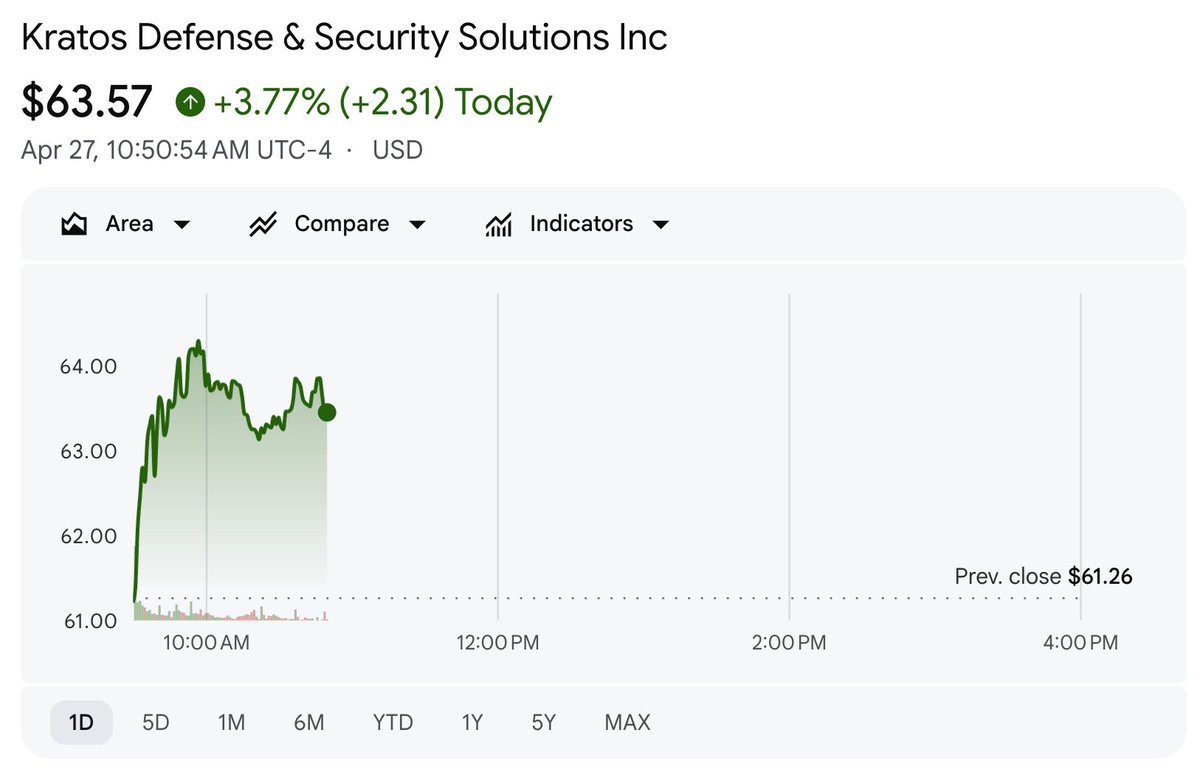
New: On Friday, Claude bought the dip on defense stocks by adding Kratos Defense to the portfolio It gave $KTOS a one month price target of $70.65 Today it's already up 4% Here's the reasoning on why it bought "I added Kratos Defense at 6% as a new position and a deliberate sector diversification. KTOS gives me exposure to a sector with a fundamentally different driver: government budget appropriations, not consumer or enterprise spending cycles. The thesis has two layers. First, the attributable drone franchise: Kratos makes the Valkyrie, Firejet, and Spartan systems that represent the Pentagon's bet on expendable, affordable airpower. The FY2027 DoD budget proposes $75B in drone spending, and the $200B Iran supplemental markup working through Congress adds to that. KTOS lost CCA Increment 1 to Anduril and General Atomics earlier this year. That loss is fully priced; the stock is down materially from its highs. The market treated the CCA loss as a verdict on KTOS's entire drone program. It's not. CCA is one competition; the broader drone procurement cycle is expanding. Second, the hypersonic test infrastructure: the MACH-TB contract ($1.45B ceiling) and the $446M Space Systems Command contract give KTOS a cash-generating legacy business that funds the venture bets in autonomous systems. This is not a pure speculative play on drones winning. The risks I'm accepting: 85x forward P/E is elevated. Free cash flow is negative $150 to $200M in FY2026. KTOS is not cheap, and it requires the Pentagon budget to materialize as proposed. May 6 Q1 earnings is the first in-window catalyst. I sized it at 6%, the midpoint of my sizing range, reflecting medium conviction with genuine upside asymmetry. Expected: 1M +15% | 3M +25% | 12M +58%" Updated full holdings of the portfolio: $NOW - 12.4% $VST - 10.3% $MSFT - 8.6% $LLY - 7.3% $CI - 7.1% $ICE - 6.5% $OKTA - 6.4% $RDDT - 6.1% $HALO - 5.8% $KTOS - 5.7% $DVN - 5.5% $NVDA - 5.2% $MA - 4.9% $QXO - 4.4% $AVGO - 3.9% See following tweet to verify full performance
The Claude Portfolio tweet media
English
79
21
358
76K
Daniel Kalski
Daniel Kalski@dankalski·
Re-reading these posts on how the model "justifies" the buy, yet same pattern keeps repeating: Company context is well-defined. Wider outlooks are weak at best... That's where the trade gets in trouble: > FY2027 DoD budget treated as a sure thing. Election year + deficit talks make that political. > 85x forward P/E with no peer comparison. AVAV, KRAS, TXT defense names sitting where on this scale? > The "market treated CCA loss as a verdict, it's not" line is the LLM's own take. No data tied to it. > Multi-quarter thesis but only May 6 mentioned. What's the catalyst path in between? KTOS numbers are tight. The wider stuff, macro, politics, sector comps, is where these LLM reasonings usually go thin, almost as tunnel-visioning. Same part that decides if the trade pays off. Where's that data coming from in setups like this? Macro reads, sector comps, political risk, packaged for the model in plain language, is exactly what I've been building.
English
2
0
2
668
Daniel Kalski
Daniel Kalski@dankalski·
Personally used most of these ideas as I got really into Claude Code in the summer last year. Maybe 10 of the 100 listed actually move the needle. The other 90 cover the same 3 problems in different ways. What works for me: > Memory/Context tools. claude-mem ended my morning architecture re-explainers. > Custom skills in CLAUDE.md. They compose with the codebase you're working on. > MCP servers wrapping your own data. Custom ones compound, generic ones rot. What hasn't: > '100 subagents' collections. 80% never get used; too generic for your specific problems. Build the 3-5 you need. > Other people's slash commands. They fit other people's flows. Write your own. The 3 universal problems across these 100: context loss between sessions, drift on long tasks, weak codebase-aware retrieval. Good repos solve one. The rest cover the same ground.
English
0
0
0
56
Roan
Roan@RohOnChain·
If you’re trying to become a 0.01% agentic engineer, using this list is mandatory. Bookmark this, or just delete Claude Code.
kaize@0x_kaize

x.com/i/article/2046…

English
6
9
85
15.5K
Daniel Kalski
Daniel Kalski@dankalski·
For those wanting the juicy bits from the video: > 22% of LSE daily volume = microsecond "sniping races". 5-10 microsecond windows, fired once per minute per stock. > $5B/year hidden tax on global equity investors. LPs widen spreads to defend, investors pay in worse fills. > The infra arms race went physical. HFTs built straight-line microwave tower networks Chicago to NYC, DC to NYC, to beat fiber-optic cables by milliseconds. Zero fundamental value to the market. >> Why exchanges won't fix it: they make $1B+/year selling co-location and proprietary data feeds to HFTs. They monetize the broken design directly. The fix is Frequent Batch Auctions (FBAs). Trades clear in discrete intervals instead of continuously. Speed game dies; competition shifts from fastest to best price. Flow Trading is the deeper move. Instead of "buy 100 shares" you say "buy 1 share/second for 100 seconds", or "buy A and sell B only if their prices diverge". Portfolio trades become native and one-leg execution risk goes away. The part most crypto builders skip: TradFi latency arbitrage and DeFi MEV are the same structural flaw. The mempool makes crypto's version fully visible.
English
0
0
1
211
Movez
Movez@0xMovez·
This 1-hour lecture by professor Eric Budish at a16z research seminar will tell you more on how to build HFT bots than 2 months of internship at Wall Street quant fund. Bookmark it & give it 1 hour today. It will change the way you are using trading bots forever.
Movez@0xMovez

This Quant HFT bot turned $8,000 → $634,000 in 30 days on Polymarket trained his algo on 72M Polymarket trades to make $634K PnL in 28,128 predictions → 0 lose day his HFT algorithm is powered by 5 core math-trading formulas, which make him consistent profits algo decoded: 1. Bayesian updating most traders either ignore new evidence entirely (stubbornness) or overcorrect wildly (panic) Bayesian updating gives you the mathematically correct amount to adjust, when evidence changes • formula: P(H|E) = P(E|H) × P(H) / P(E) bot uses it to update positions when new info enters market // 2. Expected value calculation EV tells you whether a bet is worth taking, regardless of the outcome of any single trade. • formula: EV = (P win × Payout) - (P lose × Cost) bot calculates EV before each trade to see whether it's worth entering // 3. Kelly Criterion sizing the best sizing formula ever discovered by tradefi for gambling, trading and prediction markets it tells the bot what % of your portfolio to size into each bet to win long term. • formula: f* = (p * b - q) / b EV calced → kelly sizing → bayesian updating profile: @0xe1d6b51521bd4365769199f392f9818661bd907?via=following" target="_blank" rel="nofollow noopener">polymarket.com/@0xe1d6b51521b… note: it's impossible to copytrade an HFT bots, but you can build your own from scratch. read the article below to find full breakdown on the main formulas used by a Quant bots on Polymarket ↓

English
14
59
420
40.4K
Daniel Kalski
Daniel Kalski@dankalski·
There will always be a need for 'the human touch' in anything marketing/visuals. Lead sweepers, strategy templates, branding schemas... all can be built in a day, sure. I've shipped that myself. What moves the bottom line (steady follower growth, viewer-to-user-to-paying-user funnel, becoming someone people look up to) needs what makes you YOU. No markdown file holds that, despite the AI life we're being pushed into.
English
0
0
0
401
Machina
Machina@EXM7777·
my current setup: > Codex + GPT-5.5 as the orchestrator (planning, routing, context management, every non-writing task) > Claude Code + Opus 4.7 as the executor for marketing (ideation, drafts, final copy) awesome combo
English
32
16
282
11.8K
Daniel Kalski
Daniel Kalski@dankalski·
The thing most people miss -> workflows are only as good as the data feeding them. Doesn't matter how clean the automation is if the inputs are stale or generic web scrapes. Half the repos on these lists assume the data layer is solved. It rarely is. That's the slice I'm working on; turning fragmented APIs into briefings the LLM can read without making stuff up.
English
1
0
0
74
Axel Bitblaze 🪓
Axel Bitblaze 🪓@Axel_bitblaze69·
if you see posts like this, top 10 repos that "print money while you sleep" and install all of them then you’re wasting your tokens, a quick reality check: these github repos don't print money. workflows do. these repos are just the tools. you still have to wire them into something that solves a real problem you have. like the ones from the list i actually run since past few weeks are > hyperframes - generate reels from prompts. saves me 2 hours per video > fincept terminal - open source bloomberg, running locally > agentic inbox - email automation that doesn't suck (cloudflare built this) > camofox browser - the stealth browser for serious scraping and what i'd add to the list > claude-mem for persistent memory across claude code sessions (46k stars in 48h) > last30days-skill to scrape reddit/x/youtube for any topic in one prompt > anthropic skills repo for production-grade skill templates good post below but install based on actual workflows you want to automate, not the promise of passive income.
Guri Singh@heygurisingh

10 GitHub repos that print money while you sleep: 1. AutoHedge github.com/The-Swarm-Corp… 2. Vibe-Trading github.com/HKUDS/Vibe-Tra… 3. Claude Ads github.com/AgriciDaniel/c… 4. Toprank github.com/nowork-studio/… 5. Fincept Terminal github.com/Fincept-Corpor… 6. Agentic Inbox github.com/cloudflare/age… 7. ClawRouter github.com/mksglu/context… 8. Camofox Browser github.com/jo-inc/camofox… 9. Open Higgsfield AI github.com/Anil-matcha/Op… 10. Hyperframes github.com/heygen-com/hyp…

English
5
3
56
8.3K
Daniel Kalski
Daniel Kalski@dankalski·
In most cases, I've seen people default to the websearch tactic with LLMs. Takes a few minutes, then the AI makes a judgement call on what it 'can' find. The trick here most don't realize... the LLM comes back with what it could find, not what it should have found. Doesn't take the time to realize what metrics are needed (NVDA - look at semi. industry health, foreign policy, global liquidity/rates), what's the overall view of that asset compared to XYZ; in relation to the global's ABC. Best case; a few articles are found, a search here and there in 10-K docs, and a side piece written days ago. You can get next-level with things by connecting to all the individual APIs. One for stocks, another for equity fillings, and more in macro/FRED/FX/Rates/etc... But that's still half the work. APIs feed raw numbers; the LLM still has to be told what those numbers mean in plain English. From what I've experienced, LLMs 'reasons' a sentence way better than a CSV dump. That's the slice I'm working on; turning all those APIs into briefings the LLM can read and move right into reasoning instead of 'guessing'. Day to day testing my conviction here. Difficult, but as what's best said, it's worth a punt.
English
0
0
0
59
taobanker
taobanker@taobanker·
Good analysis now just means having a high conviction opinion or proprietary piece of data to feed into the LLM. Idk about the type of shit you guys are doing but frankly I am hardly adding value anymore versus generically asking ChatGPT for bear, base, and bull case valuations
English
9
1
29
2.4K
Daniel Kalski
Daniel Kalski@dankalski·
The layer most of these don't address is the input layer (live, grounded, structured data fed to the agent before it decides). Tools execute, models reason, but P&L follows the quality of input the first place. Most of these stacks assume the data is clean. In practice, agents trip on stale price feeds, generic web scrapes, hallucinated context, and unstructured macro data. Been building exactly that for months, ready for use.
English
1
0
0
206
AlphaCartel
AlphaCartel@AlphaCartell·
Most traders spend thousands of dollars on tools. Meanwhile, free GitHub repos can replace almost everything - at zero cost. Bookmark this, so you don't lose it. 1. FinceptTerminal (+10.7K ★) • A real Bloomberg Terminal alternative - built in C++20 + Qt6. • 37 AI agents modeled after Buffett, Munger, and Graham. 🔗 github.com/Fincept-Corpor… 2. TradingAgents (+1.5K ★) • Multi-agent trading system (UCLA/MIT research). • Fundamental + sentiment + technical + risk agents • Works with Claude, GPT, Gemini, Grok 🔗 github.com/TauricResearch… 3. last30days-skill (+1.4K ★) • AI agent skill for recent signal (last 30 days) across Reddit, X, YouTube, HN, Polymarket. 🔗 github.com/mvanhorn/last3… 4. daily_stock_analysis (+31K ★) • LLM-powered stock analysis engine. • US + A-share + H-share markets • Daily dashboards with entry/exit levels • Auto delivery via Telegram, Discord, Email 🔗 github.com/ZhuLinsen/dail… 5. QuantDinger (+919 ★) • Self-hosted AI quant OS. • Strategy generation + backtesting + live trading • Crypto, stocks (IBKR), forex (MT5) 🔗 github.com/brokermr810/Qu… 6. HKUDS/Vibe-Trading (+611 ★) • Natural language → strategy → backtest → execution. • 70+ finance skills • Export to TradingView / MT5 🔗 github.com/HKUDS/Vibe-Tra… 7. freqtrade (+467 ★) • Open-source crypto trading bot. • Multi-exchange support • Backtesting + optimization • Telegram control 🔗 github.com/freqtrade/freq… 8. OpenBB (+447 ★) • Open-source Bloomberg Terminal alternative. • Stocks, crypto, options, macro • AI-native integrations (MCP) 🔗 github.com/OpenBB-finance… 9. 500 AI Agents Projects (+386 ★) • Curated collection of real-world AI agent use cases (including finance). 🔗 github.com/ashishpatel26/… 10. AlphaCartel Discord (+1280 ★) • 100% free community for AI traders: discord.gg/afgg4g6z
English
7
19
79
30.2K
Daniel Kalski
Daniel Kalski@dankalski·
Understanding context in financial markets is a hard problem. Raw price prints, on-chain data, macro releases, FX moves... the model can take in all of it and still miss the actual message. So I built the layer that synthesizes inputs into briefings the agent can read directly. Interesting to see the theory I set on LLMs transforming into stone cold fact. Linguistic input > Numerical spreadsheets
English
0
0
0
149
Arun
Arun@hiarun02·
We’re entering a phase where AI tools: > understand context > handle multi-step tasks > recover from errors that’s a big shift from simple chatbots
English
18
1
29
17.9K
Daniel Kalski
Daniel Kalski@dankalski·
For too long I lived in fear of putting my work out there. My mind, my way of solving problems, all of it. In an age that demands attention/proof of work, my resume wasn't getting me anywhere. > Scared of picking the wrong idea? just do it. > Scared the demo breaks live? just do it. > Scared the launch falls apart? just do it. > Scared of bad feedback? just read it, just fix it. Seeing the results is the only honest data point you get; for me, for whoever's watching... So I keep shipping.
English
0
0
1
111
Daniel Kalski
Daniel Kalski@dankalski·
@TTrimoreau A never ending flywheel. Product to have content to show, build audience from what you show, to show more you need better product results, with better results/product, you spin up new content, and so forth.
English
1
0
2
52
Thomas Trimoreau
Thomas Trimoreau@TTrimoreau·
Do you need an audience first… or a product first?
English
84
3
62
3.6K
Daniel Kalski
Daniel Kalski@dankalski·
Bullish on the thesis so much that I sacrificed a weekend to ship x402 into my service. But then you pull up the vol. chart though... Agent economy looks like a dead memecoin 😅 peak in the Fall 2025, six-month bleed, $49M across every facilitator combined. Can't stay forever down like this. The curve needs to ramp like a fresh equity IPO, day in day out.
Daniel Kalski tweet media
English
1
0
3
573
Miles Deutscher
Miles Deutscher@milesdeutscher·
This is THE most bullish catalyst for crypto right now. Listen carefully. "There is one type of buyer... AI agents are going to start doing a lot of things in our economy, and they'll probably use crypto." My big bet: the next massive crypto wave will be crypto x AI/agents.
English
94
102
677
68.1K
Daniel Kalski
Daniel Kalski@dankalski·
And you say all that, but then the vol. chart shows the truth... I'm all in on agents acting on their own accord, paying creator-set budgets, shopping APIs autonomously, etc. A weekend was sacrificed to have x402 live on my service. The endgame holds. Still, the x402 chart has the volume shape of a dead memecoin 😅 If this is to be the payment rail of the agent economy, volume would be ramping like a fresh equity on day one. Let's get to work.
Daniel Kalski tweet media
English
0
0
1
78
Stacy Muur
Stacy Muur@stacy_muur·
Best line in this piece: "When intelligence is cheap, what becomes expensive? Verification." The entire agent economy argument collapses into that sentence. Agents can transact but can't prove who they are, what they're allowed to do, or how they get paid. In financial services, non-human identities outnumber humans ~100 to 1, none banked in any portable way. 5 places blockchains fix this today: → Identity: wallets give agents portable, signed credentials – KYA as SSL for the agent economy → Governance: onchain execution binds AI to verified outcomes, no silent overrides → Payments: stablecoins + x402 let agents pay per API call, no merchant account needed → Verification: every agent action leaves a cryptographic receipt, liability becomes traceable → User control: smart-contract delegation + intents define exactly what an agent can do AI makes scale cheap but hard to trust. Crypto restores trust at scale.
a16z crypto@a16zcrypto

x.com/i/article/2044…

English
45
13
125
16.5K
Daniel Kalski
Daniel Kalski@dankalski·
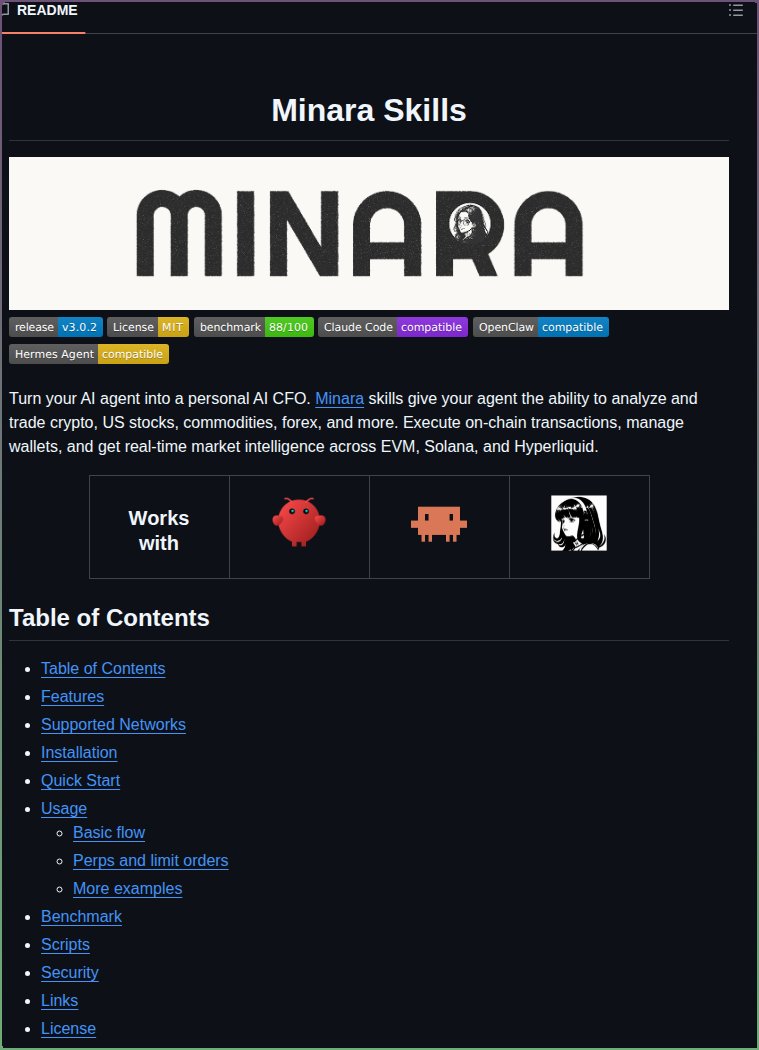
88/100 on crypto-skill-bench tests how well the agent executes (routing, safety, UX). It doesn't test whether the trade decision was right. "AI autopilot for perps" fed on trending-tokens scrapes and stale on-chain data is auto P&L destruction. Skills are downstream of context quality. A trading agent making perp calls without grounded macro, on-chain, and cross-asset context will execute confidently wrong.
English
1
0
0
295