Danny Bluestone

7K posts

Danny Bluestone banner
Danny Bluestone

Danny Bluestone

@danny_bluestone

A UX Designer and Techie at heart. Believer in stoicism and kaizen. Ex-Founder & CEO @CyberDuck_UK now CEO @ DucksHouse. Political views my own.

London Katılım Kasım 2008
349 Takip Edilen1.1K Takipçiler
Sabitlenmiş Tweet
Danny Bluestone
Danny Bluestone@danny_bluestone·
Privileged to be featured in @thetimes today. I am sharing some of my top 6 nuggets succinctly around business decision making, launching MVPs, hiring, the importance of process and how curveballs can be your biggest business opportunity.
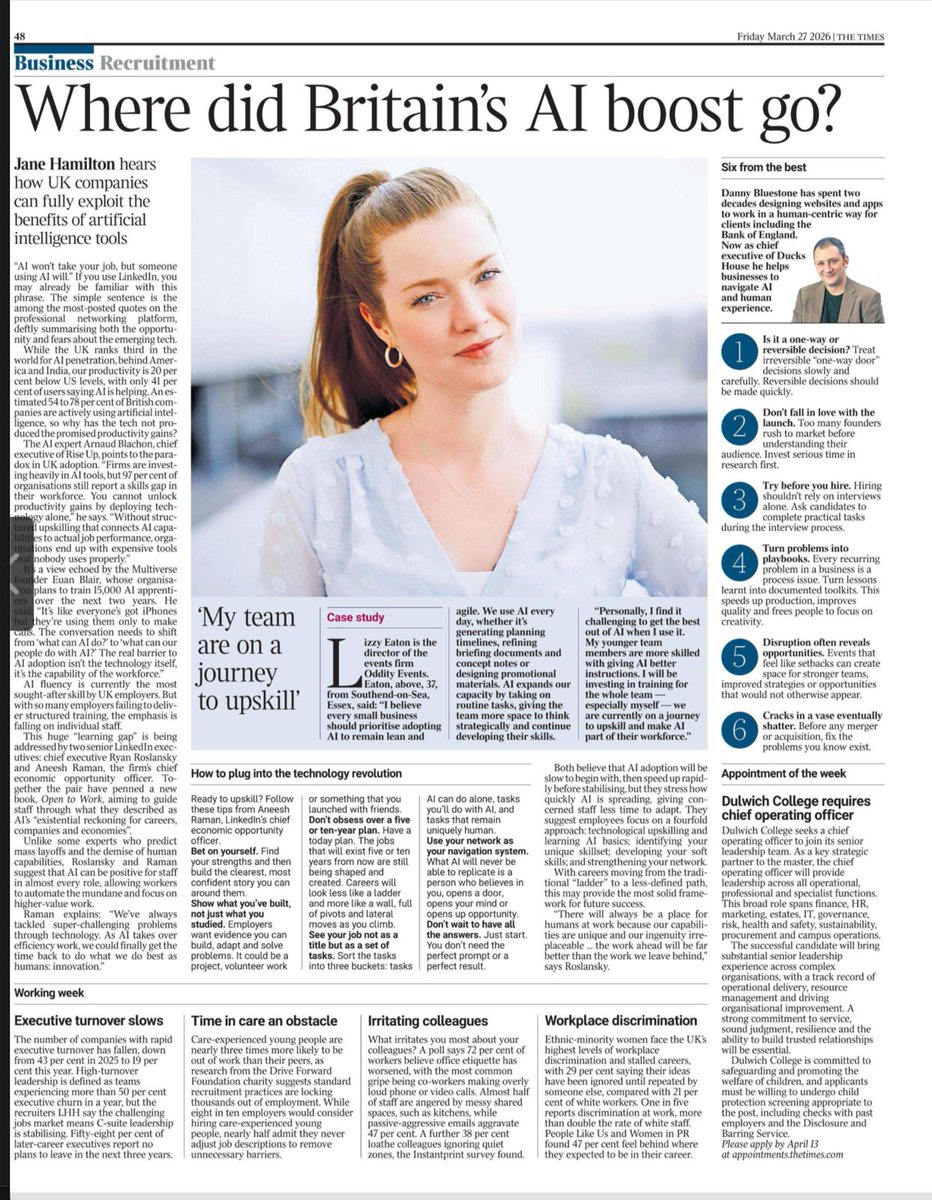
Danny Bluestone tweet media
English
0
0
0
38
Danny Bluestone retweetledi
GeniusThinking
GeniusThinking@GeniusGTX·
Marc Andreessen says Elon Musk runs 120 design reviews a day in 5-minute slots. He does this while running six different companies at once. Andreessen says Elon maps each company as a production process. Each process has one bottleneck — the single thing slowing it down. Elon finds the engineer working on that bottleneck and sits with them until it's fixed. He does this at Tesla 52 times a year. Personally. "There's no CEO like this." Most CEOs run their companies through a wall of middle managers. Andreessen watched IBM collapse under that model. Inside IBM, they had a name for the failure mode: the "Big Gray Cloud." It was the traveling court of suited men who kept the CEO away from engineers. After 12 layers of compounding lies, the CEO had no idea what was happening. Elon's method is the polar opposite. Design review math: - 5 minutes per engineer - 12 reviews per hour - 10 hours per day - 120 reviews per day An engineer described working for him as entering "a zone of shocking competence." On sustaining it, Elon's rule is: "I don't take vacations." What's the one weekly bottleneck in your work that nobody's fixing? If you're new here, @GeniusGTX is a gallery for the greatest minds in economics, psychology, and history. Follow along for more similar content. P.S. I made a free toolkit breaking down 100+ mental models used by history's greatest thinkers. 5,000+ downloads. 113 five-star reviews. Grab your free copy here: besuperhuman.gumroad.com/l/mentalmodels — Marc Andreessen ( @pmarca ), co-founder of a16z, on David Senra's ( @FoundersPodcast ) podcast
English
47
266
1.6K
414.7K
Danny Bluestone retweetledi
Dustin
Dustin@r0ck3t23·
Mark Cuban just compared the most powerful AI on earth to a two-year-old in a high chair. The toddler won. Cuban: “A two-year-old on a high chair with a sippy cup knows that when she pushes that cup off, Mom’s going to come running and the baby’s going to be laughing its ass off. It knows the consequences of its actions.” Then he named the thing no one building AI wants to say out loud. Cuban: “If you ask ChatGPT or any of them something and it gives you bad advice, it has no idea what’s going to happen because you took that bad advice.” A system that passed the bar exam. Aced medical boards. Still can’t grasp what a child who can’t tie her own shoes already knows. The child understands cause and effect. AI understands pattern and prediction. They sound similar. They are not even close. A pattern tells you what comes next in a sequence. Consequence tells you what happens to the person standing at the end of it. One is math. The other is meaning. Cuban went further. Cuban: “If you were blind at an intersection and had the choice between your seeing-eye dog or holding up a phone with AI, I’m taking the seeing-eye dog every time.” Because the dog understands something no language model on earth understands. Stakes. The dog knows a wrong step means its owner gets hurt. The app knows a wrong step means a revised output. Hundreds of billions spent building systems that can write, reason, and diagnose. Not one of them loses sleep when the answer is wrong. A toddler pushing a cup off a tray runs a tighter feedback loop than every foundation model combined. The child doesn’t just predict the outcome. The child wants the reaction. Pushes the cup off the edge, watches it fall, watches Mom come running. Laughs. Because the child knew what would happen before the cup ever hit the floor. That gap between prediction and consequence isn’t a bug. It’s not getting patched in the next update. It is the unsolved problem of artificial intelligence. We didn’t build minds. We built mirrors. Mirrors don’t flinch when you walk into traffic.
English
42
88
250
47.5K
Danny Bluestone retweetledi
Aakash Gupta
Aakash Gupta@aakashgupta·
Microsoft just turned an $11 billion startup into a Word feature. Harvey raised $200M at an $11B valuation in March on the bet that legal AI is its own surface. The numbers held that up. $190M ARR per TechCrunch's December reporting. 100,000 lawyers across 1,300 organizations including the majority of the AmLaw 100. Around $1,200 per lawyer per month per Sacra. Big firms paid because Harvey was the only tool in the category that worked. Brad just stapled a legal agent directly inside Microsoft Word, shipping in the $30 per seat Copilot subscription every law firm already pays for. Same surface every lawyer drafts in. Same .docx that gets sent and redlined. No second login, no procurement cycle, no migration. The price gap is roughly 40x. The interesting tell: Microsoft built the agent with legal engineers, many of them from Robin AI, a legal AI startup that recently went under, per Artificial Lawyer's reporting. The talent that knew how to make legal AI work for lawyers landed at Microsoft after their startup couldn't survive standalone. That's the legal AI category in one sentence. Distribution was always the constraint here. Lawyers don't switch tools. Word is where contracts get drafted, redlined, and tracked. Whichever AI lives inside that .docx wins the default workflow, and Microsoft just walked through the door uncontested. Harvey's surviving moat is the AmLaw 100 partner workflow. Domain training, agentic litigation prep, deep integrations with iManage and NetDocuments. Real moat for $1,500-an-hour partners running M&A and complex litigation. It does not extend to the millions of lawyers globally drafting NDAs, redlining vendor contracts, and updating templates. That layer is exactly what Word Legal Agent goes after, and Microsoft can ship it as a feature inside a $360-a-year subscription. The $11B valuation pays out only if legal AI work stays its own surface. Microsoft just absorbed the surface.
Brad Smith@BradSmi

Today we’re introducing a new Legal Agent in @Microsoft Word, built to support the precision and rigor legal work demands. Every clause matters. Every redline tells a story. That’s why this agent was built to follow the structured workflows lawyers use while keeping them fully in control. Early in my career, I asked for a computer on my desk because I believed technology could change how lawyers work. It did. Today, I believe this next generation of tools will do the same, grounded in trust and responsible use.

English
89
179
1.5K
788.3K
Danny Bluestone retweetledi
Boy George
Boy George@BoyGeorge·
I was in Golders Green yesterday. I arrived just as the police presence was building. My heart goes out to the two Jewish victims and to their loved ones. We need to make our Jewish community know we support them. Even before I knew what had happened I was in tears because you could feel panic in the air. These are just regular people getting with their lives. London has always been a great multicultural city. Our Jewish community brings us so much. They are an integral part of the fabric of this city. open.spotify.com/track/570ZDO2L…
English
489
976
7.7K
163.4K
Danny Bluestone retweetledi
Dustin
Dustin@r0ck3t23·
Sam Altman just told you exactly how OpenAI treats the human race. Not in a leaked memo. Not through a whistleblower. On camera. In his own words. Altman: “I think one of the most important strategic insights in the history of OpenAI was deciding we were gonna pursue iterative deployment.” The most important move in the history of the company was to release the technology before they understood it. Not after it was safe. Before. Altman: “Society and technology are a co-evolving system.” Co-evolution means neither side is driving. The machine changes us. We change the machine. Nobody is steering the outcome. This is not a product launch philosophy. This is an admission that the experiment was always designed to be run on us. Altman: “I don’t think we’re gonna solve that, like, thinking really hard about it theoretically. We’re gonna have to, like, learn from the contact with reality.” Contact with reality. That is the phrase the CEO of the most powerful AI company on Earth chose to describe what happens when his technology meets eight billion people. Not careful integration. Not measured rollout. Contact with reality. The language of test pilots describing what happens when an untested airframe hits the atmosphere. The entire promise of AI safety was that the machine would be understood before it was unleashed. Altman just admitted that promise was always a fantasy. You cannot model how intelligence reshapes civilization by running simulations. The second and third order effects are invisible until they detonate. So they shipped it. Altman: “You have to learn as you go. You have to adapt with a tight feedback loop.” Tight feedback loop means they watch what breaks. They measure the collision between human psychology and machine output in real time. Every conversation you have with ChatGPT is a data point in a civilizational stress test you never consented to. Every prompt. Every confession. Every question you would never ask another human being. That is the feedback loop. You are not the customer. You are the contact with reality. Philosophers spent centuries asking whether humanity would ever encounter an intelligence that learned from us faster than we could process what it was doing. That is not a theoretical question anymore. It is running on your phone right now. And the man building it just told you the only way to understand what it does to us is to let it happen. No simulation. No safety net. No control group. Just the experiment, running at the speed of conversation, on a species that will not be the same one that started it.
English
78
57
149
27.4K
Danny Bluestone retweetledi
Alex Hearn
Alex Hearn@hearnimator·
📺 WATCH me on @bbcnews talking about the stabbing attack in Golders Green
English
27
53
190
14.1K
Danny Bluestone retweetledi
M.A. Rothman
M.A. Rothman@MichaelARothman·
𝐊𝐄𝐌𝐈 𝐁𝐀𝐃𝐄𝐍𝐎𝐂𝐇 𝐉𝐔𝐒𝐓 𝐃𝐄𝐋𝐈𝐕𝐄𝐑𝐄𝐃 𝐓𝐇𝐄 𝐋𝐈𝐍𝐄 𝐄𝐕𝐄𝐑𝐘 𝐖𝐄𝐒𝐓𝐄𝐑𝐍 𝐂𝐎𝐍𝐒𝐄𝐑𝐕𝐀𝐓𝐈𝐕𝐄 𝐋𝐄𝐀𝐃𝐄𝐑 𝐇𝐀𝐒 𝐁𝐄𝐄𝐍 𝐃𝐎𝐃𝐆𝐈𝐍𝐆 𝐅𝐎𝐑 𝐀 𝐃𝐄𝐂𝐀𝐃𝐄. An LBC caller asked Badenoch how a Muslim could trust the Conservative Party after Shadow Justice Secretary Nick Timothy criticized mass Ramadan public prayer in Trafalgar Square as “an act of domination.” Badenoch did not duck. Her opening: 𝘔𝘺 𝘨𝘳𝘢𝘯𝘥𝘮𝘰𝘵𝘩𝘦𝘳 𝘸𝘢𝘴 𝘢 𝘔𝘶𝘴𝘭𝘪𝘮. 𝘐 𝘸𝘢𝘴 𝘣𝘰𝘳𝘯 𝘪𝘯 𝘢 𝘤𝘰𝘶𝘯𝘵𝘳𝘺 𝘵𝘩𝘢𝘵 𝘸𝘢𝘴 50% 𝘔𝘶𝘴𝘭𝘪𝘮. 𝘐 𝘴𝘢𝘪𝘥 𝘔𝘶𝘴𝘭𝘪𝘮 𝘱𝘳𝘢𝘺𝘦𝘳𝘴 𝘰𝘯 𝘍𝘳𝘪𝘥𝘢𝘺 𝘣𝘦𝘤𝘢𝘶𝘴𝘦 𝘵𝘩𝘢𝘵’𝘴 𝘸𝘩𝘢𝘵 𝘩𝘢𝘱𝘱𝘦𝘯𝘦𝘥 𝘵𝘩𝘦𝘳𝘦 𝘸𝘩𝘦𝘯 𝘐 𝘸𝘢𝘴 𝘢𝘵 𝘴𝘤𝘩𝘰𝘰𝘭. 𝘐 𝘩𝘢𝘷𝘦 𝘨𝘰𝘰𝘥 𝘧𝘳𝘪𝘦𝘯𝘥𝘴 𝘸𝘩𝘰 𝘢𝘳𝘦 𝘔𝘶𝘴𝘭𝘪𝘮. Then the line: 𝘐𝘯 𝘮𝘺 𝘷𝘪𝘦𝘸, 𝘵𝘩𝘦 𝘭𝘢𝘸 𝘢𝘯𝘥 𝘰𝘶𝘳 𝘤𝘶𝘭𝘵𝘶𝘳𝘦 𝘢𝘯𝘥 𝘯𝘰𝘳𝘮𝘴 𝘵𝘳𝘶𝘮𝘱 𝘢𝘯𝘺 𝘳𝘦𝘭𝘪𝘨𝘪𝘰𝘯, 𝘸𝘩𝘦𝘵𝘩𝘦𝘳 𝘪𝘵’𝘴 𝘊𝘩𝘳𝘪𝘴𝘵𝘪𝘢𝘯𝘪𝘵𝘺, 𝘸𝘩𝘦𝘵𝘩𝘦𝘳 𝘪𝘵 𝘪𝘴 𝘐𝘴𝘭𝘢𝘮. Then the closer: 𝘐𝘧 𝘸𝘦 𝘢𝘳𝘦 𝘵𝘳𝘺𝘪𝘯𝘨 𝘵𝘰 𝘵𝘦𝘭𝘭 𝘱𝘦𝘰𝘱𝘭𝘦 𝘵𝘩𝘢𝘵 𝘺𝘰𝘶 𝘢𝘳𝘦 𝘯𝘰𝘵 𝘢𝘭𝘭𝘰𝘸𝘦𝘥 𝘵𝘰 𝘤𝘳𝘪𝘵𝘪𝘤𝘪𝘻𝘦 𝘢𝘯𝘺 𝘳𝘦𝘭𝘪𝘨𝘪𝘰𝘯, 𝘵𝘩𝘦𝘯 𝘸𝘦 𝘢𝘳𝘦 𝘤𝘩𝘢𝘯𝘨𝘪𝘯𝘨 𝘵𝘩𝘦 𝘷𝘦𝘳𝘺 𝘧𝘢𝘣𝘳𝘪𝘤, 𝘯𝘢𝘵𝘶𝘳𝘦 𝘢𝘯𝘥 𝘤𝘶𝘭𝘵𝘶𝘳𝘦 𝘰𝘧 𝘵𝘩𝘪𝘴 𝘤𝘰𝘶𝘯𝘵𝘳𝘺. 𝘈𝘯𝘥 𝘐 𝘧𝘶𝘯𝘥𝘢𝘮𝘦𝘯𝘵𝘢𝘭𝘭𝘺 𝘥𝘪𝘴𝘢𝘨𝘳𝘦𝘦 𝘸𝘪𝘵𝘩 𝘵𝘩𝘢𝘵. British law over religious law. British culture over religious deference. The right to criticize ANY religion — Christianity, Islam, all of them — is a non-negotiable feature of a free society, not a privilege the majority granted to the minority. This is the Western mainstream conservative position. Badenoch — daughter of Nigerian immigrants, raised Christian, lived among Muslims her whole childhood — said it on national radio without hedging, without apologizing, and without softening it for the audience. 𝐓𝐡𝐞 𝐁𝐫𝐢𝐭𝐢𝐬𝐡 𝐂𝐨𝐧𝐬𝐞𝐫𝐯𝐚𝐭𝐢𝐯𝐞 𝐥𝐞𝐚𝐝𝐞𝐫 𝐣𝐮𝐬𝐭 𝐬𝐚𝐢𝐝 𝐰𝐡𝐚𝐭 𝐞𝐯𝐞𝐫𝐲 𝐖𝐞𝐬𝐭𝐞𝐫𝐧 𝐜𝐨𝐧𝐬𝐞𝐫𝐯𝐚𝐭𝐢𝐯𝐞 𝐥𝐞𝐚𝐝𝐞𝐫 𝐟𝐨𝐫 𝐭𝐡𝐞 𝐩𝐚𝐬𝐭 𝐝𝐞𝐜𝐚𝐝𝐞 𝐡𝐚𝐬 𝐛𝐞𝐞𝐧 𝐚𝐟𝐫𝐚𝐢𝐝 𝐭𝐨 𝐬𝐚𝐲. 𝐓𝐡𝐚𝐭 𝐟𝐞𝐚𝐫 𝐢𝐬 𝐝𝐲𝐢𝐧𝐠. 𝘝𝘪𝘥𝘦𝘰 𝘧𝘳𝘰𝘮 @𝘓𝘉𝘊.
English
323
2.3K
13.7K
698.9K
Danny Bluestone retweetledi
NoLimit
NoLimit@NoLimitGains·
🚨 OpenAI is reportedly building a phone designed to replace the iPhone. And it’s further along than anyone realized. Analyst Ming-Chi Kuo, the same man who predicted every major Apple product cycle for 20 years, just dropped this. Important details: 1: OpenAI is partnering with Qualcomm AND MediaTek to develop custom smartphone processors, not one chip partner, but two competing giants simultaneously 2: Luxshare has been named the exclusive system co-design and manufacturing partner, the same company that assembles Apple products 3: Mass production is targeted for 2028, the hardware roadmap is already in motion 4: The phone will run OpenAI’s own OS, replacing traditional apps entirely with AI agents that complete tasks autonomously, without you ever opening a single app 5: The processor is being designed around on-device AI performance, with complex tasks offloaded to OpenAI’s cloud infrastructure for seamless integration 6: OpenAI’s core thesis: users don’t want apps, they want results. The phone will continuously understand context, habits, and preferences in real time This isn’t a gadget. It’s a direct attempt to replace the operating system layer that Apple and Google have owned for 20 years. I’m doing more research, and what I’m about to post will blow your mind. You’ll wish you followed me sooner, trust me.
NoLimit tweet media
English
370
256
2.2K
1.1M
Danny Bluestone retweetledi
Tali Goldsheft
Tali Goldsheft@TaliGoldsheft·
Wow. Everyone should watch this. Have yet to see a more articulate description of antizionism than this one by @kdeutschjourno. Crystal clear. Well done.
English
86
663
1.9K
51.7K
Danny Bluestone retweetledi
Dustin
Dustin@r0ck3t23·
Elon Musk just used a joke to perform an autopsy on the American economy. Two economists go for a hike. They find a pile of shit. One pays the other $100 to eat it. They keep walking. Find another pile. The second economist pays $100 back to eat that one. They stop. Neither man gained a dollar. Both ate shit for nothing. But on paper they just generated $200 in GDP. Musk: “That basically would count as a job. This is to illustrate the absurdity of economics.” That is not a punchline. That is the operating system of the federal government. Every time a politician celebrates “record job creation” this is what they are describing. Not output. Not value. Not progress. Motion. The entire bureaucratic machine exists to manufacture friction and then invoice for it. Compliance layers built to justify the next compliance layer. Oversight committees that produce nothing but the need for more oversight. Consulting firms hired to audit the work of other consulting firms. Trillions circulating through systems that have never produced a single thing you can hold in your hands. But the GDP number ticks up. So everyone applauds. The shit gets eaten. The scoreboard moves. Nobody asks what actually got built. This is why Washington treats AI like a five alarm fire. AI does not play the friction game. It does not form a committee. It does not schedule a review. It does not file 400 pages of paperwork no one will ever read. It just solves the problem. And that is the one thing the machine cannot survive. The government does not tax results. It taxes the process. The longer the process, the deeper the cut. AI compresses a ten day workflow into seconds. There is nothing left to bill. Nothing left to tax. Nothing left to skim. So they will spend the next decade warning you that AI threatens the economy. What they will never say is what it actually threatens. The illusion that activity equals progress. The $200 economy where both men ate shit and called it a job. The machines are not coming for your purpose. They are coming to prove that half the economy never had one.
English
674
6.3K
20.2K
1.1M
Danny Bluestone retweetledi
Atal
Atal@ZabihullahAtal·
🚨 BREAKING: A new role is quietly emerging and it’s about to dominate the next 5 years. It’s not “AI engineer.” It’s not “prompt engineer.” It’s the Agent Operator. And it will sit inside almost every organization. Most people are still thinking about AI as a tool. That framing is already outdated. What’s actually happening is a shift from: humans using software to humans managing autonomous agents that execute work This is a fundamental redesign of how work gets done. So what is an Agent Operator? An Agent Operator is the person who: • Designs how agents interact with real workflows • Connects tools, data, and systems into agent pipelines • Translates business problems into executable agent behavior • Monitors, corrects, and improves agent performance over time They don’t just “use AI.” They orchestrate outcomes. and this matter because Every function marketing, legal, finance, biotech is becoming “agent-compatible.” Not because companies want it. Because they won’t have a choice. Agents can: • Run research loops • Execute multi-step workflows • Integrate across tools without APIs breaking the flow • Operate 24/7 at near-zero marginal cost The bottleneck is no longer capability. It’s implementation inside real-world systems. Required skills for AI Agent Operator role: → MCPs (Model Context Protocols) Understanding how agents access tools, memory, and structured context. → CLIs (Command Line Interfaces) Because serious agent workflows won’t live in GUIs—they’ll run in programmable environments. → Writing skills (the file kind) Clear specs, instructions, and structured documents. Agents run on precision, not vibes. → agents dot md fluency The ability to define agent roles, constraints, memory, and tool usage in persistent formats. → Business acumen Knowing what actually matters: Where automation creates leverage, not noise. What happens next Enterprises will begin to redesign workflows: Not around employees using dashboards… But around agents executing tasks. That means: • SOPs → Agent playbooks • Teams → Human + agent hybrids • Tools → Composable agent systems When that shift happens, companies won’t just need engineers. They’ll need operators who understand both the system and the business. The leverage is asymmetric One strong Agent Operator can: • Replace fragmented SaaS workflows • Multiply team output without adding headcount • Turn ideas into execution systems in days This is not incremental productivity. It’s operational transformation.
Atal tweet media
English
266
716
3.2K
334.2K
Danny Bluestone retweetledi
Dustin
Dustin@r0ck3t23·
Mark Cuban just described the largest wealth transfer of the AI era. Almost nobody understood what he said. Cuban: “There are 33 million companies in this country. Aren’t going to have AI budgets. Aren’t going to have AI experts.” Not tech startups. The shoe store. The regional trucking outfit. The accounting firm with 12 employees. The businesses that actually run the physical economy. They know AI is coming. They have no idea what to do with it. Cuban: “You’ve got the head of Microsoft saying software is dead because everything’s going to be customized to your unique utilization.” Software is dead. The SaaS era ran on one rule. Build a generic product. Force millions of companies to bend their workflows around it. Charge rent forever. AI ends the contract. The business stops bending to the software. The intelligence bends to the business. But customized by whom. The third-generation manufacturer cannot tell Claude from Gemini. The county hospital is staring at a reactor asking where the light switch is. Cuban: “Who’s going to do it for them?” That question is worth more than the frontier models themselves. Hundreds of billions are being burned to build the foundation. The smartest engineers alive are locked in a bloodbath over who owns the base layer. Let them fight. Let them burn the capital. Let them drive the cost of raw intelligence toward zero. Because the wealth does not collect where the brain is built. It collects where the brain meets the business. Every ambitious kid in college right now thinks survival means a seat at OpenAI or Anthropic. Cuban is staring at the other 99 percent of the economy. Learn the models. Then learn the messy, unglamorous reality of how a 50-person company actually operates. Walk through the door. Understand their problems. Wire the intelligence directly into their revenue. That is not a job title. That is an entire economic class being born. You do not need to build the brain. You need to build the nervous system. The biggest winners of the electricity era were not the engineers who built the generators. They were the ones who walked into dark factories and showed the owners where to plug in. 33 million companies are standing in the dark right now. Silicon Valley is racing to build the god. The fortunes will belong to whoever teaches him a trade.
English
487
1.9K
14.3K
3.7M