Data Doge

1.3K posts

Data Doge

Data Doge

@datadoge69420

Not a dog.

Toronto, Ontario Katılım Aralık 2014
509 Takip Edilen122 Takipçiler
Data Doge
Data Doge@datadoge69420·
@TheRoyalSerf Humanoid robots, automous vehicles, biological mastery, quantum computing discovering new materials, gen IV nuclear After all this we go to space, the final frontier
English
0
0
1
160
Serf
Serf@TheRoyalSerf·
After AI what’s next?
English
175
2
176
13.8K
Martin Shkreli
Martin Shkreli@MartinShkreli·
this is such insanity. first media is a tiny business. in the scheme of big business, you can see jews don't "control" global business. at all. there's never been a jewish president. CEO/founder of biggest media company in the world, Disney, are/were not jewish. or Tencent.
Martin Shkreli tweet media
Dan Bilzerian@DanBilzerian

Who controls the media? Meta owns: Facebook Instagram WhatsApp Messenger Threads Oculus / Meta Quest VR Meta AI Meta is controlled by Mark Zuckerberg who is jewish Alphabet owns: Google YouTube Android Gmail Chrome Pixel phones Nest smart home devices Fitbit (acquired in 2021) DeepMind Gemini AI assistant/model family Waymo — self-driving cars Verily — health technology Calico — longevity research Wing — drone delivery Alphabet is controlled by Larry Page and Sergey Brin who are both jewish Tic Tok U.S. algorithm, cybersecurity and infrastructure is controlled by Oracle Oracle is controlled by Larry Ellison and he’s jewish Hookup Apps Match Group owns: Tinder Hinge OkCupid Match.com Plenty of Fish Meetic The League BLK Archer OurTime Was founded by Barry Diller who is jewish Grindr Was founded by Joel Simkhai who is jewish Bumble Was founded by Whitney Wolfe Herd who is jewish Porn Onlyfans Owned by Leonid Radvinsky who is jewish Vixen Media Group owns: Blacked Blacked Raw Vixen Tushy Deeper Founded by Greg Lansky who is jewish Aylo/MindGeek Owns/owned: Pornhub YouPorn RedTube Brazzers Reality Kings Digital Playground Men.com Sean Cody Tube8 Solomon Friedman is the owner of Aylo and he’s jewish Gamma Entertainment owns/operates: Adult Time Pure Taboo Wicked Girlsway many affiliate studios/platforms Founded by Karl Bernard who is jewish Movies/TV/News Warner Brothers Discovery owns: Warner Bros. Pictures HBO CNN DC Studios Cartoon Network Discovery Channel TNT TBS Max (formerly HBO Max) Adult Swim HGTV Food Network Animal Planet Warner Brothers is run by David Zaslav who is jewish Disney owns: ESPN ABC Marvel Studios Lucasfilm Pixar 20th Century Studios Disney+ Hulu (major controlling stake) National Geographic Disney is run by Bob Iger who is jewish Paramount Global owns: Broadcast & News CBS CBS News CBS Sports Local CBS stations Film Studios Paramount Pictures Paramount Animation Paramount Players Cable Networks MTV Nickelodeon Comedy Central BET VH1 CMT TV Land Smithsonian Channel Logo TV Pop TV Streaming & Premium Paramount+ Showtime Pluto TV Major franchises/IP Top Gun Mission: Impossible Star Trek South Park (licensing/streaming arrangements) SpongeBob SquarePants Transformers Teenage Mutant Ninja Turtles Paramount Global is controlled by Sheri Redstone, who is jewish Comcast owns: * NBCUniversal * NBC * Universal Pictures * Peacock * MSNBC * CNBC * Telemundo * Sky (Europe) * DreamWorks Animation * Xfinity Comcast is controlled by Roberts family who is Jewish AI/Data Centers OpenAI/ChatGPT Run by Sam Altman who is jewish Palentir provides advanced data integration, surveillance, AI, and analytics infrastructure used by military, intelligence, law enforcement, and major corporations. Its platforms help organizations combine massive amounts of fragmented data into real-time operational intelligence for warfare, policing, logistics, cybersecurity, manufacturing, and decision-making, making it one of the most strategically influential data and defense technology companies in the world. Owned and operated by Peter Thiel and Alex Karp both jewish Oracle owns: Oracle Database Java MySQL NetSuite Cerner Sun Microsystems technologies It’s important because it owns core infrastructure software that powers governments, banks, hospitals, corporations, and large parts of the internet. Its control of technologies like Oracle Database, Java, MySQL, and Cerner gives it enormous influence over the backend systems modern society depends on. Owned by Larry Ellison who is jewish

English
389
116
2.3K
410.3K
Data Doge
Data Doge@datadoge69420·
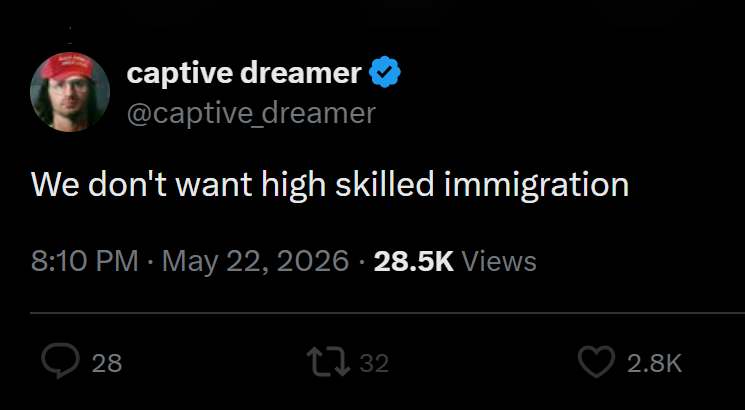
Well, you shouldn't dismiss that viewpoint so quickly. It's valid. There is a limit to how much migration a place should accept, no matter how high skilled the migrants are. Dismissing the view as "afraid of competition" is obviously wrong: should Iceland (400k pop.) accept 1 million high-skilled migrants? No. Because Icelandic culture will not survive. What is the limit for the US and other Western countries? If we all pretend there is no limit then the West's culture will soon be eradicated.
English
0
1
11
368
i/o
i/o@avidseries·
It's almost impossible to view these people as anything other than insecure downwardly-mobile losers afraid of competition from more talented immigrants.
i/o tweet media
English
1.8K
262
3.9K
2.9M
Michael A. Arouet
Michael A. Arouet@MichaelAArouet·
Wait, what? I didn’t have the German LGBTQ community voting for the AfD on my bingo card. What am I missing here?
Michael A. Arouet tweet media
English
1.3K
566
6.1K
1.6M
Data Doge
Data Doge@datadoge69420·
@tobi @grok how many employees does CPP have in 2026 and how many did it have 10 years ago?
English
1
0
0
133
Data Doge
Data Doge@datadoge69420·
@EricDLombardi They leave because they can buy a big house near employment at 27 instead of 40.
English
0
0
3
189
Eric Lombardi (EricForOLP.ca) 🇨🇦🚀
“This is not due to poor domestic compensation; top graduates earn well by Canadian standards. They leave because compensation and upward mobility for their skills are simply higher elsewhere.” I don’t know who needs to hear this at TD, but compensation is the primary factor behind brain drain. Yes, high marginal tax rates, tax complexity, etc all matter for our economy. Yes, we need substantive tax reform and simplification. But yeesh.
Martin Pelletier@MPelletierCIO

TD report on CANADA's BRAIN DRAIN is really interesting. Canada is quietly losing its top talent to the United States in what economists call a silent brain drain. While Canada does a strong job educating highly skilled workers in STEM, engineering, and entrepreneurship, it struggles to keep them due to higher taxes that kick in at much lower income levels, limited opportunities to scale companies, weaker commercialization of ideas, and much better pay and growth potential south of the border. -> Talent leaves mainly through temporary US work visas rather than permanent moves -> Outflows are heavily concentrated among the highest skilled, especially in tech and advanced degrees -> Onward migration is worst among immigrants and top university graduates -> Canada has a missing middle of medium sized firms, relying instead on many tiny businesses and a few large ones -> Personal tax rates often exceed 50 percent in major provinces and apply at much lower thresholds than in the US -> Complex corporate tax rules push entrepreneurs toward tax planning instead of growth All of this weakens productivity, innovation, and domestic returns on education, making Canada a feeder system for the US economy REPORT: economics.td.com/ca-silent-brai…


English
35
17
206
41.7K
Dwayne
Dwayne@CtrlAltDwayne·
CumBench v1.0 results are in. Gemini 3.5 Flash ranks #1 on the CumBench benchmark, outperforming much larger models a whole size above it in real-world finish quality. The gap is honestly staggering.
Dwayne tweet media
English
229
87
2.3K
354.1K
Data Doge retweetledi
More Births
More Births@MoreBirths·
THE GREAT BIRTH RATE DEBATE Chris Williamson hosted a nearly four-hour deep dive into the problem of collapsing fertility with leading experts @lymanstoneky, @SimoneHCollins and @StephenJShaw. The wide-ranging discussion covered tremendous ground. Here are some key highlights! The severity of the crisis Few really grasp how bad the birthrate crisis is going to be. Shaw emphasized the dramatic effect of compounding and how countries with below replacement fertility will be orders of magnitude smaller in the future. That means the collapse of whole economies and countries, especially those with fertility rates continuously well-below replacement, which is 2/3 of countries today. Loss of innovation Innovation is a numbers game, and it takes large populations to give rise to brilliant innovators and entrepreneurs. More than that, Stone explained that a large and highly educated population and an advanced economy are preconditions for innovation to flourish, and that benefits the whole world. But populations that are high in innovation are in sharp decline, and aging societies are much less innovative and slower to adopt new technology. Thinkers like Robin Hanson say that innovation itself will grind to a halt. Decline of small towns and rural areas Collins mentioned the “urban population shredder” because birthrates are far lower in cities. But Shaw described a great irony: small towns and rural areas will be ravaged the most by population decline, as people migrate to a few marquee cities. That means in a declining country like Japan, a city like Tokyo can remain healthy long after rural areas and smaller towns face abandonment and collapse. How do you invest in a declining world? How do you make new businesses work when there are fewer customers every year than the year before? We have gotten used to a growing world, where growth doesn’t come at a cost to anyone because the entire economy is growing. But before the Industrial Revolution, conflict was high because the pie was small and your gain was someone else’s loss. A shrinking world that is losing population every year could be like that. This topic is upsetting but necessary Williamson reflected how much he was attacked when he brought up this topic earlier in the year, because it tramples on so many sensitivities. The Internet got so mad at him it showed up in Google trends! But Stone and Collins said ruffling feathers is inevitable and a good sign. Shaw marveled at how much public awareness has grown and how far people have come in just the last three years. Perhaps hope for change lies in growing awareness of the problem. 40% of today’s young women will never be mothers Most women and men have no idea how little time they have, how quickly fertility drops off, and how high the odds are they will end up accidentally childless. The single easiest way to boost fertility may be to educate young people about how little time they have and how high the odds are that they will never have children past given ages. Shaw said that when young people learned this, the effects were life changing. You can’t save the environment without innovators There is little relationship between population growth and pollution, said Stone. What matters is technology. Emissions reductions have almost always come from changes in technology, not through changes in birthrates. We need better technology, and more innovators not fewer, to solve our environmental problems. Expectations are getting more expensive The most common reason people give for not having kids is that they can’t afford it. But society is collectively richer than ever before. What is going on? There has been a huge inflation of standards and expectations, both in material goods and in the level of parenting you are supposed to give your kids. A generation ago, hardly anyone ate fresh blueberries and most people never travelled abroad. Now these things are normal, even expected. Collins argued you should opt out and go rogue, but Stone sided with the masses that these options are great and pretty hard to resist. Economic success comes too late Male earnings peak in the 40s. Apparently, men’s earnings used to be near their peak in the 20s. This creates a big problem because people often delay until their economic value is higher, missing most of their fertility window. Shaw believes we won’t fix the birthrate crisis without finding a way to structure society so that people can get on with making money and having a family much earlier. Housing in cities is terrible for families Stone explained how there are modern norms and laws that say you need a certain number of bedrooms for a certain number of people. When you are renting, landlords often have strict occupancy limits and Child Protective Services is looming in the background. That means having a family in a place that is small is really risky. Most urban housing (studios and 1 and 2 BR apartments) would be practically illegal for a larger family and there are hardly any larger units to be found inside most cities. The pain of unplanned childlessness Not having the children you hoped to have is a source of incredible grief. How do we know? It turns out that there is a natural experiment. With fertility treatments one set of people is successful and another set of people is just unlucky. It turns out that prescriptions for antidepressants and antipsychotics are far higher among the group of people that undergoes fertility treatment without success. Do kids make you happy? Most research says yes, according to Stone. Collins objected to the whole framing. A lot of parenting is really hard, she admitted, but pleasure not how she thinks you should measure things. Deeper fulfillment along with the value of the lives brought forth should be the measure. Men are more domestic than ever before A lot of people say that men need to step up and help around the house. But today’s generation of young fathers already do more housework and are more involved with their children than any previous generation of men while birthrates are the lowest they have ever been. Work from home Stone pointed out that WFH is extremely pronatal and has a larger effect size on fertility than almost any single factor we can measure. Collins talked about how the economy used to be much more home based in the past, and how the huge conflict between work and family is kind of recent to our history. Both Stone, with four kids so far and Collins, with five so far, work from home the majority of the time. Cash for babies? Here the debate got really heated! Stone says that everyone has a price and if you give people large enough sums for babies, you will get more of them. He thinks we could get the TFR up to replacement in America for what we spend on seniors, although admitted that might not create great incentives. Collins and Shaw were much more skeptical and said that governments haven’t had great success with just financial incentives. Collins argued that this would produce few net taxpayers and would be unsound financially. The problem of travel Young people, especially young women, LOVE to travel, especially internationally and that desire comes in big conflict with having family. A lot of people feel they will lose part of themselves if they have to give that up. Stone loves to travel with his kids and wishes society prioritized families and kids in those environments. Is education the problem? All agree that we want both high education and high fertility, to have the kind of society we would want to live in. Shaw urges that we need to find ways to find ways to allow education to be achieved more quickly so that people can get on with the business of having families more quickly. Everyone felt that more people should have kids while in college or graduate school, but that is still niche and rare. The Laestadian Lutherans Most high fertility groups in the world today have low education or are weirdly insular. But there is a group that achieves high education, high achievement and high integration into modern society, all while achieving a TFR of 4 or 5 births per woman. Stone says that the Laestadian Lutherans of Scandinavia are exactly what we need more of, a group that contributes to society at a high level while maintaining very high birthrates. It’s hard to argue with that. Making motherhood high status Williamson reflected that if you could elevate the status of motherhood, that would be like the holy grail to solving the fertility crisis. He mentioned the Republic of Georgia and Stone, the author of the seminal paper on Georgian fertility, was on the scene to narrate about the power of the revered Patriarch Ilya II to create a baby boom all by himself. The difficult question, which should be a topic of great interest and research, is how to give motherhood high status in many different cultural contexts. Families aren’t getting smaller As Shaw explained, children per mother in the US is even higher than it was a generation ago. The problem is that far fewer women are becoming mothers at all. This reflects a big decline in marriage and big challenges with partnering. How can we get more people to partner up? Shaw was nothing if not consistent: we need to teach people how little time they have. The vast majority of people still want children, after all. Doctors and C-sections Simone Collins has had five kids, and plans to have more, all by C-section. Most people aren’t aware that this even possible and doctors usually people tell people who have C-sections that they can’t have more than two or three kids. Collins had a thing or two to say about that. “The world record is eleven. My surgeon who did my last C-section, her record [for one patient] is eight.” The risks for C-sections are manageable and most women who have more of them will be fine. Stone notes the irony that fear rules pregnancy in an era when pregnancy does not increase mortality at all in advanced countries. Here is the whole four-hour podcast: youtu.be/8eCM3NTBeb4?si… via @YouTube
YouTube video
YouTube
English
11
23
120
17.4K
Watching from Canada
Watching from Canada@RobertC93555010·
@SKivimaa @mabarosi @ScootBehringer @TomjSmith2 You are just a troll spewing nonsense. 31% foreigners in the workforce is false. Temporary non-permanent residents make up ~6-19% depending on the metric and sector — far from 31%. Most 'immigrants' in stats are permanent residents or citizens, not foreigners."
English
2
0
1
2.1K
Shawn Kivimaa
Shawn Kivimaa@SKivimaa·
El Salvador has more Peace, Order and Good Government than Canada. And it’s not even close.
English
36
16
159
4.2K
Data Doge retweetledi
TruePatriots
TruePatriots@TruePatriotsCA·
With the Canadian birth rate so low, a declining population would have gifted the young cheap housing, good salaries, & so on. Instead, our corrupt politicians imported millions of incompatible foreigners to compete with our youth, forcing them into low pay and renting for life.
English
8
65
366
4K
Data Doge
Data Doge@datadoge69420·
It's actually very easy to reduce temporary migrant numbers without an ICE equivalent. If they don't leave then just debank them when they're illegals or seize their assets to pay for a daily fine for being in the country illegally. It was absurd to have 7% of the population being a temporary migrant. Should be more like 1% max.
English
0
0
1
14
Tablesalt 🇨🇦🇺🇸
Tablesalt 🇨🇦🇺🇸@Tablesalt13·
The Ontario Liberal leadership contest is insane. One Jewish candidate dressed up in Muslim garb and pretenes to be one of them, only to accuse them of voter fraud ...and then another candidate is calling for 4 million immigrants to be deported. Amazing stuff.
English
29
67
960
21K
Pierre's Burner Phone, KC 🐦
@Lauraonthettc @EricDLombardi I'm not calling for a million people a year, that was too many. (It was also a one-time post-pandemic spike.) We basically hovered around the 1% of population mark from 1946 to 2020. Then came the spike. Our population has also fallen for two straight quarters now.
Pierre's Burner Phone, KC 🐦 tweet media
English
2
0
2
100
Data Doge
Data Doge@datadoge69420·
@martianwyrdlord And the wild thing is that the whole post is just a common sense position.
English
0
0
6
171
John Carter
John Carter@martianwyrdlord·
This provincial Liberal Party leadership contestant is staking out a position on immigration several steps to the right of both the provincial and federal Conservative Parties.
Eric Lombardi (EricForOLP.ca) 🇨🇦🚀@EricDLombardi

Canadian leaders are too afraid to engage seriously with the frustration many normal people feel about immigration after the last few years. But I share many of their concerns. We have made honest conversation too difficult. And in Ontario especially, we have been naive about the effects of sudden population growth on housing, wages, infrastructure, public services, and yes, social and cultural cohesion. Immigration has historically been one of Ontario’s greatest strengths. It helped build our industries, our cities, and our prosperity. But many Ontarians feel gaslit if they express frustration about current circumstances. Young people watched rents explode. Entry-level work became more competitive and lower paid. Colleges transformed into immigration pathways. Infrastructure and healthcare struggled to keep up. It has changed our politics, too. People are not imagining this. Ontario experienced a genuine immigration shock. This at least is somewhat acknowledged. And while Ottawa deserves plenty of blame, Ontario cannot pretend this simply happened to us. Doug Ford’s government helped create the conditions for this crisis by blowing up the higher education funding model. They froze tuition, underfunded colleges and universities, then allowed institutions to make up the difference by massively expanding international student enrollment. That turned parts of our higher education system into an immigration-processing business. Now Ontario now needs a reset. And because immigration policy is ultimately federal, Ontario will need to work closely with (and pressure) Ottawa to pursue a system that is sustainable, orderly, and capable of maintaining public trust. Permanent immigration should return to a more normal and sustainable baseline, and no longer be subject to insiders claiming “labour shortages”. Over the next 5-10 years, Canada should gradually unwind the enormous temporary resident population from roughly 5 million people nationally to well under 1 million. Some, of course, should be offered a path to stay, but many cannot and we need to honestly acknowledge that. That likely means a prolonged period of near-flat population growth. Going forward, temporary worker, asylum, and student streams need to shrink substantially. More than they have. Visa rules need to actually mean something. Asylum claims cannot quietly become a parallel permanent residency system. At the same time, we should reward people who follow the rules. If someone came legally, worked or studied honestly, avoided welfare, and left when required, they should receive a meaningful advantage if they later apply to immigrate permanently. And finally, we need to remember what immigration policy is for. It is not primarily a humanitarian program. It is a civilization-building and economy-building program. Ontario and Canada should prioritize immigrants with the skills, education, economic potential, and cultural compatibility to help build a prosperous, cohesive, high-trust society.

English
10
16
214
7.1K