Davidutro.eth

3.7K posts

Davidutro.eth banner
Davidutro.eth

Davidutro.eth

@Davidutro

Lover of design & technology, perpetual source of good energy, Ops & Growth @Santimentfeed, OG @thesaunadao, Prev; BD @Ajnafi, Comms & Ops @MakerDAO

Katılım Temmuz 2016
2.1K Takip Edilen3.5K Takipçiler
Sabitlenmiş Tweet
Davidutro.eth
Davidutro.eth@Davidutro·
I’ll be posting - excerpts from books i’m reading or revisiting - good advice and wisdom - price predictions and investment thesis - questions I’ll be reposting - high signal stuff relevant to crypto - good advice and wisdom - cool shit generally speaking - things I am interested in promoting like good writing, businesses, accounts, tools, etc I don’t accept payment for tweets.
English
115
2
173
1.4K
Davidutro.eth retweetledi
Ignas | DeFi
Ignas | DeFi@DefiIgnas·
Balancer proposes a survival restructuring after the V2 exploit in Nov 2025. - Balancer Labs winds down. Operations consolidate under OpCo - Team cut from ~25 to 12.5. Budget down 34% to $1.9M per year - veBAL... dead. $500K compensation to locked holders over 6 months - All BAL emissions stopped. - 100% of protocol fees now go to DAO treasury (was ~17.5%) - V3 protocol fee cut from 50% to 25% so LPs keep more Annual deficit drops from $2.6M to $700K. Runway extends from 4 years to ~9. Very sad to see as I received the BAL airdrop and had great fun LPying on it. Good times. Though I haven't used Balancer in quite a while.
Ignas | DeFi tweet media
Balancer@Balancer

Two new governance proposals are now live on the Balancer forum. They cover tokenomics changes and protocol priorities. Read both: • forum.balancer.fi/t/bip-xxx-oper…forum.balancer.fi/t/bip-xxx-bal-…

English
24
7
165
27.2K
Davidutro.eth retweetledi
MardAnwam
MardAnwam@MardAnwam·
@bartlebytaco "I cannot remember the books I've read any more than the meals I have eaten; even so, they have made me" -Vsauce Michael
English
5
280
11.8K
98.3K
Davidutro.eth retweetledi
Joumanna Nasr Bercetche
Joumanna Nasr Bercetche@JoumannaTV·
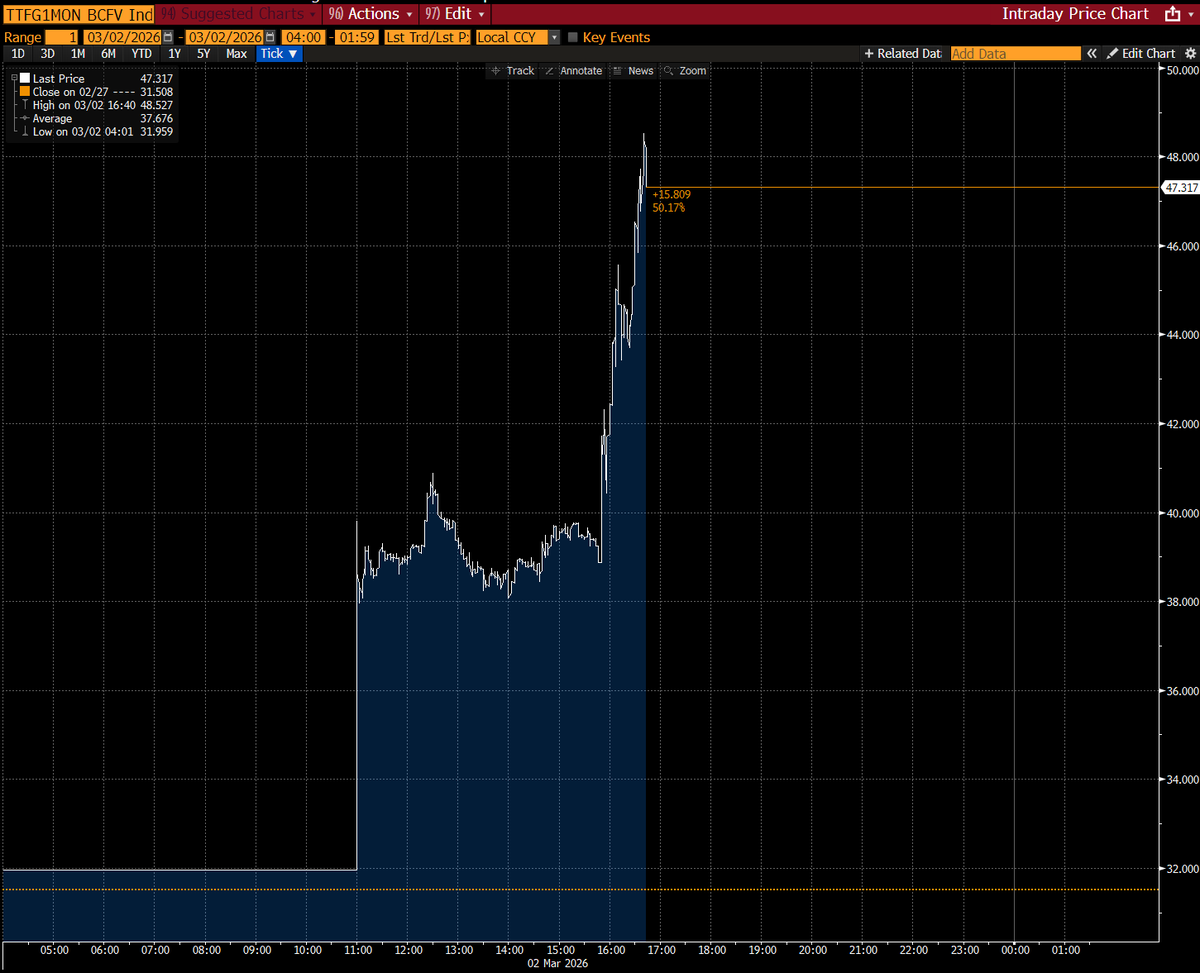
Wow wow wow European Gas prices surged 50% after the Qatari LNG production halts
Joumanna Nasr Bercetche tweet media
English
169
1.9K
6.8K
1.5M
Davidutro.eth retweetledi
Santiment
Santiment@santimentfeed·
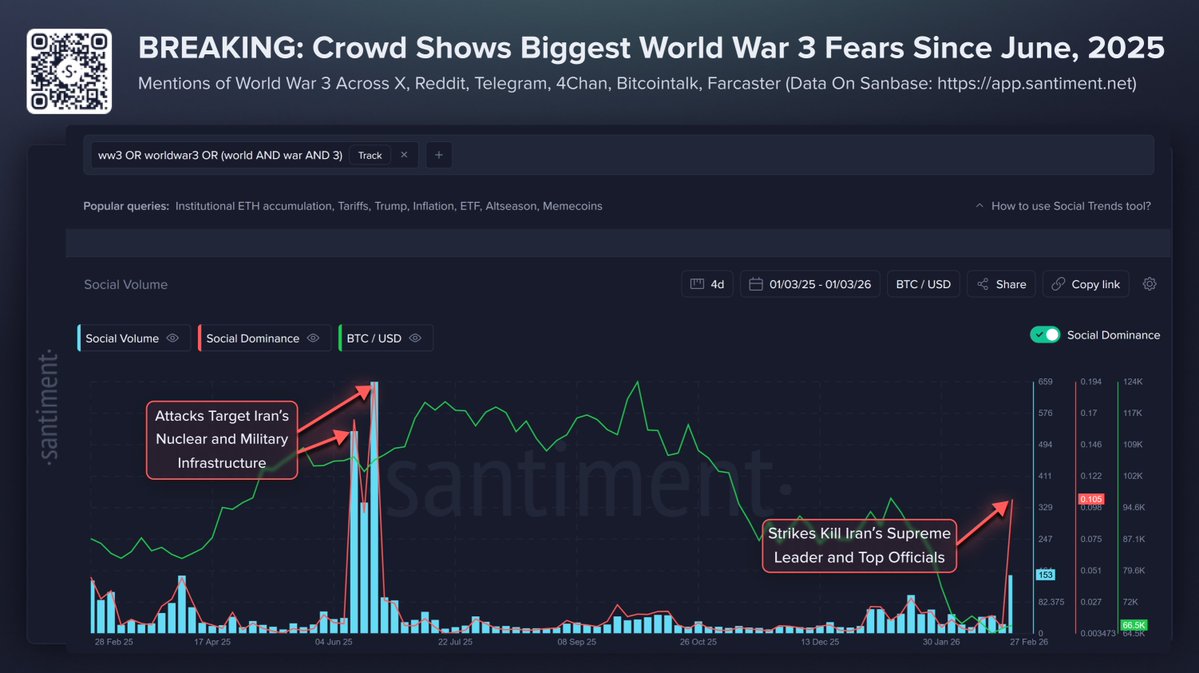
🚨 BREAKING: Crypto social media is discussing the prospect of World War 3 at the highest level since June, 2025. To summarize, based on what has been reported by news outlets: 📌 June 13, 2025 – June 24, 2025: Israel launched strikes on Iranian nuclear and military sites, escalating into a 12-day direct Israel–Iran conflict. The U.S. assisted in intercepting Iranian attacks and later conducted strikes on Iranian nuclear facilities. Iran retaliated with missile and drone attacks, including on a U.S. base in Qatar. A ceasefire was reached June 24. 📌 February 28, 2026 – : The U.S. and Israel carried out coordinated strikes across Iran, including military and leadership targets. Iran responded with missile and drone attacks on Israel and U.S. military installations across the Gulf region. Conflict is ongoing. 🌏 The uncertainty regarding the ongoing fighting in 2026 and memories of the previous conflict between the 3 countries last June has amplified fear online. This has led to social media users framing this current situation as a possible precursor to a much wider global conflict.
Santiment tweet media
English
13
5
51
34.8K
Davidutro.eth retweetledi
vitalik.eth
vitalik.eth@VitalikButerin·
Now, the quantum resistance roadmap. Today, four things in Ethereum are quantum-vulnerable: * consensus-layer BLS signatures * data availability (KZG commitments+proofs) * EOA signatures (ECDSA) * Application-layer ZK proofs (KZG or groth16) We can tackle these step by step: ## Consensus-layer signatures Lean consensus includes fully replacing BLS signatures with hash-based signatures (some variant of Winternitz), and using STARKs to do aggregation. Before lean finality, we stand a good chance of getting the Lean available chain. This also involves hash-based signatures, but there are much fewer signatures (eg. 256-1024 per slot), so we do not need STARKs for aggregation. One important thing upstream of this is choosing the hash function. This may be "Ethereum's last hash function", so it's important to choose wisely. Conventional hashes are too slow, and the most aggressive forms of Poseidon have taken hits on their security analysis recently. Likely options are: * Poseidon2 plus extra rounds, potentially non-arithmetic layers (eg. Monolith) mixed in * Poseidon1 (the older version of Poseidon, not vulnerable to any of the recent attacks on Poseidon2, but 2x slower) * BLAKE3 or similar (take the most efficient conventional hash we know) ## Data availability Today, we rely pretty heavily on KZG for erasure coding. We could move to STARKs, but this has two problems: 1. If we want to do 2D DAS, then our current setup for this relies on the "linearity" property of KZG commitments; with STARKs we don't have that. However, our current thinking is that it should be sufficient given our scale targets to just max out 1D DAS (ie. PeerDAS). Ethereum is taking a more conservative posture, it's not trying to be a high-scale data layer for the world. 2. We need proofs that erasure coded blobs are correctly constructed. KZG does this "for free". STARKs can substitute, but a STARK is ... bigger than a blob. So you need recursive starks (though there's also alternative techniques, that have their own tradeoffs). This is okay, but the logistics of this get harder if you want to support distributed blob selection. Summary: it's manageable, but there's a lot of engineering work to do. ## EOA signatures Here, the answer is clear: we add native AA (see eips.ethereum.org/EIPS/eip-8141 ), so that we get first-class accounts that can use any signature algorithm. However, to make this work, we also need quantum-resistant signature algorithms to actually be viable. ECDSA signature verification costs 3000 gas. Quantum-resistant signatures are ... much much larger and heavier to verify. We know of quantum-resistant hash-based signatures that are in the ~200k gas range to verify. We also know of lattice-based quantum-resistant signatures. Today, these are extremely inefficient to verify. However, there is work on vectorized math precompiles, that let you perform operations (+, *, %, dot product, also NTT / butterfly permutations) that are at the core of lattice math, and also STARKs. This could greatly reduce the gas cost of lattice-based signatures to a similar range, and potentially go even lower. The long-term fix is protocol-layer recursive signature and proof aggregation, which could reduce these gas overheads to near-zero. ## Proofs Today, a ZK-SNARK costs ~300-500k gas. A quantum-resistant STARK is more like 10m gas. The latter is unacceptable for privacy protocols, L2s, and other users of proofs. The solution again is protocol-layer recursive signature and proof aggregation. So let's talk about what this is. In EIP-8141, transactions have the ability to include a "validation frame", during which signature verifications and similar operations are supposed to happen. Validation frames cannot access the outside world, they can only look at their calldata and return a value, and nothing else can look at their calldata. This is designed so that it's possible to replace any validation frame (and its calldata) with a STARK that verifies it (potentially a single STARK for all the validation frames in a block). This way, a block could "contain" a thousand validation frames, each of which contains either a 3 kB signature or even a 256 kB proof, but that 3-256 MB (and the computation needed to verify it) would never come onchain. Instead, it would all get replaced by a proof verifying that the computation is correct. Potentially, this proving does not even need to be done by the block builder. Instead, I envision that it happens at mempool layer: every 500ms, each node could pass along the new valid transactions that it has seen, along with a proof verifying that they are all valid (including having validation frames that match their stated effects). The overhead is static: only one proof per 500ms. Here's a post where I talk about this: ethresear.ch/t/recursive-st… firefly.social/post/farcaster…
English
803
1K
5.7K
901.1K
Davidutro.eth retweetledi
Santiment
Santiment@santimentfeed·
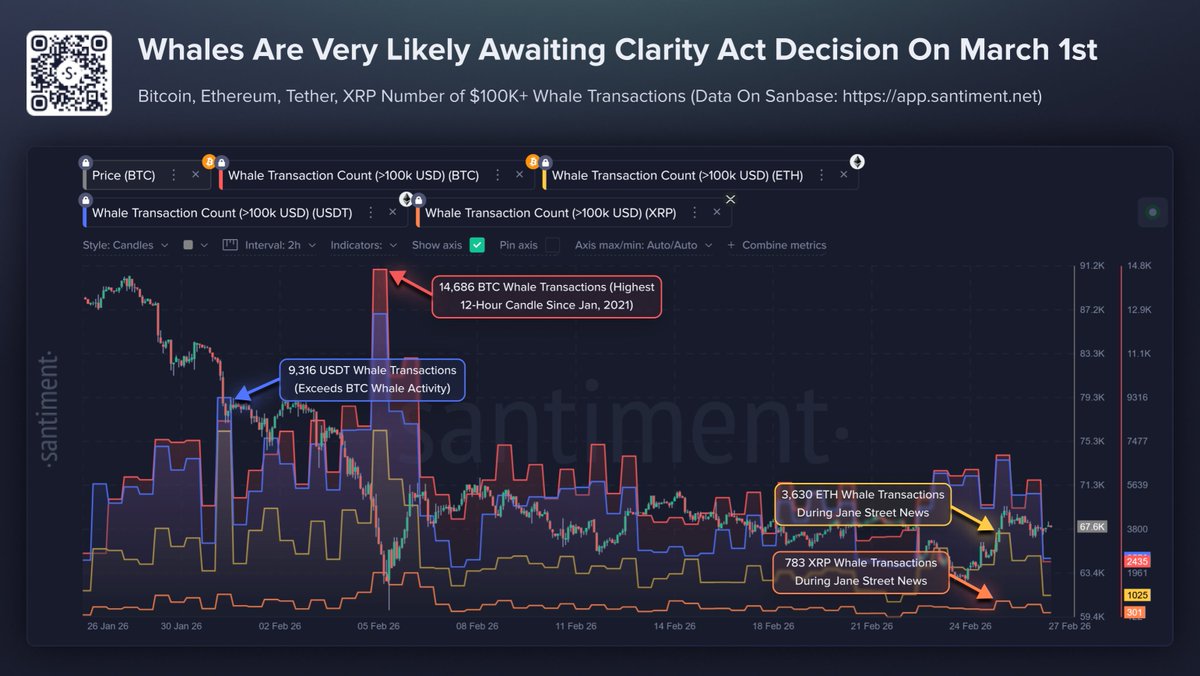
🏦 After Jane Street’s market impact earlier this week, attention is now turning to the White House’s March 1 internal deadline related to negotiations surrounding the highly anticipated Clarity Act. The legislation remains critically important for crypto because it will aim to provide clearer regulatory guidelines, reducing uncertainty for investors, exchanges, and blockchain companies. 🐳 Here are the amount of $100K+ transfers on the Bitcoin, Ethereum, Tether (ETH), and XRP Ledger networks over the past month. High spikes in whale transfers relative to the surrounding amount of whale activity will typically signal high probabilities of market reversals. Expect a big jump in whale activity at the beginning of March, regardless of what unfolds.
Santiment tweet media
English
9
9
54
5.3K
Davidutro.eth retweetledi
Santiment
Santiment@santimentfeed·
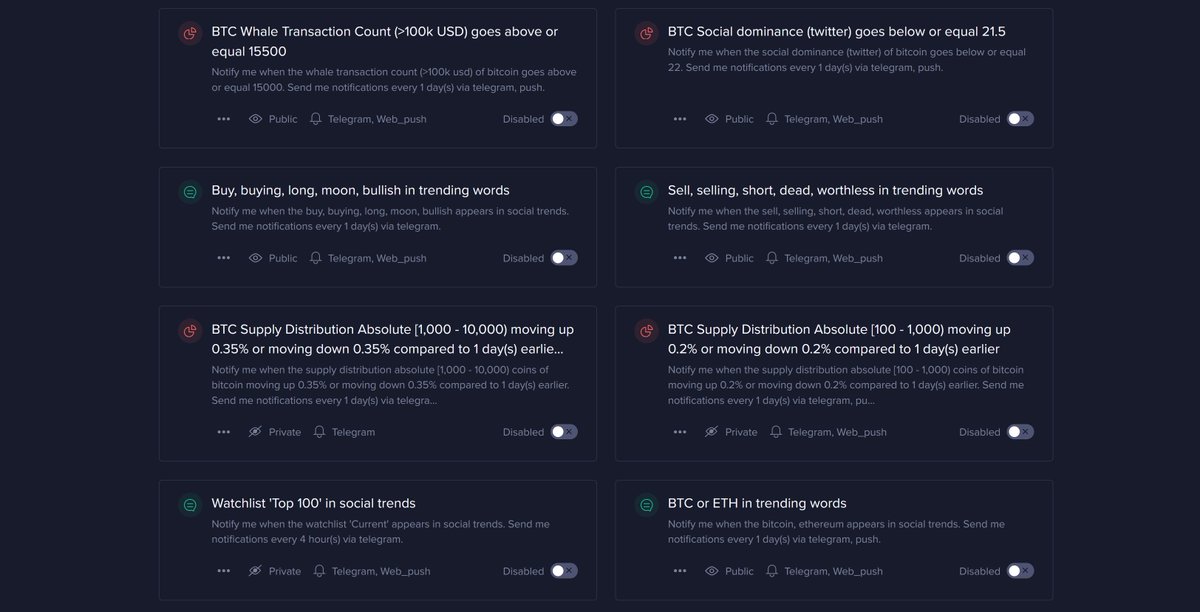
🚨 Santiment's Alerts page makes it easy to create and manage your own alerts or subscribe to existing ones from other users. A few helpful examples would be: 🛎️ Alert me when whale transactions for any top 100 asset triples in one day 🛎️ Alert me when bullish commentary toward Bitcoin is 5x more in one hour compared to the average hour 🛎️ Alert me when a specific whale addresses adds or drops at least 10% of its supply in under 24 hours ✅ Whenever your alerts trigger, you can have them sent to your Telegram in a private chat with our alert bot, or sent straight to your email! Visit the Alerts page here: app.santiment.net/alerts?utm_sou… 🤑 With a free plan, you can enjoy 3 free alerts and have them active for 30 days. With a Sanbase Pro or Max plan, your available alerts skyrockets to 20 with unlimited durations. Choose your plan here, and see what others in crypto can't: app.santiment.net/pricing?utm_so…
Santiment tweet mediaSantiment tweet mediaSantiment tweet mediaSantiment tweet media
English
3
4
26
7.3K
Davidutro.eth
Davidutro.eth@Davidutro·
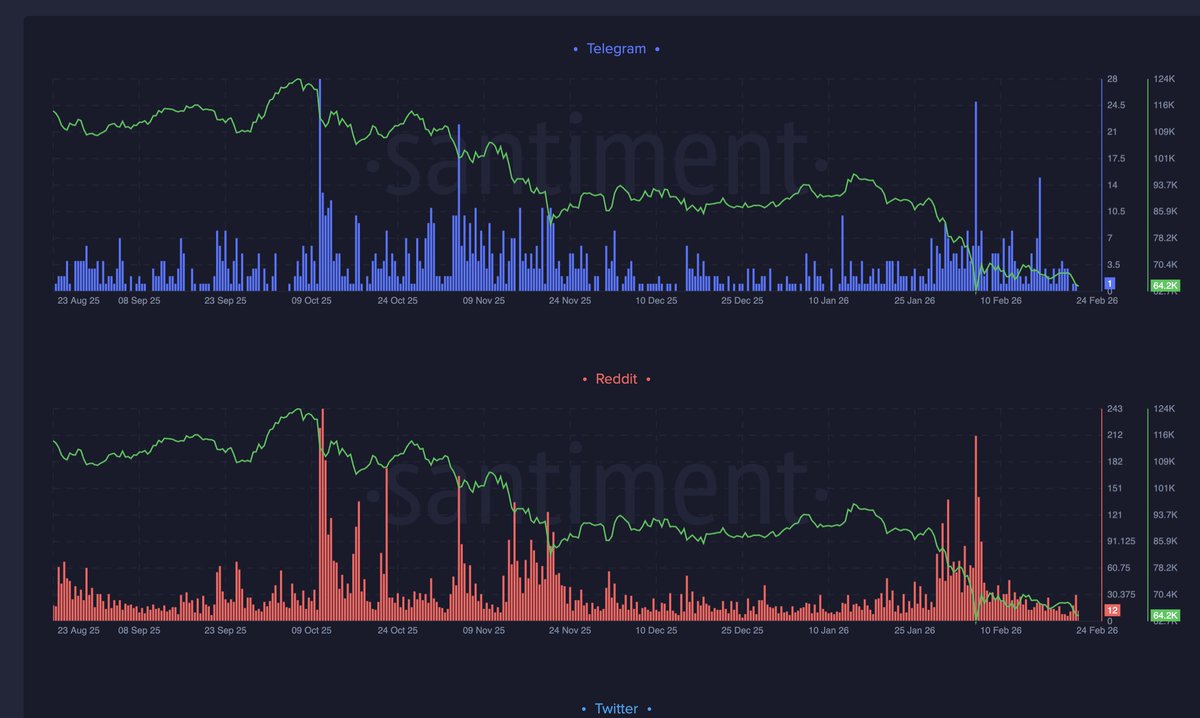
Almost no-one is talking about buying the dip this time. That's a green flag for me, such extreme loss of hope leads me to think the bottom is near. Pic below is some of the social data for mentions of buying the dip.
Davidutro.eth tweet media
English
4
0
6
116
Davidutro.eth retweetledi
Bryan Johnson
Bryan Johnson@bryan_johnson·
I’d cancel your AG1 subscription. They just completed a clinical trial and the results show no clinical benefit.  This has been obvious for years.  AG1 has no real product substance and is fundamentally an influencer heist.   Two simple alternatives (75% and 56% less $), outperform AG1 in randomized clinical trials. Two simple mono-ingredient alternatives that outperform AG1: 1. Chicory inulin 12 g daily ($20/mo) 2. Resistant starch 30 g daily for 12 weeks ($35/mo) AG1 is not worth $79/mo. AG1 study results (4-weeks, N=30): + No significant changes in blood biomarkers compared to placebo (CBC, CMP, lipids). + No statistically significant improvement in digestive quality-of-life scores (p = 0.058). + No significant metabolic or inflammatory biomarker benefits of any kind within the scope of what was measured in the trial. + Only small shifts in microbiome taxa but clinically irrelevant at this stage. + The intervention did not increase microbiome diversity compared to placebo. Alpha diversity was unchanged, and the taxa changes seen were only from pre- to post-analysis within each group. Between-group differences were limited, and the placebo actually showed similar or even potentially larger shifts. This means the observed changes fall within normal placebo-driven variability, not a real treatment effect. No global microbiota shifts were detected. Chicory inulin 12 g in constipation patients + 12 g of chicory inulin daily for 4 weeks (compared to maltodextrin placebo) + Global microbiota shifts: enrichment in butyrate-producing Bifidobacterium and Anaerostipes, and depletion of the pro-inflammatory Bilophila. +The effect was seen by comparing intervention vs placebo in a cross-over setting, a very rigorous type of clinical analysis in which each person serves as their own control, eliminating a lot of individual random noise. + The trial also met its primary objective by improving constipation symptoms in the targeted patient group. Resistant starch daily 30g for 12 weeks in older adults + Significant increase in Bifidobacterium in both middle-aged and elderly participants, with an increase in the beneficial microbiome byproduct butyrate, and reductions in Proteobacteria (including inflammatory Escherichia–Shigella) in the elderly. + Resistant starch also significantly reduced blood glucose, and produced greater reductions in blood insulin and insulin resistance (HOMA-IR) in the elderly group.
Bryan Johnson tweet media
English
969
834
16.6K
3M
Davidutro.eth retweetledi
PaperImperium
PaperImperium@ImperiumPaper·
The surprising deterioration in accounting standards apparent in the report released yesterday by the @SkyEcosystem Frontier Foundation reminded me strongly of the historical arc of the d’Medici banking empire. Students of Renaissance history probably know that Cosimo d’ Medici made tiny Florence a powerhouse in a dangerous world full of expansionist, powerful kingdoms and empires. While culturally and politically savvy, the d’ Medici bank was the true source of his power. Cosimo himself served as the auditor of last resort, and required all branch managers to provide their books annually, and they would be summoned regularly to go through their branch’s accounts line by line. This meant that the end owner, while giving his branch managers significant freedom, was always able to evaluate their work and ensure they followed rules around risk management (such as never lending to princes and kings). Good accounting and sound lending practices led to a fortune of at least 120k florins by his death — around $75m in today’s gold prices, which was an unheard of level of wealth back then. Unfortunately, his children and grandchildren were less willing or able to regularly check behind their bookkeepers and managers. Cosimo’s grandson, Lorenzo the Magnificent, entirely delegated the bank’s accounts to Francesco Sassetti. Sassetti kept good, double-entry accounting for the first few years. But as time went on, the ledgers showed fewer entries and not in the proper form. This feels like it is where Sky is today. Despite helpful examples of past reports by Steakhouse on behalf of Sky, and current examples from Spark (which are good quality for crypto), the Sky Frontier Foundation published numbers that cannot be reconciled and appear to flagrantly violate standard accounting practices. Back to the d’Medici: Sassetti, whose job was to supervise his branch managers since Lorenzo the Magnificent was unable to do so, predictably ran into trouble due to the loose oversight. The manager of the Bruges branch gave a massive loan — in excess of the branch’s entire capital — to the Duke Charles the Bold of Burgundy, who was also famous for defaulting on his debts. The manager personally benefitted by prestige and a place in the ducal court. But eventually Duke Charles died, and his successor struggled to even meet interest payments. The branch was ruined, and the d’Medicis lost a lot of money (although the branch manager lost everything). There was the branch in London, which loaned money to King Edward IV to finance the War of the Roses. Again, this was a manager breaking the rules and lending to a sovereign. The king did not honor the debt, and the London branch was left with no recourse, just as they were with the Duke of Burgundy, who at this time was de facto not subject to the King of France. Finally, the Lyon branch, which Sassetti himself was technically the manager of, reported annual returns of 70-105% for seven years straight. Typical d’Medici bank returns were 8-15%. Yet Sassetti accepted the accounts provided by the man running the Lyon branch without an audit or close inspection. By 1488, Lorenzo the Magnificent had lost most of the d’Medici banking fortune. The Florentines eventually expelled the ‘dMedici, and the famous Machiavelli (who was very fastidious about double-entry bookkeeping) took their place in a new republic. The moral of the d’Medici tale is that when lending is your business, you need the owner to be willing to examine the books directly and ask hard questions if they don’t balance or seem impossible. You also need the managers responsible for periodic oversight to be competent and motivated to make sure the books balance. Right now, SKY tokenholders and Sky Frontier Foundation appear to be playing the role of Lorenzo and Sassetti, respectively. Which makes you wonder what problems could be building up unseen or hand-waved away inside the project.
PaperImperium@ImperiumPaper

The Q4 2025 @SkyEcosystem report is out from the new @SkyEcoInsights. “Is this a joke?” accurately describes my reaction. I actually checked to make sure it wasn’t April 1st. Let’s start with numbers that are quick to verify and seem correct: USDS supply $9.18b (up 72% YoY). With that out of the way, let’s move on to material misrepresentations of Sky’s financial health. First, let’s realize this is NOT up to the standards of financial statements put out by @SteakhouseFi from Q2 2023 through Q3 2025. The report from the Frontier Foundation doesn’t have a single financial statement (e.g. balance sheet, income statement, PnL, anything at all). So it’s very difficult to understand how they arrived at some of these numbers. They cite as their only source info dot sky dot money, but that’s a real-time dashboard for tracking technical details, NOT financial information! It doesn’t even include token expenses. Info dot sky dot money is excellent as a technical tracker, but is not a substitute for financial reporting. On the table “Sky Protocol Q4 and Full Year 2025 Financials”, the numbers for profits are very difficult to make sense of. Let’s start with the box saying Q4 2025 “Protocol Profits” (not defined or broken down) were $17m. This seems very inconsistent with the change in aggregated cash holdings across Sky + Stars of only $4.86m from Sept 30 2025 to Dec 31 2025. Where is this other $12.14m if there was a $17m profit in Q4 2025? But the numbers for previous quarters in 2025 are also difficult to reconcile. For example, this report lists Q3 2025 as having $30m in Protocol Profits. This is in sharp contrast to the $29.1m LOSS reported by Steakhouse in the Q3 report, driven by transfers of $60m to off-balance-sheet vehicles (mostly the Sky Frontier Foundation that published this confusing report). If you strip out that expense and do some messy rounding, I suppose you could get to $30m. I don’t have a better explanation. Q2 2025 Protocol Profits is likewise inconsistent with the previous, much more detailed, reports. The Q2 2025 report on the forum shows $15.9m in earnings, while this Frontier Foundation report shows $20m. I don’t even have a good guess at how they got there, and they don’t show their work. And it’s not as if the errors are only in the direction of management looking good. This report shows a $14m loss in Q1 2025, while the historical reports show a more modest $5m loss. They include a footnote about updates to the Savings Rate module, but I again am left not understanding how they found $9m in losses that were not reported by Steakhouse (who DOES offer line item breakdowns). Expenses likewise do not seem to match public data, even on info dot sky dot money. Q3 and Q4 expenses didn’t even match the sole source (info dot sky dot money), so I’ll be candid that I didn’t bother to check the others. I won’t bother discussing the outlook provided in the report. (Continued in next tweet)

English
3
3
33
7.4K
MINDRAK
MINDRAK@Mindraak·
@santimentfeed Thanks David, great stuff. Could you please link to the charts? I'll have to think about this for a while.
English
1
0
2
84
Santiment
Santiment@santimentfeed·
🌊 How is wealth distributed among crypto holders, based on how long they've been hodling? Our new series, known as 'Metrics Explained', understands how to use different untapped metrics to improve trading. Read all about Hodl Waves! 👇 app.santiment.net/insights/read/…
English
1
1
10
3.4K
Davidutro.eth retweetledi
Arthur Juliani
Arthur Juliani@awjuliani·
I'm trying to figure out where to live next, and one big consideration is the climate. So naturally I made a tool that represents monthly average temperatures for cities as 3D rings so they can be compared more easily. Check it out: awjuliani.github.io/weather-explor…
English
601
569
8.7K
1.1M
Davidutro.eth
Davidutro.eth@Davidutro·
interesting take
Chris Morlock@CDMorlock

Note Of Extreme Caution To Comrades: DO NOT FALL FOR THE “IT’S ALL ABOUT OIL” LIE I’ve lived through multiple imperial wars where the so-called “left” reflexively responded with the same lazy line: “They’re just there for the oil.” I remember this explicitly during the First Gulf War, and implicitly throughout Iraq, Libya, and Syria. This is historical bunk. The United States never extracted shit from Iraq. Not in any meaningful sense. Not structurally. Not in a way that lowered prices, improved supply, or benefited the American public. The argument collapses entirely once you understand the nature of financialized capital, whose primary objective is not extraction but the prevention of productive extraction in favor of rent, debt, and control. Let me walk you through the contradiction: Trump claims explicitly what the original neocons like Paul Wolfowitz claimed implicitly in the 1990s: that there is a geopolitical payoff in seizing another country’s resources. To a battered American population paying $5 a gallon, that claim sounds concrete. On a subconscious level, people imagine that “taking the oil” means cheaper gas, lower costs, relief from austerity. They don’t care about morality. They care about price. Then the left responds by framing everything as kleptocracy while still implicitly accepting the premise that resources could be taken, but that doing so would merely be “wrong.” This is a losing argument. For someone living under austerity, there is no material counter-logic being offered. You’ve conceded the terrain. But here’s the reality: it never comes. Nothing is extracted. What actually happened in Iraq was not oil extraction, but financial looting. The U.S. state shoveled pork-barrel money into the MIC, especially firms like Halliburton, through no-bid logistics, security, and “reconstruction” contracts. Iraqi oil production, which hovered around 3.5 million barrels per day in the late 1980s, collapsed to a few hundred thousand barrels per day during parts of the 1990s and early 2000s. Even after the U.S. exit in 2011, it took another decade for Iraq to claw its way back to those production levels and only then through Chinese state-led industrial investment, not American capital. So the correct response to Trump’s argument is not moral outrage. It is to deny the premise entirely: these wars produce no material gain for anyone tangibly; only financialization, debt, suppressed production, and long-term economic ruin. Then the US economy falls apart and they print more dollars to synthesize "profit" from thin air. Sure capital accumulation occurs, completely bereft of logic and reality! Ironically, Trump himself understands this. He has repeatedly mocked the old neocons for failing to “take the oil,” lamenting their sheer incompetence and lack of “management.” But that critique misses the deeper truth: they didn’t fail. The system worked exactly as designed. Which brings us to Venezuela. Do you seriously believe that Trump, along with his Palantir Technologies cronies, are about to become industrial planners? That without invasion, without regime change, without national reconstruction, they’ll somehow negotiate a $200 billion, 15-year industrial oil expansion in a country whose infrastructure has been deliberately strangled for a decade? This is a pipe dream of pipe dreams. What’s actually lined up for Venezuela is not extraction, but asset stripping. The firms positioned to “re-enter” Venezuela are overwhelmingly financial, not productive. Asset managers like BlackRock are positioned to absorb distressed sovereign and PDVSA-linked debt, restructure it, and turn future production into collateral streams rather than national revenue. U.S. and European oil majors are waiting not to build capacity but for production-sharing agreements, arbitration rulings, and debt-for-equity swaps that cap output and guarantee rents. Sanctions relief is used as leverage not to expand capacity, but to discipline the state and force Venezuela into IMF-style restructuring, privatization, and legal subordination to Western capital markets. They want the Chinese to pay for this oil in dollars, a minor nuisance for Xi, a silly ploy for the western rentier oligarchs. In a derivatives-driven, dollar-hegemonic system, money is not made by flooding markets with oil. It is made by restricting supply, inflating prices, securitizing future flows, and extracting rents through debt instruments. That is the real play. Not oil for Americans. Not development for Venezuela. But financial control, chopped-up industry, suppressed production, and higher global prices. Here is how the mechanism actually functions, step by step, as a single integrated system: PDVSA entered the 2010s with roughly $30–35 billion in external debt, much of it accumulated during the oil-price collapse after 2014. That debt was issued under New York and international commercial law, not Venezuelan law, making it immediately vulnerable to foreign litigation once payments slowed. U.S. sanctions, primarily enforced through the Treasury Department’s OFAC regime, did not simply “punish” Venezuela. They froze PDVSA’s access to dollar clearing, blocked refinancing, prohibited U.S. persons from rolling over debt, and severed access to spare parts, diluents, insurance, shipping, and reinsurance. This guaranteed production collapse. Output fell from over 2.3 million barrels per day in 2015 to under 700 thousand by 2020. This collapse was then cited as evidence of “mismanagement,” completing the narrative loop. Once payment defaults occurred under sanctions-induced conditions, creditors activated arbitration and litigation channels. Bilateral investment treaties signed in the 1990s gave foreign firms standing in ICSID, the World Bank–linked arbitration system designed explicitly to protect capital against sovereign states. Venezuela now faces tens of billions of dollars in ICSID awards and claims, many tied to pre-Chávez privatizations and post-Chávez nationalizations. Those arbitration awards are enforceable not inside Venezuela, but against Venezuelan assets abroad. This is why CITGO, PDVSA’s U.S. subsidiary, became the primary target. Courts in Delaware treat arbitration judgments as senior claims. The result is not compensation through production, but forced asset liquidation and debt waterfalls. At no point does this process require rebuilding Venezuelan oil capacity. In fact, rebuilding capacity would undermine the entire structure by increasing supply and reducing price leverage. The rational financial outcome is permanently constrained production, collateralized future barrels, and externally controlled cash flows. Sanctions create default. Default activates arbitration. Arbitration enables asset seizure. Asset seizure disciplines the state. Financial firms then step in to “stabilize” the wreckage through debt restructuring, equity swaps, and price-managed reentry. The oil stays mostly in the ground. The rents flow outward. This is why the “they just want the oil” line is not merely wrong but backwards. The oil is most valuable when it is not produced, when it exists as a future claim backing debt, derivatives, and geopolitical leverage. Anyone telling you otherwise is either historically illiterate or selling the lie. Trump is simply accelerating the debt peonage machine, not extracting resources like the Roman Raubbauwirtschaft fantasy. The reality is the western left spent decades making the "it's wrong to extract resources cus' muh morality" argument and IT NEVER HAPPENED. It's a loser, it's time to contradict the financial oligarchy as FUNDAMENTALLY UNPRODUCTIVE in all senses.

English
3
0
9
166
Davidutro.eth retweetledi
Garga.eth (Greg Solano)
Garga.eth (Greg Solano)@CryptoGarga·
my grandmother was an educator, started a private school in Havana in the 50s and worked as the principal taught some English classes at night for adults as well so obviously Castro's goons took possession of the school after 1959 which to have your dream that you built from nothing taken from you and given to complete idiots who burn it down in short order is one thing but the most humiliating aspect of the whole ordeal that my grandmother would talk about was more specific than that it was having men show up at her door, after everything was done, holding an inventory sheet that they found which listed how many desks she had bought for the school, blackboards, etc and being asked about a few desks they couldn't find. literally that. how come there's 48 desks in the school and not the 50 on the inventory sheet. of course the answer was that they broke and they threw them out. the inventory sheet was old. but they didn't believe her, they intimidated her at gunpoint. a little lady, a school principal who probably weighed 100 pounds. where are the fucking desks. she remembered that forever. it's almost 70 years later, and the situation is if anything only more absurd, more morally and economically bankrupt in Cuba if your fridge breaks, you wait until the government sends you a new one (on the seventh of never) and docks it from your govt pay accordingly. your govt pay is ~16 USD a month. you can make more by pestering some euro or canadian tourist to buy some random junk off you -- if you follow them around enough and are persuasive enough, they will give you a $20, which is more then your doctor makes in a month. which is sort of whatever, because there really are no stores, just ration counters with 5-6 things listed on a blackboard that they'll trade you for tickets. rice, sugar, salt, cigarettes. if you don't smoke you trade you trade your cigarette rations for something else. toilet paper. when your kids get older, they don't move out, there's literally nowhere for them to move to. nothing is built, nothing is for sale, and you have no money anyway. you put up paper walls, pretend not to hear each other. the thing you smuggle into Cuba when you're visiting family isn't expensive stuff, the most precious items are USB drives with movie rips and video game roms, and $5 tins of Cafe Pilon 'cause Cuba exports any good coffee it makes, and leaves locals to drink stuff so bad that the $5 tin feels truly luxurious. when I was visiting my great aunt, one of her neighbors came in and made himself a cup of coffee. he didn't know it was fresh from the tin we brought over; it had been transferred over to their usual container. saw a grown man well up with apologetic tears in his eyes because as soon as his lips touched the drink, he knew this was different. he drank his neighbor's Cafe Pilon thinking it was just the usual crap and he almost cried. Because he felt he had taken something incredibly precious of his neighbor's without asking. anyway, my point is: you don't really need to try out repossessing people's private property in New York. there's an island 90 miles off Florida where incredibly smart people, I sincerely mean that, have been doing it for three-quarters of a century.
Mario Nawfal@MarioNawfal

🚨🇺🇸 NYC MAYOR MAMDANI'S HOUSING OFFICIAL: "YOUR HOME SHOULDN’T REALLY BE YOURS" According to Cea Weaver, a top housing advisor for NYC Mayor Mamdani, the idea of owning your home the way people always have is outdated. She says we’ve treated property as something personal for “centuries,” and now it’s time to see it as “collective.” Her words? Families (especially white ones, of course) need a “different relationship to property.” In other words: stop thinking of your house as yours, and start thinking of it as something shared. This isn’t a fringe activist on TikTok. This is a person in charge of housing policy for New York City. Heads up: this "shared equity" talk is a nice way of saying ownership might not mean what you think it does anymore. Source: @EndWokeness

English
274
1.4K
6.6K
458K
Davidutro.eth retweetledi
vitalik.eth
vitalik.eth@VitalikButerin·
Now that ZKEVMs are at alpha stage (production-quality performance, remaining work is safety) and PeerDAS is live on mainnet, it's time to talk more about what this combination means for Ethereum. These are not minor improvements; they are shifting Ethereum into being a fundamentally new and more powerful kind of decentralized network. To see why, let's look at the two major types of p2p network so far: BitTorrent (2000): huge total bandwidth, highly decentralized, no consensus Bitcoin (2009): highly decentralized, consensus, but low bandwidth - because it’s not “distributed” in the sense of work being split up, it’s *replicated* Now, Ethereum with PeerDAS (2025) and ZK-EVMs (expect small portions of the network using it in 2026), we get: decentralized, consensus and high bandwidth The trilemma has been solved - not on paper, but with live running code, of which one half (data availability sampling) is *on mainnet today*, and the other half (ZK-EVMs) is *production-quality on performance today* - safety is what remains. This was a 10-year journey (see the first commit of my original post on DAS here: github.com/ethereum/resea… , and ZK-EVM attempts started in ~2020), but it's finally here. Over the next ~4 years, expect to see the full extent of this vision roll out: * In 2026, large non-ZKEVM-dependent gas limit increases due to BALs and ePBS, and we'll see the first opportunities to run a ZKEVM node * In 2026-28, gas repricings, changes to state structure, exec payload going into blobs, and other adjustments to make higher gas limits safe * In 2027-30, large further gas limit increases, as ZKEVM becomes the primary way to validate blocks on the network A third piece of this is distributed block building. A long-term ideal holy grail is to get to a future where the full block is *never* constituted in one single place. This will not be necessary for a long time, but IMO it is worth striving for us at least have the capability to do that. Even before that point, we want the meaningful authority in block building to be as distributed as possible. This can be done either in-protocol (eg. maybe we figure out how to expand FOCIL to make it a primary channel for txs), or out-of-protocol with distributed builder marketplaces. This reduces risk of centralized interference with real-time transaction inclusion, AND it creates a better environment for geographical fairness. Onward.
English
1.1K
1.4K
7.3K
1.3M