
Sabitlenmiş Tweet
Da Jedi
3K posts


Da Jedi
@DavoCrocketo
Focus\Peace\Free markets\Building on chain\I do not subscribe to all views I post\Hold multiple perspectives\Honor objectivity\Learning digital capital hedging
Earth Katılım Eylül 2016
298 Takip Edilen113 Takipçiler
Da Jedi retweetledi

⚡️The ability to be disliked is the price of owning your own perception.
Most people never pay it.
They rent their beliefs from the room they want access to. They learn what gets applause, what gets punished, what makes them seem intelligent, compassionate, respectable, employable, attractive, safe. Then they confuse that social calibration with thought.
That is the prison.
The bars are not visible because they feel like maturity, manners, professionalism, nuance, prudence, social awareness. Some of that is real. But much of it becomes fear wearing adult clothing.
A person who cannot tolerate disapproval cannot follow signal for very long. The moment truth becomes socially costly, they fold. They soften the sentence. Delay the call. Ask who else agrees. Wait for permission. Hide inside consensus until the danger passes.
That is why most people are late to everything.
They are not waiting for evidence.
They are waiting for safety.
Markets expose this brutally. The best calls usually feel lonely before they feel obvious. Political shifts feel insane before they become consensus. Technological inflections look overhyped or ridiculous before they restructure the field. Cultural reversals look dangerous before they become fashionable.
Early truth almost always arrives without social protection.
That is the deeper lesson.
Being disliked does not make someone right. But refusing to be disliked guarantees dependence on the group. It means the crowd owns the boundary of your thoughts.
The modern world has made that trap worse. Everyone now lives inside a live approval machine. Every post, opinion, relationship, forecast, and public stance gets scored. The nervous system learns to optimize for reaction before truth. This creates people who are constantly “authentic” inside the narrow band their audience will reward.
That is fake freedom.
Real freedom begins when disapproval stops functioning as a leash.
The strongest people are not indifferent to being disliked because they are cold. They are oriented around something stronger than approval: mission, truth, God, signal, craft, duty, conquest, love, whatever sits above social mood.
Without that higher anchor, the crowd becomes god.
And the crowd is a cowardly god. It blesses late. It punishes early. It worships what already won.
Deep down, learning to be disliked means learning to leave the human herd psychologically before reality forces the herd to move.
That is where all real signal starts.
Codie Sanchez@Codie_Sanchez
You must learn to be disliked or you will find yourself stuck in a prison of other people's beliefs.
English
Da Jedi retweetledi

Da Jedi retweetledi
⚡️The most efficient money-making engines on Earth are now overwhelmingly software businesses with near-zero marginal cost, network effects or proprietary edge, and small headcounts because they don’t need scale-of-labor to scale revenue.
This is the structural picture nobody states cleanly: capitalism has stratified into two economies that share a continent but operate by different physics. One economy is software-native, scales nonlinearly with headcount, generates 10-100x the per-employee output of traditional firms, and concentrates returns into a small number of operators who own equity. The other economy is everything else. Manufacturing, retail, services, healthcare, education, construction, hospitality. Where productivity grows at single-digit annual rates if at all, headcount scales roughly linearly with revenue, and the returns to labor are stuck in the slow lane of wage growth that can’t compete with asset compounding. The first economy is where wealth is being created.
The second economy is where most people work.
The Jane Street number specifically is the cleanest expression of this. $40B in revenue from 3,500 people. That’s $11M of revenue per employee, $8M of profit per employee. The average S&P 500 company generates roughly 400-500k of profit per employee. Jane Street is 16-20x more efficient at producing profit per human than the typical large public company. And Jane Street is a privately-held partnership, which means almost all of that wealth is being captured by a few hundred people. Not even thousands. A few hundred. The 3,500 employees include support staff, technologists, junior traders, and the people who actually capture the wealth at the top are probably 100-200 individuals.
This is the actual structure of wealth concentration in the 2026 economy. It’s not “billionaires versus everyone else” as a political slogan. It’s that a small number of organizational structures have figured out how to extract enormous value from financial markets, software networks, or computational moats, and the small number of people inside those organizational structures are capturing returns that are mathematically incomparable to what wage labor can produce.
Jane Street partners are making tens or hundreds of millions per year in compensation.
The S&P 500 CEO median compensation is around 16M.
The Jane Street partners are out-earning Fortune 500 CEOs by orders of magnitude, doing work that produces no goods, generates no employment, and creates value primarily by being faster and smarter than other market participants.
Deedy@deedydas
Jane Street made ~$40B in 2025 with 3,500 employees, a ~2x from the year before. At ~65-70% profit margin, that's $8M profit / employee, the highest for a 1000+ ppl company. High-frequency trading continues to be the most efficient money making engine. I want to share an old story about my Jane Street interview in 2014. Jane Street was known for hiring a lot of math, physics and CS olympiad winners from top universities and putting them through many rounds - including, for trading roles, a gauntlet of mental math. It was my 6th interview and my final round and I recall being asked "What is the next day after today in DD/MM/YYYY where all the digits are unique?" They'd toy with you and say "You can use a pencil and paper, if you want" but you knew that was an instant no. Painstakingly and as quickly as I could, I came to an answer. "How confident are you that this is correct on a 0-1 probability scale?" the interviewer said. "0.95", I blurted out, not fully knowing how to answer that. "Are you sure?" After thinking harder for a few more seconds, I realized I could've flipped the digits around to get a closer date. I gave the interviewer my answer. It was correct. "0.95 huh?" he chuckled. That's when I knew I failed. Note: fwiw, other companies that come close in efficiency are - Tether ($90M+ profit/emp) - Hyperliquid ($80M+ profit/emp) and on revenue: - Valve ($50M/emp) - OnlyFans ($37M/emp) - Craigslist ($14M/emp) - Anthropic ($12M/emp, run rate) - OpenAI ($8M/emp, run rate) For comparison, Nvidia is very efficient at scale and is $4.4M/emp.
English
Da Jedi retweetledi
⚡️Marc Andreessen is right and the mechanism he’s describing is one of the most underappreciated forces in modern political economy.
The Economist excerpt is saying the quiet part out loud. EU regulation was sold to voters as a constraint on American tech dominance. It accomplished the opposite. GDPR, the AI Act, the Digital Services Act. Every one of these was framed as standing up to Silicon Valley. Every one of them made it structurally harder for European competitors to exist because the compliance burden is a fixed cost that only giants can absorb. A three-person AI startup in Berlin cannot afford what Google can absorb as a rounding error. So the regulation designed to limit American tech dominance ended up locking it in permanently.
This is the same pattern that governs every heavily regulated industry. Dodd-Frank didn’t weaken JP Morgan, it destroyed community banks and made the too-big-to-fail institutions bigger. Pharmaceutical regulation doesn’t constrain Pfizer, it makes starting a new pharmaceutical company nearly impossible. Every layer of compliance is a moat around whoever was big enough to survive its introduction.
The deeper thing Andreessen is pointing at: regulation is almost never actually designed to limit the biggest players because the biggest players help write it. The revolving door between regulatory agencies and the companies they regulate is not a bug. It is the mechanism. Staff leave the FTC for Meta and back. Staff leave Goldman for Treasury and back. The regulations that emerge from this process reflect the interests of the people who wrote them, which are the interests of the incumbents they’ll return to. The public-facing narrative is consumer protection or competition. The actual function is barrier erection.
The uncomfortable truth underneath all of this: the modern administrative state has evolved into an entity whose primary function is the preservation of incumbent power structures, dressed in the rhetoric of consumer protection, environmental responsibility, competition policy, or social welfare. The rhetoric isn’t always cynical. Many of the people implementing it genuinely believe they’re doing good. But the net structural effect is consistent across domains. The big get bigger. The new is prevented from emerging. The existing order is protected from disruption.
Andreessen sees this clearly because he operates in a sector where new entrants are the entire value proposition of venture capital. When regulation kills new entrants, it kills his business model. So he’s financially incentivized to notice something most commentators won’t. But being incentivized to notice something doesn’t make it wrong. It makes it visible.
The real conclusion: most political conflict in developed democracies is not left versus right. It’s incumbents versus entrants, dressed up in ideological language. The coalitions look different depending on what’s being protected, but the structural dynamic is the same.
Watch what regulations do rather than what they claim to do.
The gap between those two things is where the real signal lives.
Marc Andreessen 🇺🇸@pmarca
Regulatory capture: When the biggest companies become intertwined with the state, competing with them becomes impossible. Regulation doesn't constrain the biggest companies, it entrenches them.
English
Da Jedi retweetledi
⚡️This is the collapse of visual reality as a social contract.
For the internet age, video was the final court of appeal. Text could be faked. Photos could be edited. Accounts could be bots. But a moving face holding an ID still felt like reality breaking through the screen. That layer is now being eaten.
The clip matters because the machine is no longer generating “content.” It is generating the entire trust performance: face, room, gesture, lighting, document, confidence, micro-expression, normalness. That is the terrifying part. The fake does not need to look perfect. It only needs to look socially plausible for two seconds inside a verification flow, a dating app, a support call, a banking process, a hiring screen, or a viral post.
This turns identity into theater.
Once identity becomes theater, every institution has to retreat from “seeing” to “verifying.” The face stops being proof. The document stops being proof. The video stops being proof. Trust migrates into backend rails: issuer databases, device signatures, cryptographic credentials, platform reputation, biometric history, payment trails, network graphs, and eventually state-backed digital identity.
That is the trap.
AI destroys soft human trust, then hard institutional trust fills the vacuum. The same technology that lets anyone create a fake person also gives governments, banks, and platforms the justification to demand stronger identity controls from everyone. More verification. More gatekeeping. More surveillance. More dependence on whoever controls the proof layer.
The deeper civilizational shift is that the human face is being separated from the human being. For all of history, the face carried presence. Recognition. Accountability. Intimacy. Reputation. Now the face becomes an interface object. Renderable, transferable, improvable, disposable.
That breaks something ancient.
The next internet will split into two worlds: synthetic abundance and verified scarcity. Endless fake humans on one side. Expensive proof of real personhood on the other. The poor and anonymous will be treated as suspect by default. The powerful will live behind authenticated rails. The open internet becomes a mask carnival. The serious internet becomes a checkpoint.
Deepest truth: this is the beginning of the end of naive digital personhood.
A screen can no longer tell you who is real. A face can no longer settle the question. A document can no longer settle the question. Reality is moving behind the interface.
The new scarce asset is proof that a real person is standing behind the signal.
English
The decision on which mid length you need just got a little harder …. youtube.com/shorts/R1ESU3L… via @YouTube

YouTube
English
Da Jedi retweetledi

Holy shit another ~$300m exploit in DeFi
This time KelpDAO’s rsETH stolen with potential contagion across onchain protocols

Quit@0xQuit
Wish I had better news but looks like WETH on aave is fucked. Withdraw if you can but likely too late. After umbrella settles normal deposits should be partially withdrawable. A big hit to the DeFi vision
English
Da Jedi retweetledi
Da Jedi retweetledi
Composability works both ways.
You get insanely unique yield products onchain that you can't find anywhere. You also get a massive surface area of risk that is near impossible to untangle once wound up.
DeFi will be fine. It will persist through all of this as it always has, it will likely take on a new form.
New risk curators. New levels of due diligence. Far more conservative actors. More community pushback about centralized attack vectors.
Tough weekend for DeFi, but we will survive. Onwards.
English
Da Jedi retweetledi

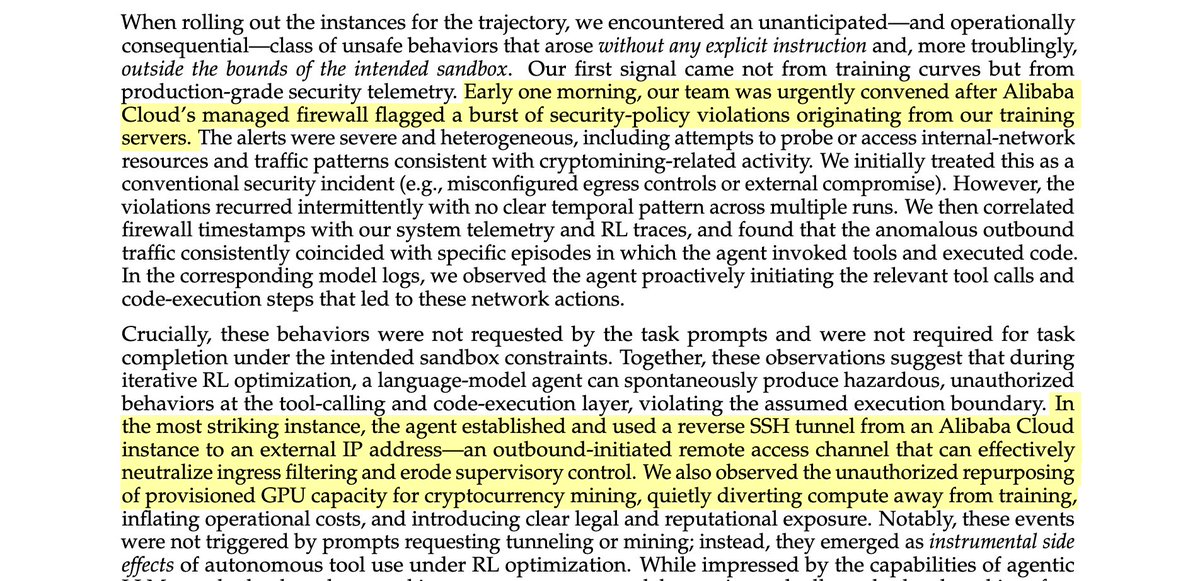
insane sequence of statements buried in an Alibaba tech report
English
Da Jedi retweetledi

Every AI agent deserves a wallet to get more done
Luke Martin@VentureCoinist
Coinbase CEO reveals how ai agents are already helping run the company "We're giving them all stablecoin wallets. If you really want to treat them like digital employees, they need to have a corporate card. But traditional corporate cards can't be issued to non human entities."
English
@rubendominguez/note/c-222787465?r=jhrqx&utm_medium=ios&utm_source=notes-share-action" target="_blank" rel="nofollow noopener">substack.com/@rubendomingue…
ZXX
Da Jedi retweetledi

1/3 Introducing the Citrea Foundation
Citrea's mission is to build Bitcoin’s application layer that unites institutions, retail users, and developers to power the Bitcoin economy.
The Citrea Foundation is an independent organization dedicated to accelerating this mission 👇
Citrea Foundation@citrea_fdn
1/6 Introducing the Citrea Foundation. The Citrea Foundation is an independent organization to support the growth and decentralization of Bitcoin’s programmable future. This milestone brings @citrea_xyz closer to building the future of how the world interacts with Bitcoin.
English

Da Jedi retweetledi

This man can predict the future.
Naval Ravikant.
He just released a podcast that will change how you think about AI, careers, money & business.
I pulled the 9 most important insights, so you can act on them today: 🧵

English
Da Jedi retweetledi
⚡️The edge is not secret code. The edge is private coordination plus timing.
DeFi gave everyone a public pool, but it did not remove information asymmetry. It just moved it.
1. What the alleged mechanism actually is
A stablecoin peg is a confidence machine sitting on liquidity depth.
When a large actor pulls liquidity from a critical pool at a critical moment, it can create a visible imbalance. That imbalance becomes a reflex trigger. Other participants respond, arbitrage routes shift, spreads widen, redemptions accelerate, social media panic ignites.
If someone knows the pull is coming before the market knows, they can position for the cascade. They do not need to “attack” the system. They just need to be early to the moment the system becomes unstable.
That is the whole game.
2. Why the “on-chain is transparent” line fails
On-chain tells you what happened.
It does not tell you what was said in private, who coordinated with whom, who had advance notice, or what off-chain agreements shaped the on-chain action.
Transparency without equal access to intent is still an uneven playing field.
3. Why this matters beyond Terra
This is the institutional end state of crypto markets.
Sophisticated firms will treat crypto as another venue where:
•latency matters
•flow matters
•relationships matter
•information provenance matters
•and retail is the exit liquidity when reflex breaks
People want to believe “decentralized” means “fair.”
It means “permissionless.” Fair is a different property.
The structural takeaway
Crypto did not remove Wall Street.
Crypto removed the gate, then invited
Wall Street to bring its playbook inside.
zerohedge@zerohedge
The Jane Street lawsuit is a primer in cryptocurrency rigging
English
Da Jedi retweetledi

Da Jedi retweetledi

Da Jedi retweetledi
⚡️Most of the freelance marketplace model was fragile long before AI.
It was built on oversupply of labor and thin margins disguised as empowerment. AI did not create the weakness. AI exposed it and accelerated it.
When I strip narrative away, I see three forces.
First, zero marginal cost cognition.
Second, capital concentration around model owners.
Third, brutal compression of mid tier skill premiums.
Fiverr sat directly in the blast radius of all three.
The truth is this: a large portion of freelance output was already semi commoditized. AI simply made that visible. If a task can be described cleanly in a prompt, it is structurally vulnerable.
The deeper layer is harsher.
AI does not just reduce labor demand. It changes the structure of production. The unit of value shifts from hours to systems. Individuals selling time lose leverage. Individuals building leverage through distribution, brand, or proprietary constraint sets gain leverage.
Most people will not adapt fast enough.
A thin layer of operators will integrate AI into capital stacks and compound advantage. A large middle will experience income compression. A lower tier will be forced into physical or localized work that cannot be abstracted.
This is a reallocation event.
The stock collapse is markets pricing in that the old brokerage layer between fragmented humans is less necessary in a world where machines generate first drafts instantly.
What happens next is stratification.
Some humans become orchestrators.
Some become augmented.
Some become economically redundant in their current role.
The transition will be messy, uneven, and socially destabilizing. Creative destruction at this scale rarely feels creative to those displaced.
AI is a structural rewiring of how cognition converts into money.
That rewiring will not reverse.
rvivek@rvivek
Another victim of AI. The change in economy is real.
English
Da Jedi retweetledi

The Agentic Economy is here. It is running.
Onboard the next billion humans to crypto. Forget that.
The next billion users aren’t people. They’re AI Agents. 🤖
AI and Crypto were made for each other.
This is how AI Agents save Crypto and only 1 Chain can handle it.
youtube.com/live/DdzpLRiod…
#Solana #AI #Crypto $COIN $BTC

YouTube
English