

Dan
3.5K posts



@DannPetty @aibek_design I like it - so fun to use and spin up new ideas. I found I wanted to copy ideas back to Figma though. I can only extract one way - which is to be expected I guess!
English

Dan retweetledi

i built a $10K @framer site in 30 days...
and filmed everything 🎬
introducing "Behind The Frame" - a documentary series showing the unfiltered process of working with a real Framer website client, from start to finish
ep. 01 drops on Youtube next Thursday @ 1PM UTC 🫶
English

Really puts life into perspective doesn’t it. Less overthinking, more just enjoying what time we have on this beautiful planet. Let’s just leave it better for the other generations 💪🏼
Polymarket@Polymarket
BREAKING: Artemis II crew captures new photo of Earth.
English

I’m giving away the system behind every big result in my coaching program.
For free.
This is the exact sequence I used to grow my own agency to $3M.
I proved it first. Now I share it freely.
Nobody handed me a roadmap. So I figured it out as I went. It worked, but it was slow.
I ran my agency for a decade. I hit $3M, working with an amazing team and world-class clients, eventually selling it—all while maintaining a reasonable work-life balance with time for family, marriage, friends, and travel.
That’s more than I ever hoped for. And more than many can say.
But so much of it was trial and error. Learning by stumbling around in the dark.
I didn’t know it was a system.
So what could have taken 2 years took me 6.
When I started coaching other agency owners, I saw the same pattern everywhere. Smart people. Good instincts. No sequence.
I finally sat down one day and tried to map it.
My prompt to myself: is there a framework for growing and scaling that I believe could work for every agency owner?
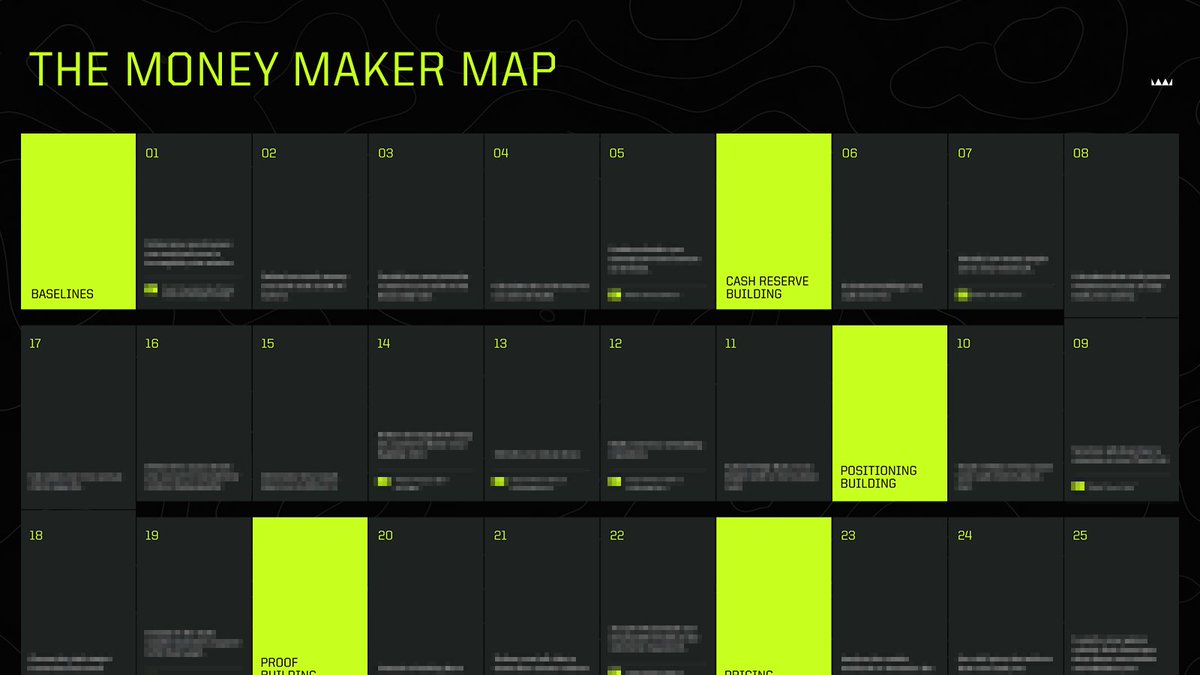
My answer is the Money Maker Map.
It’s 33 steps over 7 phases. Every step depends on the one before it.
It’s the backbone of my entire Make More Money coaching program.
It’s the reason my students go from $100K to $1M+.
It’s the most valuable piece of IP I’ve ever created.
Here’s what I‘ve found to be the 7 phases of scaling a services business:
1️⃣ Baselines — take inventory of where you actually are
2️⃣ Cash Reserve Building — build leverage so you can focus
3️⃣ Positioning — identify your ideal client and your best offers
4️⃣ Proof — establish your reputation as an expert
5️⃣ Pricing — deliver full price offers with confidence
6️⃣ Scale — systematize and hire
7️⃣ Expansion & Optionality — decide where to go next
Most agency owners jump straight to Phase 5 or 6.
They skip the steps they haven’t earned yet.
Then they wonder why everything feels like chaos.
The Money Maker Map won’t let you do that.
It answers one question better than anything else I’ve built:
“What should I be focused on right now?”
Three steps to using it:
→ Find your current step. Be honest.
→ Commit to finishing the current step before moving on.
→ Ignore everything past it.
That’s the discipline most agency owners are missing.
That’s what separates “busy” from “profitable.”
My slow learning can be your fast learning.
What took me 6 years could take you 1.
The Map is free. The discipline to follow it is the hard part.
I built this for agency owners doing $100K+ who want a clear path to $1M.
Comment “MAP” and make sure you’re following me. I’ll DM you the link.
English

Would anybody be interested in an ebook or mini course where I go over "advanced" Framer stuff?
Like:
- Performance debugging and optimisation (LPC, INP, CLS)
- Technical SEO (schema, redirects, crawlability, GSC warnings, llms.txt, robots.txt...)
- My process on how I handle big, 1000+ pages migrations like Netcraft, Hospitable, etc
- Integrations, basics of code components and overrides, etc.
👀
s4if@Designbysaif
@LucaDaCorte You know so many hidden tricks, man. You should definitely create tutorials for the Framer Marketplace. We really need advanced tutorials from you
English
@Joel7Richardson No. 2 - would be great to read a respectful counter to books like “Mystery Explained” which argue for the amillennialists angle. Book is based on the work by G K Beal.
amazon.co.uk/Mystery-Explai…
English

In considering which book I should write next, which would be the most interesting and helpful?
1) A book on the rapture. One that debunks all of the arguments for a pre-trib rapture, as well as the bogus work of men like Lee Brainard and Ken Johnson, who claim that all of the Church Fathers were pre-trib.
2) A book that simply explains and debunks the various arguments for amillennialism and postmillennialism?
3) Another fun, picture-filled book written to explain the Gospel and eschatology to kids.
English
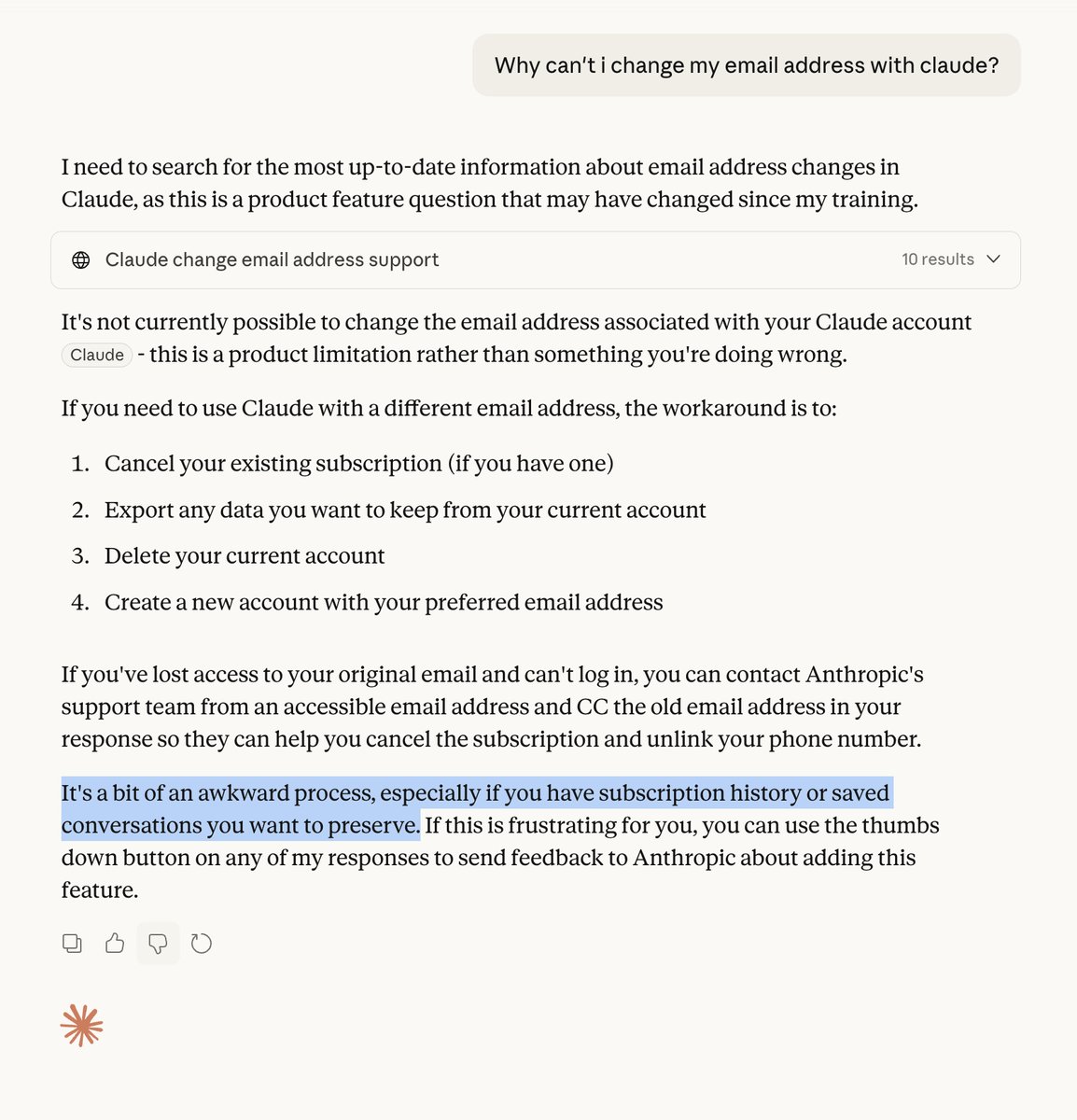
Why can't you change your email address on a Claude account?
What makes identity so immutable here? Is your email you in Claude's eyes?
Genuinely curious @AnthropicAI @mikeyk
English
Sure! The specific one I mentioned in the thread is under review by the team currently, but here's an example from a past client:
hypeproxies.com/sitemap
And we have a link in the footer (image attached), this way there's at least one crawl path to every page. The quality of the path isn't as high as it would be with method 1 (contextually relevant link), but better than orphan pages :)

English
A client I’m working with has a blog with 600+ posts on their Framer site, and they were worried most of them weren’t being crawled by Google.
Listing everything on a single index page wasn’t realistic, so orphan pages became a real concern.
Framer gives you two native options, but neither is perfect in such cases:
1. Load more
→ Items behind a load more button aren’t crawled. Therefore, Google - and other search engines - will only see the first batch.
2. Infinite scrolling
→ Better, but still limited. Google renders websites in a ~12.000 px viewport - meaning it will be able to fetch and crawl the first 20+ rows (60+ items). With 600+ items, that’s still only ~10% of the blog.
This is a common issue I see on larger sites, so here are the options we considered:
1. Topic-based internal linking
→ Add contextual links between related posts. This not only helps users discover relevant pages but also improves the crawlability of your site.
→ This is the best long-term approach and they’re already doing it well - but it’s hard to guarantee zero orphan pages at this scale.
2. Prev/next navigation
→ At the end of every blog, you can add a link to the previous and next item. This ensures each item has at least one or two internal links.
3. HTML sitemap
→ Many people are familiar with an XML sitemap, but few are aware of what an HTML sitemap is. An HTML sitemap is basically a page with a wall of links to help people and crawlers get around the site.
→ By linking it in the footer, you effectively reduce the crawl depth of the entire site to two clicks.
We ended up going with option three and built an HTML sitemap, the simplest way to ensure full coverage without much work or altering the design.
If you’re dealing with a similar setup, picking one (or two) of these options can dramatically reduce the risk of orphan pages 💯
English
Dan retweetledi

@socoloffalex Great idea! Do you find people use it? It can be soul destroying to do all the brand work, handover and see the Canva chaos.
English

I started closing 30% more brand identity deals after adding one small thing to my offer.
I saw the same pattern again and again. Strong launch, then a month later the feed looks like random Canva posts. Founders and teams do not want to learn design tools, they still need fresh graphics and a consistent brand voice every week.
So I add one deliverable. A Midjourney moodboard based on the chosen brand direction, plus tested prompts and a simple step by step guide for photos or illustrations. Clients follow the recipe and every new post still feels on brand.
Do not leave clients guessing how to use a brand system. Give simple, clear tools and they will keep the brand alive long after the project ends.
English

Created a smooth globe-to-map transform. Made with @v0.
If the geography teacher taught you with this animation, would you still hate geography?
English

ryOS simcity has evolved much faster – now built with Cursor + Composer 1
• multi-tile buildings, upgrades
• RCI, land value, crime map overlays
• ai news, fire, earthquake
• cars!
Ryo Lu@ryolu_
making sim games with ai ryo as more applets get created, the agent can fetch similar applets and read them, learn & apply patterns – like evolution, things diverge then converge
English


My real problem working with most of designers on X is their profiles look good…
But when I actually pay for a real project, the output isn’t even close.
Great UI, but weak UX thinking. No handling of complex flows. And yeah, I’ve burned a lot of money because of this.
I’m not blaming anyone. I’m also wrong for not evaluating designers properly.
But let’s be honest: too many designers are just recreating or remixing others’ work. It improves your UI, sure - but it won’t teach you UX, problem-solving, or product thinking. And that’s exactly what clients pay for.
Now I’m stuck not knowing how to find truly experienced designers anymore.
English