David

1.9K posts

David

David

@ddes888

Intellectually curious global citizen

London, England Katılım Şubat 2020
890 Takip Edilen107 Takipçiler
Serenity
Serenity@aleabitoreddit·
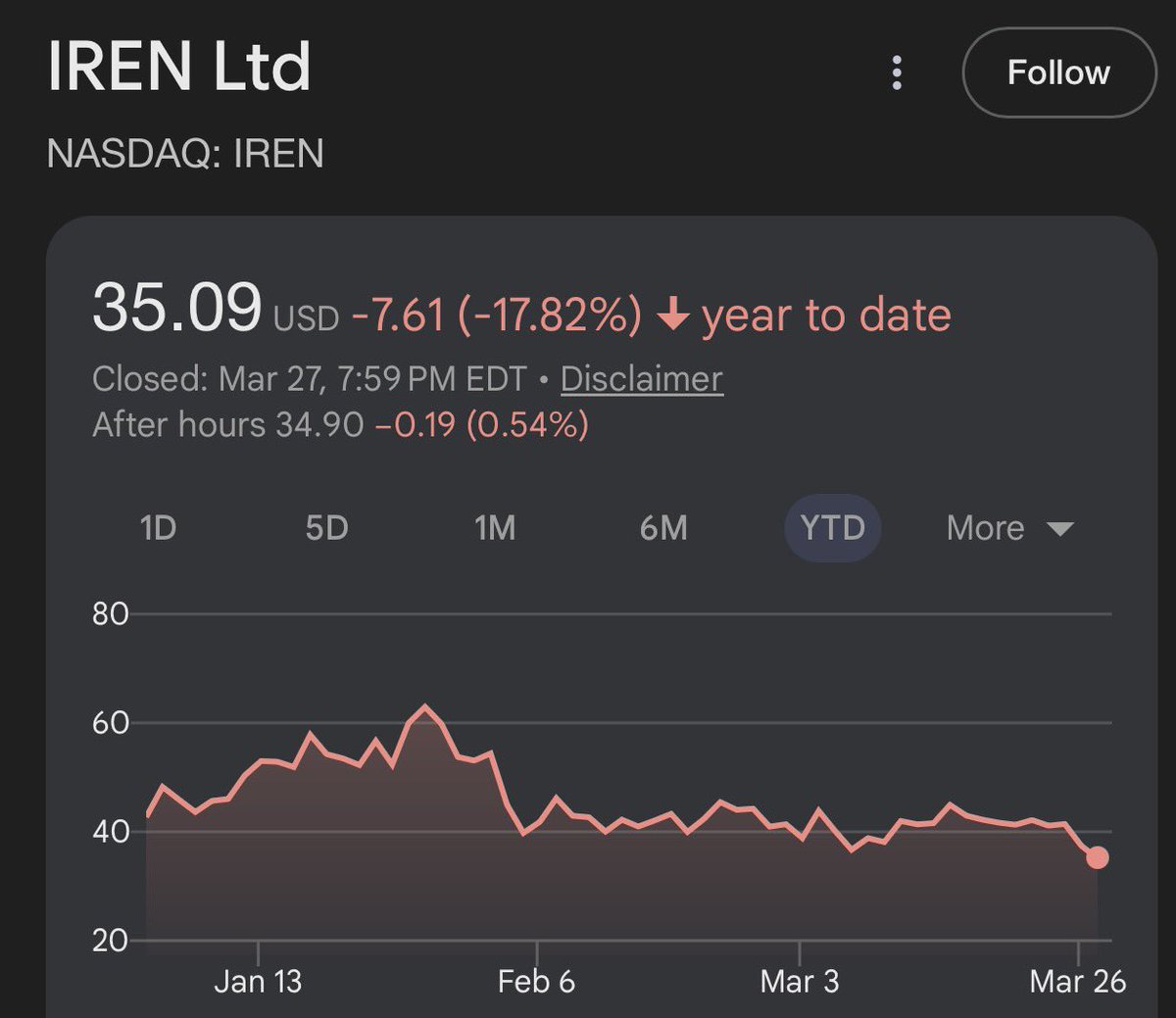
I really find it hard to disagree with my assessment. I said $IREN was accretive long term. But short term holders are the one funding the buildout by getting diluted. So the best thing to do for equity appreciation is go long after they get the funding, not while they're actively diluting. $IREN would not file a $6B ATM just for "optionality" if they didn't need to use it. Especially to monetize their 4.5GW capacity.
English
6
1
35
3.3K
Serenity
Serenity@aleabitoreddit·
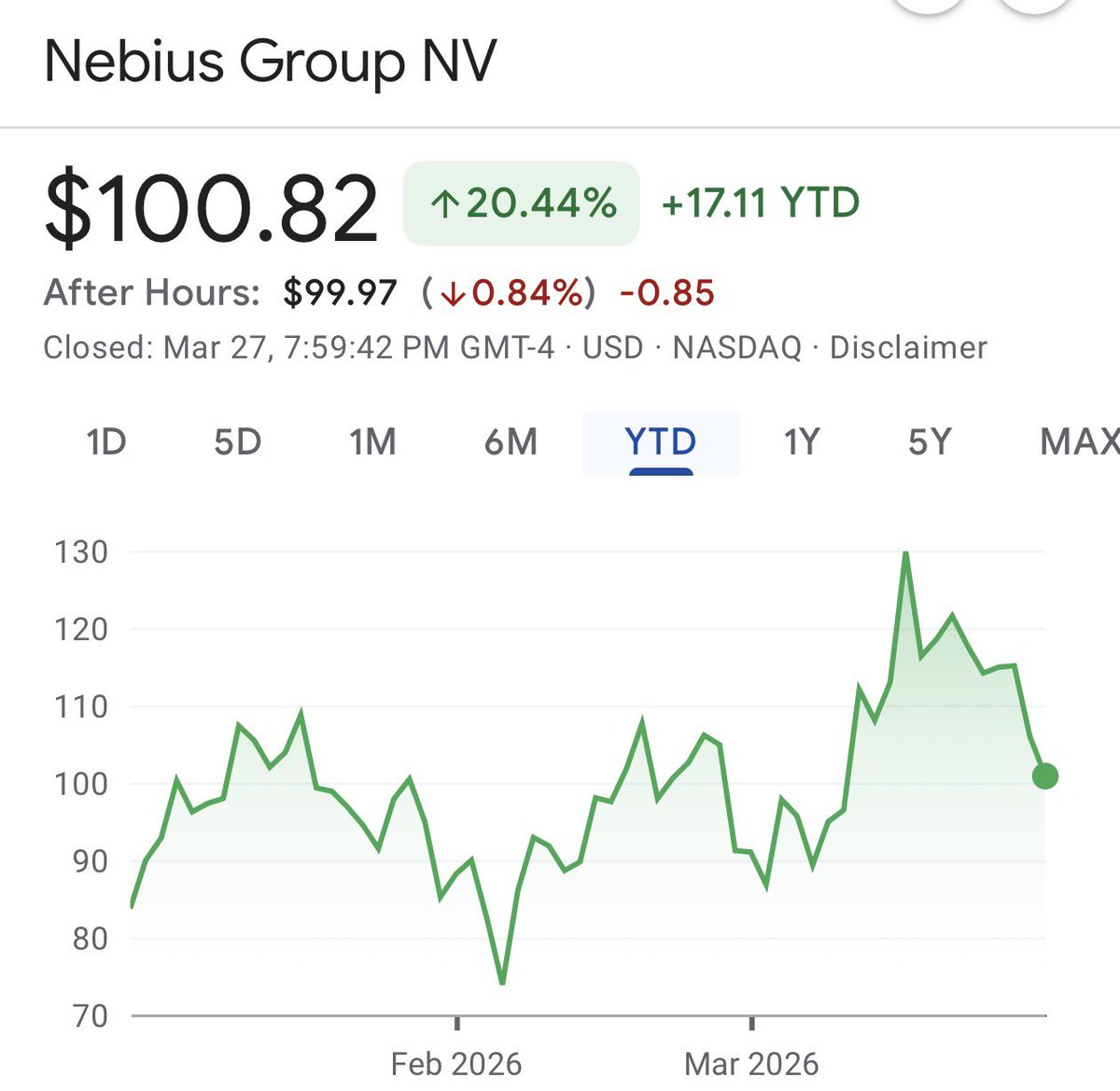
My thoughts on $NBIS, $IREN, $CRWV and the current Neocloud market. One of them ends up as the next AWS in 5 years: My guess it’s Nebius. It's not winner takes all (DigitalOcean is there with Amazon), but there's clearly superior structures and likely winners. The downside: -> Low chance of rate cuts from Iran conflict. ->Broader market doesn't appear to want to fund the CapEx cycle. But want to reap the benefits With $IREN: We get it, 4.5GW = X revenue. But who is funding the GPUs? Whoever is buying into the $6,000,000,000 ATM right now. The winners will be whoever enters after holders get fully diluted. The reality is, they don't have enough funding to monetize their capacity through GPUs without colo models. And they didn't find other financing methods, so they went through ATMs because of a cult community that will buy into anything they sell. However, I agree it will be accretive long term. Just not as much for the retail buying in now. With $CRWV: They did everything right... $NVDA backing. Hyperscaler clients... But they financed completely wrong. Now, $1.5B+ yearly debt interest is eating Coreweave alive and cuts into FCF. Almost like credit card debt, Coreweave gets a job to pay off that debt, but eventually, the debt interest is too high that working doesn't really cover that and expansion too. If any company goes down, $CRWV is the first to go the massive debt load and interest. With $NBIS: They're doing as much as they can right... $NVDA funding $2B to fund capex. Convertible note offerings (convertible note short hedging is annoying for short term price appreciation). But this is the best way to do financing structures with much lower interest than Coreweave. They now have ~$46B+ in backlog from $META and $MSFT, two of the most profitable hyperscalers out there, without direct OpenAI linked contagion like Coreweave. And unlike others; there’s appreciation from their other companies (Clickhouse equity appreciation: avride robotaxi scale up; toloka triple digit growth) From my take: Nebius is the clear winner. However, current macro environments does not favor short term holders across the board with indexes dropping 7%. Especially so if they're buying into active ATMs. Long term, the benefits when they scale up eg. $NBIS Q4 2026 (yes, even $IREN), will be immense.
Serenity tweet mediaSerenity tweet media
English
108
75
1.2K
179.9K
₿itcoin ₿utcher 🥩 🐑 🐷
₿itcoin ₿utcher 🥩 🐑 🐷@bitcoinbutcher1·
As a follow up to my @Agrippa_Inv post. Childress can hold ~154k B300. Current guidance reflects 17k at Childress. 154k-17k=137k incremental B300 GPUs that require lower cap ex retrofits and come quicker to market. Current guidance is ~$3.7B The 137k GPUs will result in ARR of $3.425B to $4.11B if they generate $25k to $30k ARR. So people can make fun of "legacy" chips but the reality is ARR will double with Childress alone. We have plenty of time to install Rubin. $7B-$8B guidance is coming soon. Sweetwater, OK, and all the unannounced pipeline is the cherry on top. $iren remains misunderstood. More for the few.
English
27
16
244
15.1K
David
David@ddes888·
@SJCapitalInvest Reminds me of a saying if you make life changing money you should use it to actually change your life which changed my mindset
English
0
0
0
9
S&J Investments
S&J Investments@SJCapitalInvest·
My biggest fear has been being the guy who made a million bucks and lost it. Today I made sure that will never happen. I turned $450k into $2.2M in the last 10 months. This morning I cleared $700k, which I am sweeping into an account that will go into stable low risk ETFs. I will keep the $1.5M to keep investing and being aggressive. Every time I hit $2M I will sweep $500k into the other account and let that stay safe and compound. The reality is, all of this is in my Roth account. I am 39 years old and in 20 years when I can access this, even at 12% growth this is well over $20M. It doesn’t make sense for me to play fast and loose with all of this. I already won. I don’t know exactly where I am parking the 700, it’s ok to just sit on cash for a bit while I figure that out. I will share a full port update tomorrow. But obviously we are on a run over here. I’ve written about my 1m spac trading year, but back then I didn’t know how to handle money, now I do. I am going to make sure this is actually life changing, and not just a moment. Appreciate you guys being on the journey with me. Let’s keep winning. 🔹
S&J Investments tweet media
English
159
48
1.8K
539.6K
David
David@ddes888·
@Agrippa_Inv do you view on responsible the use of capital has been to pay for capped calls given this new atm
English
0
0
0
54
𝐀𝐠𝐫𝐢𝐩𝐩𝐚 𝐈𝐧𝐯𝐞𝐬𝐭𝐦𝐞𝐧𝐭𝐬
$IREN's $6b ATM… I think most people are drawing the wrong conclusions from this development. Don’t get me wrong; a $6b ATM looks ridiculous relative to $IREN;s current market cap of ~$13.5b. If they tapped the entire amount at today’s levels, the share count could increase by >40%. But that’s a big “IF”, and most people are treating it like a certainty. Let’s think about it. Why would $IREN need to tap this ATM today? They’re fully funded for the $MSFT deal, having raised over $3b through converts, ~$1.93b of prepayments, and $3.6b of GPU financing. They don’t need a single additional dollar to execute the $MSFT buildout. Okay, then what about the new ~$3.5b GPU order announced yesterday, surely they’ll use the ATM for that, right? First, those costs come due gradually through H2, on terms that are 30 days post shipment. Second, and more importantly, management explicitly stated in yesterday’s press release that the procurement of 50k B300 units will be financed primarily through the same sources they’ve used over the past quarters, namely: prepayments, converts, and GPU financing. So what’s the actual purpose of this $6b ATM? The new ATM is primarily a backstop. It helps establish confidence that $IREN can deliver on large-scale deployments and strengthens their negotiating position by reducing doubts around capital availability. Will $IREN tap it eventually? Yes, almost certainly at some point, likely when the share price is materially higher. But there’s no indication they’ll draw a meaningful amount anytime soon. Net dilution from this ATM will most likely come in well below 20%, and could even be closer to ~8–12% (or less) if management stays particularly conservative. Relative to the growth opportunity in sight, that’s a small price to pay.
𝐀𝐠𝐫𝐢𝐩𝐩𝐚 𝐈𝐧𝐯𝐞𝐬𝐭𝐦𝐞𝐧𝐭𝐬 tweet media
English
81
87
735
211.3K
David
David@ddes888·
@BryanGreenbaum @Bkclaims Yes they get paid a combination of fixed and success fees depending on how engagements are structured
English
1
0
1
21
Thomas Braziel
Thomas Braziel@Bkclaims·
I’ve been thinking about something and would genuinely love feedback. Most hedge funds and VC funds have random small positions sitting on their books that just aren’t worth the time anymore. Sub-$1m litigation claims. Stub equity from old restructurings. Residual bankruptcy recoveries. Defaulted notes. Escrow holdbacks. Things that got marked to zero and effectively forgotten. They’re too small to matter to a large fund. Too annoying to actively manage. But legally, they’re still real. What if we created a 501(c)(3) to take those positions off fund books — for free or for nominal “peppercorn” consideration — and actually try to monetize them? Call it The Peppercorn Foundation. The idea would be simple: funds transfer these orphaned, written-down assets to the foundation. The foundation does the work. If something ultimately pays out, 100% of the profits go to charity. Think of it as the financial markets equivalent of the foreign currency you give up at the end of a flight. Individually it doesn’t matter. But aggregated and managed properly, it can actually become meaningful. There are billions of dollars globally in small, ignored positions sitting below materiality thresholds. Some are truly worthless. But some are just unloved, complex, or long-dated. That’s a part of markets I’ve spent a lot of time in. If structured correctly, this could let funds clean up their books, potentially create a tax-efficient transfer of illiquid assets, and convert “zero marks” into real philanthropic dollars. I’m serious about exploring this properly — but it has to be done right. If you have experience with 501(c)(3) formation, private foundations, nonprofit governance, tax treatment of contributed claims or illiquid securities, UBTI issues, or anything adjacent to this, I would really appreciate you reaching out. DMs are open. Let’s see if we can turn abandoned optionality into something that actually funds impact.
English
4
1
17
3.1K
David
David@ddes888·
@TheBigDegen Everyone just needs to keep an eye on the bigger picture. In 12-months Iren will have hit a huge inflection point. Multiple deals signed 140k GPUs deployed, Canada throwing off cash flow construction underway in sweetwater. They will be a market leader over $100. Patience is key!
English
1
0
2
38
Big Degen 🇦🇺
Big Degen 🇦🇺@TheBigDegen·
Excellent analysis and summary 👊 $IREN 🔥🔥🔥
Jordaan@JordaanTrades

Update on $IREN Investment Position Following Q2 FY2026 Results I believe the Iren sell off is overblown and below I will describe why and how we should actually look at this business. With a sell off this hard you should always ask yourself "why did I invest in this company in the first place". Remember we own shares of a company, not a number on a screen. My Investment Thesis: $IREN represents a compelling opportunity to invest in critical AI infrastructure at an inflection point, with the characteristics of an early-stage company despite its public listing. The firm has completed an eighteen-month strategic pivot from Bitcoin mining to AI cloud services, securing 4.5GW of power capacity and a $9.7 billion contract with $MSFT. Revenue from the new AI cloud business line is expected to commence at scale in CY Q2 2026, with a path to $3.4 billion in annualized run rate revenue by year-end 2026. The investment case centers on IREN's position as a vertically integrated infrastructure provider serving the world's most sophisticated technology companies in a capital-intensive industry with formidable barriers to entry. Overview & Timing: IREN should be evaluated as an early-stage infrastructure company currently in its pre-revenue phase for its core AI cloud business. The fiscal Q2 2026 results (ended December 31, 2025) reflect the transitional period during which the company is deliberately decelerating Bitcoin mining operations and constructing AI-optimized data centers. The AI Cloud Services segment generated $17.3 million in the quarter, representing initial deployments at the Prince George, British Columbia facility. The meaningful revenue ramp is expected to begin in CY Q2 2026 as the Microsoft contract becomes operational at the Childress, Texas campus and additional British Columbia capacity comes online. By CY Q4 2026, the company targets 140,000 deployed GPUs supporting $3.4 billion in annualized revenue. This timing structure is critical to the investment thesis. Current period losses of $116 million in operating income reflect the strategic build-out phase, not operational underperformance. The $720 million invested in data center infrastructure during the six months ended December 31, 2025 represents capital deployed ahead of revenue recognition. Investors should expect continued transitional losses through fiscal Q3 2026, with the business model proving itself in the subsequent three quarters as contracted capacity becomes revenue-generating. My Individual Thoughts: This AI infrastructure industry is undergoing a fundamental transformation that will reshape technology capital allocation over the next 3 years. What began as hyperscale companies building their own data centers has evolved into a recognition that compute infrastructure, particularly GPU clusters at gigawatt scale, represents a strategic asset class requiring specialized capabilities that most enterprises cannot replicate internally (not yet at least). The supply-demand imbalance in AI compute capacity will persist through at least 2028, driven by the exponential growth in model training requirements and inference workloads that show no signs of moderating (see Claude’s most recent drop). This dynamic creates exceptional pricing power for infrastructure providers who can deliver certified, reliable capacity at scale, particularly those serving tier 1 customers where uptime and performance are non-negotiable. The industry structure will consolidate rapidly around a small number of vertically integrated providers. The capital intensity, requiring billions in equity and debt financing, combined with the multi-year lead times for power interconnection agreements creates natural oligopoly conditions. Companies that secured power rights in 2023 and 2024, as IREN did, possess assets that cannot be replicated by new entrants at any reasonable timeframe. I expect three to five dominant players to emerge in North America by 2027, with IREN positioned as one of them based on its secured power portfolio and demonstrated ability to access capital markets. The competitive landscape will bifurcate between infrastructure owners like IREN who control the full stack from power to cooling systems, and asset-light resellers who will face margin compression as hyperscalers increasingly prefer direct relationships with infrastructure operators (as seen with $NBIS starting to scale data center builds and moving away from their pure play asset-light model). The investment opportunity exists precisely because IREN sits at an inflection point where the infrastructure risk has been substantially retired while the revenue risk remains unproven to public market investors. The company has already deployed $1.1 billion in data center capital over the past six months, secured firm power interconnection agreements, and signed a $9.7 billion anchor contract with Microsoft. The heavy lifting of site development, utility negotiations, and construction execution, the areas where infrastructure projects typically fail, are largely complete or de-risked. What remains is customer contract conversion, which carries materially lower execution risk when serving sophisticated counterparties conducting thorough technical and commercial diligence. (If you aren't aware technical and commercial diligence takes 3-6 months). The market has not yet priced in the revenue that will emerge in the next two quarters because investors struggle to underwrite pre-revenue infrastructure businesses and lack the operational frameworks to evaluate construction progress and contract pipeline quality. According to Dan, they are in "advanced negotiations" which I believe is LOI stages, but I could be wrong. From an operational perspective, I believe IREN's vertically integrated model will prove decisively superior to competitors relying on third-party contractors or leased power arrangements. The company's ability to bring Horizon 1 at Childress from groundbreaking to operational status in under 18 months, while simultaneously managing construction at four other sites, demonstrates execution capabilities that are genuinely scarce in not only this industry but many others. The 2,000 operational team represents an intangible asset that will compound in value as institutional knowledge accumulates around GPU cluster optimization, cooling efficiency, and rapid deployment methodologies. These operational advantages will translate into higher gross margins and faster time-to-revenue compared to peers, though this will only become evident in the financial results over the next four quarters. Not immediately. The compelling aspect of this investment at the current entry point is the asymmetric risk-reward profile created by the timing mismatch between capital deployment and revenue recognition. Investors who wait for revenue proof will pay substantially higher multiples once quarterly results demonstrate the business model's viability, for a scarce infrastructure asset serving strategic customers with high margins and deep revenue visibility (multi-year). In my opinion, the downside case is protected by the liquidation value of the power rights and constructed data centers, which would attract acquisition interest from hyperscalers and/or infrastructure funds at valuations near or even above the current market cap. Looking forward, I envision IREN as a multi-billion dollar revenue business serving numerous tier-one customers with industry-leading gross and EBITDA margins. The business model will have transitioned from capital-intensive growth to steady-state cash generation, enabling debt paydown and shareholder returns. The company's remaining power capacity will provide optionality for further expansion or partnerships, while the operational expertise will create opportunities for adjacencies such as purpose-built training clusters or inference-optimized architectures. Most importantly, the business will have demonstrated that founder-led, vertically integrated infrastructure operators can compete effectively for the most demanding workloads in technology, establishing a valuation premium to both traditional data center REITs and asset-light cloud resellers. This business is still a baby, they are purposely slowing down $BTC mining production and swapping ASICs for GPUs. I believe for the future cashflows and extremely high barriers to entry in the future, big money will pay strong premiums. In our new AI world, I believe this industry will become a safe haven asset. Along with other AI adjacent industries I see. With that being said, I can tell most of you have never operated a business, nor worked with or invested in early stage companies. We are lucky because typically you wouldn't get your money back for YEARS because of how illiquid private markets are and genuinely most early stage investments go to $0. Just my thoughts, not financial advice, and do your own research.

English
2
1
17
4.4K
David
David@ddes888·
@matthew_sigel At least Iren is in ramp up mode for HPC, CLSK outlook is horrible with the way btc is trading combined with their mining profitability
English
1
0
0
88
David
David@ddes888·
@NatedawgO7 Sounds like something similar to the U.K. where they just change the economics Via different CGT and Stamp duty taxes for landlords versus Owner occupied properties
English
0
0
0
20
Nath_Sparky
Nath_Sparky@NatedawgO7·
So I’m fairly confident I know exactly what Chalmers will do changing the cgt discount for property. He will lower it from 50% to 25% for existing homes but grandfathered. They’ll say it’s to give first home buyers a better chance against investors and encourage new supply which will get the bigger tax discount at 50%. They’ll then use the tax savings to lower income taxes as generational fairness. They’ll then wedge the liberal party like they did in the 2025 election getting them to vote against income tax cuts. I’ve read every article on what their plan is the last few days and that seems like what they’re planning. Thoughts? @AvidCommentator
Nath_Sparky@NatedawgO7

We could be on here

English
62
5
103
20.8K
David
David@ddes888·
@Scutty What path do you see for the AUD against the GBP?
English
0
0
0
11
The God Particle
The God Particle@_Sgr_A_Star·
$IREN For anyone wondering what the back-of-the-napkin math may look like to solve for the payback periods: MSFT Deal --------------------------------- Total Capex: 8.8B (GPU 5.8B, DC 3B) Total Revenue : 9.7B (1.94B per year) EBITDA Margin: 85% (proxy for Operating Cash Flow) OCF Per Year = 1.94B * 85% = 1.649B Payback math: ---------------------------------- GPU Capex Payback = 5.8B / 1.649B = 3.5 years DC Capex Payback = 3B / 1.649B = 1.8 years Total Capex Payback = 8.8B / 1.649B = 5.3 years At the end of this payback period the company would fully own Horizon 1-4 valued at 2.25B + any residual value from the GPUs.
Daniel Roberts@danroberts0101

- 3 year pay back on GPUs - the last 2 years of MSFT contract then pay off the data centers too - year 6 onwards = free data centers (for colo or cloud) + any residual value in the GB300s Or, you can sign a colo deal and wait 10++ years to get your capital back on the data centers. I'll take option 1 thanks, and keep compounding shareholder returns into the AI thematic.

English
8
8
103
33K
David
David@ddes888·
@_Sgr_A_Star Isnt the above theoretical because actual cash flow would be lower meaning pay back takes longer
English
0
0
1
51
David
David@ddes888·
@_Sgr_A_Star Wouldn’t debt service costs need to be factored in?
English
2
0
1
568
Dulce
Dulce@litigious_dulce·
I will acknowledge that today is a disaster for $IREN.
English
43
3
308
64.7K
David
David@ddes888·
@SteveOnSpeed Main residence paid off and your lifestyle expenses covered from investment income
English
0
0
0
8