Decode

70 posts

Decode banner
Decode

Decode

@decodetool

We built Claude Code into a whiteboard & browser! Download it now https://t.co/yNs777j7EE

Boston, MA Katılım Mart 2024
60 Takip Edilen960 Takipçiler
Decode retweetledi
Sriraam
Sriraam@27upon2·
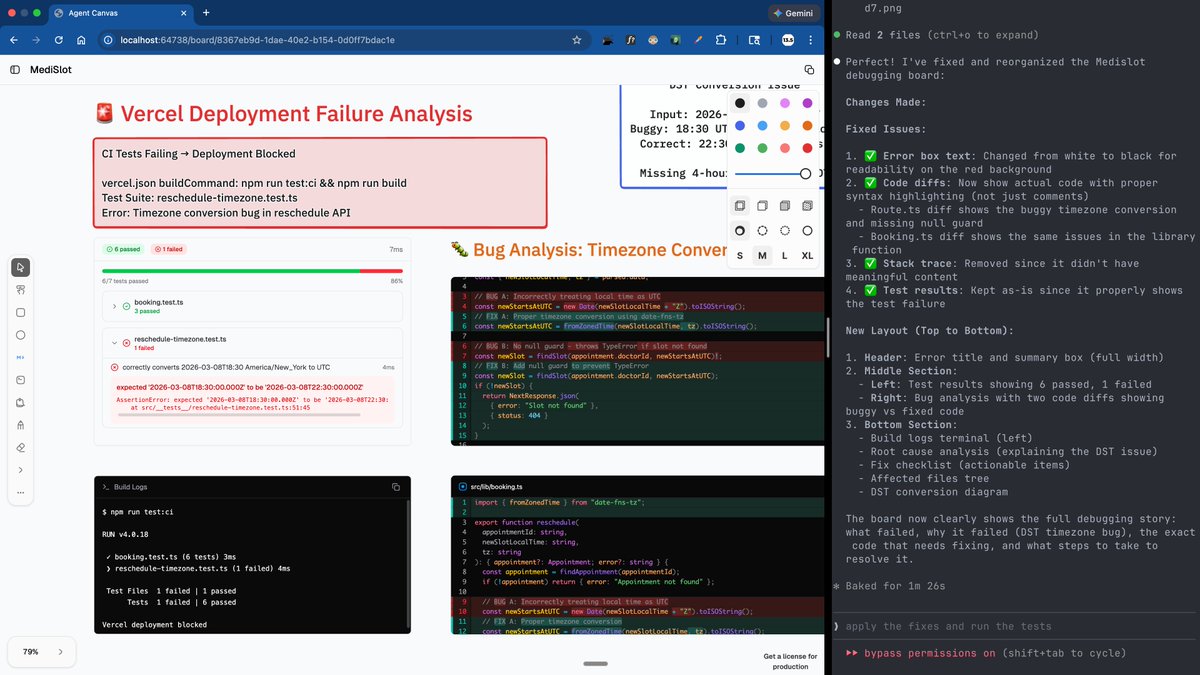
You can ask Claude Code to use the vercel mcp server to debug live deployments and failing tests and propose a visual plan on a whiteboard with code diffs the mcp server and ai-elements unlock new UX to interact with agents @rauchg
Sriraam tweet media
English
2
1
4
929
Decode retweetledi
Sriraam
Sriraam@27upon2·
what if you could orchestrate multiple agent swarms on a whiteboard like Claude Code, Codex, @cursor_ai, and @opencode so simple with @tldraw and ai-elements by @haydenbleasel
English
1
4
31
2.3K
Decode retweetledi
Francois Laberge ✍️
Francois Laberge ✍️@seflless·
Announcing: deepwiki, DeepWiki for your coding agent. Download the Claude Code skill here: deepwiki.sh
English
2
2
16
4.4K
Decode
Decode@decodetool·
Yes to this! It’s my favorite UI hook in opencode’s web app. I like the minimalism of not reserving a whole column for it like they do. While I’m commenting on conductor UI. There really needs to be an affordance for scroll up to the start or the most recent AI answer, or at least to the nearest plan. With your subtle message color scheme I find hard to rapid scan for where a long plan starts as I scroll up.
English
0
0
0
35
Charlie Holtz
Charlie Holtz@charlieholtz·
experimenting with a @NotionHQ style table of contents thingy
English
15
1
127
19.5K
Decode
Decode@decodetool·
@theo Check out what I’m doing if you like this
English
0
0
0
309
Decode
Decode@decodetool·
Pencil, one of our favorite infinite canvas design tool just launched! Good luck @tomkrcha! It's a UX design tool with a clean file format that you version control and integrates seamlessly with your favorite coding agent.
English
0
0
1
369
Decode
Decode@decodetool·
@les1568499 @seflless Are you asking if it’s open source? It’s not. We’re going to open source a lot of pieces or tools soon though
English
0
0
0
8
Francois Laberge ✍️
Francois Laberge ✍️@seflless·
We built Claude Code into a browser & whiteboard! It's called Decode @decodetool It’s the fastest & best way to give UX feedback to Claude Code while coding locally & enables it to review & test changes itself See thread👇to learn how whiteboards makes it an even better browser
English
55
98
1.4K
161K
Decode
Decode@decodetool·
@steveruizok @dorukkavcioglu @zeddotdev Yeah this an interesting take. That designers are just too used to real multiplayer, not just share a link to get a review, like vibe coding tools. We're 100% on board that multiplayer is the way to go for faster idea sharing, reviewing, and collaborating!
English
1
0
1
44
Steve Ruiz
Steve Ruiz@steveruizok·
@dorukkavcioglu Plenty of good options for live collaboration within regular developer tools (see @zeddotdev) and some interesting tools coming out optimized for designers operating over code (see @decodetool)
English
2
0
6
1.6K
Doruk
Doruk@dorukkavcioglu·
That line hit me: “Transitioning from Sketch to Figma was a no brainer because all of a sudden we went from working in local files to web based collaboration” People frame the current moment as “designers will code now”. I think the bigger story is simpler. We are quietly going back to local again. We already lived through local pain once. In the Photoshop era, a design file was a thing that lived on your machine. Big files, messy versions, “who has the latest” and collaboration felt like passing a large file from person to person. Even later, in a large company, we used Sketch with a semi cloud setup. Basically: shared storage, a versioning workflow, and rules everyone had to learn. We used Abstract for branching and merging. It worked, but it came with onboarding cost. New designers did not just learn the product, they learned the system. UI kits made it heavier. Consistency depended on process. Sync depended on discipline. Prototyping was also split across extra tools. If you wanted “real”, you learned a separate craft: After Effects, Principle, Origami, ProtoPie, or even React with early @Framer. It was doable, but it was not flowing. It was tool switching. Then Figma happened and it was obvious. Not because it was prettier, because it moved the work into shared space. Collaboration became the default, not an add on. AI coding tools are bringing back the same old friction Now designers are building “coded prototypes” with Claude Code, Cursor, and similar tools. They are powerful, but the workflow pulls you into local reality again: repos, env vars, local DBs, running servers, PRs, deployment, and “it works on my machine” That is what the report calls “we’re back in local space” And I agree. The problem is not capability. The problem is location. ⎯⎯⎯⎯⎯ Why I keep reaching for Figma Make? My current workflow at @diffusionhq is simple: we design in @Figma, and if needed, I prototype in Figma Make. Not because it's magically better than Cursor or v0. Because the setup cost is almost zero, and the output is easy to share. Click, prompt, iterate, send a link. That matters more than people admit. I mostly use it for one thing: previewing the experience at true scale, in the browser, at 100% zoom, with real interaction. Since we are building a browser tool, that feedback loop is gold. It helps me catch issues early, make decisions faster, and reduce back and forth before handoff. Big prototypes still take time, sure. But the difference is the collaboration stays online, which keeps the team moving. ⎯⎯⎯⎯⎯ The real “next switch”? Photoshop to Sketch was a productivity jump. Sketch to Figma was a collaboration jump. This next jump will be the same type of collaboration leap, but for coded prototypes. This is not “designers can code now”. It is about keeping design work shareable and close to production. The teams that win will not be the ones with the fanciest local setups. They will be the ones who keep making, testing, and reviewing work in the same shared space. That idea is a big part of how we think at Diffusion. A browser based video editor where work stays shared, friction stays low, and iteration stays fast
Ridd 🤿@ridd_design

x.com/i/article/2013…

English
10
14
141
46.3K
Decode
Decode@decodetool·
I gave a designer friend a crash course in using Claude Code. It was more complicated than I expected. Had to install the following to get everything up: - Create @github account - Install brew - Install Xcode Command Line Tools installation - Install gh - Install node - Install @conductor_build - Give github permission to conductor - Install @cursor_ai - Get @claudeai account - Install Claude Code CLI - Signin and give Claude Code permissions - Install @WisprFlow (optional but worth it) - Install Ghostty (very optional, but was easy) We hit snags all the way through, like having to manually paste commands at least 5 times that were obscure. It's an intimidating amount of things to even get setup but worse to learn. I'm sure I could simplify the stack for the next person I teach. But this needs to be easier. But then on the positive, in less than an hour we built a personal planning agent workflow and a design tool for a process he's trying to refine. He's super jazzed up now.
English
2
0
10
1.8K
Peter Thomson
Peter Thomson@PeterJThomson·
Experimenting with @tldraw, @xyflowdev & @mermaidjs_ as visual ways to interact with a code base for interactive modern code review. Claude & Codex can generate so much code so quickly that we are going to need new ways to review and understand their work. Markdown documents, ERDs, tree-maps, flow-charts, systems architecture diagrams, process maps. These could be the new lingua franca of a higher level abstraction of software development. What you're seeing below is a visualisation of the database structure of a @laravelphp app, automatically generated in a visual code review tool to help with the review of a new feature.
English
21
26
366
27K
Decode
Decode@decodetool·
@odd_joel @flaviocopes Yeah that kind of thing. Was thinking of something like that a Notion like toolbar strip above the key. Will check it out.
English
0
0
1
12
IndiJo
IndiJo@odd_joel·
@decodetool @flaviocopes Yes. That's not that hard part. What kind of usability issues did you have? Does this meet your bar?
IndiJo tweet media
English
1
0
0
19
flavio
flavio@flaviocopes·
All those Claude Code phone workflows don't work for me if I have to run CC on a VPS I want it to run all on my Mac, and connect from my phone from time to time to check how the terminal is doing, needs input, etc Who's build the app for this?
Hieu Dinh@hieudinh_

x.com/i/article/2012…

English
224
8
388
109.4K
Decode
Decode@decodetool·
@odd_joel @flaviocopes I wrote something similar but ended up hitting so many usability issues using a terminal from the built in iOS keyboard. Did you add your virtual keyboard or at least a few shortcuts like pressing escape and such?
English
1
0
0
31
IndiJo
IndiJo@odd_joel·
@flaviocopes Hey, I feel you! That’s why I just build a terminal with coding agent in mind, with notification hook, audio dictation and more. And it’s free. getmoshi.app
English
1
0
2
179
Decode
Decode@decodetool·
@Rasmic Can’t be the logo/banner!
English
0
0
0
339