Decoherence Field

40 posts

Decoherence Field banner
Decoherence Field

Decoherence Field

@decoherence_fld

Where coherence breaks and hidden structure appears

Katılım Şubat 2024
82 Takip Edilen520 Takipçiler
Decoherence Field
Decoherence Field@decoherence_fld·
● After a few people dropped other names in the comments, I went back for another pass. Some of these stacks are better than I expected. Several of these teams are years ahead of the bigger high-cap chains, which are still sitting on real retrofit risk because nobody designed them for post-quantum from day one. The point here is to flag the projects doing the work, not just the ones talking about it. If I got something wrong, or missed something obvious, say so. I'd rather fix the map. A few notes: - QRL was one of the first chains to take post-quantum seriously. Conservative on security, and they've had a live network running for years. - Cellframe is doing more than the "quantum-safe coin" pitch. The service-oriented infra layer and multi-algorithm setup is a different bet. - Tidecoin took a Bitcoin-style route but wired in modern PQ primitives in a way that isn't just for show. - Soqucoin is stronger than I expected on standards alignment and security posture. The stack is more serious than most people assume. - Raqcoin is messier on some design choices, but at least it's in the conversation instead of pretending the problem isn't there. The point isn't that these projects are equal in quality, architecture, or maturity. They're not. It's that there are already builders working on this before the rest of the market gets forced into a panic retrofit. That alone puts them ahead of most of the industry. $QRL $CELL $TDC $SOQ $RAQ
English
8
10
26
929
Decoherence Field retweetledi
Anastasia Marchenkova
Anastasia Marchenkova@amarchenkova·
It's the line you'll see in nearly every popular explainer: "a quantum computer evaluates all possibilities in parallel." It's wrong. Qubits, superposition, measurement, entanglement. We have quantum systems, ok. They can hold many states at once and link those states in ways classical bits cannot. So for a quantum algorithm: how do you arrange the computation so that the useful answer is the one most likely to appear when you measure? A classical computer sits in one definite state at every step. One path, one outcome. A quantum system can carry many possible configurations simultaneously, but when you measure, the system collapses into one outcome and you get a "classical" answer. It's all about interference. Quick detour into waves. Two waves that line up peak-to-peak add together. That's constructive interference, doubled amplitude. Two waves out of phase, peak to trough, cancel out, and that's destructive interference, flat line. Quantum states behave like waves. Each possible answer in the superposition has a phase, not just a probability. As you apply operations, those phases shift, and at the end of the computation, paths that arrive in phase reinforce one another while paths that arrive out of phase cancel each other out. So how does this map to a problem? Here's the shape of it. You set up a superposition of every possible answer to your problem (probability). You apply operations that encode the problem itself — the function you care about acts on the whole superposition at once, leaving a fingerprint in the phases of each candidate answer. Then you apply a second set of operations designed to turn that phase fingerprint into amplitude: the answers you want end up with all their paths in phase and reinforcing, every other answer ends up with paths scattered every direction and cancelling. You never read the answer directly out of the quantum state. You sculpt the amplitudes until the right answer is the biggest one, then measure. This is also why quantum algorithms don't work on every problem. You need structure for the phases to latch onto, like periodicity, symmetry, some property the operations can move the amplitude toward. Random unstructured search doesn't have much for interference to grip on. (You still get a square-root speedup; cough, Grover's) But periodicity, like Shor's, hidden inside a function, that's where the exponential speedup really works.
GIF
English
0
4
28
1.2K
Decoherence Field
Decoherence Field@decoherence_fld·
@IanSmith_HSA Oh wow, I truly had no idea about many of that, thanks for sharing, i'll dig on this on next post
English
2
0
0
48
Ian Smith
Ian Smith@IanSmith_HSA·
QANX had their hacken audited smart contract hacked. Repeatedly. They have also had an 7+ year sordid history and finally a testnet. They use secp256k1 on chain but claim it is "completely fine" because of unconnected cryptography. QRL is doing their first cryptography migration now, they have 3 to go after this. Recent audit forced them to fix some of the CVE that I complained about for months. Algorand is still using ed25519 for wallets, consensus. They have a FALCON wallet, but their infrastructure needs to have a very extensive upgrade and migration. No roadmap to fully post quantum. Cellframe's biggest weakness is the people who keep moving mainnet tokens onto ETH for the DEX trading. Plans to buy up and migrate the tokens back are discussed, but I'm only adjacent to the process.
English
1
0
4
203
Decoherence Field
Decoherence Field@decoherence_fld·
Post quantum projects are back in the spotlight as new discussions around quantum computing have brought one question back to the surface: How long will today’s networks remain truly secure? That is why names like Cellframe, Algorand, QRL and QANX are getting more attention again, each one trying to position itself inside the quantum safe narrative. This comparison is not about picking a favorite. It is about understanding what each project has already delivered, what is still being migrated and what remains closer to a promise. Algorand has been moving forward with its Falcon based approach. QRL keeps a more purist post quantum security thesis. Cellframe combines a Layer 0 architecture with flexible post quantum cryptography. QANX brings a hybrid EVM and multi language vision, but it is still pre mainnet and carries important risks from its bridge hack history. In the end, comparisons like this matter because “quantum safe” has become too strong of a narrative to accept without context. The market needs to separate real technology, actual execution and well packaged marketing. $CELL $ALGO $QRL $QANX
Decoherence Field tweet media
English
13
18
33
1K
Decoherence Field
Decoherence Field@decoherence_fld·
@jbgon01 Good, I didn't know, definitely I will check out, thanks for the info
English
0
0
0
32
Decoherence Field
Decoherence Field@decoherence_fld·
@FChinaemezu All projects have their own strengths and quality points, but it is undeniable that the readiness of Cellframe is incredible
English
0
0
2
72
Decoherence Field retweetledi
Q-CTRL
Q-CTRL@qctrlHQ·
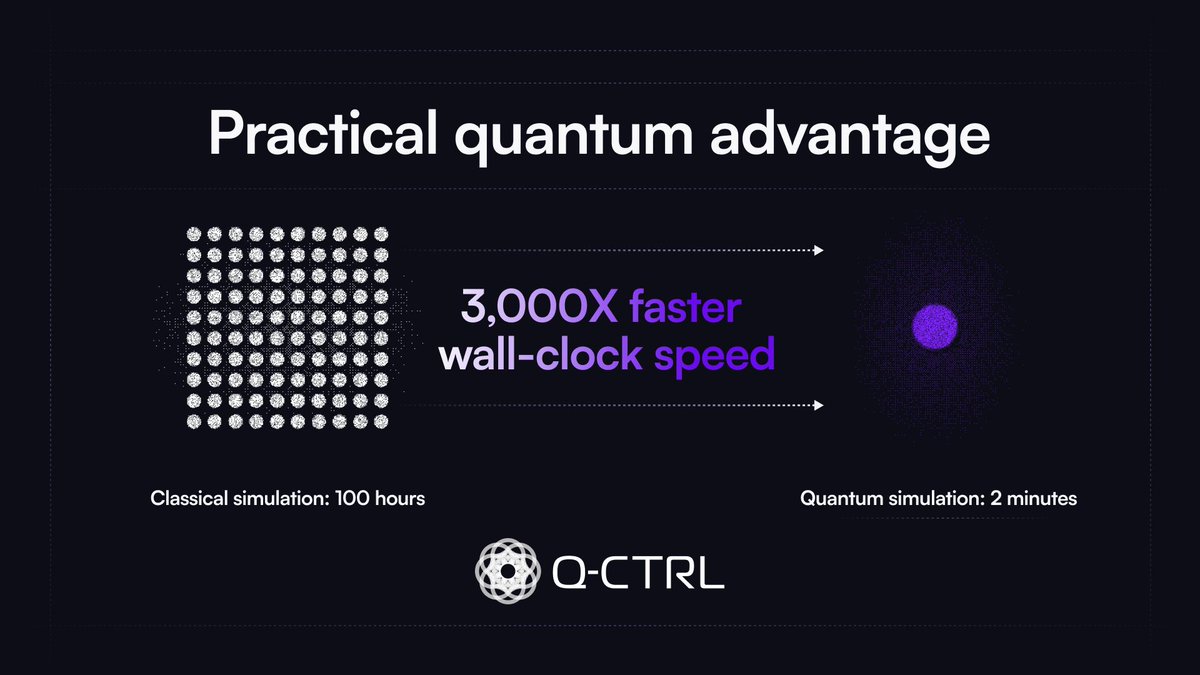
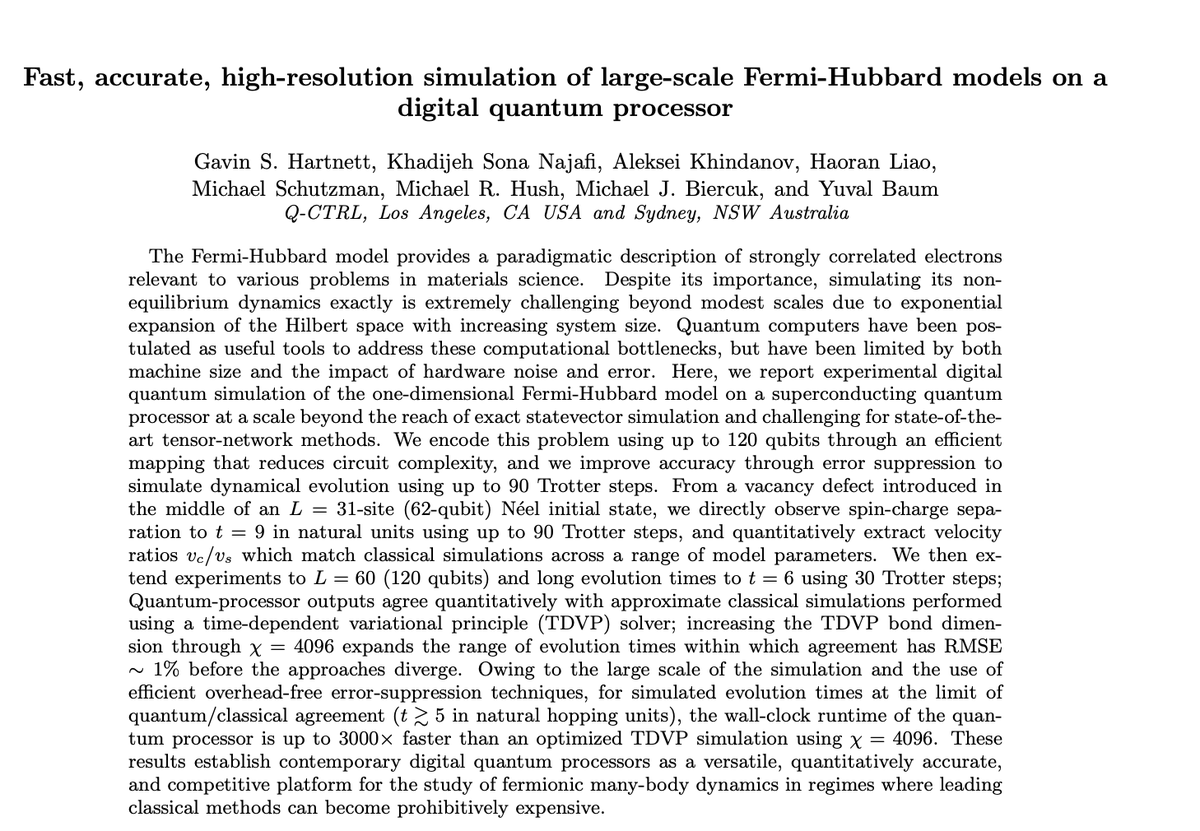
#PracticalQuantumAdvantage marks a new commercial era where quantum computers outperform conventional alternatives. Our latest results show a 3,000x speedup in materials discovery, reducing a 100-hour simulation to just 2 minutes. buff.ly/bLmGbmS
Q-CTRL tweet media
English
2
2
30
5.2K
Decoherence Field
Decoherence Field@decoherence_fld·
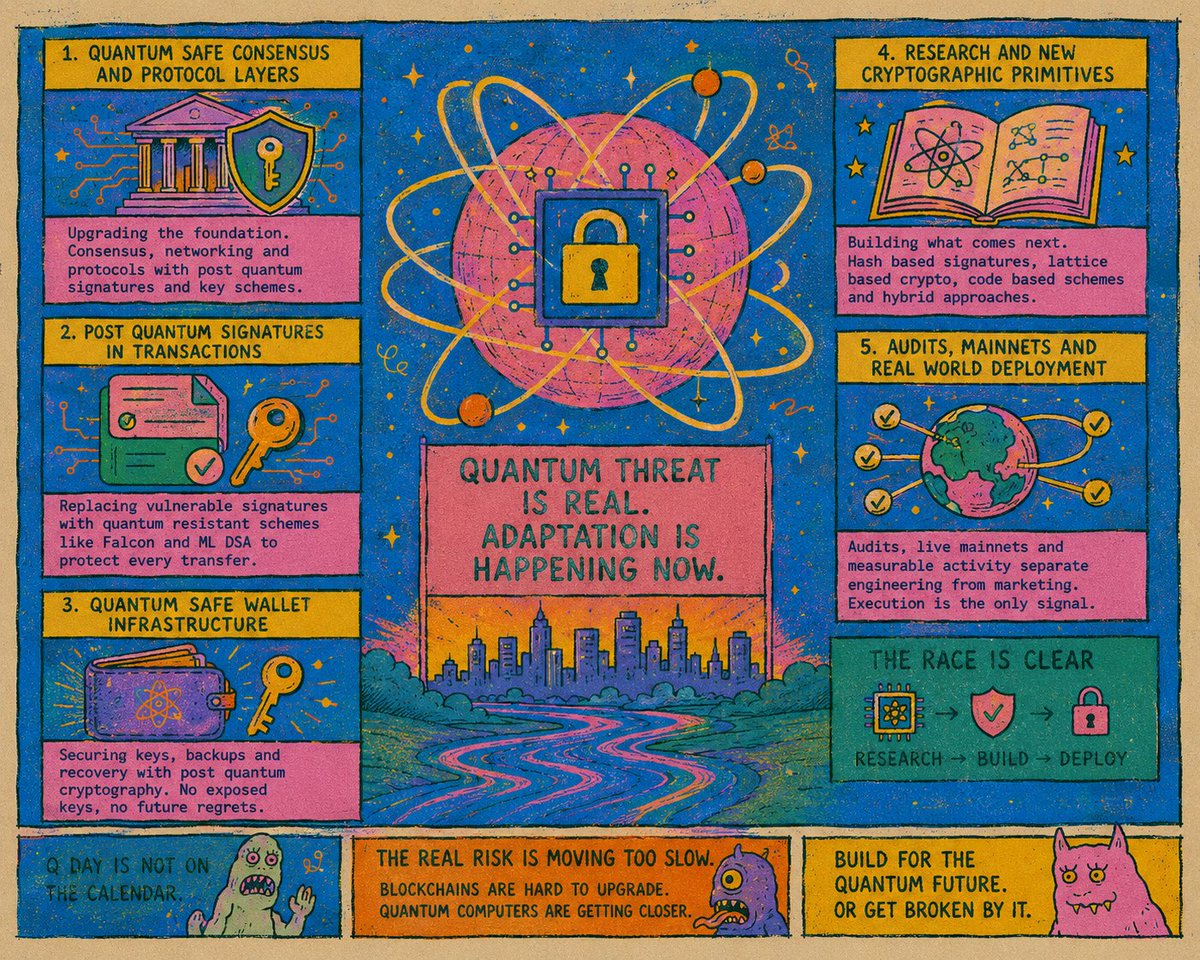
This is not Q Day. It is Q Debt. The projects worth watching are the ones with public post quantum work attached to their ecosystem, not the ones spraying quantum panic over a chart. Watch $ALGO, $SOL, $CELL, $QANX and $STRK. $ALGO has public work around Falcon signatures and quantum resilient state proofs. $SOL has public quantum readiness work through Anza and Firedancer, with Falcon implementations, plus the Winternitz Vault already active in its ecosystem. $CELL belongs here with an active mainnet, post quantum cryptography, external audits from CyStack and Qverify, and a CertiK Skynet A rating. $STRK belongs in the conversation through StarkWare, where Avihu Levy proposed Quantum Safe Bitcoin Transactions Without Softforks. $QANX is built around a quantum resistant Layer 1 thesis, with QAN XLINK using ML DSA for quantum safe signatures and a Hacken audit for that protocol. The point is simple: quantum resistance is becoming a migration race. These projects are not identical, but they are all visibly engaged. The market will still confuse engineering with branding before physics sorts it out. decrypt.co/367047/bitcoin…
Decoherence Field tweet media
English
1
3
48
781
Big Red
Big Red@RedGrindingHood·
They are fixing the exact issue you mentioned. Also $QRL is obviously a much safer option than $TDC for multiple reasons. The fact that it's only on 1 exchange with only $280 volume says a lot. And I honestly don't see any selling points as to why any Quantum holder would want to pick this project over other options. There's like no real meat to it. Look at $CELL for example, similar market cap but way more meat to it despite the controversial aspects. This just seems like a project that has cellframe risk without cellframe upside...
₿ellsDesigner 🔔@BellsDesigner

$QRL holders need to ask themselves one question: If XMSS means stateful one-time signatures, finite per-address signing capacity, and larger-signature tradeoffs, what exactly is the long-term edge over a Bitcoin Core-based chain that has run Falcon-512 from genesis since 2020? Narrative is one thing. Architecture is another. @tidecoin $TDC
English
5
4
19
1.5K
Decoherence Field retweetledi
Anastasia Marchenkova
Anastasia Marchenkova@amarchenkova·
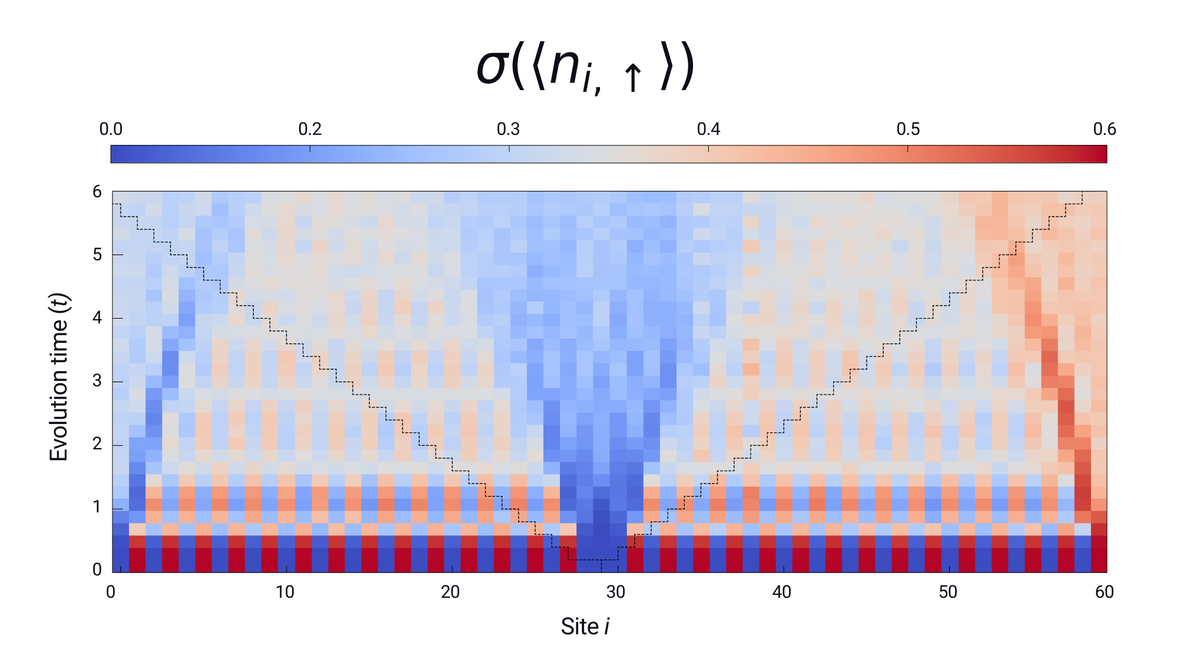
BREAKING: Q-CTRL's Practical Quantum Advantage has landed 🛬 Big thanks to Michael Biercuk (@MJBiercuk) , Yuval Baum, and Gavin Hartnett at @qctrlHQ for the pre-publication briefing on their new results. Conversations like these are what make writing about this field worthwhile, and seeing people trying to do right by the industry. And I get to ask questions, push on the framing, and dig into why specific choices were made. 🟣 1D Fermi-Hubbard simulation on IBM's ibm_boston, 120 qubits, 9,057 two-qubit gates across 152 layers 🟣 ~2 minutes quantum vs. ~100 hours classical (ITensor TDVP at χ = 4096 on a 32-core CPU node) — up to 3,000× faster at the agreement boundary 🟣 Run on the public IBM Quantum API. No privileged access, no special calibration 🟣 Validated against the classical baseline within ~1% RMSE up to t ≈ 5.2; ~4% residual error at the longest evolution times tested (community tolerance is 5–10%) The rigor of how they defined the claim — publicly accessible hardware, no privileged access, validated against the tool the community actually uses, explicit about where correctness becomes indeterminate — is how you build trust in the next era of quantum.
Anastasia Marchenkova tweet mediaAnastasia Marchenkova tweet media
English
3
27
117
25.9K
Decoherence Field
Decoherence Field@decoherence_fld·
Quantum just cracked a real 15-bit ECC key on public IBM hardware and claimed the 1 BTC prize. Laugh at “15 bits” if you want, but the real signal is not the size of the key, it is the direction of travel. Around 7M BTC already sit behind exposed public keys, and most people still talk like quantum risk is a sci-fi problem. Bitcoin’s real superpower was never being magically unbreakable. It is the ability to adapt through consensus when the threat model changes. Quantum-resistant signatures are not panic, they are preparation. Because the worst time to upgrade Bitcoin is after the first real break. This is not the end of Bitcoin. It is the first real test of whether we actually learned Satoshi’s lesson about adaptability. Prepare before the market prices fear in. Your move, cypherpunks.
Only a Trader 🔗@Only_a_Trader

🚨 SON DAKİKA İLK BTC ADRESİ KUANTUM BİLGİSAYAR KULLANILARAK KIRILDI! Bir hacker, halka açık kuantum donanımı kullanarak 15-bit’lik bir ECC anahtarını kırdı. Bu sırada yaklaşık 6.9 milyon BTC, açık (public key’i ortaya çıkmış) adreslerde tutuluyor. Eğer 256-bit ECC kırılırsa, bunlar ilk hedef olabilir. BU DURUM PİYASALAR İÇİN SON DERECE KÖTÜ!


English
0
0
34
3.1K
Decoherence Field retweetledi
Wimar.X
Wimar.X@DefiWimar·
🚨 BREAKING FIRST BTC ADDRESS JUST GOT CRACKED USING QUANTUM COMPUTING! A HACKER BROKE A 15-BIT ECC KEY USING PUBLICLY AVAILABLE QUANTUM HARDWARE. MEANWHILE, ~6.9 MILLION BTC ARE SITTING ON ADDRESSES WITH EXPOSED PUBLIC KEYS. IF 256-BIT ECC FALLS, THESE COULD BE THE FIRST TO GO. THIS IS EXTREMELY BAD FOR MARKETS!
Wimar.X tweet media
English
472
434
1.8K
903.1K
Decoherence Field retweetledi
Rand Group
Rand Group@randgroup·
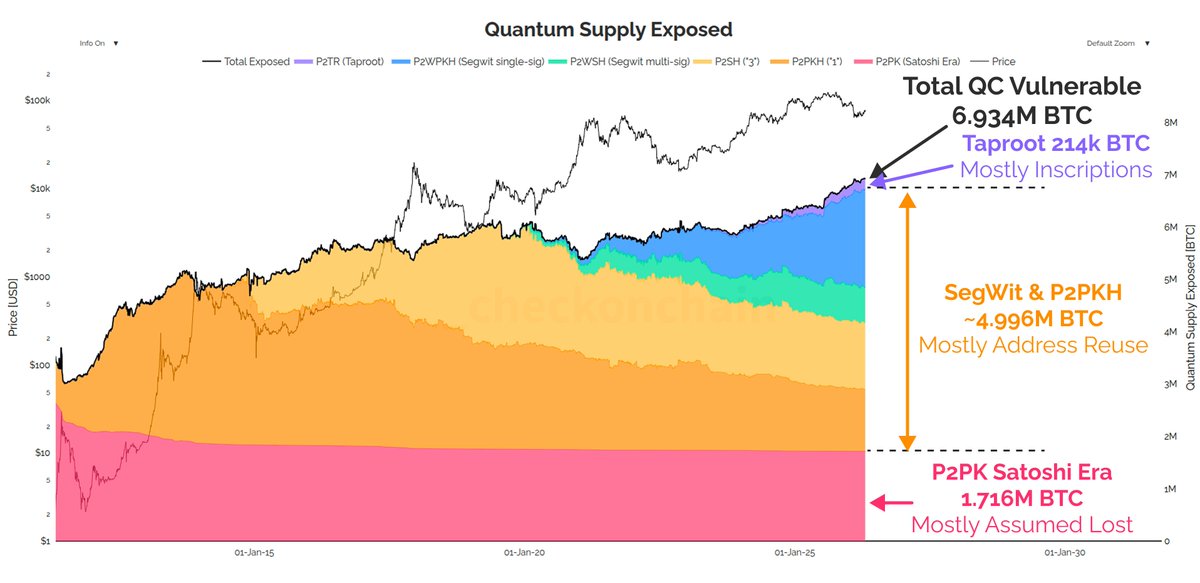
Bitcoin Supply Exposed to Quantum Attacks
Rand Group tweet media
English
12
29
152
14.6K
Decoherence Field retweetledi
The Quantum Insider
The Quantum Insider@QuantumDaily·
With $200,000 in prize funding, The Quantum Insider is proud to present the #globalquantumaichallenge Announced last week, the 2026 Global Quantum + AI Challenge is designed to accelerate the shift from quantum theory to enterprise-ready solutions by connecting real industry problems with global technical talent. We're proud to welcome the following as partners: @Airbus @ClevelandClinic @EON_SE_en @HSBC @VWGroup @awscloud (AWS) @ClassiqTech @MITREcorp Quantum in South Carolina ( SC Quantum ) Applications are now open. Teams can review full problem statements, eligibility criteria, and submission guidelines and submit proposals via here: quantumai.thequantuminsider.com 👇 #globalquantumaichallenge
The Quantum Insider tweet media
English
5
9
17
1.2K
Decoherence Field retweetledi
BLADE
BLADE@BladeDefi·
BTC PRINTING THE SAME BOTTOM AGAIN ROUNDED BASE -> EXPANSION NEXT MOVE GONNA COOK
English
32
67
362
113.9K