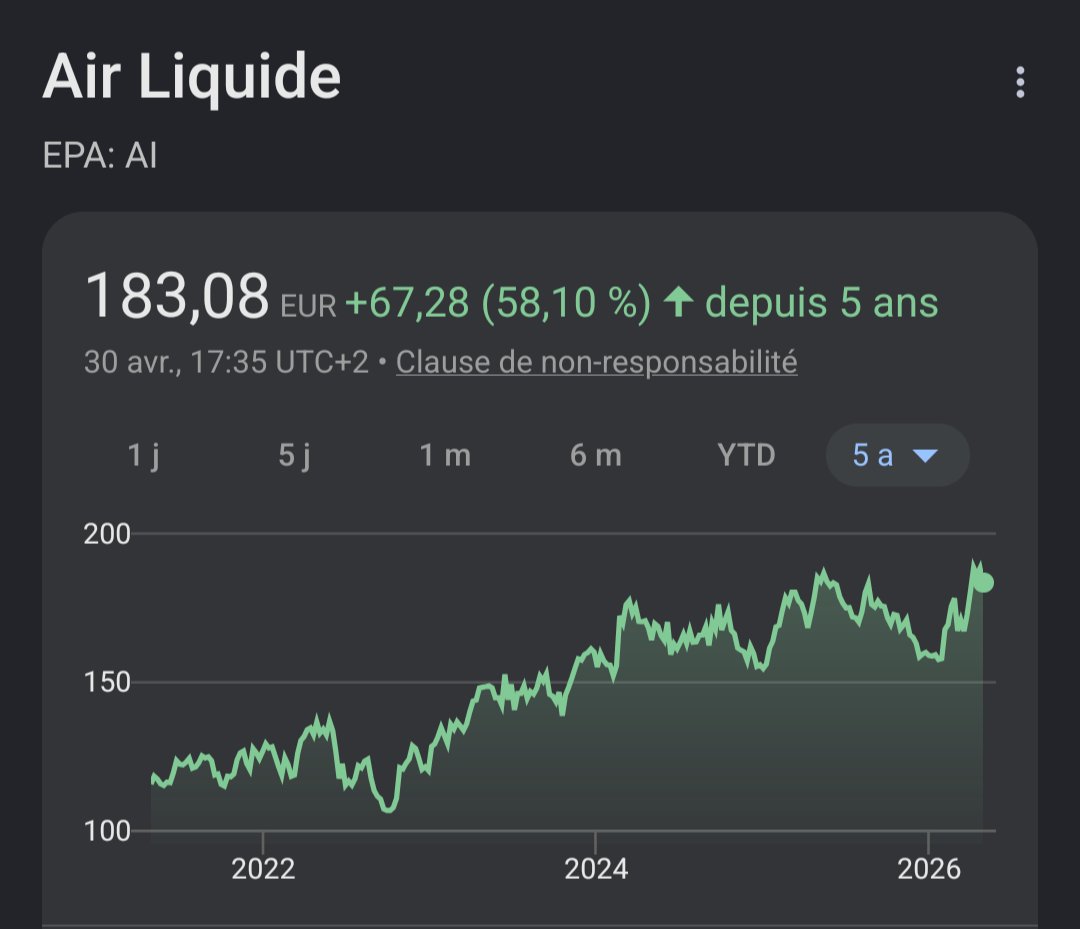
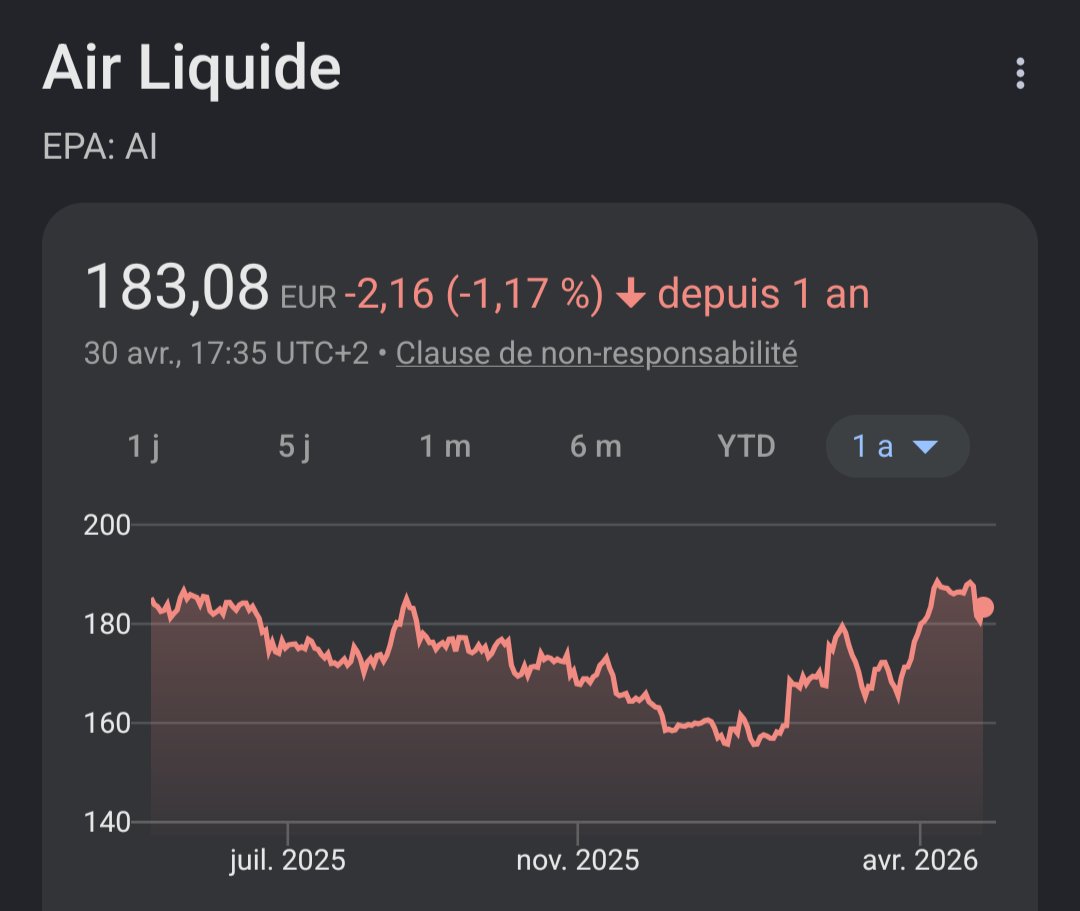
@davideneco25320 @NavajoMonde 58% en 5 ans c'est pas une montée, c'est un faux-plat.
Français
Despe 500
1.8K posts


Je suis tombé sur le PEA d’un client : 3465 actions Air Liquide 504 078€ de plus-value En 2026 l’entreprise va lui verser 12 820€ de dividendes et 346 actions gratuites soit 63 000€ au cours d’aujourd’hui.







Rough maths r.e. $IQE valuation at current ~£600M market cap: --> Base case - 2026 = £727M - 2027 = £802M - 2028 = £884M EV / rev multiple of 7x - reasonable vs peers + balances AIM status w/ recovering profits --> Bull case - 2026 = £1.14B - 2027 = £1.37B - 2028 = £1.66B EV / rev multiple of 10x - premium for AI/photonics tailwinds materialising + strong execution No takeover premium baked into any scenarios, so this is just organic/execution driven. Takeover would shortcut the whole timeline. FWIW, in Jan25, my bull case for EOY 2026 spat out £500M, which they have far surpassed in just 3.5 months of the year - my assumptions are a little more on the conservative end.





$ASML Q1 26 Earnings tomorrow, 15 Apr 2026. TLDR: main 3 signals: 1. $INTC / $TSM divergence - Any shift in tone r.e. Taiwan-bound High-NA delivery schedules for 2026/27 2. HBM4 memory - Memory EUV booking %. 50%+ confirms AI-logic memory 3. MATCH Act - Backlog regional shift & backlog duration increasing in non-China regions High level notes: ----- 1/ $INTC / $TSM divergence $INTC use High-NA to reduce complexity of multi-patterning, which kills yields. By printing 1.4nm features, they're betting that higher yields will offset the $400M tool cost Then $TSM is protecting its EUV capital base - betting that their processes can extend the life of older machines. If $ASML comms hint at $INTC’s 14A yields exceeding expectations, it could create a kind of capitulation cycle for $TSM... ...If $INTC proves a lower total cost-per-wafer via High-NA, $TSM will be forced to pull forward its volume High-NA orders - currently slated for the A14P node in 2029. To avoid losing customers like $AAPL + $NVDA who hedge w/ $INTC. So looking for any shift in tone r.e. Taiwan-bound High-NA delivery schedules for 2026/27 2/ HBM4 Transition from HBM3E -> HBM4 involves 2x the interface width to 2048-bit and, crucially, manufacturing base die on advanced logic nodes (5nm/12nm) rather than pure memory lines. Logic has to be embedded directly into the memory stack to reduce latency... ..which requires foundries ($TSM/Samsung) to produce memory using logic-grade EUV lithography. This effectively logicizes memory. $ASML's TAM for memory is now all about capturing the higher margin logic-node intensity needed for HBM4 base dies. Management previously guided that the logic/memory revenue mix could flip in 2026; if tomorrow ER shows memory bookings heavily weighted toward EUV, it proves that HBM4 is a structural driver. Will be eyeing Memory EUV booking % - 50%+ confirms AI logic memory 3. The MATCH Act The intro of the MATCH Act basically spooked the market. China accounted for 33% of 2025 revenue, and the market is pricing in a service cliff - US lawmakers are closing the back door that allowed China to maintain advanced DUV lines despite EUV bans. ...the question is where that capacity goes? The MATCH Act effectively forces global capacity to migrate to the US, Japan, and South Korea - regions where $ASML enjoys higher service margins and less geopolitical friction. If $ASML reports that the Chinese DUV backlog is being reallocated to Western fabs at a higher ASP, the China risk is actually a margin-accretive event. So looking for backlog regional shift & backlog duration increasing in non-China regions.


En France le régime de retraite par répartition devrait être plafonné à 1490€ mensuels avec comme corollaire une baisse massive des prélèvements sociaux sur les actifs. Les revenus de retraite au-delà de 1490€ devraient reposer uniquement sur des dispositifs de capitalisation individuelle.