Devon Daley

3.3K posts

Devon Daley

Devon Daley

@devondcdaley

Mojobouji-Media,Music, Movie,Mentor; Mc/Event Host🎤DJ;Feel Good Film club founder;ex BBC📻📺Presenter/Producer/Journalist/🎧moi views❤️🧘ev🚗⚽️🎾🏏🇧🇷🇬🇧🇯🇲

uk Katılım Temmuz 2012
1.1K Takip Edilen935 Takipçiler
Devon Daley retweetledi
William A. Wallace, Ph.D.
William A. Wallace, Ph.D.@WilliamWallace·
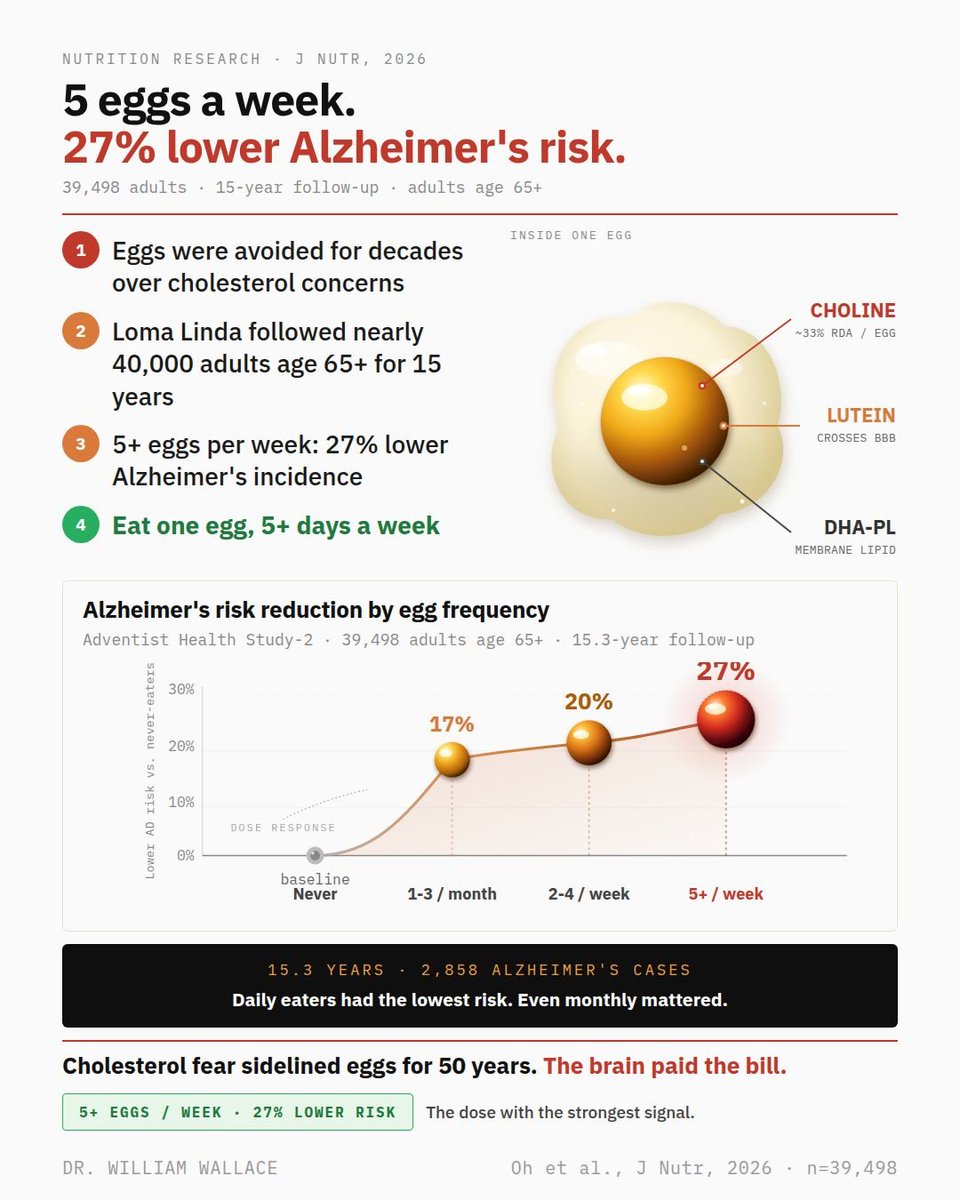
For 50 years, eggs were treated like a cardiovascular threat. The 1960s dietary guidelines capped cholesterol intake at 300mg per day. Two eggs put you at the limit. The advice moved millions away from the food, and away from a nutrient profile we didn't fully appreciate at the time. A new study from Loma Linda University followed 39,498 adults age 65 and older for 15.3 years. The team linked Adventist Health Study-2 dietary records with Medicare diagnoses. Over that window, 2,858 participants developed Alzheimer's disease. The dose-response was clean. Eating eggs 1 to 3 times a month: 17% lower incidence vs never-eaters. 2 to 4 per week: 20% lower. 5 or more per week, roughly one a day: 27% lower. The mechanism story isn't new, but the cohort scale and 15-year follow-up are. Eggs are the densest natural source of choline in the American diet. One large egg supplies roughly 33% of the daily choline requirement. Choline is the substrate for acetylcholine, the neurotransmitter that drops in Alzheimer's. Donepezil, the most prescribed Alzheimer's drug, works by blocking acetylcholine breakdown. The disease is partly defined by cholinergic neuron loss. Egg yolk also delivers lutein and zeaxanthin. These are the only two carotenoids that cross the blood-brain barrier and accumulate in cortical tissue. Higher tissue levels track with better processing speed and memory across multiple older-adult cohorts. Yolk also contains DHA, primarily in phospholipid form. Phospholipid DHA enters the brain more efficiently than DHA in triglyceride form, which is the dominant form in fish oil capsules. Now the caveats, because they matter. This is observational. Causation cannot be drawn from a cohort study. The Adventist Health Study-2 cohort skews heavily vegetarian and health-conscious, so people who eat eggs in this cohort do not look like the average American egg-eater. The "never eats eggs" comparison group is largely vegan, which is its own dietary pattern with its own complications. Reverse causation also has to be considered. People in early Alzheimer's often change eating patterns before diagnosis. Some of the apparent protection could be that healthier brains keep eating eggs, not the other way around. The mechanism story I outlined above is supported by adjacent literature, not by this paper. The study did not measure choline status, lutein levels, or DHA in tissue. It measured eggs in, dementia out. What we can say honestly: in a 40,000-person cohort followed for 15 years, egg intake tracked with substantially lower Alzheimer's incidence in a dose-response pattern. The mechanism is biochemically plausible, supported by other lines of evidence, and consistent with what we know about acetylcholine and brain carotenoid status. The randomized trial that would prove causation has not been run. The practical version: if you are over 50 and not allergic, eating an egg most days has stronger evidence behind it for brain health than most products marketed for the same goal. Five days a week was the dose with the lowest risk in this cohort. Even 1 to 3 per month showed measurable benefit. For 50 years the question was whether eggs were dangerous to your heart. The data behind that fear was always weaker than the guidelines made it sound, which is why the 2015 Dietary Guidelines for Americans quietly removed the 300mg cap. The brain question got asked too late. Oh et al., J Nutr, 2026 (DOI: 10.1016/j.tjnut.2026.101541)
William A. Wallace, Ph.D. tweet media
English
8
109
297
14K
Devon Daley retweetledi
BBC Archive
BBC Archive@BBCArchive·
#OnThisDay 1954: David Attenborough appeared on television for the first time, in Zoo Quest. In 1984, Miles Kington observed him in his natural habitat of Broadcasting House, Bristol, before discussing the craft and the challenges involved in making wildlife films.
English
7
55
215
30.4K
Devon Daley retweetledi
Virginie Debuisson
Virginie Debuisson@VirgoWhallala·
L’hommage du Roi Charles III pour les 100 ans de Richard Attenborough c’est quelque chose ! Réalisé par la @BBC C’est doux, c’est tendre. C’est plein de potizanimos. We need this
Français
35
153
640
33.1K
Devon Daley retweetledi
BBC Sport
BBC Sport@BBCSport·
Happy 100th birthday, Sir David Attenborough 🎉 Did you know that he was behind the introduction of yellow tennis balls? 🎾
English
63
1.1K
5.1K
302.8K
Devon Daley retweetledi
BBC World Service
BBC World Service@bbcworldservice·
🦍One of Sir David Attenborough's most memorable moments? This encounter with a group of playful mountain gorillas in Rwanda in 1979. Happy 100th birthday Sir David! 🎉 🎧 bbc.in/4wnTPtc
English
33
1.2K
5K
104.7K
Devon Daley retweetledi
BBC Archive
BBC Archive@BBCArchive·
It's Sir David Attenborough's 100th birthday and in 1980 he faced questions from an audience of young viewers about his life and television career. Lesley Judd hosted the show, and Attenborough talked about making a connection with gorillas, and his concerns for the environment.
English
45
851
4.4K
216K
Devon Daley retweetledi
Unfiltered
Unfiltered@quotesdaily100·
TIME IS NOT TREATED THE SAME EVERYWHERE: 1. Germany: Being late is disrespectful. Meetings start to the second. Punctuality here is not a habit. It is a moral standard. 2. Brazil: An invitation for seven means nine. Relationships matter more than schedules. Rigidity kills the atmosphere. 3. Japan: Trains run to the minute. A sixty second delay comes with a formal public apology. Time is a system. The system is everything. 4. India: Events begin when people arrive. The gathering defines the time. Presence matters more than precision. 5. Polynesian cultures: Time was tied to stars, seasons, and the ocean. Circular, not linear. The clock came later and from somewhere else. 6. United States: Time is money. Literally. Every hour is billable. Every minute is scheduled. Rest has to earn its place. 7. Spain: Lunch at three. Dinner at ten. The day bends around the person. Not the other way around. 8. Ethiopia: A different calendar entirely. Thirteen months. New Year in September. A different year than the rest of the world. Time here is a cultural choice, not a global agreement. 9. France: August belongs to rest. Emails go unanswered. Shops close. Nobody apologizes for this. Leisure is a right, not a reward. 10. Kenya: The clock starts at sunrise. Six in the morning is hour zero. Noon is hour six. Time is built around light, not an arbitrary number on a wall. 11. China: One time zone for the entire country. A landmass that should span five. In the far west the sun rises at ten in the morning. Unity was chosen over accuracy. 12.Australia: Aboriginal communities have always read time through seasons, animal movements, and the stars above. For over sixty thousand years the land itself served as the calendar. No clock was ever needed. Nature told them everything. 13. Mexico: Mañana means not right now. Urgency is often self-imposed. The present moment has its own demands and they are considered legitimate. 14. Greece: A guest arrives at any hour. You welcome them fully. The clock adjusts to the person. The person never adjusts to the clock. 15. Scandinavia: Months of darkness then months of endless light. The body follows seasons, not schedules. This is ancient. Science is only now catching up. 16. Nigeria: Start times are a suggestion. What matters is that everyone arrives, connects, and the evening becomes what it was meant to be. The experience always outranks the schedule. 17. Indonesia: Jam karet. Rubber time. Time stretches around mood, traffic, and social obligation. Rigidity is considered uncomfortable, not professional. 18. Russia: Eleven time zones. Vast winters. Long silences. Time here is treated with patience that outsiders often mistake for slowness. 19. Egypt: One of the first civilizations to invent a calendar. Yet modern Egyptian social time is deeply flexible. Hospitality always comes before the clock. 20. Congo: Community shapes the day more than any schedule. Time belongs to the people in the room, not the hands on the clock. 21. Philippines: Filipino time is a known and accepted reality. Six in the evening means seven or eight. Arriving before the host is ready is the real social mistake. 22. Vietnam: Built on endurance and long horizons. Planning here thinks in years and generations. Short deadlines feel foreign to a culture that measured time in struggles spanning decades. 23. Tanzania: Pole pole. Slowly slowly. A phrase that governs daily life. Rushing is not a virtue here. Moving with intention is. 24. Argentina: Dinner at ten. Parties at midnight. The night is its own world. Compressing it into earlier hours would make it something lesser. 25. Turkey: A meeting can become a meal can become a long evening. Nobody considers this a deviation. It is simply what time is for. 26. Iran: Its own solar calendar. New Year on the spring equinox. Time tied to nature, poetry, and a civilization so old that modern urgency feels like a passing trend.
English
71
1.1K
5K
703.9K
Devon Daley retweetledi
BBC Sport
BBC Sport@BBCSport·
WHAT HAVE WE JUST WITNESSED? 🤯 Sabastian Sawe has just become the first person in history to run a sub two-hour marathon in race conditions. Yomif Kejelcha was also under two hours for second!
BBC Sport tweet media
English
580
6.9K
38.8K
3.9M
Devon Daley retweetledi
Fixing Education
Fixing Education@FixingEducation·
A simple visual for kids (and adults) to understand delayed gratification.
English
115
2.6K
13.3K
838.7K
Devon Daley retweetledi
Big Brain Business
Big Brain Business@BigBrainBizness·
Martin Lewis, founder of MoneySavingExpert. com, on the four things it takes to be really successful, and why the most important one isn't what you'd expect: He opens with a clear framework: "It takes four things to be really successful. Talent, you've all got it, as do many more people than you think. Hard work. If you want to be really successful, you're going to have to work hard. Focus. Zone in on what you're good at." On focus, he pushes back against the idea that you need to be exceptional at everything: "Understand, none of us are unfailingly brilliant at everything. So, find the thing that you're good at and zone in on that. And that is what will create your success." But the fourth factor is where his message turns unexpected: "The most important thing is luck. You can do everything right, but it still not work for you. And you need to know that now." This reframes how he wants people to think about setbacks: "Failing does not make you a failure. Do not judge yourself. See it as a way to learn and to give yourself a better opportunity the next time." @MartinSLewis then challenges a common assumption about what success actually delivers: "Success can be stressful. Success is not a synonym for happiness. As you go through your working careers, at sometimes you may want to make a call. Do I continue to push that hard or do I smile at what I've got and enjoy happiness and the other things that life starts to give me?" He closes with a message aimed at those who do make it big: "One or two of you in here will make it really big. If that's you, remember of those four things, the most important one is luck. And that means if you're that super successful one in the room, you have a moral duty to give back."
English
7
145
950
291.8K
Devon Daley retweetledi
Fraser Nelson
Fraser Nelson@FraserNelson·
The 'Rhodesia Solution': How to use word tricks to 'disclose' a scandal to a Prime Minister while allowing him not to act. And to say, later on, that he wasn't really told...
English
116
1.5K
6.2K
504.3K
Devon Daley retweetledi
Julien Laurens
Julien Laurens@LaurensJulien·
If you thought Rayan was special, let me introduce you to Eden Cherki, 14 years old!! It just runs in the family blood!
English
104
778
8.6K
1.4M
Devon Daley retweetledi
Keepitonthedeck
Keepitonthedeck@Keepitonthedeck·
All coaches, take note. Rayan Cherki was filmed by Keepitonthedeck at the St Kevins Academy Cup ten years ago. Back then not once in that entire tournament was he met with shouts of pass the ball. Not once was he taken off for attempting tricks or flicks. No one barked at him to run aimlessly. What we saw was a young player given true freedom. At twelve years of age, playing against thirteen year olds, his ability was not just impressive, it was joyful to watch. It made people smile and at times even laugh at how effortlessly he played. Comfortable on both feet at that age as well. What stood out most was not just his skill, but the environment around him. He was allowed to express himself and grow, without being restricted by a coach or confined by a system. We even witnessed him lead and take entire team warm ups, given ownership of a team with players older than him. Coaches are there to help talent, not destroy them. Both types of coaches exist, so careful which ones you play under! As Cherki said himself, “If we don't play with pleasure, you can't play better, you can't show what you want.”
English
8
49
381
67.2K
Devon Daley retweetledi
عمر مشعل ⚡
عمر مشعل ⚡@omar_alzhra·
لو ما تعرّض للإصابات، كان محد بيوقفه حتى زيدان ما بيكون بمستواه
العربية
119
139
2.6K
869.8K