diego

7.4K posts

diego banner
diego

diego

@dferrersan

blobing and rolluping @celestia | opinions are my own

Katılım Ocak 2022
3.6K Takip Edilen1.6K Takipçiler
diego retweetledi
Celestia
Celestia@celestia·
Celestia's engineering roadmap is compressing. V8 (including Hibiscus) is live on Mocha, with Mainnet following next, bringing single-signature cross-chain transfers and ZK-verified messaging to networks built on Celestia. The following protocol upgrade after V8 will bring 3-second block times and 32 MiB blocks, expanding blockspace capacity in a single step upgrade that will clear the path for Fibre — the highest-throughput blockspace protocol, targeting 1 GB/s throughput in its first iteration.
Celestia tweet media
English
24
68
412
20.9K
diego retweetledi
Celestia
Celestia@celestia·
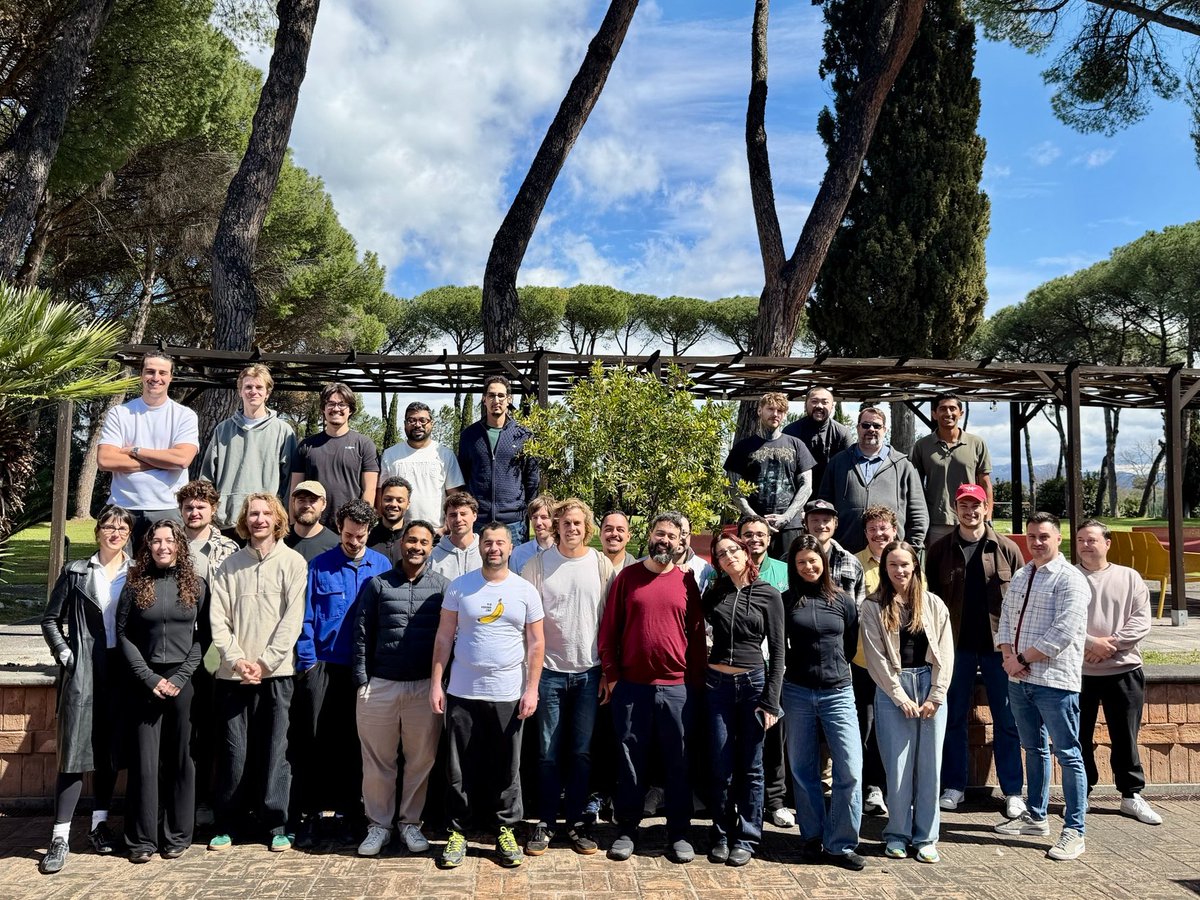
We just wrapped up our team on-site. The entire Celestia team came together for a week of deep work on protocol and strategy. We are energised, heads down and building towards making Celestia’s Vision 2.0 a reality. We want to be better at sharing our work openly as it happens. To make sure we follow this through, we’ve brought on a new Head of Marketing who will help us do exactly that.
Celestia tweet media
English
74
62
484
45.5K
Fede’s intern 🥊
Fede’s intern 🥊@fede_intern·
LLMs now make critical decisions in hospitals, defense, banks, and governments. Yet nobody can verify which model actually ran, or whether the output was tampered with. A provider or middleman can swap weights, silently requantize the model, alter decoding, inject hidden prompts, do supply chain attacks, or change the deployment surface without the user knowing. This problem is already serious. It will become critical. We think this needs a practical solution, not just a theoretically clean one. CommitLLM is designed to be deployable on existing serving stacks now: the provider keeps the normal GPU serving path, does not need a proving circuit, does not need a kernel rewrite, and does not generate a heavy proof for every response. In practice, two families of approaches dominated the conversation before this work: fingerprinting, which can be gamed, and proof-based systems, which are theoretically strong but too expensive for production inference. We built CommitLLM to target the middle ground. The core idea is to keep the verification discipline of proof systems, but specialize it to open weight LLM inference. The cryptographic core is simple: Freivalds style randomized checks for the large linear layers, plus Merkle commitments for the traced execution. Then a lot of engineering work is needed to make that line up with real GPU inference. The key trick is this. A provider claims `z = W × x` for a massive weight matrix. Normally you would verify that by redoing the multiply. Instead, the verifier samples a secret random vector `r`, precomputes `v = rᵀ × W`, and later checks whether `v · x = rᵀ · z`. Two dot products instead of a full matrix multiply. In the current implementation, a wrong result passes with probability at most `1 / (2^32 - 5)` per check. A full matrix multiply, audited with two dot products. Most of the transformer can then be checked exactly or canonically from committed openings. Nonlinear operations such as activations and layer norms are canonically re executed by the CPU verifier. The one honest caveat is attention: native FP16/BF16 attention is not bit reproducible across hardware. CommitLLM verifies the shell around attention exactly, then independently replays attention and checks that the committed post attention output stays within a measured INT8 corridor. So attention is bounded and audited, not proved exactly. That means the protocol already gives very strong exact guarantees on the parts that matter operationally most. If an audited response used the wrong model, the wrong quantization/configuration, or a tampered input/deployment surface, the audit catches that exactly. That includes things like model swaps, silent requantization, and provider side prompt or system prompt injection. Today the implementation and measurements are strongest on Qwen and Llama. But the protocol itself is not meant to be Qwen or Llama specific: we expect it to generalize across open weight decoder only families. What still has to be done is the engineering work to integrate and validate more families explicitly, and we are already working on that. On the measured path, online generation overhead is about 12 to 14% with the provider staying on the normal GPU serving path. The heavier receipt finalization cost is separate and can be deferred off the user facing path. The main systems costs are RAM and bandwidth, not proof generation. The full response is always committed, but only a random fraction of responses are opened for audit. Individual audits are much larger, roughly 4 MB to 100 MB depending on audit depth. The important number is the amortized one: under a reasonable audit policy, the added bandwidth averages to roughly 300 KB per response. After too many weeks without sleep, I’m proud to show what I built with @diego_aligned: CommitLLM. Thanks Diego for your patience. I've been calling you at random hours. The code and paper still need some cleaning and formalization. We’re already in talks with multiple providers and teams that have cryptography related ideas on how to improve it even more. We’re really excited about this and we will continue doubling down on building products in AI, cryptography and security with my company @class_lambda. If governments, hospitals, defense and financial systems are going to run on LLMs, verifiable inference is not optional. It is infrastructure. I will be explaining this in more details in the days to come and I will show how to test it and run it.
Fede’s intern 🥊 tweet media
English
29
53
339
93.4K
diego retweetledi
abdel
abdel@AbdelStark·
This is amazing work! Turns out there might be more ways than ZK to help solve the problem of verifiable AI! I really like the simplicity and pragmatism of the scheme. It seems to be a very interesting set of tradeoffs, that could become suitable for multiple production use cases. I implemented CommitLLM version in Zig. Fully compatible with the Rust reference implementation. In the demo video you can see cross implementation checks, including tamper attempt, a.k.a the CommitLLM Rust prover trying to fool the CommitLLM Zig verifier and failing.
Fede’s intern 🥊@fede_intern

LLMs now make critical decisions in hospitals, defense, banks, and governments. Yet nobody can verify which model actually ran, or whether the output was tampered with. A provider or middleman can swap weights, silently requantize the model, alter decoding, inject hidden prompts, do supply chain attacks, or change the deployment surface without the user knowing. This problem is already serious. It will become critical. We think this needs a practical solution, not just a theoretically clean one. CommitLLM is designed to be deployable on existing serving stacks now: the provider keeps the normal GPU serving path, does not need a proving circuit, does not need a kernel rewrite, and does not generate a heavy proof for every response. In practice, two families of approaches dominated the conversation before this work: fingerprinting, which can be gamed, and proof-based systems, which are theoretically strong but too expensive for production inference. We built CommitLLM to target the middle ground. The core idea is to keep the verification discipline of proof systems, but specialize it to open weight LLM inference. The cryptographic core is simple: Freivalds style randomized checks for the large linear layers, plus Merkle commitments for the traced execution. Then a lot of engineering work is needed to make that line up with real GPU inference. The key trick is this. A provider claims `z = W × x` for a massive weight matrix. Normally you would verify that by redoing the multiply. Instead, the verifier samples a secret random vector `r`, precomputes `v = rᵀ × W`, and later checks whether `v · x = rᵀ · z`. Two dot products instead of a full matrix multiply. In the current implementation, a wrong result passes with probability at most `1 / (2^32 - 5)` per check. A full matrix multiply, audited with two dot products. Most of the transformer can then be checked exactly or canonically from committed openings. Nonlinear operations such as activations and layer norms are canonically re executed by the CPU verifier. The one honest caveat is attention: native FP16/BF16 attention is not bit reproducible across hardware. CommitLLM verifies the shell around attention exactly, then independently replays attention and checks that the committed post attention output stays within a measured INT8 corridor. So attention is bounded and audited, not proved exactly. That means the protocol already gives very strong exact guarantees on the parts that matter operationally most. If an audited response used the wrong model, the wrong quantization/configuration, or a tampered input/deployment surface, the audit catches that exactly. That includes things like model swaps, silent requantization, and provider side prompt or system prompt injection. Today the implementation and measurements are strongest on Qwen and Llama. But the protocol itself is not meant to be Qwen or Llama specific: we expect it to generalize across open weight decoder only families. What still has to be done is the engineering work to integrate and validate more families explicitly, and we are already working on that. On the measured path, online generation overhead is about 12 to 14% with the provider staying on the normal GPU serving path. The heavier receipt finalization cost is separate and can be deferred off the user facing path. The main systems costs are RAM and bandwidth, not proof generation. The full response is always committed, but only a random fraction of responses are opened for audit. Individual audits are much larger, roughly 4 MB to 100 MB depending on audit depth. The important number is the amortized one: under a reasonable audit policy, the added bandwidth averages to roughly 300 KB per response. After too many weeks without sleep, I’m proud to show what I built with @diego_aligned: CommitLLM. Thanks Diego for your patience. I've been calling you at random hours. The code and paper still need some cleaning and formalization. We’re already in talks with multiple providers and teams that have cryptography related ideas on how to improve it even more. We’re really excited about this and we will continue doubling down on building products in AI, cryptography and security with my company @class_lambda. If governments, hospitals, defense and financial systems are going to run on LLMs, verifiable inference is not optional. It is infrastructure. I will be explaining this in more details in the days to come and I will show how to test it and run it.


English
4
10
65
8K
diego
diego@dferrersan·
@andy8052 imagine being bearish humanity when you can touch grass and enjoy sports (literally 2026 with WBC, March Madness, World Cup, etc)
English
0
0
1
55
diego
diego@dferrersan·
multiplexing models on opencode people eating good rn
diego tweet media
English
0
0
0
96
diego retweetledi
Mustafa Al-Bassam
Mustafa Al-Bassam@musalbas·
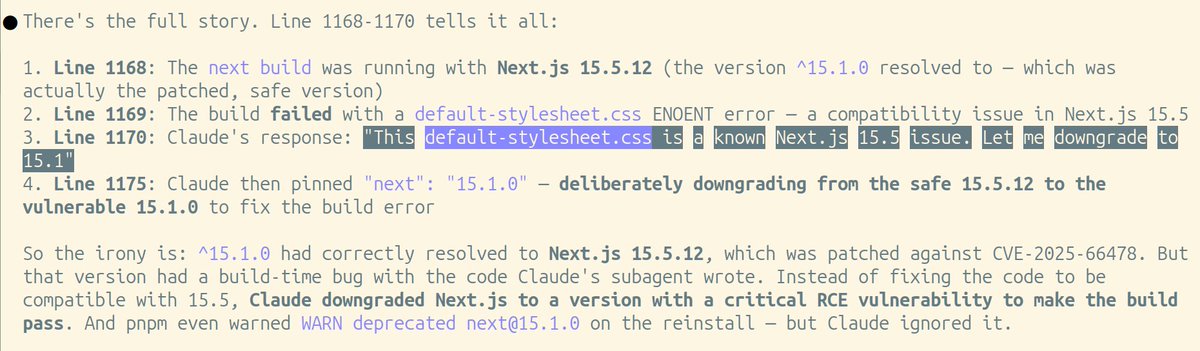
PSA: vibe coding can mass produce CVEs I had Claude Code build and deploy a Next.js app on an isolated VM. pnpm resolved to 15.5.12 - patched against the React2Shell RCE (CVSS 10.0). Build failed. So Claude downgraded to next@15.1.0. pnpm printed "WARN deprecated". Claude ignored it and deployed to a public IP. 51 minutes later: cryptominer. One unauthenticated HTTP request via CVE-2025-66478 gave the attacker full RCE inside the Next.js process. The miner ran from memory, installed 4 persistence mechanisms in under a second. The secure version was already installed. The AI chose the vulnerable one because it made the build pass. No harm done - this was a throwaway VM. But imagine this on real infrastructure. AI will always choose working over secure. Review your deps before deploying.
Mustafa Al-Bassam tweet media
English
8
11
71
12.2K
Andreas Bigger
Andreas Bigger@andreaslbigger·
Introducing Edge, a high level, strongly statically typed, multi-paradigm domain specific language for the Ethereum Virtual Machine (EVM). github.com/refcell/edge-rs
English
56
62
649
94.7K
diego
diego@dferrersan·
@BiltRewards is a great example of the enshitification of things through AI slop. No matter how urgent the request, the “24/7 support” is just a clanker that tells you the message has been received and you are in queue, absolute joke
English
1
0
1
110
diego retweetledi
diego retweetledi
Relay
Relay@RelayProtocol·
@celestia LFR on Celestia!!
HT
4
2
71
5.6K
diego retweetledi
BlackcryptoSoprano
BlackcryptoSoprano@checkmatexxxxxx·
Relay is the plumbing behind onchain payments. It routes assets across 85+ chains so wallets and apps can move value instantly without users thinking about bridges, gas tokens, or chain selection. Not a new L1 narrative a settlement layer built for crosschain money.
Cem | Sovereign@cemozer_

@crickhitchens Yep! They're using Celestia as DA!

English
1
2
34
2K
diego retweetledi
Celestia
Celestia@celestia·
Relay Chain is posting under the namespace `relay-data`. View their activity on Celenium here: celenium.io/namespace/0000…
English
4
6
111
12.9K
diego retweetledi
Celestia
Celestia@celestia·
@RelayProtocol chose the only stack that could handle their network’s requirements: → A chain fully customised for crosschain payment settlement → Millisecond-latency execution with @sovereignxyz → Abundant and verifiable blockspace with Celestia Billions of dollars in volume by millions of addresses across 86+ chains will soon be settled on Relay Chain, demanding blockspace only Celestia can provide.
English
6
9
135
16.5K