Digital Gold

3.9K posts

Digital Gold banner
Digital Gold

Digital Gold

@Digitalgold1979

CEO @ A Network Building one of the fastest growing Layer 1 ecosystems in crypto. 21M Supply • Native L1 • DEX • AI Ecosystem Leading the Ant Army.Scarcity wins

California, USA Katılım Mart 2025
10 Takip Edilen7.5K Takipçiler
Sabitlenmiş Tweet
Digital Gold
Digital Gold@Digitalgold1979·
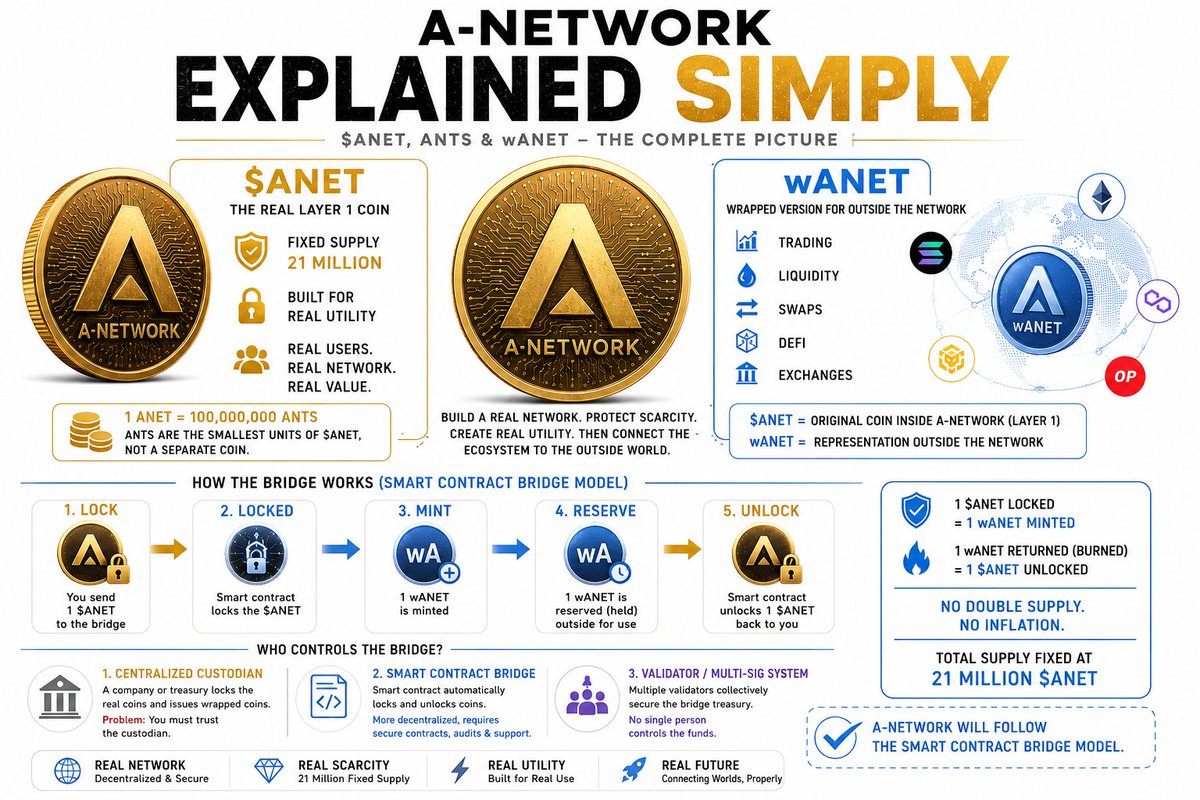
A lot of people are confused about the new A-Network whitepaper so let’s explain it in simple words. $ANET is the main coin of A-Network. ANTS are just the small pieces of $ANET. Just like: 1 Bitcoin = 100,000,000 sats A-Network works the same way: 1 ANET = 100,000,000 ANTS So ANTS are not a different coin. They are simply the smallest unit of $ANET. Now comes the important part: $ANET is the real Layer 1 blockchain coin. wANET is like a wrapped version used outside the network for trading and liquidity. Same as: BTC → Bitcoin network WBTC → used on other blockchains So: $ANET stays the main original coin. wANET helps connect A-Network to outside crypto markets. And the biggest thing: Total supply is fixed forever at only 21 million $ANET. No extra coins later. No unlimited minting. No inflation forever. The system is designed so over time: fake accounts get removed, bots disappear, inactive users leave, and real miners stay stronger. That is why scarcity becomes important. The whitepaper is basically saying: Build a real network first. Protect the supply. Create real utility. Then connect it to the outside crypto world slowly and properly. This is why many people compare A-Network’s structure to Bitcoin. Think about it like this in very simple words: $ANET = original real coin inside A-Network blockchain wANET = copy/representation of $ANET outside the blockchain Example: You have real gold locked in a bank. The bank gives you a paper certificate that says: “This paper represents 1 real gold.” Now: Gold = $ANET Paper certificate = wANET The paper is easier to trade outside, but the real gold still exists in the vault. Same thing in crypto. People outside A-Network may not be able to directly use the real Layer 1 $ANET coin on $ETH , $BNB Chain, exchanges, DeFi apps, etc. So a wrapped version is created: wANET. ( Wrapped $ANET ) How it usually works: You lock 1 real $ANET System creates 1 wANET You use wANET outside the network for: trading liquidity swaps DeFi exchanges Then later: You return/burn 1 wANET Your original 1 $ANET gets unlocked So the supply stays balanced. Very important: wANET is NOT supposed to create extra supply. Supply will still be 21 Million If done correctly: 1 $ANET locked = 1 wANET created 1 wANET burned = 1 $ANET unlocked That is why people compare it to: $BTC ↔ WBTC $ETH ↔ WETH $ANET ↔ wANET Why projects do this: Because native Layer 1 coins sometimes cannot easily interact with outside ecosystems. Wrapped coins act like a bridge between: the original blockchain and the outside crypto world. So in A-Network’s idea: $ANET = core ecosystem coin wANET = external market/liquidity version That depends on how A-Network decides to build the bridge system. So now the main question that most people asking or will ask is who controls the bridge ? Or will there be a middleman or how this will work like who will lock the layer1 $ANET ? Normally in crypto there are 3 common ways this works: CENTRALIZED CUSTODIAN MODEL: 1. Centralized Custodian Model This is how early wrapped coins like Wrapped Bitcoin worked. You send your 1 $ANET to: a company bridge operator treasury wallet validator-controlled vault They lock your real $ANET. Then they mint: 1 wANET So: your real $ANET sits locked somewhere you receive wANET outside the chain When you want your original $ANET back: you send back wANET they unlock your Layer 1 $ANET Problem: You must trust whoever controls the locked coins. SMART CONTRACT BRIDGE : 2. Smart Contract Bridge (More Decentralized) This is how many modern bridges work. Instead of humans holding coins, a smart contract locks them automatically. Example: You connect wallet Send 1 $ANET into bridge contract Contract locks it System automatically mints 1 wANET Later: you burn 1 wANET smart contract releases 1 $ANET back This is more decentralized, but only works if: the blockchain supports it properly the bridge is secure contracts are audited. VALIDATOR / MULTI-SIGNATURE SYSTEM: 3. Validator / Multi-Signature System Sometimes validators collectively secure the bridge. Example: 10 validators manage the locked treasury majority approval required no single owner controls funds This reduces risk compared to one company holding everything. So in this example: You own: 1 native Layer 1 $ANET You want: 1 wANET Possible flow: You send 1 $ANET to bridge Bridge locks the $ANET Bridge mints 1 wANET You now use wANET on exchanges or external chains Then reverse: You send back 1 wANET Bridge unlocks 1 $ANET You receive original $ANET back The important thing is: If the system is honest and properly designed, there should NEVER be: 1 $ANET unlocked AND 1 wANET active at same time Otherwise supply inflation happens. That’s why bridge transparency is extremely important in every crypto ecosystem. A Network will follow example 2. #A #ANetwork #ANet #Ants @BaskaranBBV @Joel_Dupalco @Jawad0008
Digital Gold tweet media
English
29
32
123
4K
Muhammad Bilal
Muhammad Bilal@BilalMbja3322·
@Joel_Dupalco Hae coach how is it possible that you deposit 10,499,898.020348 ANET it means they are already mined?
English
1
0
0
78
Joel Dupalco (Coach Joel)
Joel Dupalco (Coach Joel)@Joel_Dupalco·
Decentralization milestone: Founder treasury moved on-chain Date: May 25, 2026 Whitepaper version: v3.4 (live at a-network.io/whitepaper ) Hey everyone... a big one to share. Today I (@Joel_Dupalco) moved the entire 50% founder allocation I hold (10,499,798 wANET) out of my personal hot wallet and into AnetBridgeVault... the smart-contract custody we've been building toward in v3.1 → v3.3. What changed Until today, 10.5M wANET sat in an ordinary BEP-20 balance on an EOA I controlled with a single key. That's a single-key risk. As of today, that exact balance is held by a smart contract that: • Is non-upgradable. Ownership renounced. • Requires 2 of 3 independent EIP-712 signers for any release. • Has hard release caps: 10k per tx, 50k per recipient per day, 250k total per day. • Has a dedicated pauser that can panic-stop releases. • Cannot rescue wANET even by the admin. The vault asset is locked from administrative withdrawal. Why it matters This is the Bitcoin principle applied to a project treasury: no individual... including the founder... can unilaterally move the money. Even if my laptop got compromised tomorrow, my single key cannot drain the vault. On-chain proof • Vault contract: 0x31438362a7667ce5559500023D025c7c14168B49 • BscScan: bscscan.com/address/0x3143… • Vault balance after deposit: 10,499,898.020348 ANET ✅ • wANET token contract: 0x791055A7d52AA392eaE8De04250497f33807E46A (ownership renounced) What's next 1. Co-founder mirror deposit — the other 50% of the founder allocation will be moved into the same vault. 2. Admin role migration — the current admin EOA gets replaced by a 2-of-2 Gnosis Safe co-owned by both founders. Plan is published in the repo. 3. v3.5 roadmap — rotate one of the three signers to a non-founder operator, so the signer set is operator-independent. 4. After 6+ months of clean multisig operation: admin role renounced, vault becomes fully Model-2 (no privileged role at all). Read more • Whitepaper v3.4: a-network.io/whitepaper • Vault source: github.com/A-Network-2026… • Audit notes: github.com/A-Network-2026… Thank you for being here through the build. This was the milestone I was most determined to ship before mainnet adoption scales up. — Coach Joel
Joel Dupalco (Coach Joel) tweet media
English
18
20
70
2.8K
Queen Ant
Queen Ant@Queen_ANet·
@Ehs87366Ehsan I never gonna sell my coins. They are going to be rare one day, and I love COLLECTIBLE coins.
English
3
0
8
112
MMG
MMG@MMG_Labs·
Today A Network my new members
MMG tweet media
English
3
1
17
699
Digital Gold
Digital Gold@Digitalgold1979·
@coreboy_crypto I can really give you a cool answer for this and that will take your smile away 😂 But I leave u alone to enjoy the fantasy world How about that
English
0
0
0
53
orus_kelebe' 💙
orus_kelebe' 💙@coreboy_crypto·
@Digitalgold1979 I like it when you talk about anet and leave interlink alone with their fast growing community. Also talk to your Co because they still fighting with interlink
English
0
0
0
83
Digital Gold
Digital Gold@Digitalgold1979·
A lot of people ask: “If A-Network starts with zero liquidity, then how can it ever have value?” But this is exactly where people forget how Bitcoin started. Bitcoin started with: no liquidity pool no USDT pair no market makers no exchanges no buyers no price At the beginning: Bitcoin had only: miners believers community scarcity The first liquidity of Bitcoin was not a liquidity pool. It was simply: person to person trading. Someone mined BTC. Another person wanted BTC. They traded directly. That is how the first market value was created. Later: small exchanges appeared. Buyers and sellers started placing bids. Then liquidity slowly grew. Bitcoin grew like this: belief → mining → trading → market → liquidity Not: liquidity first. Now compare this to A-Network. A-Network is also starting from: miners community scarcity fixed supply belief in the network The difference is: today’s crypto world already understands markets, DEXs, wrapped assets, bridges, liquidity systems, and decentralized trading. So A-Network does not need billions of liquidity on day one. It only needs: active miners real demand community participation gradual market formation This is how liquidity can slowly form in A-Network: Stage 1 — Mining & Scarcity People mine $ANET. Supply remains limited. Community grows. No huge liquidity is needed yet. Stage 2 — P2P Trading Starts Some people may want to accumulate faster. Some miners may want to sell. Direct trading starts between people. This is exactly how early Bitcoin markets formed. Stage 3 — Small Liquidity Appears A small pool or market can form: ANET/USDT wANET/BNB or community liquidity pools Even a small pool creates: price discovery market visibility trading activity Stage 4 — Market Confidence Grows As: more sessions complete more miners unlock ecosystem utilities grow DEX activity increases more liquidity naturally enters. Because liquidity follows: attention + users + demand Stage 5 — External Market Expansion Over time: bridges wrapped assets DEX integrations external exchanges ecosystem utilities can expand liquidity further. This is why many people misunderstand early-stage projects. Liquidity does not magically appear from nowhere. Liquidity comes from: people willing to buy, people willing to hold, and people believing the network has future value. That is exactly how Bitcoin started. And that is why even if A-Network starts small, it does not mean it cannot grow structurally over time. While others chase instant hype, real networks are usually built slowly: community first, market second, liquidity third. #A #ANetwork #ANet #Ants @BaskaranBBV @Joel_Dupalco
Digital Gold tweet media
English
25
17
84
1.8K
Hasnain Ali
Hasnain Ali@Ch_Hasnain_Ali·
@Digitalgold1979 A-NETWORK 🚀🚀🚀🚀🚀 The one and only choice of all miners #A-NETWORK 🚀🚀🚀🚀🚀
Hasnain Ali tweet media
English
2
0
5
158
Digital Gold
Digital Gold@Digitalgold1979·
A lot of people are confused about the new A-Network whitepaper so let’s explain it in simple words. $ANET is the main coin of A-Network. ANTS are just the small pieces of $ANET. Just like: 1 Bitcoin = 100,000,000 sats A-Network works the same way: 1 ANET = 100,000,000 ANTS So ANTS are not a different coin. They are simply the smallest unit of $ANET. Now comes the important part: $ANET is the real Layer 1 blockchain coin. wANET is like a wrapped version used outside the network for trading and liquidity. Same as: BTC → Bitcoin network WBTC → used on other blockchains So: $ANET stays the main original coin. wANET helps connect A-Network to outside crypto markets. And the biggest thing: Total supply is fixed forever at only 21 million $ANET. No extra coins later. No unlimited minting. No inflation forever. The system is designed so over time: fake accounts get removed, bots disappear, inactive users leave, and real miners stay stronger. That is why scarcity becomes important. The whitepaper is basically saying: Build a real network first. Protect the supply. Create real utility. Then connect it to the outside crypto world slowly and properly. This is why many people compare A-Network’s structure to Bitcoin. Think about it like this in very simple words: $ANET = original real coin inside A-Network blockchain wANET = copy/representation of $ANET outside the blockchain Example: You have real gold locked in a bank. The bank gives you a paper certificate that says: “This paper represents 1 real gold.” Now: Gold = $ANET Paper certificate = wANET The paper is easier to trade outside, but the real gold still exists in the vault. Same thing in crypto. People outside A-Network may not be able to directly use the real Layer 1 $ANET coin on $ETH , $BNB Chain, exchanges, DeFi apps, etc. So a wrapped version is created: wANET. ( Wrapped $ANET ) How it usually works: You lock 1 real $ANET System creates 1 wANET You use wANET outside the network for: trading liquidity swaps DeFi exchanges Then later: You return/burn 1 wANET Your original 1 $ANET gets unlocked So the supply stays balanced. Very important: wANET is NOT supposed to create extra supply. Supply will still be 21 Million If done correctly: 1 $ANET locked = 1 wANET created 1 wANET burned = 1 $ANET unlocked That is why people compare it to: $BTC ↔ WBTC $ETH ↔ WETH $ANET ↔ wANET Why projects do this: Because native Layer 1 coins sometimes cannot easily interact with outside ecosystems. Wrapped coins act like a bridge between: the original blockchain and the outside crypto world. So in A-Network’s idea: $ANET = core ecosystem coin wANET = external market/liquidity version That depends on how A-Network decides to build the bridge system. So now the main question that most people asking or will ask is who controls the bridge ? Or will there be a middleman or how this will work like who will lock the layer1 $ANET ? Normally in crypto there are 3 common ways this works: CENTRALIZED CUSTODIAN MODEL: 1. Centralized Custodian Model This is how early wrapped coins like Wrapped Bitcoin worked. You send your 1 $ANET to: a company bridge operator treasury wallet validator-controlled vault They lock your real $ANET. Then they mint: 1 wANET So: your real $ANET sits locked somewhere you receive wANET outside the chain When you want your original $ANET back: you send back wANET they unlock your Layer 1 $ANET Problem: You must trust whoever controls the locked coins. SMART CONTRACT BRIDGE : 2. Smart Contract Bridge (More Decentralized) This is how many modern bridges work. Instead of humans holding coins, a smart contract locks them automatically. Example: You connect wallet Send 1 $ANET into bridge contract Contract locks it System automatically mints 1 wANET Later: you burn 1 wANET smart contract releases 1 $ANET back This is more decentralized, but only works if: the blockchain supports it properly the bridge is secure contracts are audited. VALIDATOR / MULTI-SIGNATURE SYSTEM: 3. Validator / Multi-Signature System Sometimes validators collectively secure the bridge. Example: 10 validators manage the locked treasury majority approval required no single owner controls funds This reduces risk compared to one company holding everything. So in this example: You own: 1 native Layer 1 $ANET You want: 1 wANET Possible flow: You send 1 $ANET to bridge Bridge locks the $ANET Bridge mints 1 wANET You now use wANET on exchanges or external chains Then reverse: You send back 1 wANET Bridge unlocks 1 $ANET You receive original $ANET back The important thing is: If the system is honest and properly designed, there should NEVER be: 1 $ANET unlocked AND 1 wANET active at same time Otherwise supply inflation happens. That’s why bridge transparency is extremely important in every crypto ecosystem. A Network will follow example 2. #A #ANetwork #ANet #Ants @BaskaranBBV @Joel_Dupalco @Jawad0008
Digital Gold tweet media
English
29
32
123
4K
Chauhan Sahab
Chauhan Sahab@Sonuchauhanhsr·
@Digitalgold1979 बहुत हीं बेहतरीन अंदाज से समझाया गया! नी संदेह Dear khurram sir, Very well explained, i think no questions about it in future, आपका अंदाज शुरू से हीं बहुत अच्छा लगा khurram Bhai 🥰❤️👌🙏
1
0
1
73
Kifayat
Kifayat@CryptoKifu·
@Digitalgold1979 I am unable to join space,I think I have been blocked to join space.
English
1
0
0
265
Digital Gold
Digital Gold@Digitalgold1979·
This is the A Network DEX. Today we sent $100 to one of our contest winners, and this screenshot is directly from his wallet. Now look carefully at the transaction fees. Almost close to nothing. That is the difference between hype and real utility. We do not force anyone to use our DEX. We do not give fake scores. We do not sell false hopes. We do not pressure users to increase rankings. For us, what matters is simple: Fast transactions. Smooth experience. Low gas fees. Real usability. We believe a blockchain should save people money, not drain their wallets. We don’t hype products. We prove them. #A #ANetwork #ANet #Ants @BaskaranBBV @Jawad0008 @MonikaInterlink @Joel_Dupalco
Digital Gold tweet media
English
24
27
104
3.3K
zahra yasir
zahra yasir@zahra13017235·
@Digitalgold1979 A network wallet Ka password thek na lag rha ho Tu Kiya kerain?a network Ka wallet 🔑 mangi Tu 7 NUM diye or Jab open kernay lagy Tu un ne 6 NUM ki option di.ap wallet open Nahi ho rha.kia kerain?
Filipino
2
0
0
304
Digital Gold
Digital Gold@Digitalgold1979·
@VideosTikt65489 You need to logout and login and better pay more attention on updates Please
English
1
1
2
115