En medio de esto, las fuerzas armadas invitaron a Chávez a renunciar a cambio de no atacar el palacio presidencial. Éste presuntamente aceptó, así lo comunicó el entonces Inspector General del Ejército. Chávez fue derrocado y se refugió en La Orchila.
En octubre de ese mismo año, Chávez decreta que unos nuevos "supervisores" nombrados por el MinEduc estarían presentes en los colegios. Jamás se pudo implementar ya que la sociedad estuvo en contra de estos cambios. Se lo acusó de querer cubanizar la educación.
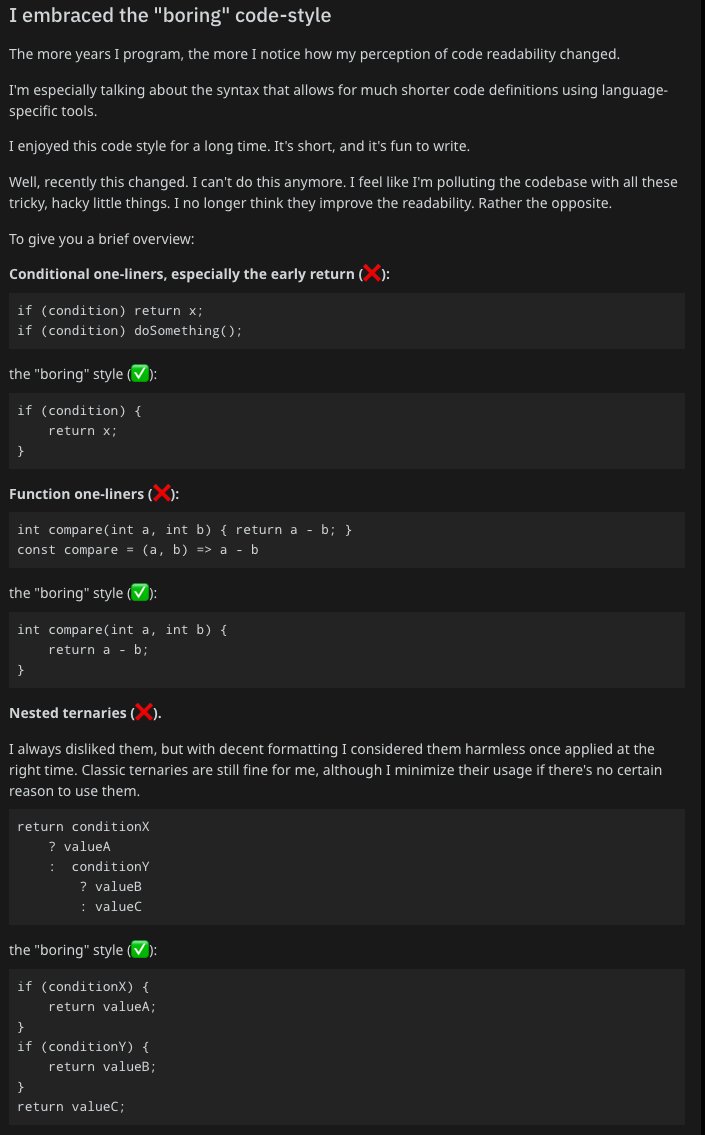
@catalinmpit I've always perfered the "boring" style.
In my mind, the "boring" style is just reducing some of the mental load for the next person.
Chances are high that you'll be that person many months from now, and you'll thank yourself for keeping things simple/commented, etc. haha
Same.
In the beginning, I was impressed by this type of "smart" code.
I also tried to write code like that because I thought it looked cool, and that's how "smart" people do it.
Nowadays, I prefer the more verbose code that's clear and easier to read & understand.
Mention: Apply common sense. It doesn't mean that I prefer verbose code just for the sake of it or that I never use shorter code if it doesn't affect legibility. Also, don't fixate on these examples from the picture. They're some examples to illustrate the point.
Scrum is a cancer.
I've been writing software for 25 years, and nothing renders a software team useless like Scrum does.
Some anecdotes:
1. They tried to convince me that Poker is a planning tool, not a game.
2. If you want to be more efficient, you must add process, not remove it. They had us attending the "ceremonies," a fancy name for a buttload of meetings: stand-ups, groomings, planning, retrospectives, and Scrum of Scrums. We spent more time talking than doing.
3. We prohibited laptops in meetings. We had to stand. We passed a ball around to keep everyone paying attention.
4. We spent more time estimating story points than writing software. Story points measure complexity, not time, but we had to decide how many story points fit in a sprint.
5. I had to use t-shirt sizes to estimate software.
6. We measured how much it cost to deliver one story point and then wrote contracts where clients paid for a package of "500 story points."
7. Management lost it when they found that 500 story points in one project weren't the same as 500 story points on another project. We had many meetings to fix this.
8. Imagine having a manager, a scrum master, a product owner, and a tech lead. You had to answer to all of them and none simultaneously.
9. We paid people who told us whether we were "burning down points" fast enough. Weren't story points about complexity instead of time? Never mind.
I believe in Agile, but this ain't agile.
We brought professional Scrum trainers. We paid people from our team to get certified. We tried Scrum this way and that other way. We spent years doing it.
The result was always the same: It didn't work.
Scrum is a cancer that will eat your development team. Scrum is not for developers; it's another tool for managers to feel they are in control.
But the best about Scrum are those who look you in the eye and tell you: "If it doesn't work for you, you are doing it wrong. Scrum is anything that works for your team."
Sure it is.
Twitter thread based on demand and cause I can't be bothered to spend 6 months writing a blog post: platform teams are dead.
Platform teams as in teams that build an internal platform that "abstracts the cloud" and "makes things easier for developers" and "our k8s platform" ⚰️
Que harta me tiene @CECOTECoficial , no hay día que ponga la CONGA y no dé problemas, estando fuera de linea, etc. El día que no dé más de sí, lo siguiente será Roomba. Por favor, no compréis CONGA, os vais a arrepentir
@luca_cloud If you're working with a cloud provider, isn't most of the operations/platform engineers actually working on their side? I don't think a dev needs a platform team to do 3 clicks in azure to provide a new database.
1/9 DevOps is not platform engineering, and platform engineering is not DevOps
I see a lot of confusion on this topic and so want to break it all down. What actually is #platformengineering?
And why do I think it's going to change everything?
A thread👇
If experience has taught me anything, it’s that nobody else has the context needed to make definitive judgements about your stack and architecture choices.
So many misnamed IT concepts that took off:
- Microservices (not so micro)
- DevOps (DevSecFinCloudPlatformOps)
- Serverless (except there are servers...)
- NoSQL (not only SQL)
- Monolith is bad (but good to start with)
- what else?
Every time I touch @sveltejs it's so apparent that it's a generational leap ahead of where the dominant web frameworks (react........ vue) are today.
The web suffers from a monoculture (react) problem, which stands in its way, but it definitely *should* win.
@Azure@AzureSupport block all our function apps with "AdminDisable" error, no notice, no email, and now they take over 6 hours to answer our ticket. Add it is the second time in 6 months.
You need PRs when:
• You don’t trust the code
• You don't trust the person writing the code
• You don’t trust the process used to write the code
• You don’t trust the system used to check in the code
Maybe we should dump the PRs and work on that trust thing instead?