David Dohan
571 posts

@dmdohan
reducing perplexity @openai | past: probabilistic programs, proteins, science & reasoning @ google brain 🧠


1/N I’m excited to share that our latest @OpenAI experimental reasoning LLM has achieved a longstanding grand challenge in AI: gold medal-level performance on the world’s most prestigious math competition—the International Math Olympiad (IMO).

1/N I’m excited to share that our latest @OpenAI experimental reasoning LLM has achieved a longstanding grand challenge in AI: gold medal-level performance on the world’s most prestigious math competition—the International Math Olympiad (IMO).

Announcing The Stargate Project The Stargate Project is a new company which intends to invest $500 billion over the next four years building new AI infrastructure for OpenAI in the United States. We will begin deploying $100 billion immediately. This infrastructure will secure American leadership in AI, create hundreds of thousands of American jobs, and generate massive economic benefit for the entire world. This project will not only support the re-industrialization of the United States but also provide a strategic capability to protect the national security of America and its allies. The initial equity funders in Stargate are SoftBank, OpenAI, Oracle, and MGX. SoftBank and OpenAI are the lead partners for Stargate, with SoftBank having financial responsibility and OpenAI having operational responsibility. Masayoshi Son will be the chairman. Arm, Microsoft, NVIDIA, Oracle, and OpenAI are the key initial technology partners. The buildout is currently underway, starting in Texas, and we are evaluating potential sites across the country for more campuses as we finalize definitive agreements. As part of Stargate, Oracle, NVIDIA, and OpenAI will closely collaborate to build and operate this computing system. This builds on a deep collaboration between OpenAI and NVIDIA going back to 2016 and a newer partnership between OpenAI and Oracle. This also builds on the existing OpenAI partnership with Microsoft. OpenAI will continue to increase its consumption of Azure as OpenAI continues its work with Microsoft with this additional compute to train leading models and deliver great products and services. All of us look forward to continuing to build and develop AI—and in particular AGI—for the benefit of all of humanity. We believe that this new step is critical on the path, and will enable creative people to figure out how to use AI to elevate humanity.

@mollyfmielke There's evidence for it: "In all cases, with exception of S9, they report having owned 1-of-3 toys widely sold by Fisher-Price between 1972 and 1989" Anecdotally, friend traces some # colors to license plate on family car. neurocritic.blogspot.com/2013/01/fisher… study: ncbi.nlm.nih.gov/pmc/articles/P…

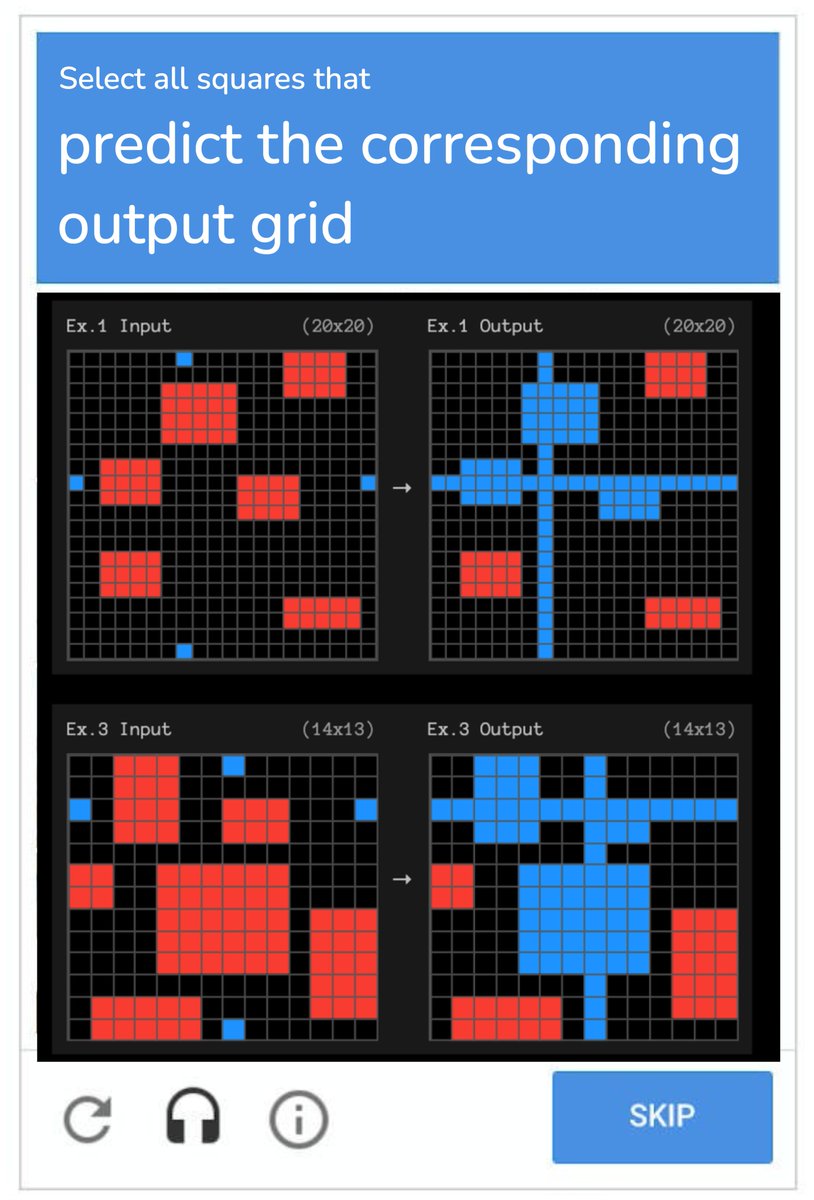
o3 @ 87.5% on ARC-AGI It was 16 hours at an increase rate of 3.5% an hour to "solved"


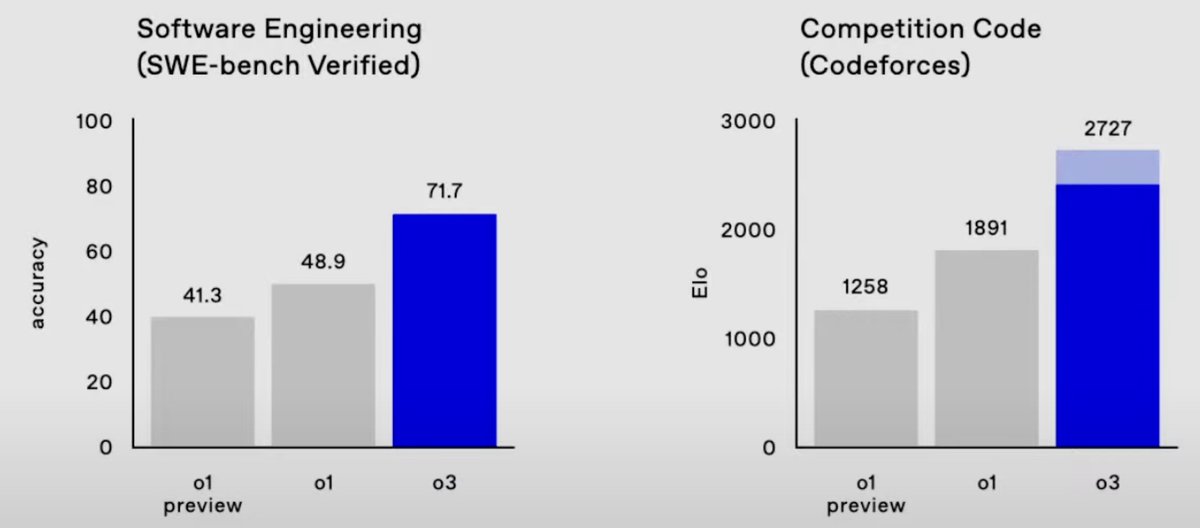
So we went from 0 to 87% in 5 years in ARC AGI score. There is no wall it seems. GPT-2 (2019): 0% GPT-3 (2020): 0% GPT-4 (2023): 2% GPT-4o (2024): 5% o1-preview (2024): 21% o1 high (2024): 32% o1 Pro (2024): ~50% o3 tuned low (2024): 76% o3 tuned high (2024): 87%

At this rate, how long til ARC-AGI is “solved”? For context: - gpt-4o @ 5% - Sonnet3.5 @ 14% - o1-preview @ 18% - o1 @ 32% - best scaffolded solution @ 54%

o3 @ 87.5% on ARC-AGI It was 16 hours at an increase rate of 3.5% an hour to "solved"

@GarrisonLovely To clear a possible misunderstanding: the quotes refer to questions in the highest tier of difficulty of FrontierMath. Not every question in the benchmark is as difficult as the ones Tao and Gowers reviewed.

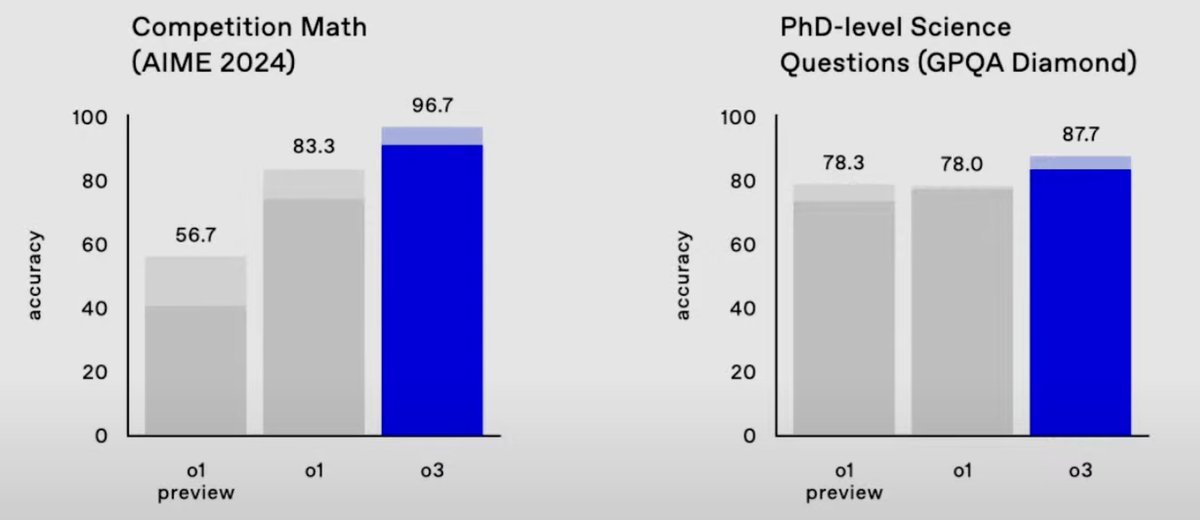
Well, on FrontierMath 2024-11-26 o3 improves the state of the art from 2% to 25% accuracy. These are absurdly hard strongly held out math questions. And on ARC, the semi-private test set and public validation set scores are 87.5% (private) and 91.5% (public). (7/n)