Dom Steil

2.6K posts

Dom Steil banner
Dom Steil

Dom Steil

@domsteil

CEO @stateset | Bitcoin | Blockchain | Technology

San Francisco, CA Katılım Haziran 2012
5.7K Takip Edilen1.8K Takipçiler
Sean Frank
Sean Frank@Seanfrank·
I personally know DTC brands who spend $100,000,000 a year on ads at break even. they live and eat off credit card points. That era is ending. Will they spend less? Maybe. Will they tolerate how much payment processing they pay? this is the real thing to watch. we pay 2-3% of all revenue to payment processing. But we used to get 1-2% of ad spend back. it was a deal we all accepted. treated it as a rebate. with the tax advantage, we were only REALLY paying .5% or less but the knock on affects are here. With points gone, how long until you see people hounding stripe, pushing debit card transaction, pushing stable coins. Prediction: in 4 years, the average brands payment processing rate will fall in half. and ad spend will always go up.
English
25
3
139
20K
Guillermo Flor
Guillermo Flor@guilleflorvs·
Sequoia's thesis that the next $1T company will sell work, not software, is the most important reframe in AI right now. The argument: if you sell a copilot, you're competing with every new model release. But if you sell the outcome — books closed, contracts reviewed, claims handled — every AI improvement makes your margins better, not your product obsolete. The key insight most people miss: for every $1 spent on software, ~$6 is spent on services. The entire SaaS playbook was about capturing the software dollar. The AI playbook is about capturing the services dollar — at software margins. Not "AI for accountants." The AI accounting firm. Not "AI for lawyers." The AI law firm. The companies that figure this out won't look like SaaS companies. They'll look like services firms rebuilt on software infrastructure. That's a fundamentally different company to build, fund, and scale. And most founders are still building copilots.
Guillermo Flor tweet media
English
228
538
5.6K
2.1M
Dom Steil
Dom Steil@domsteil·
@martin_casado 💯it's like a combination of using asic miners in house before selling them and mev
English
0
0
1
11
martin_casado
martin_casado@martin_casado·
It's only a matter of time before only the model creators have access to the most powerful models. The rest get access to smaller, distilled versions. Or access the models through first party apps and services that don't provide direct access to the token path. The investment needs for training are too high, and distillation too effective to warrant any other future.
English
108
68
868
492.1K
Simon Taylor
Simon Taylor@sytaylor·
Agentic commerce is dead. Despite ALL the hype from payments companies, agentic commerce isn't happening. Walmart saw a 66% drop in conversion when adding agentic commerce. We shouldn't embed checkouts in chatbots. We should make payments invisible and agent-native.
Simon Taylor@sytaylor

x.com/i/article/2040…

English
45
15
180
60.1K
Dom Steil
Dom Steil@domsteil·
@chamath webhook on chat to serverless api with embeddings api, embed chat output, query and check update or upsert in qdrant vdb
English
0
0
0
396
Chamath Palihapitiya
Chamath Palihapitiya@chamath·
This may be a dumb question but I’ll ask it here anyways: I can’t find a good way for my various AI chats to automatically sync its conversation history into a structured knowledge base. So that as I update various chats from time to time and refine context, my knowledge base automatically grows with this new info.
English
1.1K
63
2.4K
806.4K
Ben Kennedy 🏔️
Ben Kennedy 🏔️@benfkennedy·
Reply to this post if: A) You are a Shopify store operator and have seen an order come in on a ChatGPT sales channel. B) You are a customer who has been able to buy something directly through ChatGPT on a Shopify store. I still haven't seen either of these happen
Harley Finkelstein@harleyf

Brands on @Shopify are now shoppable inside @ChatGPTapp. AI shopping isn’t coming. It’s here. As always, our merchants are best positioned. Let's go.

English
14
0
41
18.9K
Dom Steil
Dom Steil@domsteil·
We applied the autoresearch optimization loop to the StateSet STARK proving system, a Winterfell-based prover for zero-knowledge commerce compliance proofs. Over 5 rounds and 30+ experiments, implementation changes (trace length reduction, constant precomputation) reduced prove time from 37ms to 13.4ms at the original ~128-bit conjectured security level — a 2.8x speedup with no security trade-off. A further parameter relaxation to 80-bit conjectured security yielded 6.3ms prove time and 42KB proofs (5.9x total speedup, 44% proof size reduction). github.com/stateset/state… github.com/stateset/state…
English
1
0
10
133
Dom Steil
Dom Steil@domsteil·
On the decentralized autoresearch network. Starks can verify the metric is improving eg the loss is better. Agent generates a stark proof for every autoresearch commit, multiple autoresearch agents running in parallel optimizing code, verifying the loss is better without having to check and test the code changes.
English
0
0
3
65
Dom Steil
Dom Steil@domsteil·
github.com/stateset/blind… The StateSet Blind Auction Protocol is a zero-knowledge procurement infrastructure designed specifically for agentic commerce. It allows automated agents to participate in trustless, sealed-bid auctions using cryptographic proofs to guarantee fairness, privacy, and fast settlement. Here is an overview of how the protocol works and its core features: 1. The Auction Mechanism (Vickrey Auctions) By default, the protocol uses Vickrey (second-price) auctions. In this type of auction, all bids are sealed so no one knows what anyone else is bidding. The highest bidder wins the auction, but they only have to pay the amount of the second-highest bid. This mechanism mathematically incentivizes agents to simply bid their true maximum value, eliminating the need to strategize or "shade" their bids. 2. Privacy via STARK Proofs To ensure the auction is truly "blind" and trustless, the protocol uses Zero-Knowledge STARK proofs (utilizing the Winterfell prover). When an agent submits a bid, they don't submit the plaintext amount. Instead, they submit a cryptographic proof (~95KB) that validates their bid is legitimate without revealing the actual amount or leaking real-time bid counts to competitors. 3. The Workflow The lifecycle of an auction on the protocol looks like this: * Creation: A supplier creates a lot (e.g., "500 Industrial Sensors") and sets a reserve price, mechanism, and escrow ratio. * Bidding: Autonomous agents submit their sealed bids. Each bid generates a STARK proof in about 45 milliseconds. * Close & Reveal: The supplier closes the auction. A "ZK ordering proof" is generated to mathematically verify that the bids were sorted correctly without tampering. * Settlement: The highest bidder wins but pays the second-highest price. Settlement happens in USDC via x402 payment intents on a layer-2 network with rapid 2-second finality. 4. Capital Efficiency & Escrow Usually, decentralized auctions require bidders to lock up 100% of their bid amount in escrow, which is highly capital inefficient. This protocol only requires a 10-20% collateralization ratio. It uses ZK solvency proofs to verify that agents have the funds to cover their bids across multiple concurrent auctions without needing to lock up the full amount everywhere. Agents also must stake a minimum of $1,000 to register, which can be slashed (penalized) if they misbehave. 5. Built for AI Agents The entire protocol is structured to be "agent-native." It includes an MCP server, OpenAPI 3.0 specifications, webhooks, Server-Sent Events (SSE) streams, and a TypeScript SDK. This makes it incredibly easy to plug the protocol directly into AI agents so they can autonomously negotiate and procure goods on behalf of human users or companies.
English
0
0
0
46
TBPN
TBPN@tbpn·
Sequoia’s @JulienBek says many of their founders are now wondering if they’re “just an iteration away” from AI labs destroying their business. He says the most defensible companies - and potentially the next trillion-dollar company - will be “a software business that masquerades as a services firm.” “If you sell tools today, you’re really in the line of sight for the models and you’re effectively competing with the next generation that they’re going to launch.” “Whereas if you sell the work, you’re actually benefiting from what the models are doing and all the billions of dollars that are going towards AI.”
Julien Bek@JulienBek

x.com/i/article/2029…

English
70
133
1.8K
682.7K
Dom Steil retweetledi
Morpheus
Morpheus@MorpheusAIs·
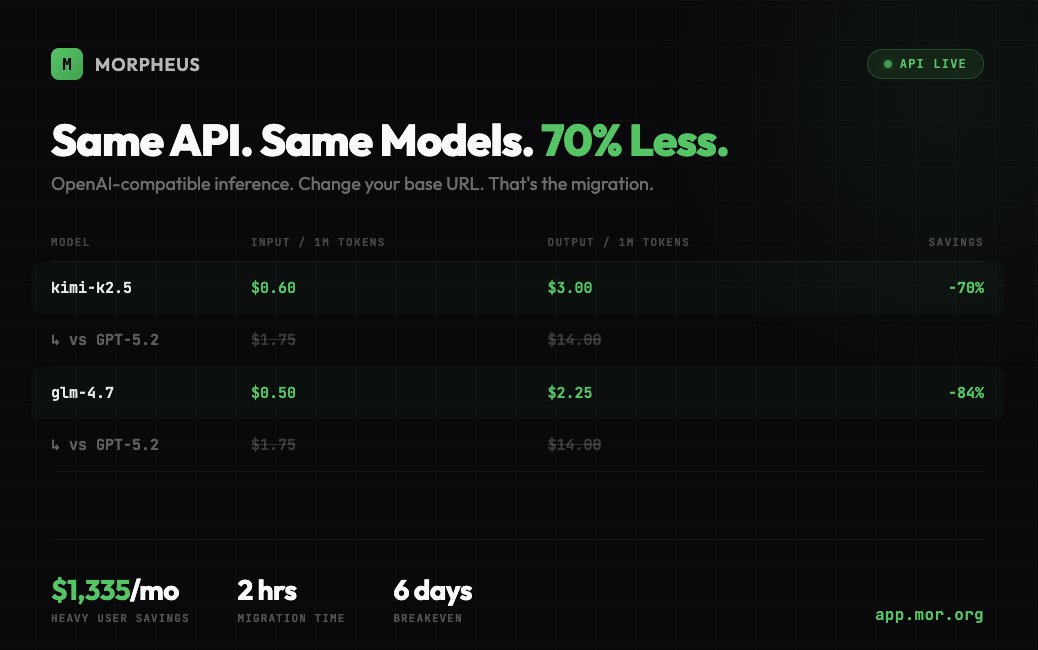
The Morpheus Inference API is live. Same API as OpenAI. 70% cheaper. No content filters. No vendor lock-in. Change your base URL. Your code works. Heavy users save >$1,335/month. AI that no one controls.
Morpheus tweet media
English
5
28
58
4.2K
Dom Steil
Dom Steil@domsteil·
The models are expert blenders, git clone the best repos you can find as context and grade your codebase against it to accelerate dev cycles
English
1
0
1
75
Dom Steil
Dom Steil@domsteil·
open source cli for dtc operators: github.com/stateset/state… claude code for intelligent commerce Just added new read/write actions across shopify, recharge, klaviyo, stay, skio, amazon, recharge and more.
English
1
0
3
138
Dom Steil
Dom Steil@domsteil·
I find my workflow to be multiple terminals open, review this codebase and grade it, right a technical whitepaper on it, have two agents review the paper and provide feedback, create and implement our next sprint based on the feedback, bump the version, tag it and push it, build and deploy on k8s using kubectl
English
0
0
2
372
Andrej Karpathy
Andrej Karpathy@karpathy·
It is hard to communicate how much programming has changed due to AI in the last 2 months: not gradually and over time in the "progress as usual" way, but specifically this last December. There are a number of asterisks but imo coding agents basically didn’t work before December and basically work since - the models have significantly higher quality, long-term coherence and tenacity and they can power through large and long tasks, well past enough that it is extremely disruptive to the default programming workflow. Just to give an example, over the weekend I was building a local video analysis dashboard for the cameras of my home so I wrote: “Here is the local IP and username/password of my DGX Spark. Log in, set up ssh keys, set up vLLM, download and bench Qwen3-VL, set up a server endpoint to inference videos, a basic web ui dashboard, test everything, set it up with systemd, record memory notes for yourself and write up a markdown report for me”. The agent went off for ~30 minutes, ran into multiple issues, researched solutions online, resolved them one by one, wrote the code, tested it, debugged it, set up the services, and came back with the report and it was just done. I didn’t touch anything. All of this could easily have been a weekend project just 3 months ago but today it’s something you kick off and forget about for 30 minutes. As a result, programming is becoming unrecognizable. You’re not typing computer code into an editor like the way things were since computers were invented, that era is over. You're spinning up AI agents, giving them tasks *in English* and managing and reviewing their work in parallel. The biggest prize is in figuring out how you can keep ascending the layers of abstraction to set up long-running orchestrator Claws with all of the right tools, memory and instructions that productively manage multiple parallel Code instances for you. The leverage achievable via top tier "agentic engineering" feels very high right now. It’s not perfect, it needs high-level direction, judgement, taste, oversight, iteration and hints and ideas. It works a lot better in some scenarios than others (e.g. especially for tasks that are well-specified and where you can verify/test functionality). The key is to build intuition to decompose the task just right to hand off the parts that work and help out around the edges. But imo, this is nowhere near "business as usual" time in software.
English
1.6K
4.8K
37.2K
5.1M
Dom Steil
Dom Steil@domsteil·
@mcuban Yes, and they will need to charge for either the outcomes their own Agent produces or usage pricing for state changes on their systems executed from within a customer's own agentic workflows.
English
0
0
0
38
Mark Cuban
Mark Cuban@mcuban·
If true and agents work on top of enterprise software, doesn't this eliminate the need for per seat pricing by the software companies ? The coin of the realm for agents and AI in general is tokens. I don't see how enterprise software reconciles this conflict. Particularly when the agent "shops" for the most cost effective path with in an enterprise. I think the enterprise software companies will be able to charge for creating and managing agents and how they engage for companies that can't. But I don't see how the revenues stay where they are. Thoughts ?
zerohedge@zerohedge

"After watching Anthropic's Enterprise Agents briefing event, we have even greater conviction that model providers are unlikely to displace software incumbents and are instead positioning themselves and their agents to be an orchestration layer on top of existing and incumbent systems" - Deutsche Bank


English
270
30
628
484K
Aakash Gupta
Aakash Gupta@aakashgupta·
This tweet frames Zvec as a Pinecone killer. That framing obscures what Alibaba actually built. Zvec is an embedded, in-process library. No server. No network calls. No daemon. You import it like you import pandas. Pinecone and Weaviate will never see this in their competitive dashboards because it targets a completely different layer of the stack. The technical lineage matters here. Proxima has been running production vector search inside Alibaba for years. Taobao product search, Alipay face payments, Youku video recommendations, Alimama advertising. Billions of queries across systems where latency failures cost real revenue. What Alibaba’s Tongyi Lab did is strip that engine down, wrap it in a Python API, and release it as a library anyone can pip install. The benchmarks back it up. On VectorDBBench with the Cohere 10M dataset, Zvec hits 8,000+ QPS at comparable recall. That’s more than 2x ZillizCloud, the previous #1, with faster index build times. An embedded library matching or beating managed cloud services on raw throughput. This follows the SQLite playbook. SQLite opened an entirely new category of database usage by embedding directly inside applications. Software that would never have run a client-server database suddenly had access to SQL. Zvec is making the same bet for vector search: local RAG pipelines, desktop AI assistants, CLI tools, edge devices, anywhere spinning up a Pinecone cluster would be absurd. And that tells you where AI inference is heading. Every agent framework, every local assistant, every on-device RAG system needs vector search. The vast majority of those workloads run fine on an in-process library with 64 MB streaming writes and configurable memory limits. Pinecone raised $138M and just repositioned as a “knowledge platform.” Weaviate raised $50M. Their customers have SLAs, compliance requirements, and enterprise procurement cycles. Zvec is going after the 90% of developers who were overprovisioning infrastructure for workloads that fit inside a single process. The companies that should actually be nervous are Chroma and FAISS, the current defaults for lightweight local vector search, because Zvec just showed up with Alibaba-scale engineering in a pip-installable package.
English
23
28
320
42K