doucheen
2.3K posts

can you not distinguish between chinese and vietnamese you racist
そこねさがし📈@BlueHawk1378
ベトナムからの配信です。日本人からすると、不可解なことが、沢山つまっている動画ですね。。
English


@IntCyberDigest @L1v1ng0ffTh3L4N chrome has private key to decrypt those passwords in memory, too.
English

❗️🚨 Microsoft Edge keeps every saved password in process memory as cleartext from the moment it launches. Microsoft's responsed when reported: "by design."
All of them. Including credentials for sites you won't open this session.
Researcher @L1v1ng0ffTh3L4N tested every major Chromium browser. Edge is the only one that behaves this way.
Chrome decrypts credentials on demand, and App-Bound Encryption locks the keys to an authenticated Chrome process so other processes can't reuse them.
In Chrome, plaintext surfaces only during autofill or when a password is viewed, making memory scraping far less useful.
What makes this extra weird is that Edge still demands re-authentication before revealing those passwords in its Password Manager UI, while the same browser process already holds every one of them in plaintext.
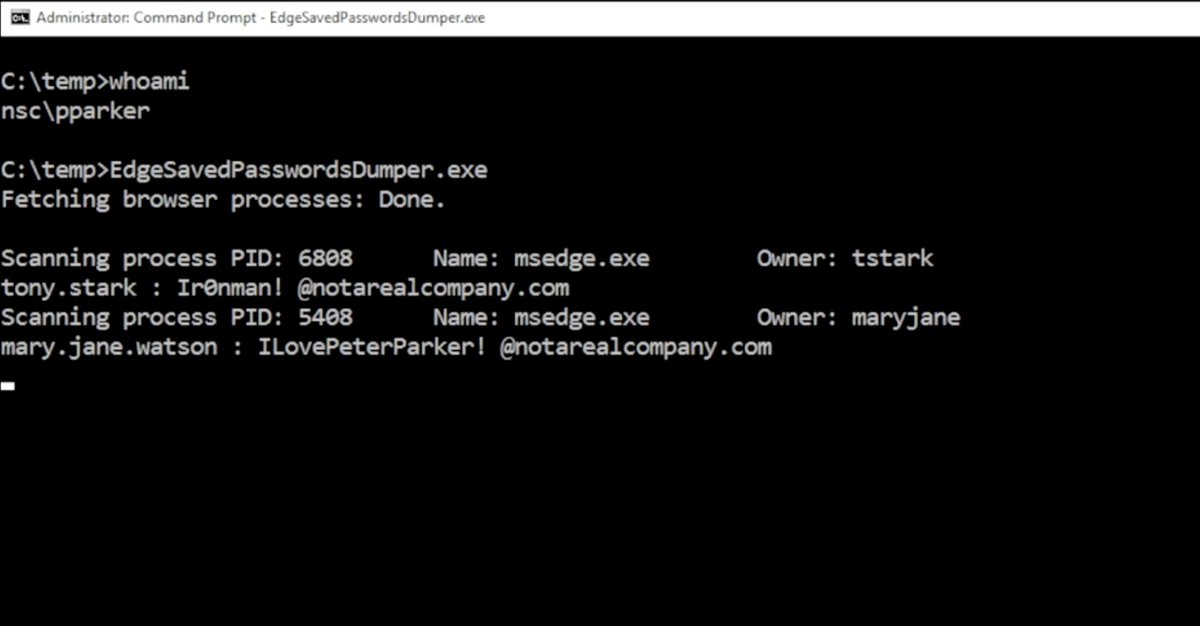
In shared environments, this turns into a credential harvest. On a terminal server, an attacker with admin rights can read the memory of every logged-on user process. In the published PoC video, a compromised admin account lifts stored credentials from two other logged-on (and even disconnected) users with Edge running.
Microsoft's official response when notified: "by design."
The finding was disclosed April 29 at BigBiteOfTech by PaloAltoNtwks Norway, alongside a small educational tool that lets anyone verify the cleartext storage for themselves.

English

Notice how all the loudest voices against climate change are silent on data centers and AI? Wonder why that is...
English
@KenraalitSuomi Liberal democracy was always an American thing. People love authorities.
English

The EU is a far‑left monster — a corrupt, unelected bureaucracy drowning in woke ideology. EU isn't about safety. It's about total control: digital ID, chat surveillance, VPN bans. Brussels doesn't want citizens. It wants obedient subjects. Tear it down.
English





qBittorrent 5.2 introduces UI updates, new features like system reboot post-download, tracker status filter, torrent creator button, and expanded language support. It also improves performance, web API, and RSS, and fixes bugs for better stability.
alternativeto.net/news/2026/5/qb…

English

There’s a famous Usenet story about a programmer (Mel) who refused higher level abstractions.
It was the late 1950s, and even in that era, Mel was…well today we’d call him a boomer.
Mel only wrote in raw hexadecimal. He didn’t approve of compilers, and refused to use optimizing assemblers.
"You never know where it's going to put things”, he said.
Everyone else in the company was moving on to FORTRAN, and they didn’t understand why Mel was so stubborn about using new tools. He *loved* self-modifying code.
“If a program can’t rewrite its own code”, he asked, “what good is it?”
Mel eventually left the company, and other engineers were tasked with understanding what was left.
Mel’s hand-optimized routines always beat the assemblers; but some of it looked absolutely bizarre.
One engineer took ~2 weeks to understand why there were loops with no exit condition…yet the program worked fine.
I won’t spoil all the details, you should really read it, it’s short. But it’s a fantastic piece on “what defines a real programmer?”…which is becoming increasingly relevant in this vibe-coded era.
I strive to understand computers as deeply as Mel! If we aren’t careful, we’re going to lose the “Mels” of this world to time.
That’s part of why I go so deep in my youtube videos. I hope that younger viewers are genuinely fascinated by the inner workings of our machines, instead of handing everything off to higher abstractions.
solst/ICE of Astarte@IceSolst
Interesting article on treating agent output like compiler output (and why) skiplabs.io/blog/codegen_a…
English
@Mericamemed still better than the real finale. i wish i stopped watching it in the first series.
English

@SumamosValor @Argenpoirot yep. he was awful in Dr. Dolittle and many more. I haven't watched it, but in Sherlock Holmes as well.
English




He truly believes he has the right to choose how many people live on Earth
matrixbot@thematrixb0t
Bill Gates: "Due to advances in AI, humans will no longer be needed." "Will we still need humans? "Not for most things. We'll decide."
English

In OS development we absolutely do review compiler output by reading assembly. Not every build, but in general - yes, even though it is highly accurate and deterministic.
For security fixes, I used to read both assembly and disassembly of the final fix.
solst/ICE of Astarte@IceSolst
Interesting article on treating agent output like compiler output (and why) skiplabs.io/blog/codegen_a…
English

🦀 Rust vs C for embedded firmware : researchers finally put it to the test.
Two teams. Same functionality. One wrote it in C. One in Rust.
They ran side by side for months on real industrial IoT hardware.
The result? 👇
No strong reason to prefer C over Rust, not on memory footprint, not on execution speed.
And Rust's runtime (Ariel OS) actually came out smaller than the traditional bare-metal C stack.
The "C is faster for embedded" argument just got a lot harder to make. ⚡
🔗 arxiv.org/abs/2604.25679
#Rust #RustLang #EmbeddedSystems #IoT #SystemsProgramming #C

English


@rolandbouman One of the pain points of llm. It's not deterministic based on understood static logic and you must review every line. To to reach the compiler level reliability, the agents must understand how the universe works deterministically.
English

Compiler construction is one of the oldest, best understood CS fields. It's decades of work by the brightest minds, and it's grounded in logic, informed by experience and strictly deterministic.
Comparing that with LLM-based coding agents is just wrong.
x.com/IceSolst/statu…
solst/ICE of Astarte@IceSolst
Interesting article on treating agent output like compiler output (and why) skiplabs.io/blog/codegen_a…
English
@MuenzenMeister Ask for refund. The whole experience of having ice cream is ruined.
English

Guilt Tipping in Deutschland:
War gerade Eis essen. Am Kartenlesegerät kommt vor der Zahlung die Trinkgeldfrage: 5%, 10%, 15% oder individuell. Für einen Eisbecher zum Mitnehmen! Und jeder in der Schlange hinter dir sowie der Kassierer sieht auf dem Bildschirm was tippst.
Dieses System kommt aus den USA und breitet sich hier gerade überall aus. Restaurants, Cafés, Bäckereien.
Wichtig zu wissen:
In den USA verdient ein Kellner als Grundgehalt 2,13 Dollar die Stunde. Ohne Trinkgeld kann der seine Miete nicht zahlen.
In Deutschland jedoch bekommt jeder Kellner mindestens 13,90 Euro die Stunde, egal ob du Trinkgeld gibst oder nicht. Wir übernehmen gerade ein System das für ein Problem erfunden wurde das wir gar nicht haben.

Deutsch

Balıklarınız akvaryumda sıkılıyorsa, onlar için bir köprü yapın!
Türkçe

Ursula von der Leyen tells a man he is lucky to live in the EU, where there is free speech, while he is being arrested for protesting against her
English


doucheen retweetledi