RusticDreams

177 posts

RusticDreams banner
RusticDreams

RusticDreams

@dreamrust50227

Katılım Nisan 2025
202 Takip Edilen106 Takipçiler
RusticDreams
RusticDreams@dreamrust50227·
There’s a special event happening on the Rialo Discord today at 16:30 UTC. I’ve spent a long time reading about Latch, researching it, and creating content around it. But today, we’ll get to hear about it directly from the person who built it. Ade, Rialo’s Co-Founder & CEO, is joining the community in this format for the first time. He’ll start with a deep dive into Latch, followed by a live Q&A where anyone can ask their questions directly. I’ve been part of this community for about a year now, and this is the first time I’ve seen our CEO connect with the community like this. That alone makes this a session I don’t want to miss. 📍 16:30 UTC — Rialo Discord Hope to see you there 👋 @RialoHQ @RialoTR
RusticDreams tweet media
English
5
0
16
137
RusticDreams
RusticDreams@dreamrust50227·
100:1. People say there will be 100 agents for every human in the digital economy. The number sounds reasonable, but I don’t think the real question is the number itself. It’s how much authority those agents will actually have. Today, most agents still can’t operate independently in any meaningful way. They can’t manage money, access critical systems, or make important decisions on their own. The trust problem hasn’t been solved yet. a16z breaks this down into five different areas, but they all point to the same thing. The first is identity. Agents are still the “unbanked” users of the digital world. They can’t easily prove who they are, what they’re authorized to do, or how they get paid in a portable and verifiable way. The second is governance. As agents take on more responsibility, the question becomes who is really in control. Users can vote, but if the underlying infrastructure is controlled by a single provider, that authority only goes so far. The third is payments. Protocols like x402 are turning agents into economic actors that can pay each other directly without relying on traditional payment flows. The fourth is trust. Intelligence is getting cheaper. Verification is becoming more valuable. Human oversight simply can’t keep up with the speed agents operate at. The fifth is user control. Agents are no longer just deciding how a task gets done. They’re increasingly deciding who does it. The user shifts from operator to supervisor. To me, that’s the most important takeaway from the article. The Agentic Age won’t be unlocked by smarter models alone. It will be unlocked by more trustworthy systems. Without solving identity, payments, verification, and authorization, it’s hard to imagine an economy where hundreds of millions of agents can operate at scale. That’s what caught my attention about Rialo. It doesn’t treat trust as a feature you add later. It treats trust as part of the foundation from the start. @RialoHQ @RialoTR
RusticDreams tweet media
English
7
0
24
223
slymnogunc
slymnogunc@slymnogunc·
Speed is money. But most people still think networking is about bandwidth. It's not. Every millisecond of latency carries an economic cost. Every delayed packet is a missed opportunity. Every second saved is value captured. That's why Optimum isn't just making networks faster. It's transforming time itself into an economic advantage. With RLNC-powered mump2p, networks spend less time waiting, less time retransmitting, and more time delivering innovative information. ⚡More innovative data. ⚡Faster decoding. ⚡More completed transactions. ⚡More value extracted from the same infrastructure. The next generation of internet winners won't be the ones moving the most data. They'll be the ones extracting the most value from every second. Speed isn't a feature. It's a financial primitive. ⚡️ @get_optimum is building for that future. 🔥 @cryptooflashh @blockchainjeff
English
4
0
22
193
eliot
eliot@cryptowoodd·
For the past couple of weeks, I've been thinking about what I could build for the Magnitude community. I wanted to build something that everyone could be part of. Something that could become a small memory from their Seismic journey... So I built Magnitudes Selfie. A little project that mixes my art, AI, and a lot of vibe coding, where anyone can take a selfie with Rocky and leave a small message about what Magnitude, Rocky, Seismic, or the community means to them. I genuinely hope you enjoy it as much as I enjoyed building it. Can't wait to see everyone's selfies)) [🔗magnitudesselfie.xyz] @xealistt @NoxxW3 @heathcliff_eth
English
42
2
115
12.9K
RusticDreams
RusticDreams@dreamrust50227·
@tmsiyahbeyaz Most projects are building vehicles. Rialo is building the highway they’ll travel on.
English
0
0
1
14
Tuby 🔆
Tuby 🔆@tmsiyahbeyaz·
The Submarine Cable Between Traditional Finance and Blockchain: Rialo Think about the early days of the internet. Anyone who wanted to build a website had to manage servers, configure networks, and wrestle with infrastructure. Then cloud computing arrived. People stopped worrying about cables and started focusing on ideas. Rialo is creating a similar transformation for blockchain. Today, many blockchain projects operate like ships trying to navigate in the middle of the ocean. Data is scattered across different sources, systems remain disconnected, and developers constantly find themselves building new bridges. Rialo acts like an invisible submarine cable connecting those isolated islands. Institutional-grade market data, the same kind used by traditional finance, can now flow directly into blockchain applications without complex integrations. One of the clearest examples is Rialo's integration with Cboe, one of the world's leading financial market infrastructure providers. This allows developers to focus on building applications instead of spending their time dealing with fragmented data providers. Because Rialo is not just a blockchain. It is an intelligent financial operating system that brings together data, automation, and real-world connectivity in a single environment. The real goal is not building another blockchain. The real goal is paving the roads of the future financial system. While many projects are focused on building vehicles, Rialo is building the highway those vehicles will travel on. That is why being featured in the Cboe Innovation Spotlight is more than a milestone. It is a signal that traditional finance and the onchain economy are beginning to speak the same language. As the next generation of finance is being built, some will create applications. Rialo is preparing the foundation they will stand on. @RialoHQ @RialoTR (This is not an advertisement or collaboration.)
Tuby 🔆 tweet media
English
12
0
30
391
RusticDreams
RusticDreams@dreamrust50227·
API keys have had the same problem for years. Whoever has the key gets the access. It can be copied, leaked, or stolen. The system doesn’t know who’s actually using it, it only checks whether the key is valid. What caught my attention about Latch is that it approaches the problem from a completely different angle. Instead of asking “How do we protect API keys better?”, it asks a much simpler question: What if there was no key to steal in the first place? With Machine Bound Identity, access is tied to authorized machines instead of a string. If a machine isn’t on the whitelist, it doesn’t get access. Stealing a key alone doesn’t really help because the system is no longer asking “Is this the right key?” It’s asking “Is this an authorized machine?” Cedar policies and spend limits are another interesting piece of the puzzle. You can define exactly which APIs an agent can access, what actions it can take, and how much it can spend. Agents are getting more autonomy every day. They’re making decisions, executing actions, and handling more responsibility. Because of that, access control is becoming one of the most important parts of the stack. Getting rid of API keys entirely is a big goal. But the idea behind Latch is surprisingly simple: Can’t steal credentials if there are no credentials to steal. onlatch.com @RialoHQ @RialoTR
English
5
0
20
196
Gökdeniz(❖,❖)
Gökdeniz(❖,❖)@0xgokdeniz·
Rialo is viewed as an approach offering an innovative solution to the growing problem of compounded marginalization within the crypto ecosystem. This issue arises from the increasing number of middleware services required for blockchain applications to function and the fact that each service is billed independently. As individual service providers aim to maximize their own profits, total costs escalate rapidly, this drives up expenses for application developers and inflates the fees paid by end users. Consequently, user demand declines and system wide earnings drop, effectively restricting the crypto ecosystem to a limited group of well funded, financially robust applications. Rialo aims to resolve this fundamental structural issue through a vertical integration strategy. Services that are left to independent middleware providers in the traditional model are integrated directly into the protocol within Rialo's system. This consolidates critical functions such as data provision, transaction automation, indexing and crosschain communication into a single, unified structure. This approach eliminates third party dependencies and removes the cost burdens associated with the separate fees charged by independent layers. Furthermore, by centrally coordinating pricing, the system aims to boost overall efficiency and user satisfaction rather than merely maximizing individual profits. This solution significantly reduces operational costs for developers while enabling users to benefit from more accessible, lower cost applications. Rialo also mitigates the overconsumption of common resources plaguing the current system, thereby contributing to the establishment of a more balanced economic order. This model not only reduces costs but also fosters innovation, enables the emergence of new applications and paves the way for the mass adoption of crypto. @RialoHQ @RialoTR @slymnogunc
Gökdeniz(❖,❖) tweet media
Gökdeniz(❖,❖)@0xgokdeniz

It begins by emphasizing that, in distributed systems, consistency answers the question "which data does the client see, when and in what order?" rather than simply "is the data correct?" This is because data is replicated across different servers and writes propagate to these servers with a delay rather than instantaneously consequently, viewing the same data from different points may temporarily yield different results. This situation is not an error but a natural outcome of the system design. At this juncture, consistency is categorized into two types server side consistency guarantees that committed data is correct and durable, whereas client side consistency determines how the client perceives this data which is the focus of the article. The consistency models used to address this issue are viewed as a spectrum. Strong consistency the most robust model mandates that every read operation accesses the most up to date data, forcing the system to behave as if there were only a single copy of the data however, achieving this requires coordination among replicas, which increases latency and in some instances, reduces availability. Bounded staleness allows data to be slightly outdated but constrains this lag within specific time or version limits, thereby enhancing system performance while keeping data freshness under control. The consistent prefix model guarantees the preservation of write order while a client might not see the absolute latest data, the sequence is never disrupted and intermediate steps are never skipped. Monotonic reads ensure that the data a client sees throughout a session never regresses the data may start out stale, but it never reverts to an older state as the session progresses. Read my writes guarantees that a client can immediately see the changes they have made a feature that is particularly critical for user experience. Finally, eventual consistency the weakest model accepts that the system may return any stale value Reads may be inconsistent or out of order, but once new writes cease, all replicas eventually converge to the same state. It also clarifies the distinction between linearizability and serializability while serializability guarantees that operations can be reduced to a valid sequential execution, linearizability mandates that this ordering aligns with real time meaning that reads performed after an operation completes must reflect that operation. These consistency models are evaluated based on the trade off between safety and performance. Strong consistency ensures high correctness but comes at a high cost weak consistency offers greater speed and availability but permits temporary inconsistencies. Consequently, real world systems often strike a pragmatic balance rather than choosing a single model, employing strong consistency for critical operations and weaker models for less critical read operations. @RialoHQ @RialoTR @slymnogunc

English
10
0
39
741
TheFalcon🫟
TheFalcon🫟@TheFalconTez·
Biggest misconception about proof systems? That they're only for privacy. The real shift is scale. When computation happens off chain and verification stays on chain, you unlock real time simulations, HFT financial logic, and private AI workflows. Rialo gets this. They're using proofs as a foundational execution model, enabling applications traditional chains could never support. Every piece of content I create for Rialo comes with a different level of excitement, simply because the quality of what they build keeps blowing me away. As Thetezcan & TheFalcon, I've been covering Rialo for almost a year, and I'll definitely keep dropping updates for you all. @RialoHQ @itachee_x @slymnogunc @ecelannister
TheFalcon🫟 tweet media
English
11
0
25
277
Fay
Fay@fayfilmkm·
good morning my frens 💕 and yes yes, you are special ☺️
Fay tweet media
English
14
0
32
244
RusticDreams
RusticDreams@dreamrust50227·
In crypto, borrowing money often means you already need to have money. Want to borrow $100? You’ll probably need to lock up $150 in collateral. The system doesn’t know who you are, so collateral is the only thing it can trust. Banks don’t work that way. They look at your credit history, income, identity, and repayment record. That information replaces collateral. That’s why mortgages, credit cards, and business loans exist in the first place. Rialo is trying to bring that idea onchain, but with a different approach. Most solutions need to see your data. Rialo doesn’t. It can verify things like your credit score or banking history without exposing the underlying information. By default, the data stays private and is only revealed if you default. Not having to choose between privacy and access to credit feels like a pretty big shift to me. The global unsecured lending market is worth around $4.7 trillion. Onchain lending is roughly $56 billion, and almost all of it is overcollateralized. That’s a massive gap. Rialo built a simple demo that lets you see the idea in action. The more information you choose to verify, the less collateral you need to post. You can try it yourself: lending-calculator.rialo.io 👀 @RialoHQ @RialoTR
RusticDreams tweet media
English
6
0
23
239
Meraj
Meraj@0xMerajj·
⚪Why Integration Creates More Value Than Specialization Most people think scaling different parts of a system separately is the most efficient path But the biggest breakthroughs often happen when complementary components are built together. Think about an EV company producing both batteries and vehicles. Better batteries make vehicle production cheaper safer and more scalable More vehicles create stronger demand for batteries, making battery innovation even more valuable. The result isn’t just growth in two separate products It’s the creation of new capabilities, lower costs, higher quality and innovations that wouldn’t exist if each component were developed in isolation. This same principle is at the core of @RialoHQ When components reinforce each other in production, integration unlocks more value than separation ever could. The strongest systems aren’t built from isolated optimizations They’re built from aligned components that compound each other’s strengths @slymnogunc | @itachee_x
Meraj tweet media
Meraj@0xMerajj

⚪️ How reactive execution works inside blocks @RialoHQ allows users to register transactions that automatically execute when a predefined condition becomes true ✅ The process works as follows👇🏻 1️⃣ Users register a condition and the logic that should run when it is met. 2️⃣ Regular transactions execute and update the blockchain state. 3️⃣ At the end of each block Rialo checks whether any registered predicates have been satisfied by those state changes. 4️⃣ If a predicate becomes true the associated transaction is automatically queued for execution. 5️⃣ Its execution is guaranteed by the network’s consensus mechanism and the resulting state changes are visible to all nodes. ^^^^^^^^^^^^^^^^^^^^^^^^^^^^^^^^^ The key advantage is that everything happens natively on chain and is handled by validators eliminating the need for bots or external automation services This reduces complexity prevents race conditions, improves reliability during network congestion and provides stronger security guarantees @itachee_x @slymnogunc @ericargent31113

English
31
0
42
1.2K
SpecialistOG
SpecialistOG@SpecialistOG1·
RIALO Connecting The Physical World With Blockchain Technology By integrating digital services with the physical world and its associated data and with decentralised applications, Rialo is building the ultimate blockchain platform to enable users to access, utilise and leverage Web3 technology using the traditional systems they are familiar with. Through its platform, data will be transferred from real world to blockchain (and vice versa), thus establishing a base for developers, entrepreneurs and businesses to build connections with their respective users while allowing for the real time exchange of data and/or interactions from the real world. Innovations in finance, AI, digital identity, enterprise and other core areas will continue to be created and enhanced by Rialo’s direct and indirect contributions to enhancing global connectivity with blockchain technology. Benefits Of Rialo • Integrates Real World Data • Developer Backed Infrastructure • Secure & Scalable Connectivity • Enterprise Grade Applications • Groundbreaking Innovations Rialo’s Vision Rialo’s vision for the future of global connectivity is to bridge the gap between blockchain technology and the real world by enabling seamless data; application; and user interconnectivity on a holistic level and to create the foundation for the future of decentralised innovations. One Network. One Purpose. Endless Possibilities. @RialoHQ @RialoTR @slymnogunc
SpecialistOG tweet media
English
14
1
38
507
SpecialistOG
SpecialistOG@SpecialistOG1·
@dreamrust50227 Interesting perspective. If compliance can be enforced by code rather than centralized discretion, it could reduce the tradeoff between regulation and decentralization. The challenge is whether those rules remain transparent, fair, and adaptable over time.
English
1
0
0
41
RusticDreams
RusticDreams@dreamrust50227·
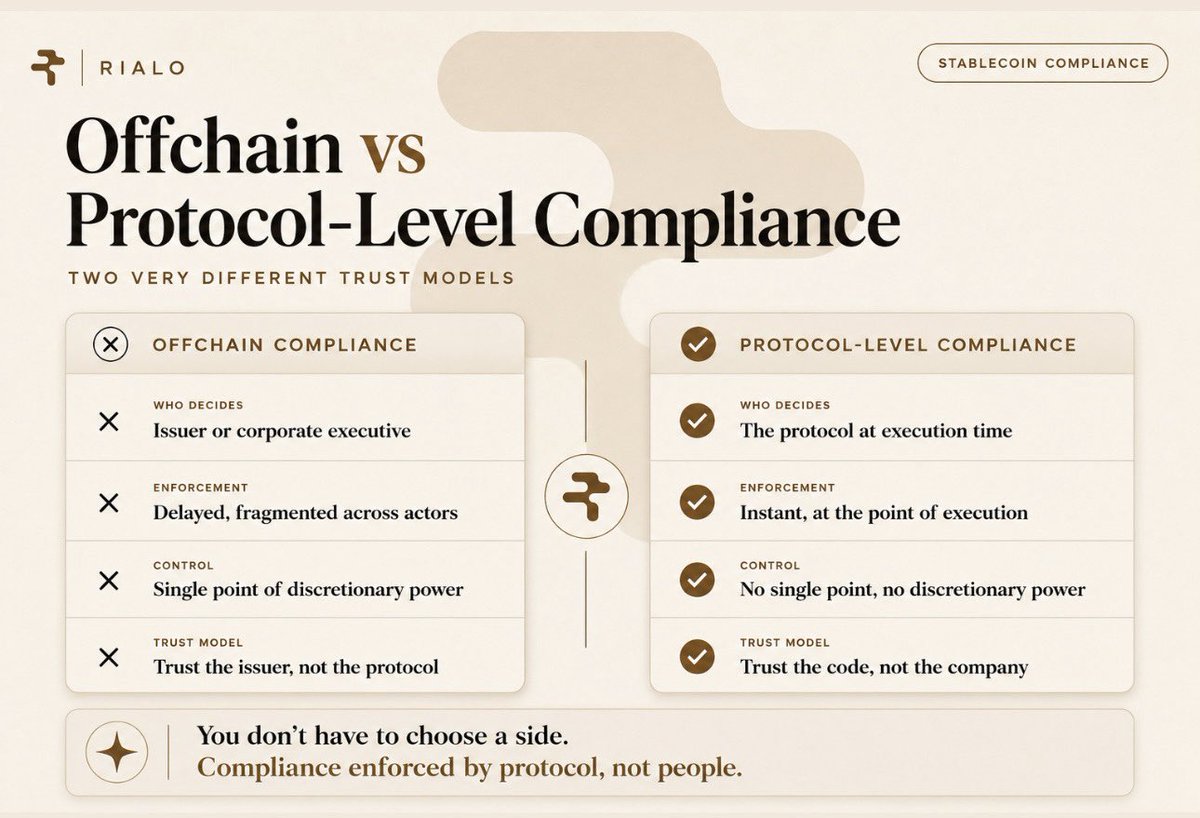
Stablecoin censorship always ends up in the same debate. One side says compliance is necessary. The other says giving that power to a single institution recreates the very trust problem crypto was supposed to solve. Honestly, both sides have a point. Companies like Circle can freeze wallets and restrict funds. That means a corporate entity ultimately decides what is allowed and what isn’t. For many people, that feels at odds with the idea of decentralization. At the same time, it’s hard to imagine stablecoins reaching mainstream adoption without some form of compliance. What caught my attention in Rialo’s demo is that it asks a different question: What if compliance didn’t have to rely on an offchain decision-maker? Instead of trusting an issuer or a middleware provider, the protocol itself evaluates transactions at execution time. If a rule is violated, the transaction simply doesn’t execute. No state changes. No discretionary decisions. No single actor making the call. Rialo didn’t just talk about this idea. They showed a working implementation. Maybe the real goal isn’t choosing between compliance and decentralization. Maybe it’s finding a way to have both. @RialoHQ @RialoTR
RusticDreams tweet media
English
2
0
16
237
Klaus Michaelson
Klaus Michaelson@klaus_michels0n·
Rialo: Real Loans. Real Returns. Most DeFi "earnings" have a dirty secret: They don't come from the real world. They come from other crypto users borrowing money to gamble on prices. No new money enters. Just the same dollars spinning in circles. Scientists call this a closed-loop system economists call it unsustainable. --- Think of it like a poker table. Everyone's winning... from each other. The moment people stop playing? The "yields" vanish overnight. --- Rialo flipped the table entirely. Instead of recycling crypto dollars, Rialo connects your capital to real businesses, companies borrowing to buy delivery trucks, expand operations, pay real employees. They repay loans from actual profits. Not speculation. --- Here's what makes Rialo different from just "trusting the process": Its Determination Layer pulls raw data, bank records, payment histories directly from the source. No middlemen. No hidden truth. Just verifiable, on-chain proof that a real business is paying back a real loan. --- Real trucks. Real payments. Real yield. That's what @Rialohq is building, a bridge between blockchain capital and actual economic activity. DeFi finally grew up.
English
30
0
69
843