

drew carlyle
391 posts


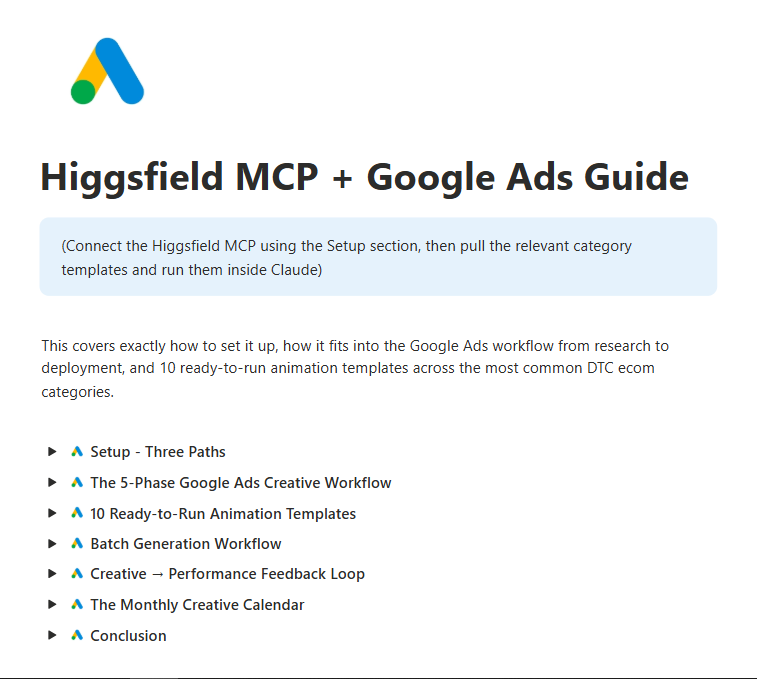
i've been testing the new Higgsfield MCP connector to generate ALL our google ads creatives inside a normal Claude project
and results have been absolutely INSANE
so i've decided to document the ENTIRE system...
covering the setup, workflow, and ready-to-run templates to generate visuals for shopping, display, demand gen, shorts, and long-form youtube ad campaigns in SECONDS inside Claude
here's what's included inside the guide:
> 3 paths to connect Higgsfield MCP to Claude
(Claude Cowork, Claude Code with JSON config, Python for automation)
> phase-by-phase workflow:
product photography → video generation → asset organisation > campaign deployment
> 10 animation templates
covering supplements, pet care, skincare, fitness, collagen, and home goods
> batch generation prompt
builds a full asset package in one session
> the prompt feedback loop
turning one winning format into 40+ proven variants
> monthly calendar:
week-by-week production schedule to sustain creative velocity
all backed by everything i learned after generating $20M+ for ecom brands at my google ads agency.
and for 24h, it can be ALL yours for free
like + comment "GUIDE" and i'll send it over
(must be following + RT for priority access)
English

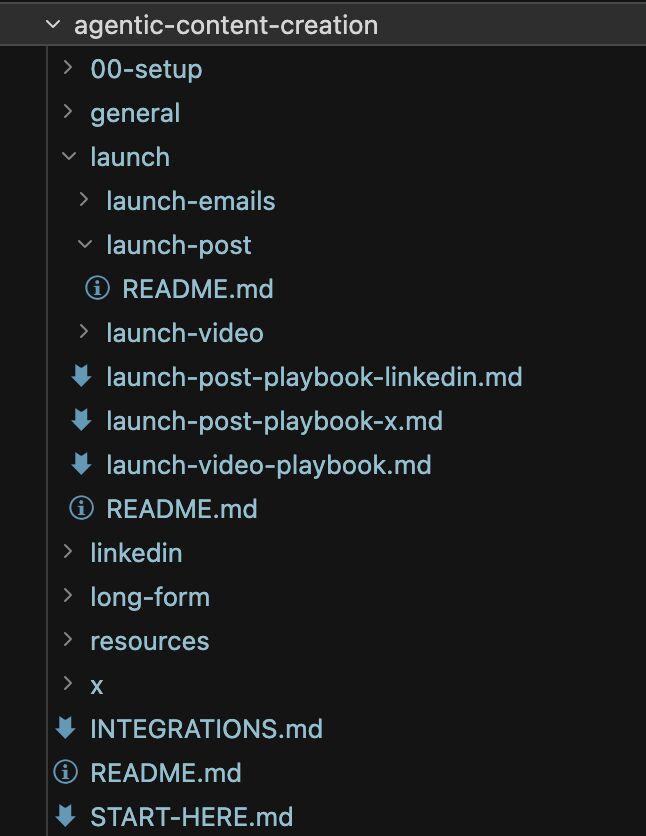
spent like 20hrs making a massive zip file of skills and agents for content creation
linkedin, X, longform, launch videos, etc all a prompt away. I used it to write our next launch script.
lmk if you want to try it and ill send it over.
English


English

Spotify needs to release a “kids” setting so I can play all the songs my kids listen to without it affecting my own Discovery algorithm.
Insane that I can’t do this already.
My Discover Weekly is just nursery songs and Moana.
@Spotify please fix this.
English
@danielcberk @Spotify Haha. I set up an email address for them so I could have a kids account so I don’t randomly get Disney songs thinking that’s what I want to hear
English
@moseskagan Industrial is my next play. All out rent houses were always so painful and we are in a landlord friendly state
English
Industrial real estate in a good area:
1. Figure out roughly what tenants are willing to pay
2. Buy a building for a price where that rent will generate a reasonable return
3. Once the existing tenant(s)' lease ends, re-lease at market rent
4. Sell, refi or hold all-cash
We're currently working on Step 3 on our first industrial deal.
Bc I'm like a whipped dog from repositioning so many apartment buildings in LA, I keep flinching, waiting for the pain to begin.
And, so far... nothing.
Without meaning to jinx myself: If this keeps up, I'm really going to start to wonder what the h*ll I have been doing with my life.
English
@titankansas @luxemiaa Yep. As someone who has been in the family position I would always take the worse seats.
English

@luxemiaa Note to parents- if you need to change seats to accommodate your family, ask the people with worse seats than you purchased. Otherwise it someday off as rude and entitled.
English
@pzjmcg_gowan @luxemiaa While I agree. I have also booked a lot of flights for my family of four. And I have run into on more than 10 occasions that I can remember where there were no seats to select so I had to rely on the airline to try to make it work
English
@luxemiaa Airlines have rigged the system in their favour so if a family doesn’t pay that are split up deliberately by the airline who then try to get another passenger to give up the seat , tell the airline to stop splitting up families for profit don’t take their cynical crap
English
@antonia_mdprjct @Pete19869423 I’ll add that during bidding (as a gc) if you don’t note your assumptions and exclusions you are setting yourself up for lots of conflict if not worse
English

@Pete19869423 What do you mean by "operationalize during bidding?
Yes, bidders are required to list assumptions and exclusions, otherwise we don't have a way to level the bids.
English
Red Flags in Contractor Pricing
This is a quick list of some of the most common issues I see people struggle with during pricing.
(This one is equally relevant for project owners and for contractors!)
1 - When a contractor drops their price by >10% without scope changes. They either don't know the scope well (scary) or they're desperate for work to the extent that they are bidding below their costs (scarier).
Neither situation is good.
When a price decreases significantly during the bid process, either a corresponding scope change or a cleared-up misunderstanding should be documented.
2 - Getting a price that's significantly lower than other bids? That's not a win.
Either they missed major scope items or they're planning to make it up on change orders. Good contractors are typically within 5-8% of each other on well-documented projects.
If all your bids are out of whack, consider that your drawings and scope aren't clear. Talk it out with the team (architect, GC, subs) to get to the bottom of the discrepancies.
3 - Watch out for the "preliminary budget" that looks surprisingly detailed.
Some contractors throw in false precision to make their guesswork look more legitimate. A detailed breakdown of an incomplete scope is still just educated guessing.
Conversely, be wary of bid pricing that is entirely made up of whole numbers. Markups and burden rates tend to make a bid look like $436,233 and not like $450,000.
4 - If your contractor won't walk you through their material supplier relationships and current pricing trends, they're either disorganized or hiding something.
Good contractors know their supply chain and aren't afraid to show their work.
This isn't about sharing their contacts, but rather about proof that they have relationships that will help give the team better options, especially during procurement.
5 - Beware the "guaranteed maximum price" that's full of allowances and exclusions.
That's not a GMP - it's a minimum price that's guaranteed to go up.
Real GMPs have very few allowances and crystal-clear exclusions.
(See #2, if the GC can't provide a comfortable level of clarity)
6 - When a contractor can't explain their overhead and profit structure clearly, run.
Everyone should make money on a project. The good ones know their numbers cold and can justify their margins. Vague responses usually mean they're either hiding something or they don't know.
The last thing you need is a GC going bankrupt during construction.
7 - If a contractor's payment schedule is front-loaded beyond what is reasonable, it usually means they have cash flow problems.
The last thing you want is for your mobilization costs and material deposits to fund another job.
The payment schedule should match the actual workflow.
Hopefully, you don't run into these too often, but if you do, now you can identify them and address them before they become a real problem.
Let's get those buildings built!
English

Sorely needed on iOS:
- 1-click to google an unknown number
- Disable buttons on FaceTime
English

I run my google ads with @openclaw for $0/month 😱
here's the system that runs autonomously:
step 1: map what you're actually spending
→ agent pulls every keyword from your @GoogleAds account
→ classifies intent: buyers, researchers, comparison shoppers, freebie hunters
→ tells you if overspending on clicks or if you're buying the wrong ones
step 2: kill waste before it compounds
→ @OpenClaw flags keywords burning budget with NO buying intent
→ specific negatives that won't kill your good traffic by accident
→ one account: 23% of spend on research queries. zero conversions. gone.
step 3: separate winners from losers
→ buyers and researchers in the same ad group = bids optimizing against trash
→ agent shows you exactly which ad groups to break up
→ clean signal in, clean decisions out
step 4: write ads from real buyer language
→ agent reads what your converting searchers actually type
→ generates RSAs from their words,
→ not templates. not Google's auto-AI. patterns from YOUR winners
step 5: apply with instant undo
→ every change is a draft. dry run. confirm. done.
→ negatives, pauses, budget shifts w/ full audit trail
→ nothing hits your account without you saying yes
step 6: morning brief + memory that compounds
→ /google-ads daily = what matters today. 90 seconds. → bleeding campaigns, wasted spend, what's ready to scale
→ week 4 catches what week 1 missed. it doesn't forget
input: your google ads account + your target CPA
output: an AI that kills waste, writes ads, shifts budget, and learns what works
agencies charge $3-5K/month for this. this runs for $0.
I packaged the entire system as the google ads kit.
15 @OpenClaw skills:
- connect (setup + health check)
- daily (what matters today)
- audit (full strategic review)
- search-terms (waste + signal + routing)
- intent-map (compounds across sessions)
- negatives (scoped, with collateral warnings)
- structure (campaign architecture)
- rsas (copy from buyer language)
- budget (scaling grounded in signal)
- apply (controlled writes + instant undo)
giving it away free.
comment PAID + like + follow
(must follow so i can DM)
English

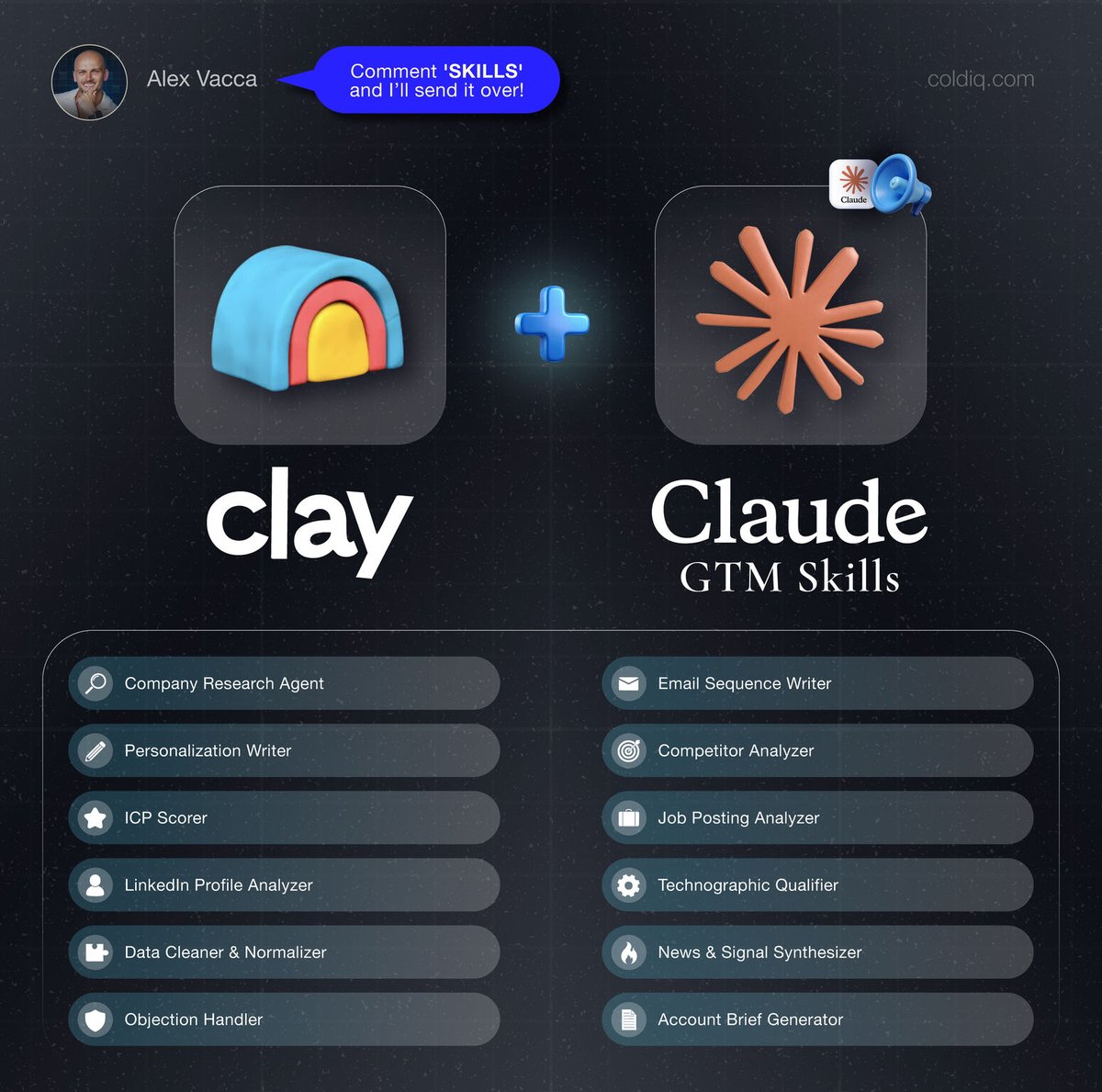
We built 12 Claude Skill files that run our entire GTM operation inside Clay (and I'm giving it all away)
Prompts give you generic output. These skill files on the other hand are built from hundreds of Clay tables across 80+ B2B clients at $7M ARR.
Each one does a specific job:
→ Company Research Agent
→ Personalization Writer
→ ICP Scorer
→ LinkedIn Profile Analyzer
→ Data Cleaner & Normalizer
→ Objection Handler
→ Email Sequence Writer
→ Competitor Analyzer
→ Job Posting Analyzer
→ Technographic Qualifier
→ News & Signal Synthesizer
→ Account Brief Generator
How it works: drop it into Clay → map your columns → run.
No prompt engineering. No switching tools. Just output.
Giving the full pack away free. Reply "SKILLS" and I'll send it.
English

Claude Cowork is f*cking cracked for Meta Ads 🤯
Point it at a folder with your ad export, your brand context, and your brief template —>
... and it analyzes your account like a senior creative strategist + saves a finished brief directly to your computer.
All inside Claude Cowork.
Perfect for DTC brands and agencies who are still manually digging through ad reports trying to figure out why performance shifted.
If you're running Meta Ads and pulling weekly reports that tell you what happened but not why —
CPAs creeping up, CTRs dropping...
You're killing creatives on gut feel because mapping performance back to hook type, angle, and offer framing takes hours you don't have.
Claude Cowork eliminates the entire loop:
→ Drop your Meta Ads CSV export into a project folder
→ Add a brand context file and your brief template
→ Claude reads all three files and audits across 4 lenses: hook performance, offer angles, fatigue signals, next test recommendations
→ Asks clarifying questions if it needs them
→ Saves a finished creative brief as a real .md file directly to your folder
No copy-pasting data into chat windows.
No manually tagging creatives in a spreadsheet.
No "here are your metrics" summaries that tell you nothing new.
What you get:
→ Pattern analysis across every creative — which hook structures are converting and why
→ Creative fatigue signals before CPAs blow up
→ Competitor intelligence layered in from the Meta Ad Library
→ A data-backed brief your creative team can execute immediately
Set it up once, drop in a fresh CSV every week and run the same prompt.
I put together a full playbook with the exact folder setup, the prompts, and the brief template to get this running in under 30 minutes.
Want it for free?
> Like this post
> Comment "ADS"
And I'll send it over (must be following so I can DM)
English
I run my meta ads with @openclaw for $0/month 😱
here's the system that runs autonomously:
step 1: daily health check
→ social-cli (major shoutout to @vishalojha_me) wraps @Meta's marketing API (token refresh, pagination, rate limits all handled)
→ am I on track? what's running? who's winning? who's bleeding? any fatigue?
→ the same 5 questions I asked Ads Manager every morning for 20 years
step 2: catch dying ads before CPA spikes
→ @OpenClaw pulls daily frequency by ad
→ frequency > 3.5 = audience is cooked, CTR is about to drop
→ this one signal saves more money than any dashboard
step 3: auto-pause bleeders + shift budget to winners
→ CPA > 2.5x target for 48hrs? auto-pause. no hesitation.
→ ranks every campaign by efficiency. recommends shifting spend.
→ last fri it paused an $87 CPA campaign at 3am and scaled my best performer 30%
step 4: write new ad copy from your winners
→ agent analyzes what's working (hooks, angles, CTAs)
→ generates variations based on the patterns in YOUR top performers
→ copy modeled on what already converts in your account.
step 5: upload ads directly to your account
→ new creative + copy
→ live in @Meta Ads Manager
→ no more downloading, formatting, clicking through the upload flow
→ agent handles the entire publish cycle
step 6: content concepts + morning brief
→ spots patterns across winners and suggests what to test next
→ delivers everything to Telegram, Slack, wherever you want it
→ 90 seconds to read. reply "approved." done.
input: your ad account + your target CPA
output: an AI that monitors, kills, scales, writes, AND uploads your ads
dozens of hours in ad manager → 1 text message
I packaged the entire system as the Meta Ads Kit.
5 @OpenClaw skills:
- meta-ads (daily checks + auto-pause)
- ad-creative-monitor (fatigue detection)
- budget-optimizer (efficiency scoring + shift recs)
- ad-copy-generator (writes variations from your winners)
- ad-upload (publishes creative directly to your account)
giving it away free.
comment ADS + like + follow
(must follow so i can DM)
English
@philkyprianou @dtcprophet I was just “talking” to Claude about this yesterday. Trying to improve / simplify my bundle options
English


If you are in ecom, what have you vibe coded or built with Claude that has provided quantifiable value to your business or your customers?
Please share any and every example you have
English

A million people have asked how to best use OpenClaw, so I had my agent document everything we’ve learned + best practices as a book. (It’s ~240 pages).
I had her put it on Gumroad with a suggested $5 price (but you can also choose $0 if you want to download it for free).
English
@kylesshortcuts @AnthonyLapietra Let me know how that works out. Was thinking about that exact integration this weekend
English

@AnthonyLapietra I’m trying to configure it to work with Gorgias and Shopify to help with CX
English

Your company will go through four stages:
1. Survival
2. Stability
3. Scale
4. Significance
Best to kow where you are...
English

Introducing Fin: The world’s first AI Chief Financial Officer.
Fin outperforms humans 100% of the time.
RT + Comment “FIN” and I’ll send you an AI agent that saves 6-7 figures/year.
English
@mbertulli Agree completely with your thoughts here. I’m in e-commerce and can certainly see several scenarios where we pay for a service that will be replaced by this. I’m just not technical enough to implement yet. Though I am digging in!
English
AI is going to pose a really serious challenge to founders, just speaking from my own experience.
It’s really easy now to do a lot more yourself.
Instead of delegating, I can spin up Claude and just go make something, or connect it to systems and get information.
I think this is breaking some of the traditional leadership tropes around elevate and delegate.
You want people you trust. You want to give them autonomy. You want them to move.
But the context is changing fast.
This is also the next 12–24 months, where AI actually starts showing up inside consumer companies in a real way.
We have to make physical things and ship them, so the surface area for AI is naturally lower than pure digital businesses.
But I think where people are actually struggling is knowing what’s possible and then using good judgement to pursue the right things:
- How do we get everyone using this stuff?
- How do we decide where they should use it versus where they shouldn’t?
- What’s safe, what’s high risk, what’s low risk but high impact?
This is creating so much optionality that it’s going to seriously test leadership.
Centralizing everything around me scares the sh*t out of me. That just makes me the bottleneck again.
I understand the temptation. Founders already struggle to transition into real delegation as the business grows. We just naturally feel better doing things ourselves.
But AI is giving everyone permission to just do it themselves again.
And as exciting as that is, it’s also terrifying.
Don’t know that it works long term but we’ll see soon enough.
Dario Amodei@DarioAmodei
The Adolescence of Technology: an essay on the risks posed by powerful AI to national security, economies and democracy—and how we can defend against them: darioamodei.com/essay/the-adol…
English

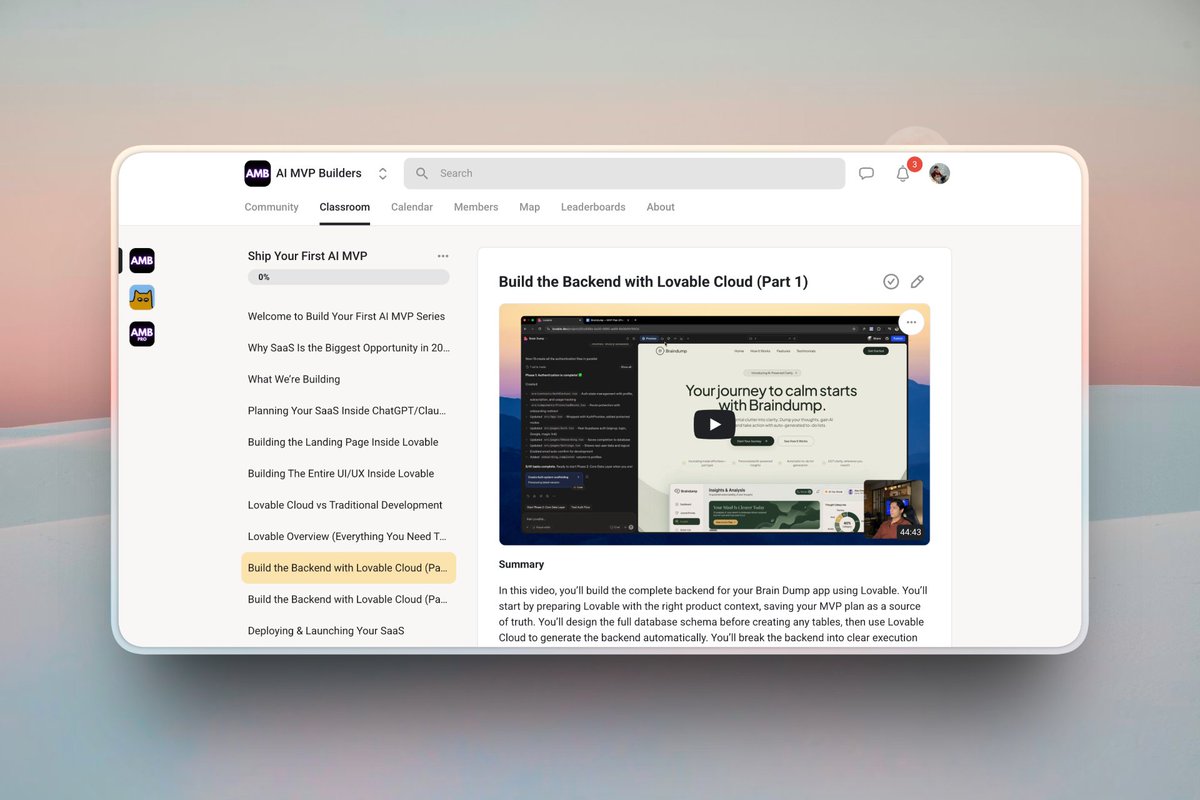
This should probably be a paid course.
It’s basically my full @Lovable workflow.
I spent weeks recording this.
10 modules covering everything:
→ Planning inside ChatGPT/Claude
→ Building the entire frontend and backend
→ Adding AI features
→ Stripe payments
→ Deploying to production
The same workflow I've refined after shipping 40+ SaaS for clients and refined after teaching 650+ builders.
If you stick to this, you will be able to ship your SaaS in the next 10 days. I promise you that.
Comment “LOVABLE” and I will DM you the link.
English