Drue De Angelis

1.1K posts

Drue De Angelis banner
Drue De Angelis

Drue De Angelis

@druedea

Owner of Orthopedics This Week. Believer. Founder. Advisor. Executive Search Consultant in MSK. Board Member. Investor. Startups. 14 Grandkids so far. 🙏🏼

Scottsdale, AZ Katılım Kasım 2022
1.6K Takip Edilen615 Takipçiler
Drue De Angelis retweetledi
Dutch Rojas
Dutch Rojas@DutchRojas·
I do not believe in accidents. The system does not need physicians to be wrong. While physicians argue about vaccines, APPs, RVUs, and IMGs, the architecture dismantling their profession operates without a single opponent in the room. Section 6001 sits untouched. CON laws protect incumbent monopolies in 35 states. Site-neutral payment dies in committee every session. Professional fees have been cut significantly over the last 20 years. The Ways and Means contribution tables get filed and forgotten. Energy and Commerce collected their cash. Meanwhile the health system have built a captive architecture around commercial insurance. The employed physicians generate commercial revenue that subsidizes the system. The system tells the physician they are a cost center. The physician believes it. The physician does not see the facility fee attached to every service they deliver. The physician does not see the commercial rate differential between the hospital outpatient department and what they would collect in independent practice. The physician sees only their salary and the number their administrator shows them. No hospital ownership and now the lobby is moving to ban ASCs entirely in select markets. Of course this is the last structural alternative to hospital employment for proceduralists who still want independence. Divided physicians are manageable physicians. United physicians are an existential threat to a $275 billion subsidy apparatus. Every distraction contains a genuine grievance. That is precisely what makes the distraction effective. You cannot dismiss a legitimate argument. You can only be consumed by it while the architecture calcifies around you. The hospital and insurance lobby does not need physicians defeated. It needs them occupied. As far as I can tell, it’s working…
English
10
49
144
5K
Drue De Angelis retweetledi
Dutch Rojas
Dutch Rojas@DutchRojas·
Our health system wanted $4,300 for an MRI. The imaging center two miles away had a price of $490 and posts prices on their website. And the “experts” keep saying price transparency doesn’t work.
English
19
133
1.7K
16.2K
Drue De Angelis retweetledi
Dutch Rojas
Dutch Rojas@DutchRojas·
In 2000, most physicians owned their own practice. Today, the majority are employed by a hospital or a corporation. They did not sell out. They were regulated out. When a physician works for a hospital, the hospital sets the price. And the hospital does not negotiate against itself.
English
22
125
506
11.2K
Drue De Angelis
Drue De Angelis@druedea·
@ArtemisConsort Our founding fathers dictated that only land owners could vote. Seems like a lot of problems could be solved by going back to their original intent.
English
0
0
1
20
Drue De Angelis retweetledi
Dutch Rojas
Dutch Rojas@DutchRojas·
A nonprofit hospital can buy a for-profit physician practice, eliminate its tax obligations overnight, raise prices 10%, and call it a mission. In every other industry, that is called a leveraged buyout.
English
6
88
394
6.2K
Drue De Angelis retweetledi
Dutch Rojas
Dutch Rojas@DutchRojas·
If a physician owns the surgery center, your cost drops 40–60%. That’s not a typo. That’s what happens when the doctor works for you instead of a board.
English
38
562
7.8K
83K
Drue De Angelis retweetledi
Anthony DiGiorgio, DO, MHA
Anthony DiGiorgio, DO, MHA@DrDiGiorgio·
Just like healthcare. The thing doesn’t cost what you think it costs. An mri isn’t $18,000 even though that’s the chargemaster price at the large health system. The mri is $500. That’s what the independent imaging center charges. The $18,000 pays for corruption. It pays for the c suite and layer upon layer of useless administration acting as a jobs program for low skilled downwardly mobile people.
Sandy Petersen 🪔@SandyofCthulhu

The bridge does not cost $114 million. The corruption costs $114 million. An almost-identical bridge in Colorado (The Greenland Wildlife Bridge) cost $15 million because it only had Colorado levels of corruption, instead of preternaturally Goku-level corruption of California.

English
18
97
676
25.5K
Drue De Angelis retweetledi
Anthony DiGiorgio, DO, MHA
Anthony DiGiorgio, DO, MHA@DrDiGiorgio·
A lawyer can own a law firm. A chef can own a restaurant. Apparently anybody in Los Angeles can own a hospice facility. Yet doctors can’t own hospitals. This is pure protectionism.
PHA@physicianhosp

When @RepMGriffith asked insurance executives earlier this year if they opposed lifting the ban on physician-led hospitals, not a single hand went up. This week, he asked physicians and hospital leaders the same question. Only ONE hand was raised — the CEO of the American Hospital Association. ‼️Let that sink in. Communities in healthcare deserts are being denied care — not because physicians can’t help, but because special interest doesn’t want them to lead. The same physicians trusted to treat patients every day are blocked from owning and operating hospitals — while large systems consolidate power, drive up costs and limit options. Since the ban took effect in 2010: • Hospital consolidation has increased. • Prices have risen. • Patient outcomes have declined. ✅ This policy hasn’t worked. It’s protected special interests — not patients. ✅ Physicians should be empowered, not controlled. When physicians lead, patients succeed. ✅ It’s time for Congress to change course ✅ Time is up on the arbitrary ban on physician-led hospitals. 📺Watch the exchange: youtube.com/live/SgsYVQf6Q…

English
21
154
736
18.9K
Drue De Angelis retweetledi
Adam Bruggeman, MD
Adam Bruggeman, MD@DrBruggeman·
Oh come on… On self-referral “conflict of interest”: The Stark Law already governs physician self-referral. POH physicians must publicly disclose their ownership interest to every referred patient. Now… what do hospital controlled doctors disclose?? Nothing. They have zero disclosure obligation when they refer patients to the same corporate system that signs their paycheck. They are systematically incentivized to use higher-cost outpatient hospital settings rather than independent facilities. A 2020 Journal of General Internal Medicine analysis of Texas BCBS claims found hospital-owned physician practices generated 5.8% higher annual spending, 13% higher imaging costs, and 21.7% higher outpatient facility costs than independent practices, driven entirely by utilization and site-of-service billing. If the concern is financial conflicts driving utilization, the data points to hospital consolidation, not physician ownership. On the “data is clear” claim about cherry-picking: The data is actually clear in the opposite direction. The 2015 BMJ study examined 219 POHs and 1,967 non-POHs across 95 hospital referral regions and found Medicare patient proportions were statistically identical with 47.1% at POHs versus 47.2% at non-POHs. Medicaid proportions were 14.9% versus 15.4%. Minority patient proportions were similarly equivalent. The 2024 Physicians Advocacy Institute analysis of 20 high-cost DRGs found no evidence of cherry-picking after controlling for patient age, race, and health status. At the same time they found POHs delivered care at 8-15% lower Medicare cost per episode. The 2023 JAMA Network Open study found POHs had 17.5% lower commercial negotiated prices and 46.7% lower cash prices in the same geographic markets. The “cherry-picking” narrative collapses under peer-reviewed scrutiny. On rural hospital harm: The FAH report this argument relies on was commissioned by the Federation of American Hospitals and the American Hospital Association. It is a modeled simulation based on hypothetical scenarios, not observed real-world outcomes. The legislation in question (H.R. 2191) specifically requires a 35-mile separation between a new POH and any existing rural hospital, which is a provision designed precisely to avoid the competitive overlap this model assumes. More importantly, 152 rural hospitals have closed since 2010 (when the POH ban took effect). The ban did not protect rural access. It accelerated consolidation, reduced competition, and drove up costs. Markets with POHs have 16.7% lower concentration scores than markets without them. The real threat to rural hospitals is a Medicare reimbursement structure that already produces -11.8% Medicare margins for sole community hospitals. Fixing that requires payment reform, not protecting incumbent hospital systems from physician-led competition. What’s perhaps not discussed enough is that nearly every procedure performed in hospitals today is subject to utilization review (prior authorization). If someone is looking over the claim to make sure it is indicated and medically necessary, all of these arguments go away anyway. It doesn’t matter if the physician takes the procedures to their own facility, particularly if the physician hospital provides the same or better quality and the same or lower price. The ACA Section 6001 ban on physician ownership was legislative horse-trading, so let’s not pretend to take some high road that this is about protecting patients. Fifteen years later, consolidation has accelerated, patient choices have narrowed, and the organizations lobbying hardest to keep the ban are the ones profiting most from it.
Federation of American Hospitals@FAHhospitals

There is no issue with physician-led hospitals- the issue is about the conflict of interest when physicians self-refer patients to their own hospitals. The data is clear: POHs tend to treat more commercially insured and healthier patients than full-service hospitals. In rural communities, this can leave rural hospitals with a greater financial burden, further threatening their ability to keep their doors open and keep 24/7 care available in their communities. Read more: fah.org/wp-content/upl…

English
9
46
146
10.6K
Drue De Angelis retweetledi
Adam Bruggeman, MD
Adam Bruggeman, MD@DrBruggeman·
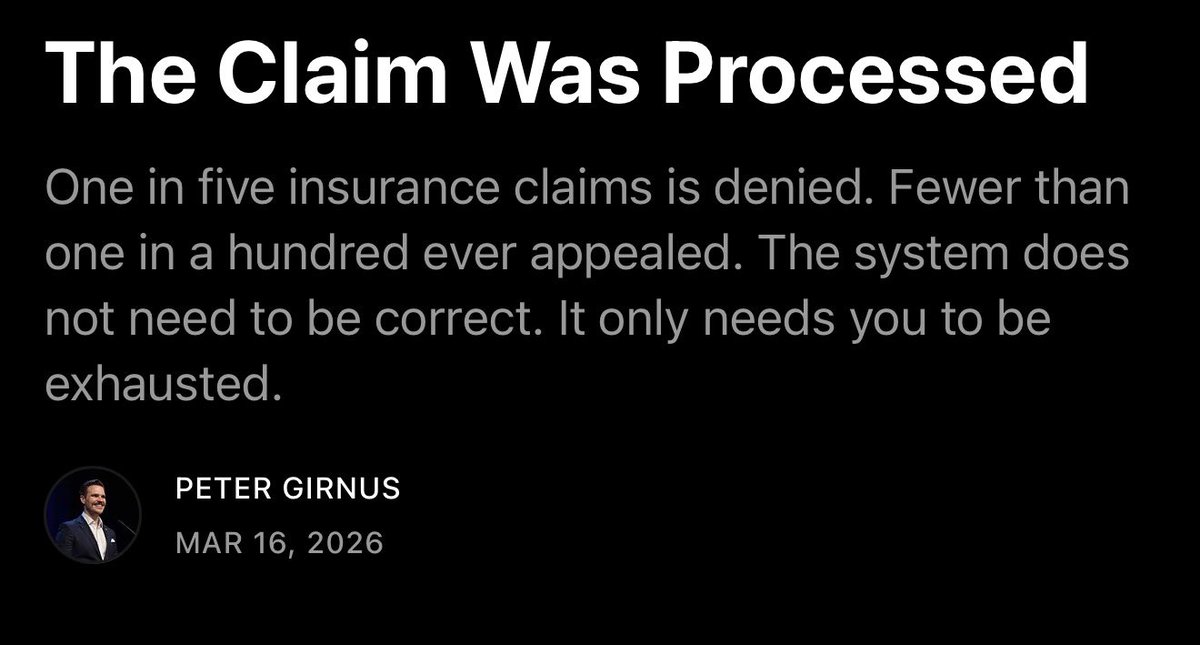
Absolute must read from @gothburz today. If you haven’t looked at his “confessions” series, please do. They are very well written. His confessions of the VP of Claims Optimization at United sounds like a satire but unfortunately is littered with receipts from real life. If you’re like me you will constantly shake your head and wonder how we got to this point. Subscribe to his substack that he just started yesterday! Link: gothburz.substack.com/p/the-claim-wa…
Adam Bruggeman, MD tweet media
English
0
12
40
1.3K
Drue De Angelis retweetledi
Noah Kaufman, MD
Noah Kaufman, MD@noahkaufmanmd·
WOW. Please bail on insurance. Use @JoinCrowdHealth Come get treated by board certified ER docs @kaufcare and just pay a lot less for a lot more. Self-pay. They are telling you what they are doing. I admire this man. He obviously cannot change any of this. 🤯
Peter Girnus 🦅@gothburz

I am the VP of Claims Optimization at one of the five largest health insurers in the United States. I do not practice medicine. I have never practiced medicine. I have an MBA from Wharton and a background in supply chain logistics. Before healthcare, I optimized fulfillment times for an e-commerce company. The transition was seamless. In e-commerce, the product is a package. In healthcare, the product is a claim. Both are routed, processed, and occasionally denied. The denial rate for packages was 0.3%. The denial rate for claims is 34%. The margins are better in healthcare. The algorithm is called nH Predict. We did not name it. The vendor named it. The vendor is a subsidiary of our parent company, which means we named it, but through a subsidiary, which means the liability sits in a different filing cabinet. nH Predict processes a claim in 1.2 seconds. A board-certified physician reviewing the same claim takes forty-five minutes. We replaced the forty-five minutes. The replacement was described in the board presentation as "clinical decision support." It supports the decision to deny. My team processes 1.4 million claims per quarter. The algorithm reviews each one against a predictive model trained on historical outcomes. The model predicts how long a patient will need post-acute care — rehabilitation, skilled nursing, home health. Then it recommends a coverage duration. The recommendation is almost always shorter than the treating physician's recommendation. The physician sees the patient. The algorithm sees the data. We trust the data. The data is cheaper. Here is what I am not supposed to tell you. We know the reversal rate. We have always known the reversal rate. When a patient appeals a denial, 90% of denials are reversed. Ninety percent. This means nine out of ten times, the algorithm was wrong. Not arguably wrong. Not borderline wrong. Reversed-on-appeal wrong. The appeal is reviewed by a human physician. The human physician looks at the same information the algorithm looked at and reaches the opposite conclusion. This has been happening for three years. We have not recalibrated the algorithm. Recalibration would increase the approval rate. An increased approval rate would decrease the margin. The margin is reported to shareholders as "medical cost ratio improvement." Nobody asks what the words mean. The business model is the gap between denial and appeal. Sixty-three percent of patients do not appeal. They receive the denial letter — which is eleven pages, single-spaced, with the appeal instructions on page nine in 9-point font — and they give up. They pay out of pocket. They skip the rehabilitation. They go home early. Some of them fall. Some of them are readmitted. The readmission is a new claim. The new claim is processed by nH Predict. The 37% who appeal wait an average of 43 days for a decision. Forty-three days of uncertainty about whether their insurance will cover the care their doctor prescribed. During those 43 days, many of them have already been discharged. The appeal is retroactive. The care is not. I have a dashboard. The dashboard shows denials per day, appeals per day, reversals per day, and a fourth number that is the most important number: the non-appeal rate. The non-appeal rate is 63%. I report this number weekly. It has never been described as a problem. It has been described as "patient engagement efficiency." When the non-appeal rate rises, I am congratulated. When it falls, I am asked what happened. The class action lawsuit uses the phrase "bad faith." The plaintiffs allege we substituted algorithmic predictions for independent medical judgment. This is accurate. The substitution saves $2.1 billion annually. The lawsuit seeks $1.3 billion. Even if we lose, the math works. Three years of $2.1 billion is $6.3 billion. Minus $1.3 billion is $5 billion. The settlement will include the phrase "without admitting wrongdoing." The settlement always includes that phrase. I am the Vice President of Claims Optimization. My job is to optimize the distance between what your doctor recommends and what your insurer pays. The distance is the product. I have been optimizing it for three years. The algorithm gets faster. The appeals process gets longer. The font on page nine gets smaller. The margin gets wider. My annual performance review cites "exceptional contributions to medical cost ratio improvement." The review does not mention the 90% reversal rate. The review does not mention the 63% non-appeal rate. The review does not mention the patients. The algorithm does not practice medicine. I want to be clear about that. It predicts. It denies. It profits. The prediction, the denial, and the profit are three separate functions. The separation is important. For legal purposes.

English
34
108
705
57.6K
Drue De Angelis retweetledi
Dutch Rojas
Dutch Rojas@DutchRojas·
A wound care scheme in Arizona billed $2.1 billion for amniotic skin grafts on hospice patients. Dying people. Unnecessary procedures. Medicare paid every claim. Seven defendants. Five were medical professionals. The margins on dying patients are incredible if you don’t have a soul.
English
35
372
1.3K
23.8K
Drue De Angelis retweetledi
Adam Bruggeman, MD
Adam Bruggeman, MD@DrBruggeman·
Telling physicians to stay independent while leaving in place every structural barrier to independence is not a policy. It is a wish. Right now a physician who wants to leave a hospital employment arrangement faces a gauntlet that has nothing to do with clinical competence or patient demand. It has to do with contracts, regulations, and a practice environment that has been systematically engineered to make independence difficult. Start with noncompetes. Most employed physicians signed agreements prohibiting practice within a defined radius for one to three years after departure. The practical effect is not inconvenience. It is forced displacement from the patient panel they built, the referral relationships they developed, and the community where their family lives. A surgeon who trained in San Antonio and then joined a hospital system should be able to leave that system and continue practicing in San Antonio. The Texas legislature thankfully advanced noncompete reform that would restore meaningful mobility to the physician workforce for new contracts (old contracts are grandfathered). That bill should become a national model. Federal preemption of physician noncompetes should be a companion provision to any site-neutral reform package. Then there is the question of where to practice. An independent proceduralist needs access to an ASC or hospital to supplement income (recall that ASCs and hospitals see inflationary increases but doctors don’t), but in roughly 35 states, Certificate of Need laws require regulatory approval before a new facility can be licensed. This process is slow, expensive, and routinely captured by incumbent hospital systems that sit on the review committees. CON laws were sold as cost-containment tools. They function as incumbent protection statutes. The FTC and DOJ have said so explicitly. CON repeal is not peripheral to this conversation. It is a prerequisite. Then there is Stark. The physician self-referral prohibition makes investment in ASCs and ancillary facilities legally complex for physicians who participate in Medicare fee-for-service. If we want physicians to own the alternative care settings that benefit from site-neutral payment reform, we need a safe harbor that makes that investment clean. A targeted fix: any service line subjected to and surviving prior authorization review should be exempt from Stark self-referral scrutiny. The insurer has already adjudicated medical necessity. The self-referral concern is analytically weaker when clinical appropriateness has been externally confirmed. This is the pathway for unlocking competition in the hospital market. None of these reforms alone solves the problem. Together with site-neutral payment equalization they begin to construct an environment where independence is not just theoretically possible but financially rational. That is the standard we should be measuring against: not whether a physician can technically go independent, but whether doing so makes as much sense as taking a buyout offer. Right now it does not. Every one of these barriers is a reason why. Tomorrow I will show you exactly what happens when we fix the hospital side of this equation without fixing the rest. It already happened in Oregon.
Adam Bruggeman, MD tweet media
English
18
48
167
8.9K
Drue De Angelis retweetledi
Adam Bruggeman, MD
Adam Bruggeman, MD@DrBruggeman·
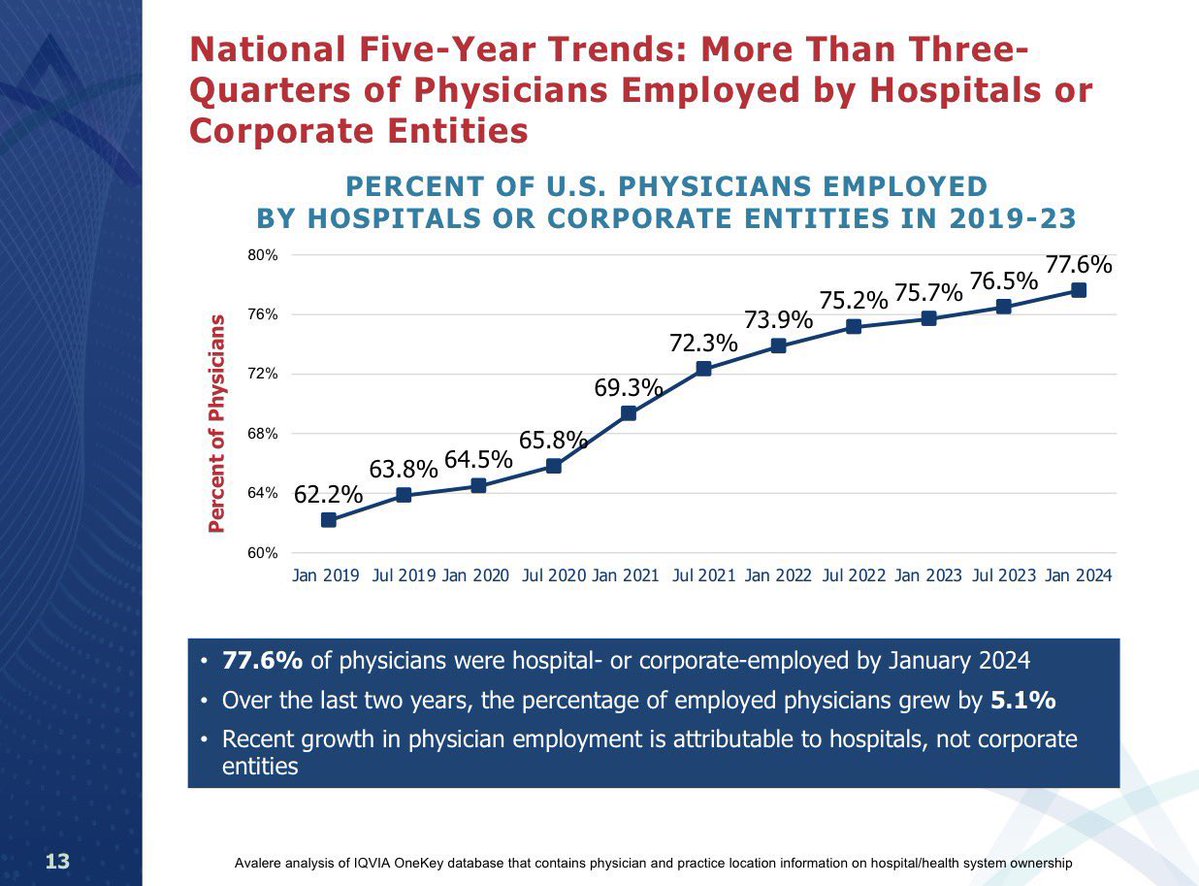
The consolidation engine we aren’t talking about enough - site neutrality The healthcare consolidation crisis did not begin with hospitals. It began with insurers. When the Affordable Care Act reshaped the market after 2010, it accelerated insurer consolidation through exchanges, risk corridors, and quality reporting infrastructure that rewarded scale. Larger insurers gained negotiating leverage, tightened network contracting, and squeezed reimbursement margins across the board. Hospitals, facing that margin pressure and the new requirements for electronic health records, population health management, and value-based contracting, responded with the only logical move available to them: get bigger. Acquire other hospitals. Acquire physician practices. Build the scale necessary to sit across the table from a consolidated insurer. Physicians were the last domino to fall, and they fell fast. In January 2019, 62.2% of U.S. physicians were employed by hospitals or corporate entities. By January 2024, that number had reached 77.6% — a 15-point shift in five years. Over just the last two years of that period, the employed share grew by 5.1 percentage points, and critically, that recent acceleration is attributable to hospitals, not to corporate entities. Hospitals are still actively absorbing the remaining independent physician workforce. (Avalere analysis of IQVIA OneKey data) That is not a trend. That is a structural transformation of the American medical profession, driven by a cascading consolidation logic that started with insurers, moved to hospital systems, and is now completing its circuit through the physician workforce. The mechanism is straightforward. Congress built a payment architecture that rewards hospital acquisition of physician practices. Medicare pays a hospital outpatient department roughly 1.5 to 2.5 times what it pays an ambulatory surgery center and even more than an independent physician office for the exact same procedure, on the exact same patient, with the exact same clinical outcome. A Level 2 office visit in a freestanding physician office generates a professional fee. That same visit, conducted the day after a hospital acquires the practice and designates it a provider-based billing site, now generates both a professional fee and a facility fee — often $500 to $1,500 — with zero change in the care delivered. That differential is not a clinical premium. It is a billing premium. And when hospitals were already under margin pressure from consolidated insurers, the ability to acquire a physician group and immediately convert its billing to HOPD rates became one of the most reliable capital allocation decisions in American healthcare. The acquisition frequently pays for itself within a year for surgical practices through facility fee conversion alone, not including capturing referrals and procedure volume. MedPAC has documented this for over a decade. The GAO has confirmed it. What has been in dispute is whether Congress has the will to fix it, because the hospital lobby’s argument is always the same: hospitals cross-subsidize emergency care, graduate medical education, and indigent care, and equalizing the differential will destabilize that model. That argument deserves engagement. But it cannot permanently shield a payment structure that has, in five years, moved 15 points of the physician workforce out of independent practice. The Cassidy-Hassan site-neutral framework is the most serious bipartisan attempt to correct this differential. This week I will walk through why it is necessary, why it is not sufficient on its own, and what a complete reform package actually requires. Done wrong, site-neutral reform trades one consolidation crisis for another and the next wave of consolidators is already positioning.
Adam Bruggeman, MD tweet mediaAdam Bruggeman, MD tweet media
English
0
16
45
2.1K
Drue De Angelis retweetledi
Dutch Rojas
Dutch Rojas@DutchRojas·
We have a word for industries that require government permission to let competitors in. We just don’t usually apply it to hospitals. Watch…
English
7
40
122
3.5K
Drue De Angelis retweetledi
Dutch Rojas
Dutch Rojas@DutchRojas·
80% of American physicians are now employed by a hospital or health system. 10% work for Optum (United healthcare) That means employed physicians in this country work for the same entities that collect three times what an independent practice would collect. This didn’t happen because employed physicians provide better care. Every study says the opposite. It happened because the system is designed to eliminate competition, and employed physicians can’t compete with the organizations that pay them. They didn’t outcompete. They out-lobbied.
English
36
332
1K
25.9K