Willem

620 posts

Willem banner
Willem

Willem

@DutchFlowTrader

Discretionary & Systematic Trader using Funded Prop Programs. Former Market Maker Options. Aerospace Engineer BSc & MSc ✈️🛩🛫🛬🪂💺🚁🛰🚀🛸🌛🌜☀️🌞🪐⭐️☄️🪁

The Netherlands Katılım March 2024
171 Takip Edilen100 Takipçiler

2026 Yıllık Özeti

@DutchFlowTrader hesabının Twitter yılını gör

Sabitlenmiş Tweet
Willem
Willem@DutchFlowTrader·
Don't come with bullshit to me. Every day I have to read and see more bullshit in the trading space. More liars and dumb bitches who are not profitable traders but lie, sell courses, mentorships, affiliates to get rich. I have zero problem calling out those scammers.
English
2
0
5
1.1K
Willem
Willem@DutchFlowTrader·
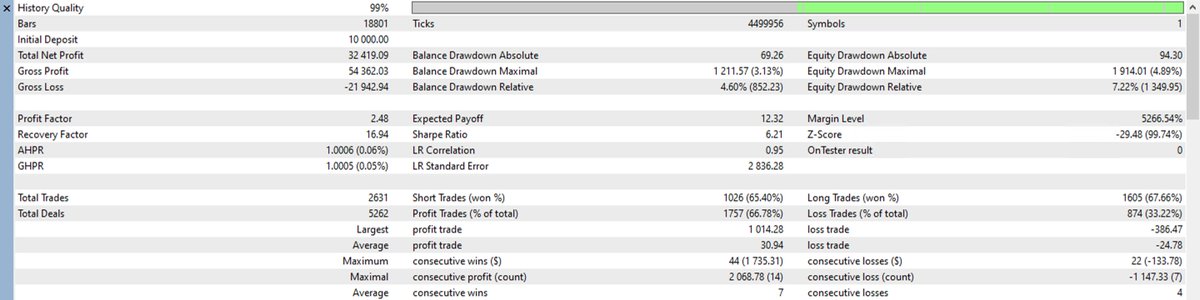
@quandapro @algojan Exactly, Sharpe Ratio of is 6.21 is absolute bullshit, complete garbage. It only tells your strategy is completely overfitted.
English
0
0
0
27
Quan Duong
Quan Duong@quandapro·
@algojan Sharpe of 6.21 only means two things: - Your strategy overfits 2020-2026 regime - You got an unicorn edge. So I would suggest you get full Gold historical data via Tick Data Suite and backtest on full history to rule out first possibility.
English
1
0
3
75
Jan - Algo Trader
Jan - Algo Trader@algojan·
Just finished working on a new algo project, here are the stats of the 2020-2026 backtests on real ticks: Asset: Gold Return: 324.19% Compound Annual Growth Rate (CAGR): ≈ 27.2% per year Sharpe Ratio: 6.21 Win Rate: 66.78% Profit Factor: 2.48 Maximum Equity Drawdown: 7.22% Total Trades: 2,631
Jan - Algo Trader tweet media
English
20
3
82
10.4K
DoopieCash®
DoopieCash®@DoopieCash·
Hou jij weleens een positie of setup overnight aan...?🤔
Nederlands
43
0
45
10.8K
Willem
Willem@DutchFlowTrader·
@dmartin_trading @yavuzkaaa @E8Markets 2. Propfirms are not honest, they use infuencers that cannot trade to show how 'traders' make money. For sure propfirms try to make fake reviews on Trustpilot. Trustpilot > Propfirms. Never trust a propfirm, only FTMO.
English
0
0
1
37
Willem
Willem@DutchFlowTrader·
@dmartin_trading @yavuzkaaa @E8Markets 1. I would always trust Trustpilot over any claim from a propfirm. I made several reviews on Trustpilot, 1 got flagged by their AI. I had to prove that I used cTrader with emails etc. So Trustpilot is doing a great job, sometimes checking and asking for proof.
English
1
0
1
25
Yavuz k.
Yavuz k.@yavuzkaaa·
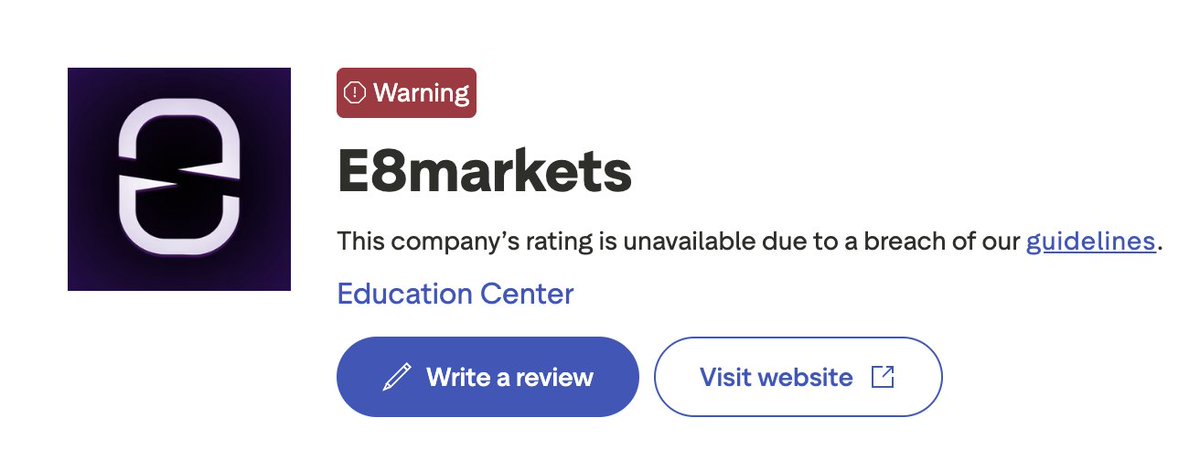
Trustpilot just made @E8Markets' rating "unavailable," saying it removed a batch of fake reviews. I used to work at E8. I don't anymore — so no reason to carry water for them. But this genuinely doesn't make sense. E8 has a real, active userbase and gets around 40 reviews a month. That's a healthy, normal, even lower end review volume — not the pattern of a firm faking or buying reviews.
Yavuz k. tweet media
English
20
2
52
17.6K
D. Martin
D. Martin@dmartin_trading·
@DutchFlowTrader I started build strategies on s&P this month. I'm actually now looking to build less on indices because I realize most of what I am building now have high correlation with what I already have
English
1
0
0
236
D. Martin
D. Martin@dmartin_trading·
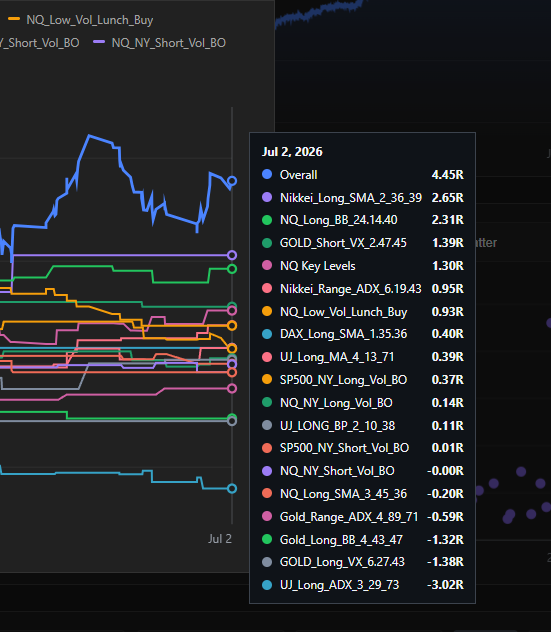
Performance of all my strategies since April. I have 18 Strategies and counting. Added 4 new ones so far this Month. Despite building so many strategies I have yet to successfully find any mean reversion (that suits my criteria) All 18 strategies are breakouts. The rest of this month will be spent on developing at least two mean reversions. Let's see if I'll have any success
D. Martin tweet media
English
18
0
85
8K
Willem
Willem@DutchFlowTrader·
@dmartin_trading For cTrader you have website ClickAlgo and they have demo's and of course they want to sell strategies. Nice equity curves, but 48 parameters (yes really). Test OOS -> zero edge. Now I understand why all these algo sellers use strategies with lots of parameters.
English
0
0
1
57
D. Martin
D. Martin@dmartin_trading·
I’m obsessed with simple strategies. You often hear that simple strategies are more robust and less likely to be overfit and the more systems I develop, the more I see the truth in that. One thing I’ve noticed is that simple strategies tend to transfer better across markets. For example, I have a Nasdaq strategy that is also profitable across other major indices, several major FX pairs, and Commodities. When I add more parameters, the system may "improve" on Nasdaq, but performance usually starts to weaken across other markets. I’ve also noticed that OOS performance tends to stay much closer to IS performance with simpler systems. Walk-forward tests also tend to hold up better. My view is that additional parameters often introduce more training bias, even when they appear to improve the backtest. There are studies on this already, but I like seeing it for myself. From what I’ve seen, simplicity is one of the best filters for robustness. If a strategy has more than two entry conditions, I’m usually not interested.
English
3
1
34
1.6K
Willem
Willem@DutchFlowTrader·
@dmartin_trading Yes, exactly, I found that too. More parameters are mostly more chance at overfitting.
English
0
0
1
45
Willem
Willem@DutchFlowTrader·
@dmartin_trading I don't agree. I hear this all the time. But people do not understand risk metrics. For 2 strategies with the same expectancy and different winrates, the strategy with the higher winrate is much better. The risk properties, all of them, are much worse for the lower winrate.
English
0
0
0
22
D. Martin
D. Martin@dmartin_trading·
The debate over which RR is better is a bit pointless if these four things are ignored: Win rate, R expectancy, trade frequency and personal preference. Example: Strategy 1 Win rate: 65% RR: 1:1 Avg. trades per Month: 10 R expectancy: 0.30R Strategy 2 Win Rate: 32% RR: 1:3 Avg. trades/Month: 10 R expectancy: 0.30R Both of these strategies will produce on average, the same returns over the long run because they have the same R expectancy. The difference will be in the paths they take. The higher win rate strategy tends to win more frequently but losses usually cluster and you will miss out on huge moves. The lower win rate strategy loses more often but 2 or 3 trades can make up for cluster of losses as you will catch runners more often. Both will make the same money on average. It's just about which can you psychologically handle better? Maybe FOMO is a big weakness for you. Low win rate strategy is better suited as you will catch runners but lose more often. Maybe you don't mind missing a few runners and rather be in and out quick. Higher win rate is for you. Never focus on RR alone. Look at Win rate, calculate your R expectancy, look at trade frequency and lastly, ask yourself if you could honestly handle the drawdowns of this strategy. Below is an example of the equity curve you can expect (in theory) for both strategies mentioned above. Both end with a 112% return. They just took different paths.
D. Martin tweet media
tfk@timeframeking

1:1RR trading is so dumb There’s a lot of guys promoting it right now because they know the majority of traders are using 1:2RR or 1:3RR And the majority of traders fail So instead of saying you need to work more on your setup, gather more data, etc They tell you that the REASON you’re failing is because you’re trading higher RR But if you actually look at data for it, 1:1RR doesn’t have a lot of edge at all All it takes is one bad week and you spend the next 2-3 week trying to make it back because your wins are so small Meanwhile I’ll have a bad week and can make it back in 1-2 trades I can see the use-case of smaller RR for prop firms where your drawdown is tiny - but no real trader using personal capital does 1:1

English
6
1
34
4.7K
Willem
Willem@DutchFlowTrader·
@dmartin_trading 4. And now suddenly the whole world is full of 'traders' because people can go long or short, without money, and think now that they are traders. It's sad. 99% will lose. Retail trading is boring.
English
0
0
1
25
Willem
Willem@DutchFlowTrader·
@dmartin_trading 3. I have seen so much retarded egos who really think that they are big traders. But it's all retail trading. With retail trading I mean that if you trade, you always have to chose a direction, short or long. And so you have a winrate and RR. All retail trading is doing this.
English
1
0
0
36
D. Martin
D. Martin@dmartin_trading·
The more I trade, the more I don't want to be a "full time" trader. When trading is going good, you feel on top of the world and don't see the need for it not being your main source of income but when you go through those inevitable drawdowns it's a different story. I completely get why most traders (profitable ones) sell a course, offer a mentorship or other trading related services. Most will not admit it but the main reason I believe is because full time trading is not as "Free" as it is painted. The "you are your own boss", you can work whenever and wherever you want and there is huge scaling potential pitch, is true in theory. But in practice, you realize it is not that smooth.
English
6
0
33
14.9K
Willem
Willem@DutchFlowTrader·
@FibboKing He was checking W, D, H4, H1, 15min, 5min. And had to align for the most part. I also check most of the time frames but I have no rules or alignment. W, D, H4, and 15min. If I could only choose one time frame, it would be H4.
English
0
0
1
6
Fibboking🤖
Fibboking🤖@FibboKing·
Price is a fractal, patterns repeat across timescales. But most traders use this as an excuse to overcomplicate. Mandelbrot showed markets are fractal, the same patterns appear on 1-minute and 1-month charts. This means a signal on a single timeframe might be noise, but the same signal confirmed on a higher timeframe carries real weight. Most traders overdo it: “I need alignment on M5, M15, H1, H4, and Daily." That’s paralysis disguised as analysis. I used to do that. I’d wait for 5 timeframes to line up, miss 80% of trades, and the ones I took were late. I trimmed it to a two-timeframe filter: The trading timeframe (H1) and the regime timeframe (D1). The D1 chart is used only to classify regime trending, range, or transitional using a simple ADX and structure algorithm. The H1 then executes only the setups appropriate to that regime. This tiny fractal filter had a massive impact. My bot’s win rate in trending D1 regimes for trend-following signals jumped from 42% to 56%. In ranging regimes, the bot switched to mean-reversion mode and avoided trend traps. Multi-timeframe doesn’t mean more charts. It means a higher-level context that filters the lower-level noise. Use the higher timeframe as a permission gate, not an entry trigger.
English
1
1
1
139
Willem
Willem@DutchFlowTrader·
@yavuzkaaa @Trustpilot Ok my experience as a user is good. I made a genuine review, but it was taken down immediately and flagged as possible 'marketing'. I had to provide proof that I actually used that software (cTrader).
English
0
0
0
30
Yavuz k.
Yavuz k.@yavuzkaaa·
A lot of traders judge a prop firm by its @Trustpilot score. After dealing with Trustpilot from the firm side at two different companies, I can tell you it means a lot less than you'd think.
English
6
0
15
2.4K
Willem
Willem@DutchFlowTrader·
@algojan Oh no that's really good. 60 days, so 2 to 3 months for 10% is really good. Nice to hear algos are working for propfirms. I tried to trade manually for 6 months, all underlyings and strategies but the result is around 0%. So now I started with Algo.
English
1
0
2
39
Jan - Algo Trader
Jan - Algo Trader@algojan·
@DutchFlowTrader Around 60 days for the phase 1 Now almost done with verification It took its time, but quality over quantity
English
1
0
1
27
Jan - Algo Trader
Jan - Algo Trader@algojan·
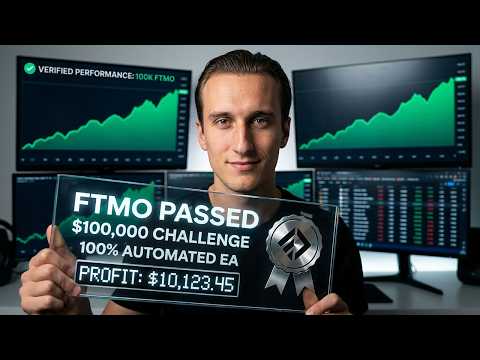
My algorithm passed Phase 1 of a 100K FTMO challenge. Zero manual trades. Not a single one. The same people who told me algos cannot pass prop firm challenges are still failing them manually. Full breakdown on YouTube youtu.be/9N8XgmA_LwE
YouTube video
YouTube
Jan - Algo Trader tweet media
English
4
0
12
1.4K
Willem
Willem@DutchFlowTrader·
@onlybreakouts No I only blame you! 😂🤣 Explain it!
English
0
0
0
14
Breakout Trading Academy
Breakout Trading Academy@onlybreakouts·
Most traders blame their strategy… but it’s actually False Breakouts wrecking their results. Before you tweak anything, run your numbers through this calculator. You’ll see exactly where the real damage is coming from. Try it in the comments ↓
Breakout Trading Academy tweet media
English
2
1
9
2.7K
Willem
Willem@DutchFlowTrader·
@FibboKing Amazing. I traded Gold manually. No succes. I stopped. Volatility too high. I might try a trading robot...
English
0
0
1
14
Fibboking🤖
Fibboking🤖@FibboKing·
Losing streaks are an inevitable reality of the markets, but drawdown management is entirely within our control. In systematic trading, survivorship is the ultimate objective. The longer your system can stay in the game, the more room you give your edge to play out and generate profits naturally. whenever I build an algorithmic bot, the architecture is engineered to prioritize downside protection over aggressive profit targets. ​A prime example of this can be seen in the XAUUSD trade history from NinjabotATR intraday breakout EA. A sequence of small, controlled losses keeps the account safe, allowing the bot to survive long enough to catch the significant profitable moves that follow. Build to survive first; the profits will follow.
Fibboking🤖 tweet media
English
1
0
2
123