dipanjanr

1.1K posts

dipanjanr banner
dipanjanr

dipanjanr

@dynamicdip

Neuroscientist, Physicist, Senior Faculty @IITJ Adjunct @DBT_NBRC Fellow-FNASc, DBT-Ramalingaswami fellow (past), formerly @CNRS,@TUBerlin, @BCCN, @MIT

Jodhpur, Rajasthan Katılım Ağustos 2008
322 Takip Edilen949 Takipçiler
dipanjanr
dipanjanr@dynamicdip·
8/8 TL;DR: When you're thinking about yourself — even briefly — your brain literally rewires how it encodes the world around you. Beta oscillations that normally protect working memory get overridden. Next time you zone out in a meeting, now you know exactly which brain wave is responsible 😅
English
0
0
0
73
dipanjanr
dipanjanr@dynamicdip·
7/8 The impactful finding: medial-frontal beta power during encoding was the key predictor of memory errors — but only in the externally focused group. In the self-reflection group? Beta's protective effect on memory was completely disrupted.
English
1
0
0
69
dipanjanr
dipanjanr@dynamicdip·
1/8 Ever wonder why daydreaming makes you forget things? A new EEG study just cracked open the brain mechanism behind it 🧵 #Neurosciences #WorkingMemory #BrainWaves New publication alert from CBDL @DBT_NBRC @saide_iitj @iitjodhpur led by PhD student @ankitcog investigating human memory using dual task EEG and self-related processing along with @arpansview Yadav, Banerjee & Roy (2026), Frontiers in Human Neuroscience #EEG #CogNeuro #BetaWaves #MindWandering #WorkingMemory frontiersin.org/journals/human…
English
1
6
22
658
dipanjanr
dipanjanr@dynamicdip·
Great to know you found this interesting. Mainstream emotion studies primarily focused on mean BOLD responses, missing neural & behavioural variability entirely. We found behavioural variability is conserved regardless of static vs dynamic experience. In elderly, uncertainty → frequent belief updates → more idiosyncratic emotional experiences — not explained by attention or sensory differences. Neurally, medial & lateral OFC sit atop the Bayesian inference hierarchy for emotion’s temporal dynamics. Elderly show distorted latent emotion spaces with clear spillover. Cross-species emotion circuits? Likely rich in both shared & unique signatures — not fully explained by genetics. Resilience & adaptation drive neural & behavioural variability under emotional uncertainty. 🧠
English
0
0
1
35
Carlos E Alvarez
Carlos E Alvarez@CarlosEAlvare17·
Dipanjan, this is super interesting and to me seems outside the mainstream focus. I study dog behavioral genetics and have been increasingly curious about the potential for such effects for the last 6 years or so. I wonder if you have any thoughts on my question here: x.com/CarlosEAlvare1…. As an example of feasibility for what I am thinking, this is an example of how ethological data could be acquired for study of transitions. In this was, it was captive macaques (link in the preceding tweet of the thread): x.com/CarlosEAlvare1…. I also wonder if misophonia could be an example of genetic risk related to transitions, in part because of the issue of connectivity in transitions: x.com/CarlosEAlvare1…. It also presents an outstanding psychiatric condition in humans because of its easy access by brain imaging and genetics.
English
1
0
1
76
dipanjanr
dipanjanr@dynamicdip·
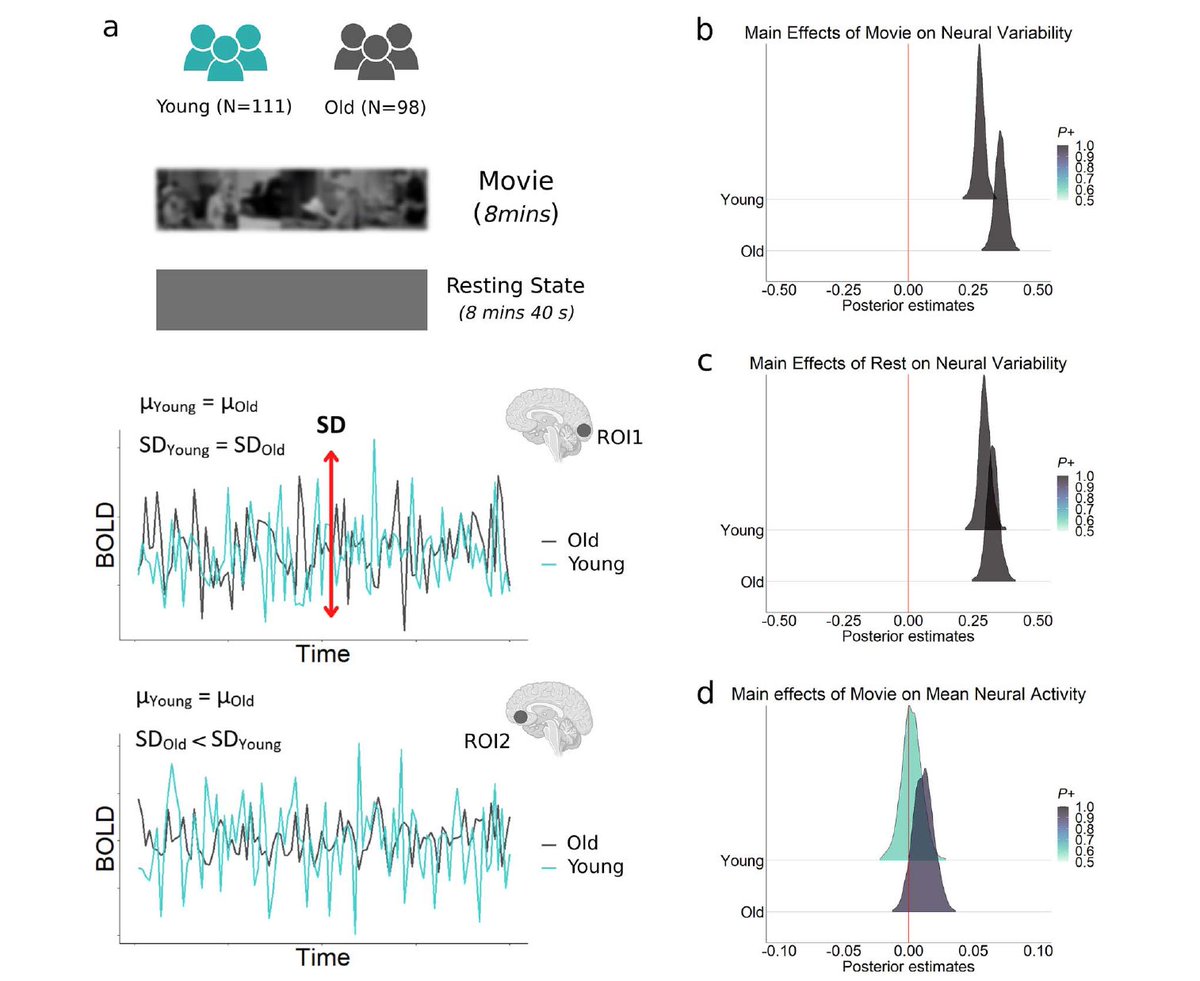
🧠 NEW PAPER ALERT in @CerebralCortex! from Cognitive Brain Dynamics Lab @iitjodhpur @DBT_NBRC @DBTIndia @EduMinOfIndia @MoHFW_INDIA We discovered how aging changes emotional brain processing during movie-watching. Spoiler: It's not about average activity—it's about VOLATILITY. Huge thanks to first author @gargi_4 this study part of her final PhD thesis work with amazing co-authors @FahdYazin, @ArpanBanerjee, and the entire team at NBRC & IIT Jodhpur! 📄 Read the full paper: Cerebral Cortex (2026) 🔗 DOI: 10.1093/cercor/bhag053 #Neuroscience #Aging #Emotions #fMRI Study: 209 participants (young vs older adults) Hitchcock movie watching Thread 👇 academic.oup.com/cercor/article…
dipanjanr tweet media
English
4
9
38
2.6K
dipanjanr
dipanjanr@dynamicdip·
Part 10 - The Big Picture & Impact 🎯 TAKEAWAYS: Neural volatility reveals aging signatures invisible to traditional measures OFC shows heightened uncertainty in affective inference This may be an ADAPTIVE response to aging Naturalistic paradigms (movies!) unlock real-world brain dynamics 📄 Full paper: DOI 10.1093/cercor/bhag053
English
0
0
0
78
dipanjanr
dipanjanr@dynamicdip·
Part 9 - The Pattern Emerges (Figure 6, Part 2) Think of it like blurred vision for emotions: Increased uncertainty → Adjacent emotions blend (anger/fear), but distant ones stay separate (anger/happiness). Neural volatility creates systematic distortions in emotional space—not random noise!
dipanjanr tweet media
English
1
0
0
123
dipanjanr
dipanjanr@dynamicdip·
Part 8 - Beyond Movies: Emotion Recognition (Figure 6, Part 1) Does this extend to other tasks? We tested facial emotion recognition (Happy, Sad, Anger, Fear, Disgust, Surprise). Older adults: 📊 Higher variability in accuracy (SD: 17.44 vs 11.08, P<0.0001) 🔀 "Spillover" between ADJACENT emotions (Fear↔Surprise, Anger↔Disgust)
dipanjanr tweet media
English
1
0
0
92
dipanjanr
dipanjanr@dynamicdip·
Part 7 - Neural State Transitions (Figure 5, Part 2) Model prediction: More uncertainty → More state transitions We tested with Hidden Markov Models: ✅ Young: Stable OFC states ✅ Older: Rapid, frequent transitions Predictions matched neural data! Control (visual cortex): No difference between groups.
dipanjanr tweet media
English
1
0
0
67
dipanjanr
dipanjanr@dynamicdip·
Part 6 - Computational Mechanism (Figure 5, Part 1) We built a Bayesian learning model to decode what's happening computationally. The winning model revealed older adults: ⬆️ Represent MORE uncertainty around changing emotions ⬇️ Update beliefs about environmental stability differently Math meets mind! 🧮🧠
dipanjanr tweet media
English
1
0
0
67
dipanjanr
dipanjanr@dynamicdip·
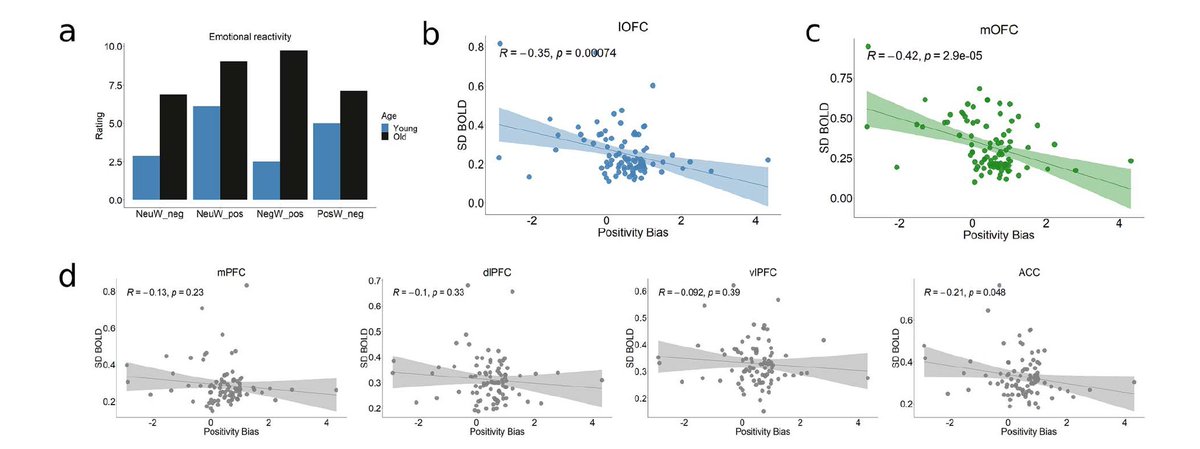
Part 5 - Individual Emotional Profiles (Figure 4) Does OFC volatility relate to real-world emotions? YES! In a separate emotional reactivity task: 📉 Higher OFC volatility → Lower positivity bias (r=-0.35 to -0.42) This relationship was Specific to OFC—other prefrontal regions showed no correlation.
dipanjanr tweet media
English
1
0
0
57
dipanjanr
dipanjanr@dynamicdip·
Part 4 - Disrupted Temporal Dynamics (Figure 3) Using T-PHATE analysis, we visualized how OFC activity unfolds during the movie: 👥 Young: Smooth, sequential trajectories 👴 Older: Disrupted, distorted patterns Plus, older adults rated arousal as lower and MORE volatile (r=-0.67, P<0.001). Neural chaos = emotional divergence!
dipanjanr tweet media
English
1
0
0
105
dipanjanr
dipanjanr@dynamicdip·
Part 3 - The OFC Story (Figures 1-2) Not all brain regions changed equally! The orbitofrontal cortex (OFC)—your brain's emotional hub—showed UNIQUELY high volatility in older adults. Other prefrontal areas? Unchanged. This pinpoints specific alterations in affective processing with age. 🎯
dipanjanr tweet media
English
1
0
0
118
dipanjanr
dipanjanr@dynamicdip·
Part 2 - Core Finding: Volatility ≠ Noise Why measure brain signal variability instead of averages? 🔑 KEY RESULT: Older adults showed dramatically increased neural volatility during the movie (P=0.99, BF=415), but mean brain activity? No difference between groups. Variability captures unique aging signatures!
English
1
0
0
165