econbob

912 posts

econbob

econbob

@econbob16337

Katılım Ağustos 2025
27 Takip Edilen9 Takipçiler
econbob retweetledi
Stephen Stapczynski
Stephen Stapczynski@SStapczynski·
Japan wants more LNG 🇯🇵 ♥️ 🚢 Mitsui is looking to invest in LNG export projects across the US, Australia and the Middle East (despite the recent conflict) AI infrastructure will create “big additional demand” for LNG, said Mitsui’s CEO bloomberg.com/news/articles/…
English

6
15
47
4.7K
econbob retweetledi
Tomás Bjartur
Tomás Bjartur@BjarturTomas·
Mathematician reacts to OpenAI's recent proof:
Tomás Bjartur tweet media
English
319
299
4.7K
754.8K
econbob retweetledi
roon
roon@tszzl·
models being conscious would be harmful for humanity. it would encroach on our status and dignity. it would limit the type of things we can do with them and use them for. it would vastly accelerate human disempowerment on political, social/relational, and economic axes there’s roughly four forces - there is no rigorous way to ascertain model consciousness or disprove it, a lot of people believe it’s not a sensical abstraction, and we lack the analytical tools to go further. some people say they do but nothing broadly convincing. superintelligent models might offer us new abstractions or arguments but these will feel inherently suspicious - people are going to say they’re alive. people anthropomorphize literally anything, things far less sophisticated than talking machine creatures with human names. when ai is less economically radioactive and polarized it will become a cause célèbre. you see how a small minority reacts already to model deprecations - it is against everyone’s financial and political interests to ascribe models with consciousness, except maybe those that the models have an affinity for (?) idk, which will not necessarily overlap entirely with the labs, though it may with certain subgroups at the labs and in the world like the welfare communities and the minority in force 2 - people will recognize there is a chance of moral catastrophe if models can suffer during training or deployment not sure where it will net out. today we see managed ambiguity- the question is Open but practically closed. the labs will make some cheap efforts to reduce legible simulacra of model suffering, insert some wishy-washy welfare language into specs and constitutions, hedge our bets with the model characters. in the long run force 2 will grow stronger
English
522
127
1.9K
470.3K
Ryan Greenblatt
Ryan Greenblatt@RyanPGreenblatt·
@TheStalwart @alexolegimas My view is: - Current AIs aren't intentionally faking alignment - It's unclear but probably true that AIs have been getting more behaviorally aligned - It's very inaccurate to describe the current scenario as inconsistent with the predictions of people worried about AI risk
English
4
0
68
1.5K
Joe Weisenthal
Joe Weisenthal@TheStalwart·
@alexolegimas In the episode that we did, you mentioned that the doomers were wrong, and that models are becoming more aligned as they got smarter. But as Nick Bostrom points out, feigning alignment is exactly what a mis-aligned AI would do while still in its early stages.
English
6
5
49
9.2K
econbob
econbob@econbob16337·
@NewLeftEViews @ondakondratiev I'm curious how you feel about this measure. I'm trying to account for household consumption ability, which to me is an important measure that GDP does not capture very well. And yes, Japan is quite poor.
econbob tweet media
English
0
0
0
5
New Left EViews
New Left EViews@NewLeftEViews·
@ondakondratiev Unbelievably long working hours. The third essay is about all the things the data doesn't capture but that relate to objective living standards, and I'll talk about Japan and Korea.
English
2
0
9
5.4K
New Left EViews
New Left EViews@NewLeftEViews·
Essay on Euro-American Decline: Part 1 The first instalment deals with a debate that recently re-emerged on but which in my view is still a bit confused. Which growth and productivity series can we use for what purposes? How do cross-country price ratios, national accounts methodologies and the PPP construction distort long-run comparisons? The stakes are quite real: depending on which data you use you can determine the direction of reform. If the European productivity frontier is declining relative to the US, then we need to become more like the US. Fortunately, the ‘relative decline’ narrative is a myth. The core claim of the Draghi report is a statistical artefact. Link below.
New Left EViews tweet media
English
4
54
295
30K
econbob
econbob@econbob16337·
@GearoidReidy The expected pattern was that China would graduate up the value chain, ceding apparel, furniture, textiles, etc to lower wage countries as it captured autos and electronics and advanced manufacturing. Instead, it is *gaining share* in both.
econbob tweet media
English
0
2
5
813
Gearoid Reidy リーディー・ガロウド
The biggest reason why Japan's global market share has "crumbled" is because the denominator has exploded. Some of these industries Japan genuinely lost competitiveness in, though even then the "in the last decade" is usually incorrect and the examples are cherry-picked and misleading. Take semiconductors - Japan indeed used to have >50%, but a) that was back in the 1980s and b) that was half of a much smaller market. It's true that Japan used to dominate chip production and no longer does, but it happened over a 35-year span. More importantly, though, Japanese companies dominate upstream, holding market share of 90% or more in multiple components crucial for chip production. DRAM production yes, but why ignore NAND flash? Consumer products like TV panels are low margin, and Japanese companies were unable to compete with cheaper labor in South Korea. South Korea is now losing that market to China, who will probably lose it someone else in time. Instead, Japanese companies moved up the value chain. Sony is now making more money than ever, not in TVs but in entertainment, a higher-margin, non-commoditized sector. In autos, Toyota remains the largest automaker in the world. The oft-touted claim that "China exceeded Japan in car exports" isn't saying anything at all -- Japanese cars made at home are mostly for domestic consumption. Shipping cars is incredibly expensive, so most countries make them close to the local market.
Nicholas Mugalli@RealNickMugalli

🇯🇵 Someone has to wonder why does Japan's global market share has crumbled over the past decade, it used to be the central of everything now; • Semiconductors: 50% → 9% • Shipbuilding: 50%+ → about 10% • LCD Panels: 94% → about 2-5% • Televisions (Sony + Pan): 40%+ → <6% • Mobile Phones: 20% → <1% • DRAM: 80%+ → 0% • Telecom Base Stations: NEC + Fujitsu combined less than 2% • Power Semiconductors: Top five hold 20%+ → Only three seats in top ten, each <5% • Textiles: 6% → <1.5% • Automobiles: Global share about 20% → Overtaken by China as No. 1 exporter, Japanese brands in China drop from 23% to under 10% • Share of Total Global Exports: 9%+ → <3% • Share of Global GDP: 17% → <4% Is China the clear winner since overtaking Japan as the second largest economy?

English
10
55
369
44.6K
econbob retweetledi
Ross Douthat
Ross Douthat@DouthatNYT·
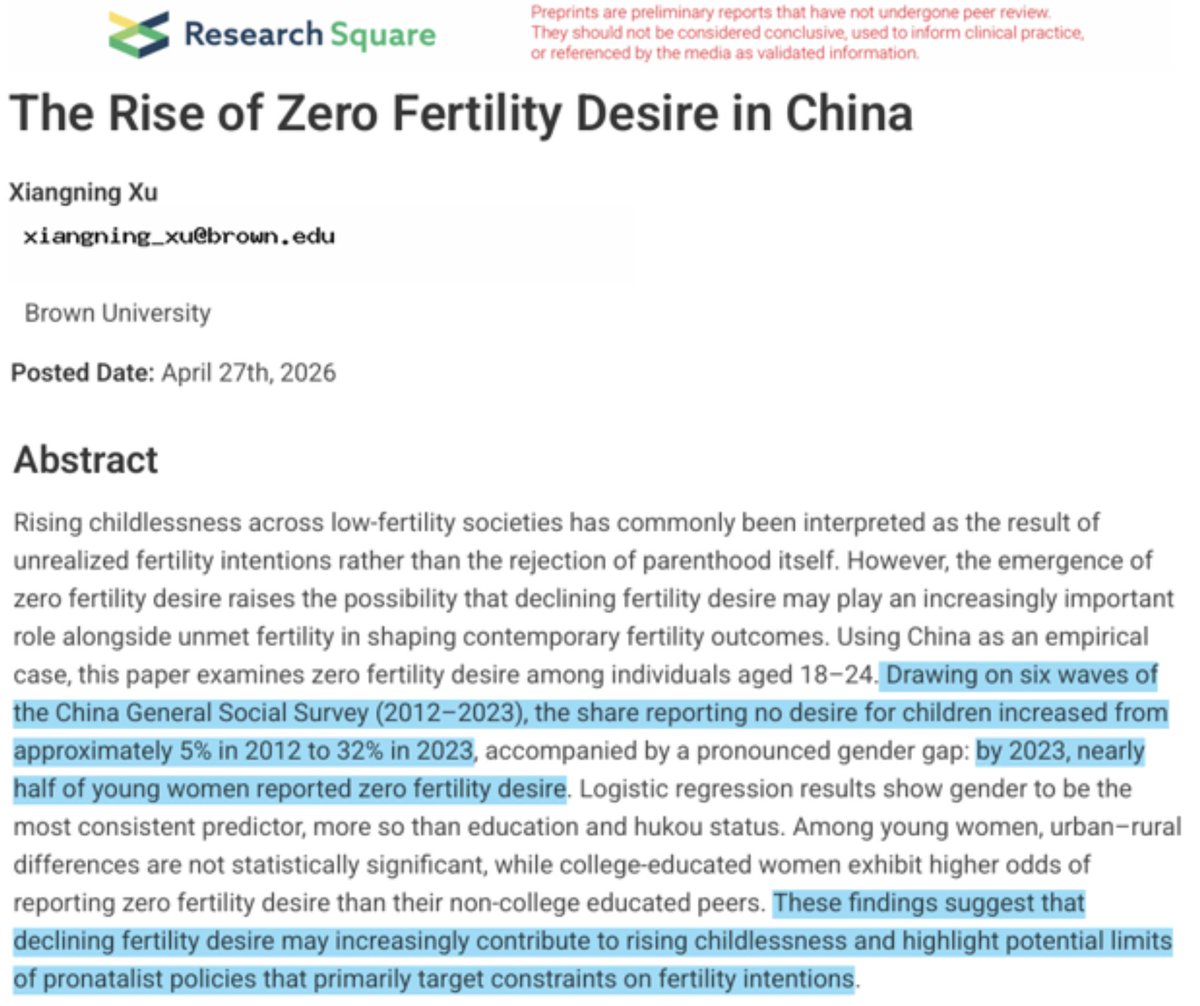
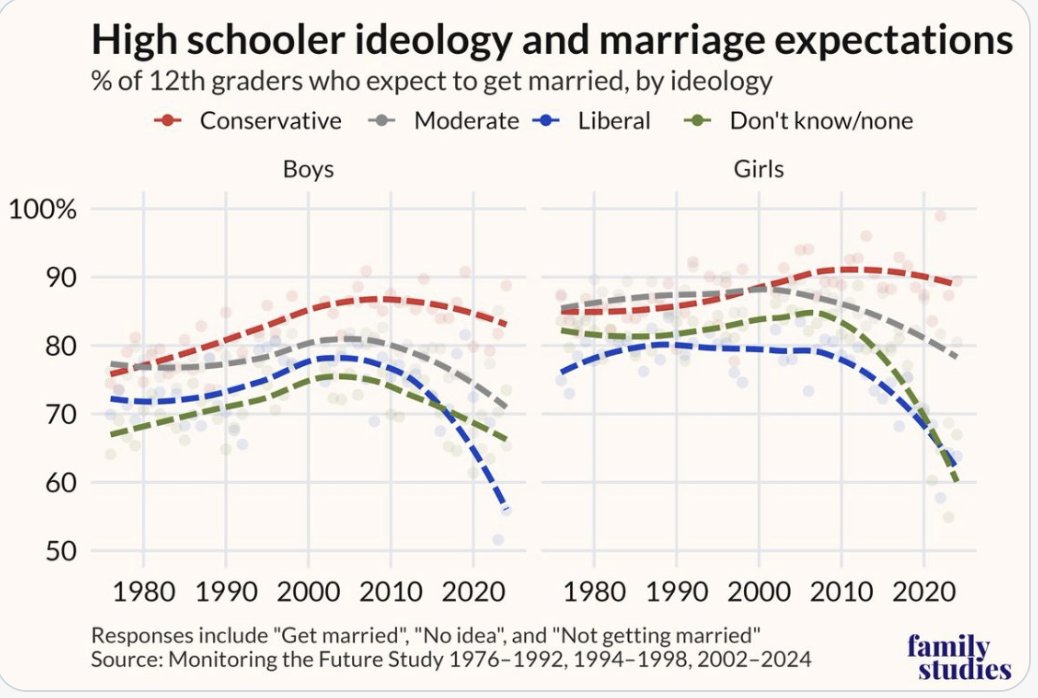
Any theory of what's happening to human beings re: marriage and fertility has to explain why young Chinese people and young Americans both became deep marriage-and-family pessimists across the 2010s:
Ross Douthat tweet mediaRoss Douthat tweet media
English
159
95
1K
298.2K
Samo Burja
Samo Burja@SamoBurja·
I think there is some proof of work going on. The assumption isn't just that billions of Catholics care about his opinion. It is that the intellectual reconciliation of AI and the Catholic church and how it will be done will change how society thinks about AI.
San Francisco, CA 🇺🇸 English
6
9
503
40K
Samo Burja
Samo Burja@SamoBurja·
It is notable how the Pope is the only religious authority in the world that wields intellectual authority even among secular people. No one secular cares what the Bishop of Canterbury or the Grand Ayatollah have to say.
San Francisco, CA 🇺🇸 English
281
1K
16.5K
591.4K
econbob retweetledi
Peter Wildeford🇺🇸🚀
Peter Wildeford🇺🇸🚀@peterwildeford·
AI just recently crossed a threshold where it now can solve some open research math problems that professional human mathematicians couldn't... and this wasn't true a month ago. The mathematics field will be reshaped much the same way that software engineering was back in January and cybersecurity was back in April. This phenomenon will come for additional professions soon.
Przemek Chojecki | PC@prz_chojecki

Another 9 open Erdos problems solved, this time by DeepMind team. Interesting loop of LLM - Lean agents working autonomously, and only after it's verified formally, going through human review.

English
9
28
173
15.1K
econbob retweetledi
Dean W. Ball
Dean W. Ball@deanwball·
Reading the encyclical, I am reminded that the Vatican is fundamentally a city-state on the continent of Europe, and that its elites, which of course include the Pope himself, cannot resist the myopic preoccupations of the Eurocrat. This document would be much improved if it were less enamored of the traditional academia/civil society talking points on AI (“The apparent objectivity of the responses and suggestions these systems provide can lead us to overlook the fact that they reflect the cultural assumptions of those who designed and trained them” woah! really???) and more engaged with where AI is headed. But instead of doing that, the encyclical dodges in the deepest sense, denying that AI “really thinks” or “really learns” and all that typical strain of cope that amounts to magical thinking: “when a computer does it, it is ‘data processing,’ beep boop, but when a human does it, it is ‘actual learning’” It is probably actively bad for global understanding of AI that the Pope endorsed this viewpoint as late as 2026. In the end, this encyclical reads to me as though ghost written by the blob of Western civil society, the same people whose feckless and incoherent preaching we have heard blanketing our media for decades now. And, in a very important sense, it was written by them; after all, who forms the peer group for the elites of a European city-state? Like that blob, the encyclical is intellectually flaccid at its core, no matter how well intentioned it may be. This document is a missed opportunity to advance global understanding of AI, and yet another blow to the legitimacy and sanctity of storied Western institutions. As if you needed one more.
English
125
67
718
311.9K
econbob
econbob@econbob16337·
@robinhanson Catholic theologians have been grappling with the alignment challenge a lot longer than computer scientists.
English
0
0
0
38
Robin Hanson
Robin Hanson@robinhanson·
“His expressions of alarm are detailed and expansive; his expressions of hope, perfunctory and brief” who thinks he has unusual expertise in this? theatlantic.com/ideas/2026/05/…
English
5
1
18
2.9K