E
9.8K posts

E
@ehuna
FSD Videos 🚗 Ex-Tesla 🤖 Long $TSLA 📈 More than just a pretty face 🤩 Buying a Tesla? Get up to $1000 off with my referral link https://t.co/vjHPO9I2f7

@wholemars @WR4NYGov Logs show driver disengaged Autopilot four seconds before crashing


@WilliamShatner @RobertPicardo If u had a Tesla this wouldn’t ever happen


I went to the exact same location of the Cybertruck accident shown in the Fox News video. This is the US-69/59 Eastex Freeway northbound HOV lane at the Y-split near the Eastex Park & Ride exit (approaching from downtown Houston toward Humble). In the Fox News video, the vehicle failed to follow the right curve, going straight into the barrier. Well, I tested it twice today with Tesla FSD engaged the entire time with zero human intervention. And unless you think I am a hologram speaking to you from another dimension now, it worked out really well. Here is the video of me taking the exact same curve twice, with Tesla FSD v14.2.2.5.

I went to the exact same location of the Cybertruck accident shown in the Fox News video. This is the US-69/59 Eastex Freeway northbound HOV lane at the Y-split near the Eastex Park & Ride exit (approaching from downtown Houston toward Humble). In the Fox News video, the vehicle failed to follow the right curve, going straight into the barrier. Well, I tested it twice today with Tesla FSD engaged the entire time with zero human intervention. And unless you think I am a hologram speaking to you from another dimension now, it worked out really well. Here is the video of me taking the exact same curve twice, with Tesla FSD v14.2.2.5.


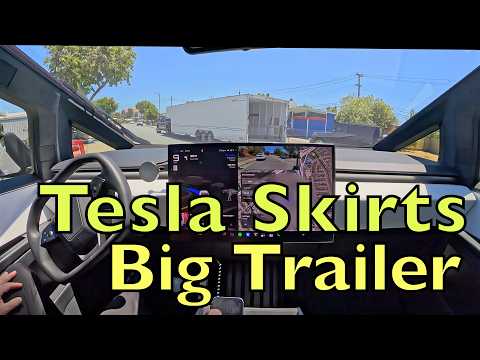
Elon Musk's full 2025 Q4 Tesla call remarks with 3 flawless no-touch Tesla self-driving (FSD) rides. I've removed silence, hesitations, and stutters, cleaned up the audio and the AI transcript slop, and translated to multiple languages. The whole thing is searchable and can easily be referenced in the future. This is long, it's ok to listen to it like a podcast. 🙌 (00:02) Travis Axelrod: Good afternoon, everyone, and welcome to Tesla's fourth quarter 2025 Q&A webcast. (00:07) My name is Travis Axelrod, Head of Investor Relations, and I'm joined today by Elon Musk, Vaibhav Taneja and a number of other executives. (00:16) Before we jump into Q&A, Elon has some opening remarks. Elon. (00:21) Elon Musk: Thanks, Travis. So we've updated the Tesla mission to "Amazing Abundance". (00:27) And this is intended to send a message of optimism about the future. I think we're most likely headed to an exciting, amazing era of abundance. (00:40) And I think with the advent or with the continued growth of AI and robotics, I think we actually are headed to a future of universal high income, not universal basic income, but universal high income. (00:56) I mean, there's going to be a lot of change along the way, but that is what I see as the most likely outcome. (01:04) So I think that it makes sense to update Tesla's mission to reflect that goal. (01:13) And obviously along the way, we're going to keep improving safety, driving down the cost of goods and getting people access to anything they need without compromise and still making sure that the environment is great, nature is great and people can have whatever they want, which seems like probably the best future. (01:33) I'm open to other ideas, but that sounds like... If you could say what is the best future you could possibly imagine? (01:41) I guess it would be that everyone can have whatever they want, including amazing medical care but we still keep the beauty of nature and earth. I think that's probably the best outcome. (01:56) And we're seeing obviously the first steps along that way this year for Tesla, [with the] first major steps, as we increase vehicle autonomy and begin to produce Optimus robots at scale. (02:12) We're making very big investments. So this is going to be a very big CapEx here as Vaibhav will get into. (02:19) That is deliberate because we're making big investments for an epic future. So I think all these investments make a lot of sense. (02:25) We'll continue to make sure that when we do spend capital, it is spent very efficiently. (02:35) But it's a lot of things, major investments in batteries and the entire supply chain of batteries. (02:43) So we're also going to be significant manufacturers of solar cells and we're making massive investments in AI chips. (02:57) So I think these will all make a ton of strategic sense. (03:01) And then I guess I have like one... I guess it's not like... It's not exactly bad news, but it's time to basically bring the Model S & X programs to an end with an honorable discharge, because we're really moving into a future that is based on autonomy. (03:33) And so if you're interested in buying a Model S or X, now would be the time to order it because we expect to wind down S & X production in the next quarter and basically stop production of Model S & X next quarter. (03:51) We'll obviously continue to support the Model S & X programs for as long as people have the vehicles. (03:57) But we're going to take the Model S & X production space in our Fremont factory and convert that into an Optimus factory, with the long term goal of having a million units a year of Optimus robots in the current S and X space in Fremont. (04:18) So that is slightly sad, but it is time to bring the S and X programs to an end and shift... Really it's part of our overall shift to an autonomous future. (04:39) As my profile picture on X [shows] for a few months there, the future is autonomous. (04:49) And so, let's say, with respect to full self-driving and Robotaxi, people are obviously following with very close attention the progress of FSD and you can experience it for yourself. (05:03) If you've got a Tesla, you notice with every software update, the car gets better and better at autonomy. (05:13) And we're able to do our first rides with no safety monitor in the car in Austin [Texas]. These are paid rides. (05:25) So these are just sort of randomly selected paid rides with no safety monitor. (05:32) And I think maybe, as of maybe yesterday or so, we actually don't even have a chase car or anything like that. (05:42) So these are just cars with no people in them and no one's following the car in Austin. (05:50) So we're obviously being very cautious about this because we want to have no injuries or serious accidents along the way. (05:59) So I think it makes sense to be very cautious, but you'll see the amount of autonomy increase dramatically, I think every month essentially. (06:10) So there will also be an opportunity, something we've talked about for a long time, for existing owners of Teslas to add or subtract their cars to the fleet, kind of like how Airbnb works, where you can add or subtract your house to the Airbnb inventory. (06:36) And I think probably the value of the Tesla, with people adding or subtracting their cars to Tesla's autonomous fleet is probably a little underweighted by a lot of people because we've got millions of cars with AI4 that can do this. (06:56) So, it might potentially... I think it will provide an opportunity for a lot of customers to earn more by lending their car to the fleet than their lease cost to Tesla. (07:17) Yeah, which is kind of... You get... In that scenario, you basically get paid to own a Tesla. It's quite a good scenario. (07:28) And we expect to have fully autonomous vehicles in probably somewhere between a quarter and half of the United States by the end of the year, pending regulatory approval. (07:48) You know, a big factor would be if there's some kind of federal [framework] for autonomous vehicles. (07:54) In the absence of that, you kind of have to go on a city by city or state by state basis. (08:00) But nonetheless, even if it is city by city, state by state, we expect to be in dozens of cities, dozens of major cities by the end of the year. (08:17) With respect to energy, the Tesla energy team has done incredible work and the growth rate is continuing to be very strong. (08:28) And we're building more manufacturing capacity and expect that energy will have very high growth for really as far into the future as we can imagine. (08:41) The solar opportunity is underestimated. (08:45) We think the best way to add significant capability to the grid, let's say for powering AI data centers, is solar and batteries on Earth and solar in space. (09:00) So that's why we're going to work towards getting 100 gigawatts a year of solar cell production integrating across the entire supply chain from raw materials all the way to finished solar panels. (09:21) A little bit more about Optimus. We'll probably unveil Optimus 3 in a few months. (09:31) And I think it's going to be quite surprising to people, it's an incredibly capable robot. (09:40) And as I mentioned, we are replacing the S & X line in Fremont with a million unit, a 1,000,000 unit per year line of Optimus. Now, because it is a completely new supply chain, there's really nothing from the existing supply chains that exist in Optimus. (09:56) Everything is designed from physics first principles. (10:10) So that means that the normal S curve of manufacturing ramp will be longer for Optimus than it is for products that have at least some portion of an existing supply chain. (10:24) Like when everything's new, the production rate will be proportionate to the least lucky, least confident part of the entire supply chain. (10:35) And if there's 10,000 things that need to go right, it's you know, it only takes one to to be slow, to lag that. (10:42) So it will be sort of a stretched out S curve. (10:46) But I'm, I'm confident that we'll get to 1,000,000 units a year, in Fremont, of Optimus 3. (10:57) And Optimus really will be a general purpose robot that can learn by observing human behaviour. (11:04) So you can demonstrate a task or literally verbally describe a task, or show it a task, or even show it a video and it will be able to do that task. (11:13) So it's going to be a very capable robot. (11:18) I think long term Optimus will have a very significant impact on the US GDP, it will actually move the needle on US GDP significantly. (11:33) So in conclusion, there are still obviously many who doubt our ambitions for creating amazing abundance, but we're confident it can be done and we're making the right moves technologically to ensure that it does. (11:52) And Tesla's obviously has never been a company to shy away from solving some of the hardest problems. (12:00) I think that's how you build value in companies, you solve hard problems. I don't know how you create value by solving easy problems. (12:10) So there are a lot of hard problems that the Tesla team is going to solve, but it's an incredibly talented and hard working team. (12:18) And I'd like to thank actually everyone at Tesla for their their incredible hard work. (12:25) And it's an honor to work with such a talented group. (12:28) So thank you to everyone who is supporting this mission. The future is more exciting than you can imagine. (12:34) Travis Axelrod: Now we're going to head over to investor questions. (12:36) As always, we will start with questions from say.com The first question is: (12:41) Today there are approximately 90 million cars sold globally each year. (12:46) Does Tesla have a view, based on its Robotaxi ambition, what this number will be in five or ten years? (12:52) And how does this impact Tesla's EV strategy to have more models? (12:57) Lars Moravy: Yeah, thanks Travis. (12:58) As Elon said, the future is autonomous and obviously autonomy and Cybercab are going to change the global market size and mix quite significantly. I think that's quite obvious. (13:07) You know, general transportation is going to be better served by autonomy as it will be safer and cheaper and over 90% of vehicle miles travelled are with two or less passengers now, which is why we designed Cybercab that way. (13:17) In this new autonomous market, we at Tesla have the advantage of efficiency, cost, and manufacturing at scale that really no one else has. (13:24) And we've built that over the last decades and we believe that that segment that we are creating will grow millions year over year. (13:31) Elon Musk: Just to add to what Lars said there, the point he last made, which is that 90% of miles driven are with one or two passengers or one or two occupants essentially, is a very important one, because that implies that the Cybercab, which is a dedicated 2 seater or dedicated Robotaxi. (13:58) It's a little confusing with the terms Robotaxi and Cybercab, sorry about the confusion. And in fact in some states we're not allowed to use the word Cab or Taxi, so it's going to get even more strange. (14:08) It's going to be like Cyber Vehicle or something [like] Cyber Car. (14:13) But the Cybercab, which is a specific vehicle model that we're making, does not have a steering wheel or pedals. (14:21) So this is clearly... There's no fall back mechanism here. (14:27) This car either drives itself or it does not drive. (14:32) And we expect to start production in April. As always, it's an S curve of the production rate. (14:40) So it starts off very slowly and then grows exponentially. (14:44) Then you hit the linear and then ultimately it asymptotes at what your target volume is. We would expect over time to make far more Cybercabs than all of our other vehicles combined. (15:03) Given given that 90% of distance driven or distance being travelled (exactly [it's] no longer driving) is one or two people. I think it's like 80% is just one. (15:21) So it would mean that long term we would make several times more Cybercabs per year than all of our other vehicles combined. (15:34) Travis Axelrod: Great, thank you so much. (15:35) The next question, a bit related. Are there still plans to launch new models to address different price segments and vehicle types, which could materially expand the TAM for Tesla? (15:49) Lars Moravy: Yeah, to further on what we were just talking about, we've launched our least expensive models ever over the last few months and we continue to expand those models globally. (15:58) And over the last decade, we have continually brought down the cost of our vehicles without sacrificing range, performance, or premiumness. (16:04) And we'll continue to do that as Vaibhav said, investing in our factories. But these are all trade-offs of where we spend our time or money. (16:10) And to Elon's point, just now with Cybercab coming, we are aiming to bring that Tesla premium ride experience to our largest market yet. (16:17) That could be 5 or 10 times our current levels of production. (16:20) This new autonomous market, you have to start thinking about us as moving to providing transportation as a service more than the total addressable market for the purchase vehicles alone. (16:30) And of course, we do have plans to have Robotaxis in various shapes and sizes, but obviously Cybercab will be the grand majority of that volume. (16:38) Elon Musk: Yeah, the vast majority of miles travelled will be autonomous in the future. (16:45) I would say probably less than... I'm just guessing, but probably less than 5% of miles driven will be where somebody's actually driving the car themselves in the future, maybe as low as 1%. (16:56) Travis Axelrod: Great. (16:57) The next question is historically, Tesla has spoken about gross margin per model. (17:03) Are there standalone gross margin targets for the current models excluding the benefits for FSD sales? (17:09) Vaibhav Taneja: You know, we've talked about this with the previous two cautions, but transportation as we know is changing and I think we cannot keep applying the same framework from a car sales model to the future, what we are trying to do. (17:24) So it has to be looked at it more holistically. (17:27) In autonomy, software will be the driver for growth from now. (17:31) And as we aim to maximize the global fleet, we've been laser focused on COGS from our side, because that is something which we manage. (17:41) So we will keep focusing on that. But I think we need to look at it from a different dimension. (17:48) Elon Musk: Yeah, like the Cybercab, that is the whole design of Cybercab was to optimize the fully considered cost per mile of autonomous driving. (17:59) And it's a different design problem than if you're trying to design cars for people who will be driving versus being driven. (18:09) And so Cybercab is like I said, super optimized for minimum cost per mile and also for a much higher duty cycle. (18:21) So we would expect Cybercab to be used probably 50 or 60 hours a week instead of the 10 or 11 hours a week that a driven vehicle is used. (18:35) So typically people might drive their car for an hour and a half a day on average. So it's like 10 hours per week out of 168. (18:45) But I think an autonomous vehicle is likely to be used probably five times as often, which means that you need to design the vehicle for a much more wear and tear per unit time and much more resilience. (19:01) It's more like a commercial truck that's in continuous operation or close to continuous operation. That's how you design an autonomous vehicle. (19:16) And we will have larger vehicles like the Cybercab in the future that are designed for full autonomy. (19:24) And we've actually shown pictures of this and in fact have shown prototypes. So this is not exactly a secret. (19:30) In fact, we've given people rides in them. (19:32) So we're not hiding this light under a bushel here. We're literally saying what we're going to do and have said what we're going to do for a while. (19:44) I think long term the only vehicles that we'll make will be autonomous vehicles, with the exception of the next generation Roadster, which we're hoping to debut in April hopefully. (20:04) it's going to be something out of this world. (20:07) Travis Axelrod: Fantastic. (20:08) [Next Question:] What is the current bottleneck to increase Robotaxi deployment and personal use of unsupervised FSD? (20:14) Is it the safety and performance of the most recent models? (20:20) Or is it people to monitor the Robotaxis in car or remotely? Or is there some other blocker? (20:27) I don't know, Ashok if you want to kick off on this one? (20:30) Ashok Elluswamy: Yeah, we have scaled the Robotaxi service that's available to customers over the last year in order to just learn the scaling problems without having to like wait for the unsupervised. Basically [we have] 2 two goals: first learn as much as possible from the fleet with the safety monitors. (20:47) And secondly we laser focused, for the engineering team to solve the unsupervised FSD problem. (20:53) I think we did both, by the end of last year we we had a long tail of issues that we were able to churn through. (21:00) And then in the last couple of weeks we have started our unsupervised Robotaxi service to public customers in Austin. (21:09) I think some customers took rides last week and also the service continues today without any real problems. (21:15) Separately, we did scale the fleet size in the Bay Area and in Austin and through that we learned [about] issues with charging and other issues that we would have seen once we scale the unsupervised fleet. (21:26) So both are happening in parallel. (21:29) A variant of the software that's used for the Robotaxi service was shipped to customers with version 14 and customers saw a huge jump in performance, [with] a lot of happy feedback from customers. (21:42) And since then we've improved the software significantly as well. (21:45) And customers will continue to see with their own software releases that the software is so good that you know they're like screaming to remove the driver monitoring software because they're bored inside the car too much. (21:58) Lars Moravy: Adding to that a little bit with what Ashok said about learning about our charging and service needs, we're using our vast network of charging and service centers that really only Tesla has in this space to jumpstart our infrastructure build out needs to get ahead of Robotaxi autonomous vehicle demand. (22:12) And exactly because of this network, we are the only company capable of scaling at the rate that is needed for the tsunami of autonomy that is coming. (22:21) Elon Musk: Uh-huh, yeah! (22:22) Travis Axelrod: Great. (22:23) Moving on to the next question. (22:24) After the unveil of the Cybertruck, Elon stated that if it didn't sell well, Tesla would build a more conventional looking pickup. (22:32) How practical would it be to create this new design on the Cybertruck architecture and could it be conveniently built on the existing production lines? (22:41) Lars Moravy: Actually in its segment, Cybertruck continues to be a leader and is selling more than any other electric truck out there, while our competition continues to pull back. (22:51) But to the question itself, from a line standpoint, we always design our lines to be super flexible. (22:55) We built 3 and Y on the same line. We built S & X on the same line, still showing that we can do that. (23:01) The Cybertruck line was designed in the same way and is one of our most fully ready for autonomy platforms. (23:06) Elon Musk: Yeah, we will transition the Cybertruck line to just a fully autonomous line. (23:12) And there's obviously a market there for cargo delivery like localized cargo delivery within a city, within a few 100 miles, something like that. (23:22) There's a lot of cargo that needs to move locally ...(truncated 5983 characters)...00:27:34,252 Ashok Elluswamy: Yeah, there's yeah, varying amounts of vehicles depending on the load. (27:34) You can have more vehicles during peak times and then fewer vehicles in the off hours. (27:39) Elon Musk: Yeah, this will probably, you know, double every month type of thing. It's on an exponential curve. (27:47) Vaibhav Taneja: One other thing, people forget that we've been deliberate on all this, in the sense that we have the supporting infrastructure already been in place, whether it's service centers, charging, yes we'll have to augment as the fleet grows depending upon the density of where the demand is and whatnot. (28:07) But it's not something that we just stumbled upon it and we're starting to, we've been at it for years. (28:14) Yes, not every city is designed the same way. Same thing, our infrastructure is also not the same in every city. (28:21) But you have to give us credit that it's been a journey and like Lars said, if there's some company which can do it, we've already been at it, so we should be able to deliver much better. (28:35) Travis Axelrod: And Elon, you've been spending significant personal time on Tesla's chip design? (28:39) Elon Musk: Yeah. (28:39) Travis Axelrod: What was the forcing function behind this increased involvement? (28:42) And do you think external chip sales will represent a significant portion of Tesla's valuation by the end of the decade? (28:49) Elon Musk: Well I tend to spend time on wherever, whatever the most critical issue is for the company and completing the AI5 chip design and having it be a great chip is arguably the number one most critical thing to get done, which is why I'm spending more time on that than currently anything else at Tesla. I spend pretty much every Saturday on this and a chunk of every Tuesday. (29:17) So if I'm spending my Saturdays on something, it's going to be something pretty important. (29:25) I do think AI5 will be a very good chip and I feel quite confident about the design at this point. (29:35) And then AI6, which will aspirationally follow that in under a year, will be yet another big leap beyond AI5. (29:46) So I feel pretty good about our chip strategy right now, but in terms of selling it outside of Tesla, we first need to make sure we have enough chips for the all of our vehicle production and all of our Optimus production and then we will actually use the AI5 chips in our data centers. (30:10) We already use the AI4 chips in our data centers. (30:13) So when we do training, it's a combination of the AI4 chips and NVIDIA hardware primarily that we do training with. (30:23) But he said by the end of the decade, things are changing so fast that it's hard to imagine what happens at the end of the decade. When I look ahead at what's the limiting factor for Tesla growth? (30:44) If you go say 3 or 4 years out? I think it actually is chip production. (30:47) Is there enough AI logic and enough memory, enough RAM for our volume? (30:59) And right now, I see that as being the thing that probably limits our growth in three or four years, which would imply that we're not selling chips outside of Tesla, because we need them. (31:17) I think it's going to make sense. (31:19) And this is definitely going to be a sort of a controversial thing, but I think Tesla needs to build a TeraFab. (31:29) I did mention this at the shareholders meeting. (31:33) But when even when we look at the best case output of all of our key suppliers, and I'd say even beyond the suppliers, there are strategic partners like Samsung, TSMC and Micron, and we say "What's the most you could possibly make?" and it's not enough. (31:57) So in order to remove the probable constraint in three or four years, we're going to have to build a Tesla TeraFab, a very big fab that includes logic, memory, and packaging, domestically. (32:20) And that's actually also going to be very important to ensure that we are protected against any geopolitical risks. (32:30) I think people may be underweighting some of the geopolitical risks that are going to be a major factor in a few years. (32:41) Now, a lot of people are saying "that's crazy, fabs are really hard". Yes, I know fabs are really hard, I don't think they're easy. But (32:56) we do a lot of hard things. [more below...] As with all of our FSD 14.2+ drives, these 50 minutes include 3 separate rides where I 100% don't touch the steering wheels, or brakes and accelerator pedals, from origin to destination, including parking. At the end there's also some Cybercab, Robovan, and Optimus footage I took at Tesla's "We, Robot" event. 1/3


@wholemars @WR4NYGov Logs show driver disengaged Autopilot four seconds before crashing


In this post I list a bunch of free Tesla X spaces, their hosts and speakers - check it out! Below I also include a video where we continue our adventures in Baja California, Mexico while using Tesla FSD and Starlink and I recommend you subscribe to @WholeMarsCatalog to get access to his Office Hours weekly space. Tesla X Spaces Below I list a bunch of Tesla X spaces, hosts, and speakers - you can listen to for free during the week. Every week there are tons of Tesla news and news on Elon Musk's other endeavors such as SpaceX and Starlink, the Boring company, Neuralink, X and xAI, DOGE, and more. There's also a lot of "Fear, Uncertainty, and Doubt" (FUD) spread by the oil and ICE vehicles industries, the advertising media, the TSLA shorts, certain politicians, and others against Tesla and Elon all over the world. We have a strong Tesla community and together we can fight the FUD! 💪 In addition to subscribing to @WholeMarsCatalog, keep yourself informed by listening to the following X spaces, they are all free. There's some cross pollination where some of the speakers and hosts also speak in other spaces. Follow the hosts, the speakers, and some of the listeners, you'll get reminders of when the spaces start, X notifications are also your friend. If you can spare a couple of bucks, subscribe to some of them as well. Elon and his companies and endeavors @elonmusk @tesla @teslaenergy @tesla_ai @SpaceX @Starlink @X @xai @neuralink @boringcompany @DOGE Tesla X Spaces Hosts and speakers In no particular order - @wholemars @SawyerMerritt @Farzyness @WOLF_Financial @TheGigaCast @herbertong @cyberbulls @TeslaBoomerMama @WR4NYGov @thejefflutz @TeslaLarry @Scobleizer @xandersky @teslayoda @a_meta4 @99_Colorado @JimmyOnInOne @LinkN01 @sierracatalina @jcchristopher @MobofJoggers @dallasteslaclub EV Positive List I have also created an "EV Positive" list, follow it at x.com/i/lists/108578… It includes all of the folks above and many others that are for the advent of sustainable energy and transportation Here are sample spaces from the past week - Sunday Omar's Office Hours (Subscribers only, highly recommended) Host @wholemars x.com/i/spaces/1dRKZ… In these times where some organizations such as "Tesla Takedown" and others are in a war against Tesla employees, owners, and shareholders, it's important to stay informed. Listening to @WholeMarsCatalog Office Hours is an excellent way to fight back - Omar interprets current news and expresses ideas and analogies in a clear way, making it easier to understand the future that's ahead for Tesla, our community, and humanity. Monday Talkin' Tesla Host @dallasteslaclub x.com/i/spaces/1ZkJz… Tuesday Tesla Deep Dive Host @WOLF_Financial x.com/i/spaces/1ypKd… TESLA and Elon Musk w/ CyberBulls Host @herbertong x.com/i/spaces/1kvJp… Wednesday Sierra Catalina and Uzi Obi have popup spaces at different days and times, these happened last Wednesday - Host @sierracatalina x.com/i/spaces/1OwxW… Host @uziobi x.com/i/spaces/1eaKb… Thursday TTS Host @TheCaptainEli x.com/i/spaces/1ynJO… Cyberbulls Host @herbertong x.com/i/broadcasts/1… Friday The GigaCast Host @TheGigaCast x.com/TheGigaCast/st… Tesla Beat Host @teslaownersSV x.com/i/broadcasts/1… Only $TSLA Host @LinkN01 x.com/i/spaces/1OyJA… Saturday $TSLA weekly recap Host @piangfa x.com/i/spaces/1BRJj… For some of the spaces above you can also subscribe on YouTube. This list will change over time, I don't know what I'm doing, so I apologize if I made a mistake or left anyone out. Soup nazis and other Tesla haters are excluded on purpose. Who else can we add to this list? Video Description I go over our Starlink setup while Tesla full self-driving (FSD) drives us, in bumper to bumper traffic in a small town in Baja. I go over the benefits of using a Starlink mini on the road, including accessing in our Tesla Spotify and live traffic, as well as many other services on our Model Y's big screen when we are stopped, such as Netflix, Hulu, or YouTube. We even got a Tesla FSD update while on the road in Baja! I also mention @WholeMarsCatalog and the excellent news, ideas, and analogies he brings to our Tesla community. I recommend you subscribe to @WholeMarsCatalog, the monthly subscription is less than the price of a latte and you'll be able to access among other things his weekly "Office Hours". 4k with subtitles youtu.be/6PAZqqKkpKc On YouTube, use "cc" to turn on captions, then use "Settings" ⛭ to set the title captions to French 🇫🇷, Portuguese 🇧🇷, or Hebrew 🇮🇱. See dozens of additional Tesla full self-driving videos in my highlights x.com/ehuna/highligh… This was on our 2024 Tesla Model Y, running artificial intelligence version 4 (AI4), on FSD version 13.2.8. The background music is "Captain Bacardi", by the epic Bossa Nova composer Antonio Carlos Jobim from Brazil. Good times!