@Eileenvan55 #🟦 Eileen to the left 😷

176.6K posts

@Eileenvan55 #🟦 Eileen to the left 😷 banner
@Eileenvan55 #🟦 Eileen to the left 😷

@Eileenvan55 #🟦 Eileen to the left 😷

@eileenvan55

When tyranny becomes law, Rebellion becomes Duty #NOFEAR PEACEFULLY PROTEST, THEY CANT KILL US ALL NO DM’s it’s an automatic block unless I know you

Reality Katılım Nisan 2019
13.2K Takip Edilen18.4K Takipçiler
Archaeo - Histories
Archaeo - Histories@archeohistories·
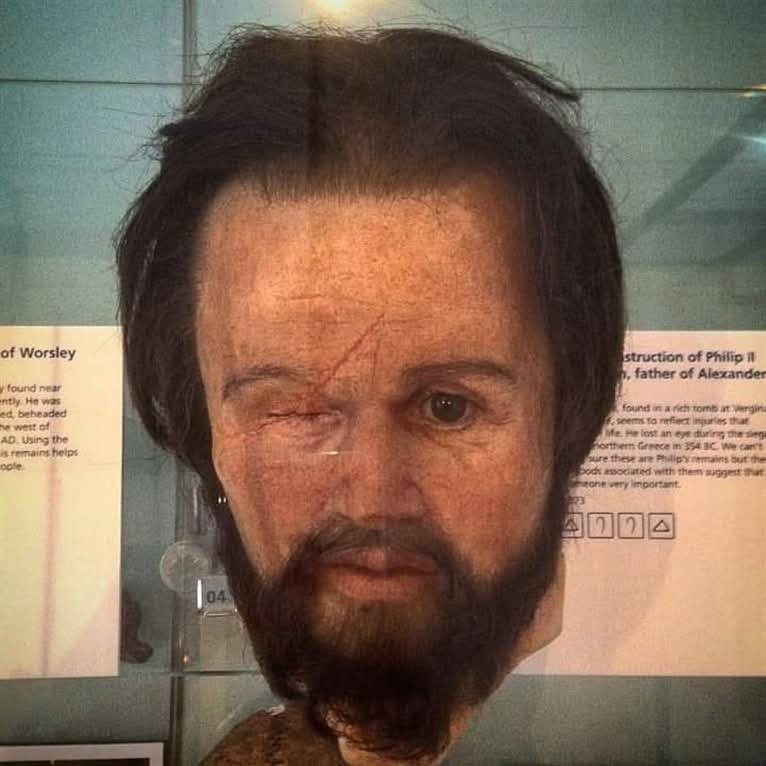
A facial reconstruction of Philip II of Macedon, the father of Alexander the Great. The reconstruction was created by a team at the University of Manchester..... Philip II of Macedon reigned from 359 BC until his assassination in 336 BC. The reconstruction shows a facial injury, which is consistent with historical accounts that he lost an eye during a siege in northern Greece in 354 BC. The reconstruction is based on remains found in a rich tomb at Vergina. The remains are believed to be Philip's, but it cannot be confirmed with absolute certainty. Scars tell tales of battles fought and victories won. The missing eye, lost in the siege of northern Greece around 354 BC, is a testament to his warrior spirit. Though time has weathered his face, the reconstruction reveals a man of strength and determination, a king who led his people through turbulent times. Gazing into his one good eye, we see not just a ruler, but a man who bore the weight of a kingdom on his shoulders. His image, frozen in time, speaks of resilience, ambition, and the enduring power of the human spirit. A haunting echo of an era long past, yet forever etched in the annals of history. #archaeohistories
Archaeo - Histories tweet media
English
95
100
874
77.1K
@Eileenvan55 #🟦 Eileen to the left 😷
@archeohistories I hate this story. Being Greek, my ancestors talked of this, but said if they went back after 3 days n the infant was alive, they took the infant in saying it was strong enough to live on. 😢🤯
English
1
0
6
493
Archaeo - Histories
Archaeo - Histories@archeohistories·
They called it “exposure.” A term that sounds clinical, maybe even benign—like sunlight or fresh air. But in practice, it meant this: a newborn baby, often a girl, carried outside the city and left alone in the wild to die. In ancient Athens, this wasn’t considered murder. It was routine. A matter-of-fact part of life. People talked about it openly—as if it were no more controversial than choosing when to plant crops or how to balance the household budget. It was framed as economic necessity, sometimes even responsible parenting. The decision belonged to the father. The law backed him up. So did tradition. And it wasn’t equal. Not even close. Girls were abandoned far more often than boys. A son could carry on the family name, inherit land, perform sacred rituals, and care for aging parents. A daughter? She came with a dowry, couldn’t inherit in the same way, and was seen—across all levels of society—as a financial liability. Wealth didn’t shield her. One ancient writer said it plainly: “Everyone raises a son, even if he is poor. But a daughter? Even the rich expose her.” There was no illusion of mercy. No comforting story to soften the cruelty. Some babies might have been taken in by strangers or trafficked into slavery, but that was a fluke—not the plan. Most died, slowly and alone—of cold, hunger, or animals. And everyone knew it. The practice didn’t just thin out the population. It carved a deep message into the cultural bedrock: that female life was optional. Conditional. Disposable. Generations were raised with that belief quietly embedded in their worldview. Mothers? They had almost no say. Once the baby was born, it was laid at the father’s feet. Literally. That was the custom. He looked down and decided: raise or discard. It’s a part of classical civilization that doesn’t show up in the gleam of marble statues or the echo of great speeches. While Athens was laying the intellectual foundation for democracy, philosophy, and reason, it was also drawing a hard line—before a girl could even cry out—about who mattered and who didn’t. © Women In World History #archaeohistories
Archaeo - Histories tweet media
English
228
694
3.5K
312K
Britney Tears
Britney Tears@HeyarH75828·
@archeohistories They STILL do it in Pakistan 100s of newborn girls dumped The sex that should be aborted is the sex that gang SA's with 400 other strange men
Britney Tears tweet mediaBritney Tears tweet media
English
4
11
91
6.3K
@Eileenvan55 #🟦 Eileen to the left 😷 retweetledi
Robert Reich
Robert Reich@RBReich·
All Senate Democrats (and independents) must vote tomorrow against the DHS appropriations bill. Please call your senators today and say NO more funding for ICE: 202-224-3121. Here's more about what you should know: robertreich.substack.com/p/dems-must-st…
Robert Reich tweet media
English
133
1.2K
2K
36.1K
@Eileenvan55 #🟦 Eileen to the left 😷 retweetledi
Jamie Raskin
Jamie Raskin@jamie_raskin·
When Democrats take back the House, we will stop at nothing to see accountability for the killers of Alex Pretti and Renée Good, and justice for the victims and their families.
English
474
1.1K
3.7K
24.7K
@Eileenvan55 #🟦 Eileen to the left 😷 retweetledi
CALL TO ACTIVISM
CALL TO ACTIVISM@CalltoActivism·
🚨KRISTI NOEM GETS AN ULTIMATUM Rep. Jamie Raskin drops a bomb on Kristi Noem’s future and says if she’s not FIRED or doesn’t quit by NEXT WEEK, Democrats will move to try her for treason, bribery, and other high crimes. The Clock’s ticking.
CALL TO ACTIVISM@CalltoActivism

🚨CAUGHT LIVE: Watch the moment the attack on Ilhan Omar interrupts my interview with Rep. Jamie Raskin. Raskin didn’t mince words: “He’s putting lives at risk… Donald Trump's constant vilification of Ilhan is dangerous… He must stop.” This is the impact of Trump’s rhetoric.

English
2.1K
5.3K
19K
722.5K
@Eileenvan55 #🟦 Eileen to the left 😷 retweetledi
Archaeo - Histories
Archaeo - Histories@archeohistories·
For centuries, when harvests failed and hunger set in, societies looked for someone to blame—and too often, they chose women. Not in metaphor, but in flesh. In a world without climate science, where droughts or crop disease couldn’t be explained, fear demanded a scapegoat. And women—especially those who bled, aged, gave birth, or simply lived outside the bounds of obedience—were cast as the cause. In early modern Europe, during times of environmental collapse like the Little Ice Age, this fear sharpened. Crops withered, winters dragged on, and instead of facing nature’s chaos, communities turned inward. Widows, midwives, healers, or women who simply spoke too much were accused of tampering with the natural world. A failed harvest wasn’t random—it was a sign of moral failure. And hunger demanded someone to punish. Witch trials didn’t erupt in times of abundance—they followed famine, plague, and crisis. Women were blamed for ruining crops, killing livestock, even causing bad weather. Their “crimes” were often just being too visible, too sexual, too old, too independent. In some courts, a dream about a woman’s spirit damaging crops was enough to convict her. Her actual presence wasn’t even required. Menstruation became a powerful symbol of this fear. Across cultures, menstrual blood was seen as poison—thought to ruin seeds, spoil wine, blight gardens. Farming manuals warned women not to touch plants during their cycle. Religious texts framed them as impure. Over time, this wasn’t just superstition—it became a system of control. The cruelest irony? Women were blamed for what they couldn’t control, then pushed out of the very work that sustained their communities. If they helped in the fields, they were punished. If they didn’t, they were called lazy. The logic trapped them either way. At its core, this wasn’t about crops—it was about power. Regulating women’s bodies became a way to manage fear. And even though the witch trials ended, the logic behind them didn’t vanish. We still see it today, when women are blamed for decline, disorder, or change. #archaeohistories
Archaeo - Histories tweet media
English
202
149
604
49.4K
Trump was right all along!!!!!
Trump was right all along!!!!!@PatCollado4·
@peekaboo_jen Just re-watching season 5 again and I'm trying to make my eyes do what Jamie does which is always looking to the side or looking down. My eyeballs don't move like that. I wonder how in the world he got his eyeballs to do that without any effort at all
English
2
0
3
631
Science Magazine
Science Magazine@ScienceMagazine·
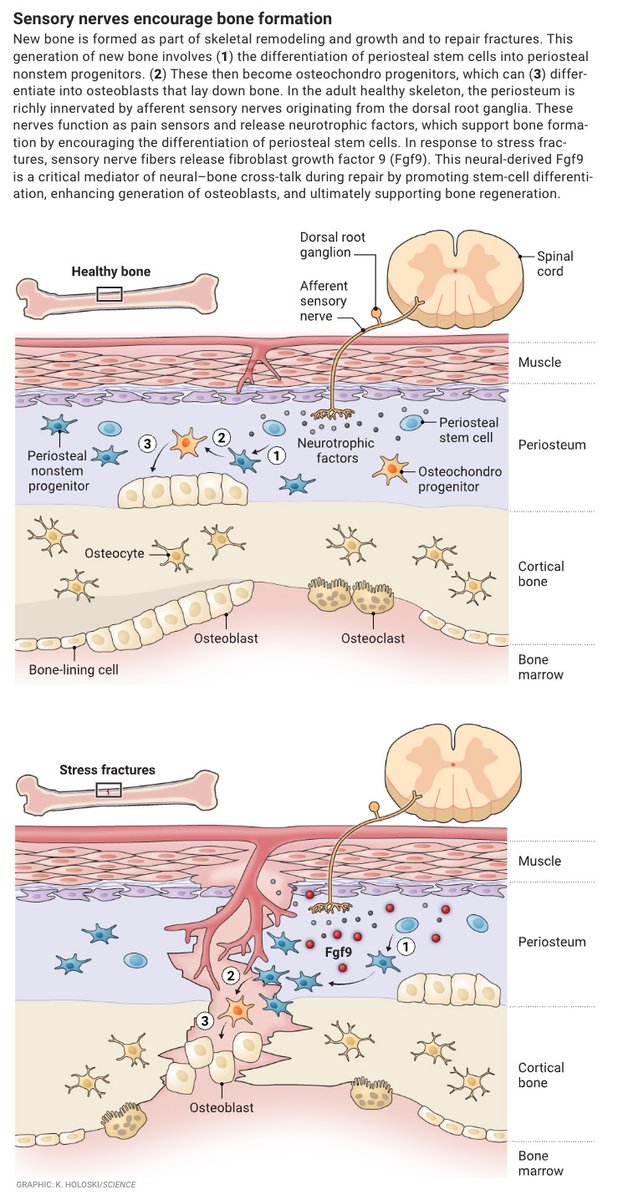
In a new Science study, researchers report an unexpected role for sensory nerves in bone healing, providing insights into communication between the nervous system and the cells responsible for bone repair. Learn more in a new #SciencePerspective: scim.ag/3Nj6M5p
Science Magazine tweet media
English
16
122
371
29.3K
Archaeo - Histories
Archaeo - Histories@archeohistories·
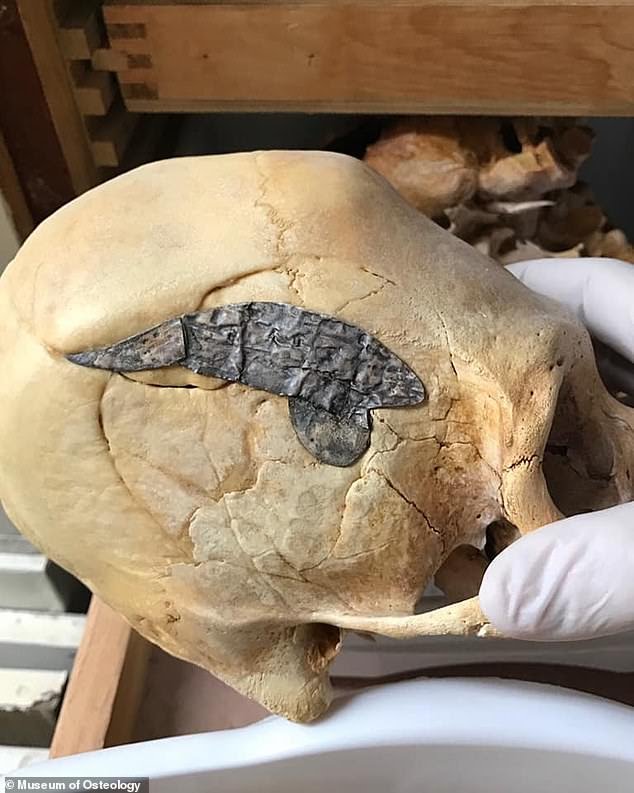
The 2000 year old skull of a Peruvian warrior was found to have been fused together with metal in one of the world's oldest examples of advanced surgery, according to a museum. Museum of Osteology in  Oklahoma says the skull, which is in its collection, is reported to have been that of a man who was injured during battle before having some of the earliest forms of surgery to implant a piece of metal in his head to repair the fracture. According to experts, that the man survived the surgery, with the skull now a key piece of evidence in proving that ancient peoples were capable of performing advanced surgeries. The skull in question is an example of a Peruvian elongated skull, which is an ancient form of body modification where tribe members intentionally deformed the skulls of young children by binding them with cloth or even binding the head between two pieces of wood for prolonged periods of time.  'This is a Peruvian elongated skull with metal surgically implanted after returning from battle, estimated to be from about 2000 years ago. One of our more interesting and oldest pieces in the collection,' the museum said. 'We don't have a ton of background on this piece, but we do know he survived the procedure. Based on the broken bone surrounding the repair, you can see that it's tightly fused together. It was a successful surgery.'  Skull had originally been kept in the museum's private collection, however it was officially put on display in 2020 following growing public interest in the artifact due to news coverage on the discovery of the skull. The area where the skull was discovered in Peru has long been known for surgeons who invented a series of complex procedures to treat a fractured skull.  The injury was commonplace at the time due to the use of projectiles like slingshots during battle. Elongated skulls were common in Peru at the time, and were stretched by applying force to a person's cranium, often by binding it between two pieces of wood. Multiple reasons have been given for skull elongation, varying from serving as a way for society's elites to mark themselves out, to acting as a form of defense. Subsequent archaeological digs have found that Peruvian women who had elongated skulls were less likely to have suffered serious head injuries than those without.  Surgeons during that time period would scrape a hole in the skull of a living human without the use of modern anesthesia or sterile techniques. 'They learned early on that this was a treatment that could save lives. We have overwhelming evidence that trepanation was not done to increase consciousness or as a purely ritual activity but is linked to patients with severe head injury, (especially) skull fracture,' physical anthropologist John Verano of Tulane University told National Geographic in 2016. 'We don't know the metal. Traditionally, silver and gold was used for this type of procedure,' a spokesperson for the Skeletons: Museum of Osteology. In a 2018 study published in Current Anthropology, the practice of elongating skulls was found among disparate cultures ranging from the Mayas to the Huns, and were found to be a status symbol of privilege and prestige in groups worldwide.  © Museum of Osteology #archaeohistories
Archaeo - Histories tweet media
English
175
191
1K
127.7K
Archaeo - Histories
Archaeo - Histories@archeohistories·
JFK lived with his sister Eunice for 3 years during his time as a congressman in the late 1940s. Here they are photographed together in the house itself, located on 34th Street NW, Washington D.C. He would later end up moving out in 1951. John F. Kennedy shared a Washington home with his sister Eunice Kennedy during his early political career, a period that shaped both his public and private life. After being elected to Congress in 1946, Kennedy needed a base in D.C., and the arrangement with Eunice provided him both family support and stability while navigating the demands of national politics. Their house on 34th Street NW became a lively center for political discussions, social gatherings, and family visits, reflecting the Kennedy family’s strong bonds and shared ambition. Eunice Kennedy herself would later go on to play an influential role in American society as the founder of the Special Olympics, a lasting legacy that paralleled her brother’s public service. The image of the two siblings, casually caught in a kitchen moment, stands in contrast to the weight of their future roles. At the time, Kennedy was a young congressman still battling chronic health issues, far from the polished figure who would become president a decade later. The Kennedy family was known for their tight-knit support system. Several siblings often lived together in Washington during the late 1940s and early 1950s, creating a kind of “Kennedy outpost” in the nation’s capital. © Vintage American Photos #archaeohistories
Archaeo - Histories tweet media
English
84
213
2K
142.2K
ArchaeoHistories
ArchaeoHistories@histories_arch·
Roman society showed a surprisingly deep emotional bond between people and their dogs. Beyond their practical roles as guards, hunters, or herders, dogs were often treated as companions within the household. Roman writers mention them by name, praise their loyalty, and describe daily life shared with them, revealing affection that went well beyond utility. Archaeological evidence supports this sentiment. Dogs were sometimes buried carefully, even individually, and a number of surviving epitaphs express genuine grief. The language used in these inscriptions mirrors that found on human graves, emphasizing years spent together, faithfulness, and sorrow at separation. Such texts reflect Roman values of pietas and emotional attachment extending beyond human relationships. These practices show that care for animals was woven into Roman cultural and domestic life. Honoring dogs in death was a way of acknowledging companionship, loyalty, and shared memory. It reminds us that the emotional lives of Romans were complex and intimate, and that their love for animals was not so different from our own. #archaeohistories
ArchaeoHistories tweet media
English
43
146
804
42.3K
@Eileenvan55 #🟦 Eileen to the left 😷 retweetledi
The Bulwark
The Bulwark@BulwarkOnline·
Q: “You said you would have no problem with releasing the full video of that strike on September 2nd.” Trump: “I didn’t say that. You said that. I didn’t say that. This is ABC fake news.” Trump on Dec. 3: “Whatever they have, we’d certainly release. No problem.”
English
670
8.5K
33.4K
1.5M
@Eileenvan55 #🟦 Eileen to the left 😷 retweetledi
Jürgen Nauditt 🇩🇪🇺🇦
Jürgen Nauditt 🇩🇪🇺🇦@jurgen_nauditt·
The security of Ukraine must be guaranteed as the first line of defense for our alliance, said European Commission President Ursula von der Leyen after a meeting with Zelenskyy, Rutte, and Costa. Ukrainians are dying on the first line of defense without being a member of the EU and NATO. That's the hypocrisy we know Ursula to be.
Jürgen Nauditt 🇩🇪🇺🇦 tweet media
English
89
97
372
11.3K
@Eileenvan55 #🟦 Eileen to the left 😷 retweetledi
CALL TO ACTIVISM
CALL TO ACTIVISM@CalltoActivism·
🚨BREAKING: Jasmine Crockett has just announced that she is running for U.S. Senate in Texas. Her announcement video showing Trump calling her "low IQ" and her rolling her eyes is EPIC. She knows exactly how to get under Trump’s skin.
English
1.4K
7.5K
52.9K
847.8K
@Eileenvan55 #🟦 Eileen to the left 😷 retweetledi
Brian Allen
Brian Allen@allenanalysis·
Jasmine Crockett didn’t hold back: “I’m done with politics as usual. I’m done watching rural hospitals and public schools shut down. I’m done watching parents fear sending their kids to school, the mall, or the movies because Republicans flooded our streets with guns. I’m done watching senators do nothing while Trump skims your Social Security, slashes Medicare, and hands tax breaks to billionaires. I’m done watching the American Dream on life support while Trump tries to pull the plug.” This is the fire Democrats should’ve been speaking with years ago.
English
362
1.6K
6.8K
79.7K
@Eileenvan55 #🟦 Eileen to the left 😷 retweetledi
Don Winslow
Don Winslow@donwinslow·
Cleanup on aisle 4.
Don Winslow tweet media
English
151
819
5.9K
56K
@Eileenvan55 #🟦 Eileen to the left 😷 retweetledi
Mike Levin
Mike Levin@MikeLevin·
ICE now admits that hundreds of children were held past the legal 20-day custody limit set to protect their safety. Five were kept for 168 days. Some faced unsafe conditions and went days without medical care. This crosses a moral line. Regardless of your politics, people of integrity know that a decent country should always protect children. apnews.com/article/immigr…
English
809
5.4K
10.2K
299.5K