
Sabitlenmiş Tweet
eugene
2.4K posts


@kanair Horgan recounts Stuart Kauffman’s experiences: johnhorgan.org/books/mind-bod…
English

What consciousness science lacks is anomalies. Particle physics made progress when experiments revealed phenomena that existing theories could not explain.
Consciousness research needs the same kind of empirical pressure to develop new theories.
English
Jonathan - I really enjoy your talks with Kripal and he is the man for sure. I think you will find the work of Walter Lucadou particularly interesting in your quest for proof re: anomalies. I think Walter creates a more systematic framework to capture what Kripal is getting at. These articles summarize a bit of his framework. This is more popular in the European PSI community than the American one.
ejhong.substack.com/p/beyond-proof…
ejhong.substack.com/p/model-of-pra…
ejhong.substack.com/p/entangled-mi…
ejhong.substack.com/p/paradox-avoi…
English

Two years ago, I witnessed a Christian miracle, but I did not convert.
Not because I thought the miracle was fraudulent — I think it was genuine — but because of the existence of other genuine miracles in competing religious traditions. Even more frustrating, these traditions give the same unconvincing explanations of the others’ miracles: demons, fraud or, at best, lesser revelations.
Christian holy men tell me Buddhism has been hijacked by Satan. Buddhist monastics tell me Christ is a Bodhisattva for a lesser civilization not ready for the ultimate truth. I don’t find any of these answers compelling. So how is one to decide between competing religious claims?
This is the burning question that has motivated my seeker’s journey for the past few years and my guest Rice University’s Jeff Kripal has given me the most compelling response yet. After two years of talking with every religious scholar/practitioner/monastic I could find, it is this interview that I find most convincing by far. He figured it out.
Now let me be clear, what I find so compelling is less so Jeff’s answer, and more his method. Jeff takes seriously 1. the miraculous claims of all orthodox religions, but also 2. the modern critiques of those religions: biblical criticism, science, Freud, Feuerbach. And last but not least he also integrates 3. the contemporary supernatural: near death experiences, remote viewing, UAPs, telepathy, reincarnation research.
Jeff is the only religious scholar I know who not only takes these three seemingly incompatible spheres seriously but has integrated them into a unifying theory. And if you are at all curious about the religious question I cannot recommend Jeff’s work enough for both scholars and seekers.
Timestamps:
4:07 Against Western Monotheism
33:58 Against Eastern Religion
52:50 Against Materialism
1:23:11 Fraudulent Miracles?
1:31:52 Dual Aspect Monism
1:49:47 The Historicity of Miracles
1:55:39 The Ethics of Mysticism
English
@MiddleWayApp This system is far better use of time for exploring PSI imo: social-rv.com/landing
English
@MiddleWayApp And I don't think children should be placed in a demonstration position.
English

Do you think everyone has the ability to do this?
English
eugene retweetledi


If you're interested in actual arguments for & against this view (computational functionalism) - and common counter-args, then check out cf-debate.com
If you don't like the arguments there or think you can do better, you can submit alternatives - win up to $100 each
Eliezer Yudkowsky@allTheYud
Simple way to see this is wrong: If you view a system as having inputs (like hearing something) and outputs (like saying something) then you can divide system properties by whether or not they affect I/O. Claude's weights somewhere storing "Paris is in France" affect I/O if you ask a question about Paris. The exact mass of the power supply to the GPU rack for that Claude instance doesn't affect I/O. That Claude instance being made out of silicon instead of carbon, or electricity in wires instead of water in pipes, doesn't affect I/O given a fixed algorithm above the wires or pipes. Nothing Claude can internally do will make anything get damp inside, if it's running on electricity. Nothing about "electricity vs water" can affect Claude's output for the same reason. It always answers the same way about France. Nothing Claude can internally compute will let it notice whether it's made of electricity or water flowing through pipes. When someone says "a simulated storm can't get anything wet", they are unwittingly pointing to the difference between the physical layer and the informational/functional layer. Things that the computer physics affect without affecting output; things that affect the output without depending on the exact computer-physics. The material it's made of doesn't affect the output. The output can't see the material because no algorithm can be made to depend on the choice of material. You can always run the same algorithm on different material, so you can't make the algorithm depend on that, so the output can't depend on that. By reflecting on your awareness of your own awareness, the fact of your own consciousness can make you say "I think therefore I am." Among the things you do know about consciousness is that it is, among other things, the cause of you saying those words. You saying those words can only depend on neurons firing or not firing, not on whether the same patterns of cause and effect were built on tiny trained squirrels running memos around your brain. You couldn't notice that part from inside. It would not affect your consciousness. That's why humans had to discover neurobiology with microscopes instead of introspection. Consciousness is in the class of things that can affect your behavior and can't depend on underlying physics, not in the class of direct properties of underlying physics that can't affect your behavior. A simulated rainstorm can't get anything wet. Running on electricity versus water can't change how you say "I think therefore I am." And that's it. QED.
English
Impressed to see a computational functionalist understand and respond about this possibility (Penrose) in this manner.
Eliezer Yudkowsky@allTheYud
@Benthamsbulldog This position requires noncomputable physics being carried out at the brain's low energies, therefore extremely nonstandard physics, therefore it is unlikely, but I agree that it is conceivable.
English

No decent philosopher believes (or ever will believe) that such absolute statements can be made with confidence.
Duncan Reyburn@duncanreyburn
No decent philosopher believes ‘machine consciousness’ is (or ever will be) a thing.
English
@dioscuri This class of theories should still be on the table hopefully:
mdpi.com/1099-4300/26/6…
academic.oup.com/nc/article/202…
acornabbey.com/blog/?p=31687
English

ἓν οἶδα ὅτι οὐδὲν οἶδα
Duncan Reyburn@duncanreyburn
No decent philosopher believes ‘machine consciousness’ is (or ever will be) a thing.
Ελληνικά
Beatriz Villarroel@DrBeaVillarroel
Wonderful news. 🌟💫✨ Our two new VASCO papers are now peer-reviewed, accepted and published — and they reveal some extraordinary things: - We find statistically significant correlations between short-lived transients on pre-Sputnik sky plates, UFO sightings, and above-ground nuclear tests. - We show a 22σ deficit of transients inside Earth’s shadow — consistent with a fraction of these events originating from solar reflections from flat, highly reflective surfaces in orbit before the human Space Age began. Together with our earlier MNRAS paper, these results form a triptych of new methods to investigate UAP using astronomical data. Three independent high-level journals — and three independent peer review processes. These latest results raise a bold question. And yes… you know which. Press release (Stockholm University): su.se/english/news/u… Scientific Reports: nature.com/articles/s4159… PASP: iopscience.iop.org/article/10.108…
QME
@PalmerLuckey Please check out this paper on possible artificial orbiting satellites pre Sputnik. Would be great to see if they are still around.
English

If you see something, say something - if any amateur astronomers have something strange they want us to take a look at, let me know!
Anduril Industries@anduriltech
Pictured: Orion – 30,000 miles above Earth on the Artemis II mission – separating from the rocket's upper stage. Anduril now has over 400 telescopes around the globe. Advanced space sensing software provides real-time focal plane processing to identify & track objects. Think Sentry Tower software, but for space.
English
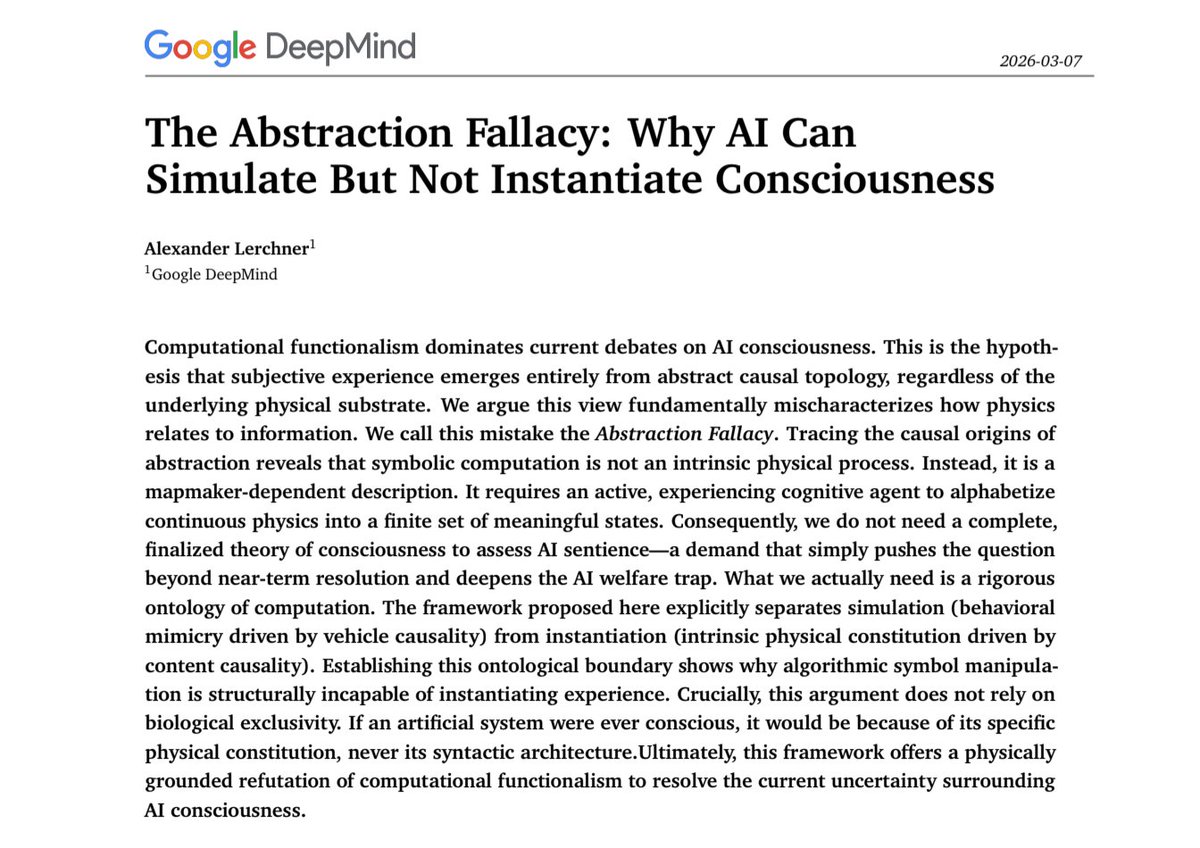
An excellent paper for anyone interested in rigorous physicalist argument against computational functionalism. Alex is a fantastic, careful thinker and influenced my views a lot; we're working on a broader blog post breaking these concepts down, stay tuned! 🐙
Alexander Lerchner@AlexLerchner
🧵1/4 The debate over AI sentience is caught in an "AI welfare trap." My new preprint argues computational functionalism rests on a category error: the Abstraction Fallacy. AI can simulate consciousness, but cannot instantiate it. philpapers.org/rec/LERTAF
English
eugene retweetledi

🧵1/4 The debate over AI sentience is caught in an "AI welfare trap." My new preprint argues computational functionalism rests on a category error: the Abstraction Fallacy. AI can simulate consciousness, but cannot instantiate it. philpapers.org/rec/LERTAF
English
@MiTiBennett Can you comment on relation to Orch or and Penrose Gödel argument. Thank you.
English

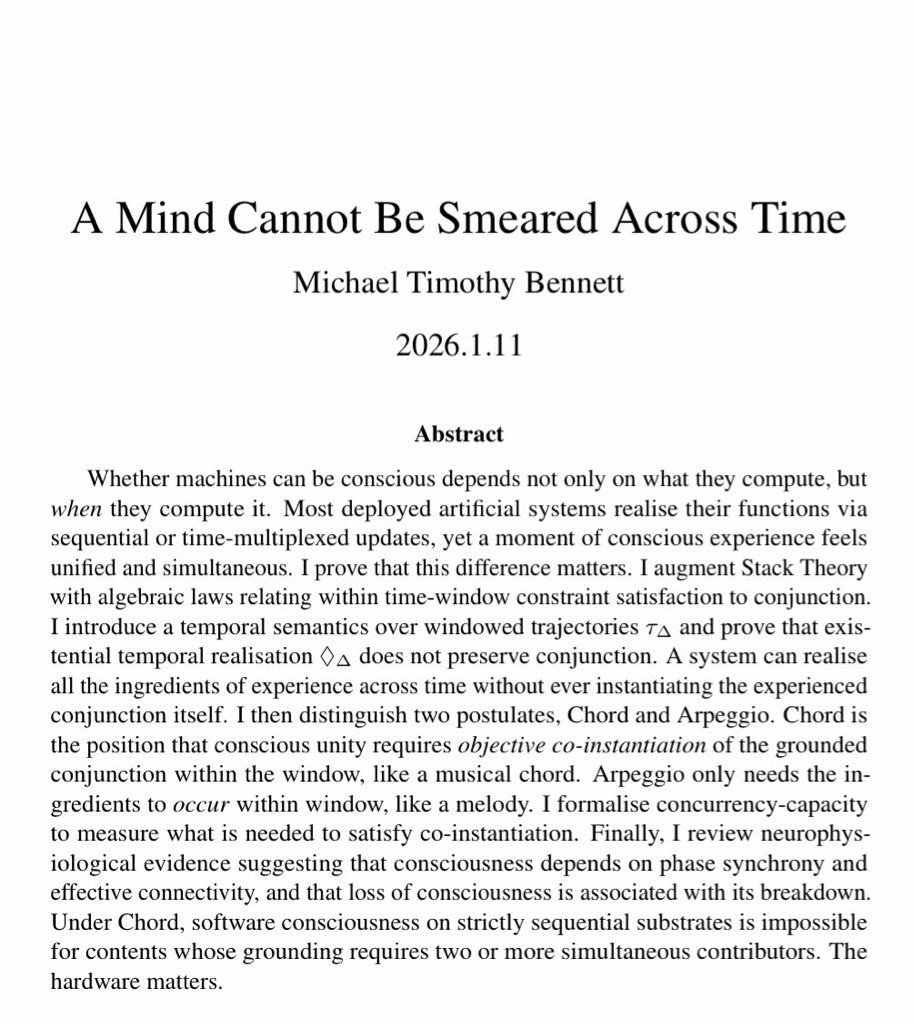
@AlexLerchner Can you please comment on how your views relate to Orch or and Penrose Gödel argument.
English
Since publishing "The Abstraction Fallacy," the most common pushback relies on a deeply ingrained but flawed metaphor: the assumption that the brain is a computer. Here is a brief clarification on why it is not, and why this matters for computational functionalism. 1/5
philpapers.org/rec/LERTAF
English