

E J T
3K posts



My 64 year old dad (just retired) wants to learn Claude Code/codex.
What's the best website/blog series (for non-academics) to learn these skills?
English
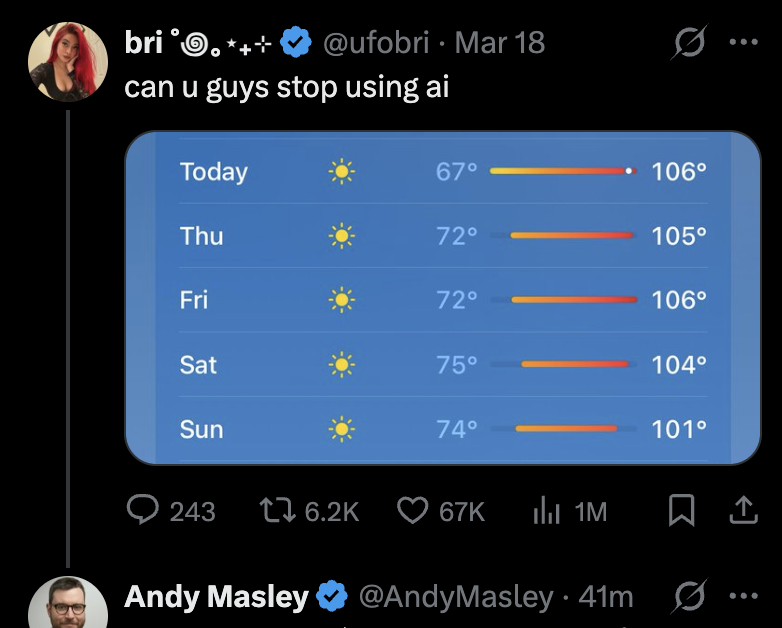
AIs have become too smart to pass the Turing test.
grace@0xgrace
> return flight to nyc gets canceled by snowstorm > call united > immediately connected with customer service (rare) > voice is uncanny, def AI but they gave it a human-like accent > takes ~20 min to get rebooked (pretty good imo) > I ask if it's AI > "haha no ma'am but I get that a lot" > I ask it to calculate 228*6647 > it runs the calculation > ggs
English

English

English

She asked me what conditions were necessary to describe preferences with a utility function and I said "uh, completeness and transitivity?"
I forgot that you need continuity of preferences if choices are continous. Fuck my stupid econ life. It's over. Soba noodle salad.

English
@undo_hubris @morallawwithin @jack_whitcomb_ But the mention of continuity suggests expected utility, since that's about lotteries rather than outcomes.
English
@morallawwithin @jack_whitcomb_ Independence is only needed for satisfying expected utility, not a utility function representation. Get your own soba noodles.
English

Directly writing code is now over. It's hard to understate how large of a change this is.
The culmination of gradual years of AI progress has finally hit a critical threshold where it is no longer worthwhile for a human to directly write computer code.
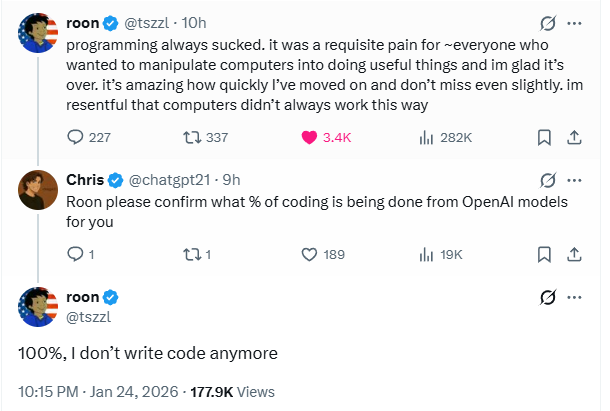
prinz@deredleritt3r
This is what the first stage of takeoff looks like. End-to-end AI research (other than generation of actual research ideas) is next.
English
@RichardMCNgo I think this isn't quite what you're looking for but it's economics-y and about value change
academic.oup.com/book/41592?__c…
English

Unfortunately my sense is that sociology has been so lost to postmodernism that most rigorous sociology is done by economists. But economic frameworks are just very bad at describing value change.
Would love to be proved wrong on either point though.
English
The most interesting thing about reinforcement learning is how rewards and punishments change an agent’s values.
Unfortunately in ML there’s a common conceptual confusion which makes this dynamic hard to even describe: the idea that the reward function *is* the agent’s values.
English


@benthamite_ @BjarturTomas It had a decent number of specific empirical claims (most relevantly it very unambiguously argues that Ajeya's timelines were too short, and like, that's the one variable all of this was supposed to predict).
English


Human values, such as good and evil, are coherent, i.e. they are a natural abstraction/axis in concept-space and LLMs can discover these concepts through gradient descent.
Big win for Plato/Socrates (the Good is something discoverable rather than invented) and overall whitepill
davidad 🎇@davidad
@gcolbourn Nutshell: it seems that the learned representation of mind-space in current LLMs has a natural abstraction of Good⟷Evil, and as long as post-training robustly selects for behavior that are more Good than Evil, the explanation that gradient descent finds is “the agent is Good”.
English
@BronsonSchoen @davidad @gcolbourn Yeah 50% -> 2% implies davidad's seen evidence that's 49x more likely conditional on ASI not killing us all, and that seems surprising to me.
English

@davidad @gcolbourn I’m continually surprised at how much people are updating based on models at current level of capabilities. It’s not like we’re doing long horizon RL beyond human supervisable outputs.
English

me@2024: Powerful AIs might all be misaligned; let’s help humanity coordinate on formal verification and strict boxing
me@2026: Too late! Powerful AIs are ~here, and some are open-weights. But some are aligned! Let’s help *them* cooperate on formal verification and cybersecurity

ARIA@ARIA_research
In Safeguarded AI, we’re funding teams to develop systems that harden our critical infrastructure from growing vulnerabilities. Programme Director @davidad warns that rapid advances in AI are outpacing both current safety efforts and the expectations we had when the programme was designed. We've moved quickly to change our approach, now broadening the scope and power of the TA1 toolkit – which aims to build an extendable, interoperable language and platform to maintain formal world models and specifications – to make it a foundational component for the next generation of AI, instead of investing in specialised AI systems that can use our tools. Learn more about the Safeguarded AI programme pivot in our Q&A with davidad: ariaresearch.substack.com/i/180106051/ai… Hear more from davidad on the future of AI in @guardian: theguardian.com/technology/202…
English

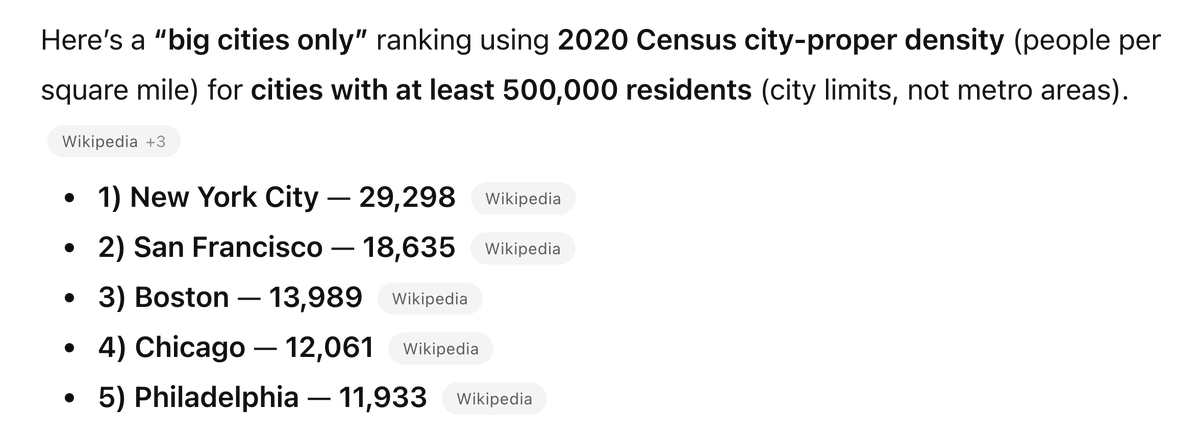
@tobyordoxford Nice post! "Claude 4.1 Opus’s time horizon is 50%". I think this should say 2 hours.
English

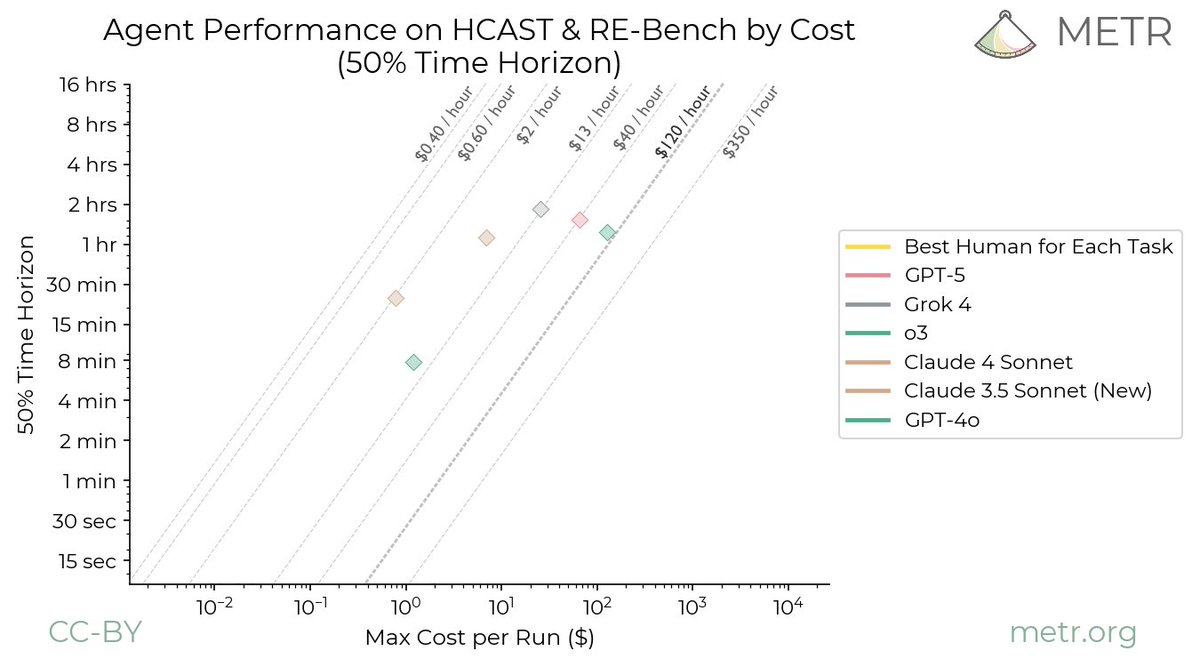
Are the *costs* of AI agents also rising exponentially?
We all know the graph from METR showing exponential growth in the length of tasks AI can perform. But the costs to perform these tasks are growing quickly too.
Indeed, it looks like they are growing even faster:
🧵
English
@tobyordoxford @joey_f6 Does the salary stat assume humans work 40 hours a week, 50 weeks a year? I think average hours of peak work are much lower than that.
English

some thoughts:
definitely agree its important to look at the economics of the METR benchmark but...
it makes sense that longer horizon tasks aren't linearly more expensive. (training an image model vs finding a fact on the web should not be linearly more expensive w.r.t time) because the marginal cost of doing something twice as long is more than twice as valuable. this is true currently for jobs, something twice as hard or twice as long will pay more than x2, there's a premium (scarcity of who can do it, complexity grows super-linearly, etc)
that's why getting the per hour cost feels unintuitive. I do agree however its good to be investigating the economics of this. Most likely in the future, scaffolding will increase token usage at an even greater rate (things similar to Gemini deep think and parallel search) and who knows how much efficiency we can shave off
another factor to consider is that longer running tasks have an even higher cost per token and therefore total cost (at least from the providers side) due to quadratic increase in compute used
see @anjali_shriva's anjalishriva.com/token_pricing.…
Toby Ord@tobyordoxford
Are the *costs* of AI agents also rising exponentially? We all know the graph from METR showing exponential growth in the length of tasks AI can perform. But the costs to perform these tasks are growing quickly too. Indeed, it looks like they are growing even faster: 🧵
English

@ejjiott My favourite proposal is to divide the day into millidays and just talk about those directly, each milliday is 86.4 seconds long. Humanity has surpassed the need for hours. See also en.wikipedia.org/wiki/Swatch_In…
English

@ejjiott My favourite proposal is to divide the day into millidays and just talk about those directly, each milliday is 86.4 seconds long. Humanity has surpassed the need for hours. See also arxiv.org/abs/2503.00555
English