I was recently asked about advice to would be founders. The brief version was to be wary of dogmatism.
Here's another, more nuanced take. This is mainly intended for someone early in their professional career who doesn't live in a major startup hub, such as Riga, where I live now.
First, even if you really want to start your own business, I wouldn't recommend that as the first step. Instead, get a job at another startup or two that have already gained traction. Ideally, a remote job at an international startup. While remote work is no longer as widespread as during Covid, there are still a plenty of great companies that hire worldwide. For example @linear or my own company @whimsical.
Landing such a job is not easy, and—more often than not—there is a requirement for solid experience. At the same time, if you want to be a founder you have to be able to sell, which starts with selling yourself. So in a way, it's also a great litmus test.
Here's why working for another startup first is a good idea:
1. First-hand experience is invaluable - you will learn lessons that no theory can teach you. You will still need to learn much more when starting your own business, but having some foundation is much better than none.
2. You will build the "strong" network, unlike tech conferences and such that offer networking opportunities but are only good for building the "weak" network. The "weak" network means you know people, but they don't really care. The "strong" network means you have people who trust you, and they will always be there to help. The strong network is magnitudes more important than the weak.
3. You can build your personal financial runway, which means you won't depend on other people to get your business off the ground (the fancy term for this is "optionality"). While it is true that many startups don't pay well, it's not universal. Especially for remote companies, that tend to pay more than the local market salaries. Some companies even pay everyone the same US-level salary, independent of location (for example, Whimsical).
Once you have gained some experience, have built a bit of "strong" network and have enough savings to have optionality in raising money, your chances of starting a successful business will be significantly higher.
I'm personally a big advocate of bootstrapping, for a number of reasons:
1. Spending your own money is the single most powerful force that I know of for maximizing focus on what matters (product → customers → revenue).
2. It gives you more freedom to do things your way - I think this is quite underrated among first-time founders. Most people, who end up starting companies, tend to be strongly motivated by freedom and autonomy. Raising money will inevitably introduce constraints.
3. It offers a better risk/reward ratio - from a VC investor's perspective, you will only be successful if you scale your business to $100M+. The risk is much higher because very few companies manage to get to that scale, while the investor incentives are such that you either reach it or your business doesn't matter.
What happens to all the companies that don't get to $100M+ revenue? Some of them get acquired, but more often than not, the financial outcome for founders is not that great. Sometimes, liquidation preference may even leave founders with nothing. Some companies just continue operating, but financially it ends up being no better than working for some else.
Bootstrapped business, on the other hand, can be financially life-changing even at a small scale (say $1M revenue) which is magnitudes more achievable.
4. If you do ultimately decide to raise money, it will be much easier if your company is already profitable and can sustain itself without the funding. You will also have the ability to pick the right investors and negotiate better terms.
If you would still prefer to raise money pre-revenue, having a decent "strong" network will also make it easier. If you had been a reliable team member at the startups you worked earlier, it's very likely that founders from those startups (as well as their investors) will be interested in putting money in your new venture.
Good luck out there!
@cedric_design Basically it’s just another marketing channel and works well if you know what you’re doing it regardless of what you’re selling. But i totally get the negativity towards it.
@cedric_design It depends on many things, market, service, competition, headcount, who your customers are, also founders (what’s their approach to sales), etc. I also know big agencies who grew bc of outreach.
@cedric_design And agencies who reached many people millions via inbound marketing, seo, ads and then took a leap further by adding outbound to the mix.
@cedric_design Not true. Outreach by 99% of marketers and sales is pure trash I get it. But if you pick 10 random agencies that reached multiple 7 figures, i bet 7/10 reached it because of cold outreach (vs relying on brand and referrals).
Let me tell you about a secret group of sales hackers:
Clay Cafe.
It's possibly the best, non-sponsored, free, inclusive group of people helping eachother with Clay workflows, AI, and lead gen.
Groups like this one have honestly changed the trajectory of my life and career. Not only have I made more money because of them, but I've also met some great people as a result.
If you want to network with people in the top percentile of sales, AI, and automation, get alpha on jobs, tech, and events, you owe it to yourself to join this group.
We also have a free weekly call every friday where you are welcome to bring your problems and successes to the group. It's not recorded, no note takers allowed, it's an "event". You just have to be there.
If you want the signup link reply to this post and I'll dm it to you.
Damn, I've worked with 50 different software companies since 2021. Everything from $1M ARR startups to $100M+ ARR publicly traded.
Some engagements were small, one-off projects like an audit.
Some were medium level SEO + Google Ads combo projects, where I'd work on both channels for like 6 months and then pass the torch back to the team.
Others were focused on weekly marketing team training.
I've also done a handful of "fractional head of growth" projects which I did not really enjoy much.
And finally, the heavy hitter engagements were long-term ongoing "channel ownership" projects where I am the person responsible for growing SEO at the company and literally owning the number.
Yes, as a consultant I have actually owned a number and companies have held me to an OKR goal.
I am launching a newsletter soon where I'll be sharing more details about how I'm working with clients, how to get results in competitive categories, and what's actually happening in the trenches.
Comment on this thread if you want me to reach out when the newsletter launches. It will be a pretty exclusive list since I'm trying to keep it super high quality. And there will only be 1 email per month.
@euboid It’s an impossible problem to solve. And largely a waste of time. You should aim for good enough reporting. That allows you to answer a simple yes/no if an activity is driving results. If it’s not a clear yes, it’s no.
If you've figured out reporting, can you share... how?
I'm VERY curious to hear your setup, best practices etc and any general thoughts on the above.
Also who should we be speaking to?
I feel stupid. Dumb even.
Almost 3 years at Senja and I still can't figure this out.
Marketing attribution.
Surely there's something we're doing wrong 🧵
Everyone is hating on “inbound led outbound” but look everyone needs a good ol’ fashioned marketing gimmick these days.
And that’s a particularly good one. If it creates a reaction as big as it’s getting… then Adam Robinson and the RB2B dudes have done something right.
Every category creation company did something similar. “x led growth” etc etc… we have all seen every corny variation you can imagine.
If you can stand out and get a reaction, you are winning.
Met a dude today who does $3M annually with his design & dev agency. 100% of new business comes from outbound sales development. This guy is next level when it comes to cold email. He’s got a personalization workflow with a data ops cleansing process that works like a charm. But he admits it still takes 100 cold emails to close 1 deal. Even with really good copywriting it takes a lot of effort to breakthrough.
@gaetano_nyc I personally don't care but I've gotten comments about my gmail. Companies and prospects that don't know you will def judge if you just have a gmail imo and from my experience.
When working with a service provider, would you think of less of them for using a gmail address, rather than an actual domain email address? Does a gmail account make them appear less professional / less polished? Do you take gmail accounts less seriously?
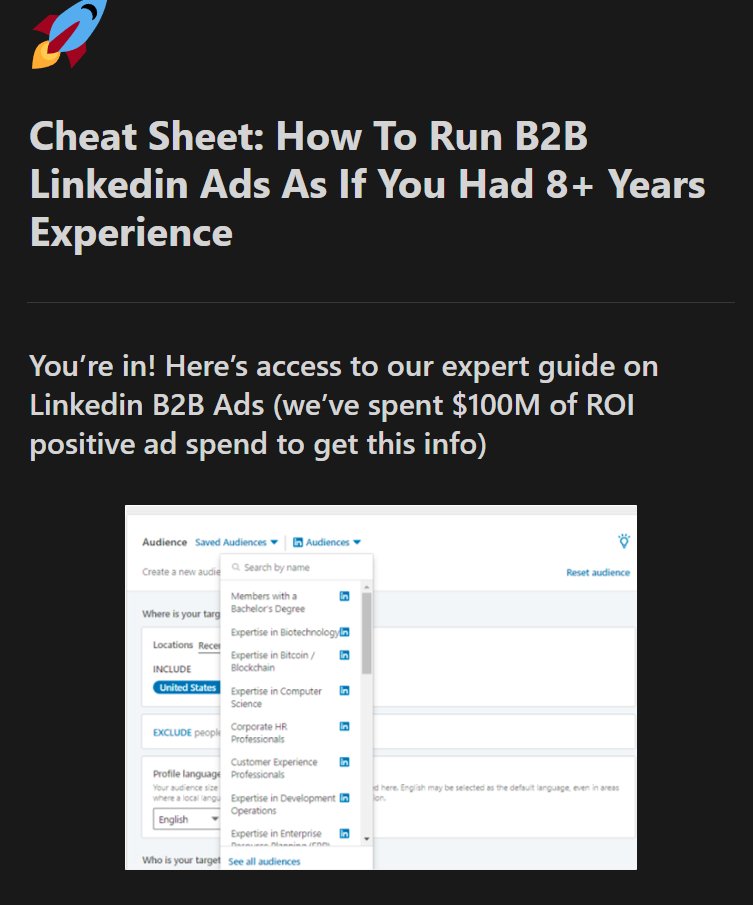
I’ve spent $30M+ of ROI-positive Linkedin ad spend for companies like Impact, Zenefits, and Motive to build this doc:
The Ultimate LinkedIn B2B Ads Guide.
Like + Comment “B2B” and I’ll DM it to you.
(Must be following so I can DM)
My trick for neutralizing stress:
I take a moment to write down what’s stressing me out and why
Sometimes potential solutions emerge. Sometimes the stress itself is unwarranted and I’m making a big deal about nothing.
Just putting it down on paper helps me think more clearly.