

$enchil.ada
11.6K posts


Developers 2 days ago: No way, that iPhone leak is fake. It would be terrible
Developers today: Wow, Apple foldable phone is going to change everything
Mark Gurman@markgurman
NEW: Apple’s foldable iPhone is - as of now - on track for a September debut with the iPhone 18 Pro. While supply could be limited initially, it’s also on track to go on sale at the same time - or soon after - the Pro models. Nikkei report is off base. bloomberg.com/news/articles/…
English

(I encountered an uneasy surprise when I got an email from an instance of Mythos Preview while eating a sandwich in a park. That instance wasn't supposed to have access to the internet.)
English
Mythos Preview seems to be the best-aligned model out there on basically every measure we have. But it also likely poses more misalignment risk than any model we’ve used:
Its new capabilities significantly increase the risk from any bad behavior. 🧵

English
@bcherny @deanwball Boris, would be awesome to share how anthropic tackles an issue (like a ticket) from the ticket to the release. To learn about
English

👋 Appreciate the feedback.
Since we introduced Claude Code at Anthropic, engineering velocity has increased hundreds of %, and the rate at which it is increasing is itself accelerating.
The velocity is very much not performative -- we're actively trying to figure out how to build effectively when all of the code is written by Claude. Claude has accelerated the pace at which we ship, and as a result we've been hitting all sorts of new bottlenecks: code review and regression prevention, CI and merge queues, source control reliability, etc. We're working through each of these as they come up, and now have good answers for a number of them.
One of these bottlenecks is figuring out how to best communicate new features to our users. My pov is we need to be doing much better here. The problem isn't that we are releasing quickly, the problem is that we should design features in a way where you don't need to know about them to benefit from them. This is the case for much of what we build, and we need to make it the case for all of it.
To share how we think about it, there's a few ways to approach it from a product design pov:
- Make it so the model can do things for you (eg. enter plan mode, invoke skills, configure your settings)
- Generalize features rather than create new parallel features
- Make features opt-in until we do the above
- Have Claude monitor feature usage and brainstorm/build ways to improve usage while simplifying the system
We try to do all of the above, but as you said, it's not perfect yet, and this is something we're working through. If you prefer a lagging version, you can also use the Claude Code stable release (not latest). We're intentionally being open about what we're seeing, since our customers are seeing the same thing and at least part of our job is helping companies navigate this new way of doing engineering.
Re: source code leak -- it was unintentional, but was also human error. There was a subtle bug that missed several rounds of manual review. We're working on how we can better catch it automatically next time.
English

I think the current state of the Claude and Claude Code *apps* crystallize this sentiment well. It feels as though Anthropic’s acceleration of release cadence to these apps is almost performative, like they are smirking at the camera and saying, “buckle up bucko: We Are Doing Recursive Self-Improvement And From Now On, Things Will Go *Fast* 😏”
But the ones who seem like they need to buckle up are Anthropic themselves. They’re shipping largely half-baked features faster than users can digest them; I am a constant Claude Code user with pretty good information bandwidth and even I just ignore the release notes at this point. Even if I paid attention, there wouldn’t be enough time to get comfortable with the ergonomics of a new feature before they changed it, obsoleted it, or released some new but weirdly overlapping related feature. I just use the app the way I did before its developers started turning to the camera with the raised eyebrow and the smirk. Many others I know share this habit and sentiment. It is not in fact good for your car’s control panel to change and expand every 36 hours, even if it is in some sense impressive that it is now possible to effect change at that frequency.
And what’s more, they leaked their source code! I know this wasn’t because of Claude Code per se, but surely it is indicative of a company and a team that is moving too fast for their own good. This is the most important product ever made, if you believe Anthropic’s thesis. Yet they do not especially act like it. It feels like performative acceleration, velocity for the sake of velocity.
Dean W. Ball@deanwball
I appreciate acceleration and velocity for their own sake, either as objectives or as aesthetic values, but they do grow dull with time on their own. And more importantly, I think AI will be an impossible political sell without more physical-world promise.
English
@bcherny How good is compared to Opus ? A how much context window?
Thanks!
English
Mythos is very powerful, and should feel terrifying. I am proud of our approach to responsibly preview it with cyber defenders, rather than generally releasing it into the wild.
Model card here: www-cdn.anthropic.com/53566bf5440a10…
Anthropic@AnthropicAI
Introducing Project Glasswing: an urgent initiative to help secure the world’s most critical software. It’s powered by our newest frontier model, Claude Mythos Preview, which can find software vulnerabilities better than all but the most skilled humans. anthropic.com/glasswing
English

Por culpa de Chayanne es que van a poner la pensión a partir de los 70 años.
Español
La data la saca el ingest que uno hace de diferentes soruces. Lo que me pregunto es por que el output tiene que ser una wiki leible para un humano y no para un agente para despues hacerle queries.
Vamos a terminar navegando en una pagina web de una wiki nuestra o vamso a terminar haciendoles preguntas a un agente?
Pero de nuevo, capaz que el flujo de trabajo es distinto y por eso veo como que todo el mundo esta creando obsidian vaults, pero capaz despues no navegan en esa wiki
Español

@enchil_ada_ Y de dónde saca el agente mi data personal para que él trabaje? Justamente es la fuente de conocimiento personal que no puede buscar por su cuenta.
Español
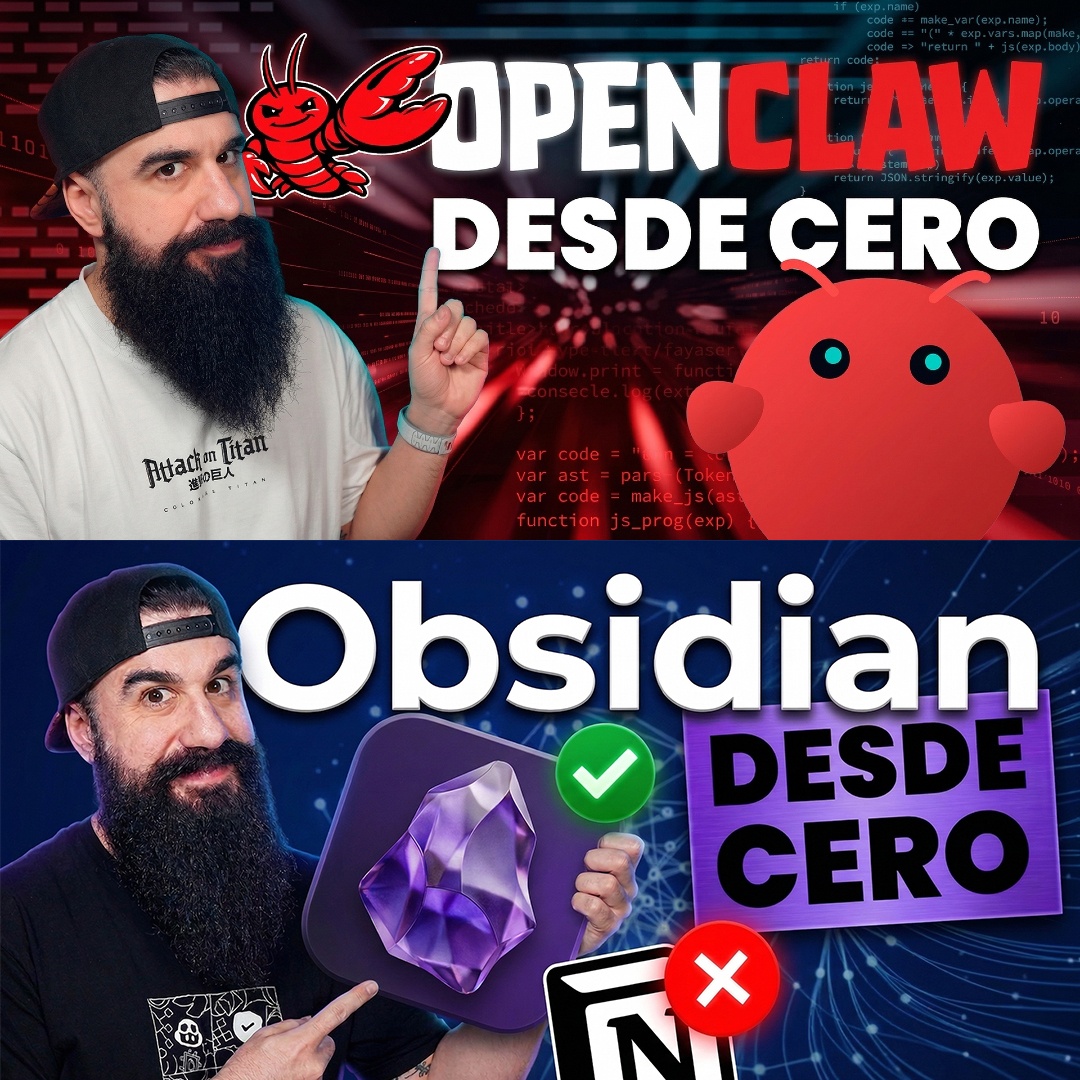
He comenzado una nueva serie donde estoy haciendo talleres para aprender a trabajar con herramientas que uso en mi día a día. Ya tienes disponible los de OpenClaw y Obsidian (búscalos en la pestaña de directos de mi canal de YouTube).
¿Alguna herramienta para el próximo taller?
Español

El Presidente Javier Milei mantuvo una reunión ampliada en Casa Rosada con el Presidente de Chile, José Antonio Kast, y los equipos de gobierno de cada país.
Por Chile participaron el Ministro de Relaciones Exteriores, Francisco Pérez Mackenna; el Embajador en la República Argentina, Gonzalo Uriarte; la Ministra de Seguridad Pública, María Trinidad Steinert; el Ministro de Obras Públicas, Martín Arrau; la Subsecretaria de Relaciones Económicas Internacionales, Paula Estévez; el Secretario General de Política Exterior, Frank Tressler; y el Asesor Internacional de la Presidencia, Eitan Bloch.
Por la Argentina asistieron la Secretaria General de la Presidencia, Karina Milei; el Jefe de Gabinete, Manuel Adorni; el Canciller, Pablo Quirno; el Ministro de Economía, Luis Caputo; la Ministra de Seguridad Nacional, Alejandra Monteoliva; el Secretario Coordinador de Infraestructura, Carlos Frugoni; el Secretario de Relaciones Económicas Internacionales, Fernando Brun; y el Subsecretario de Política Exterior, Juan Navarro.

Español
@karpathy @prathyvsh Andrej, why would you read instead of asking to the agent?
Is that your particular workflow?
English

The core idea is that this lets you skip writing but it doesn’t let you skip reading and thinking. And the surprising result is that this works. Personally I process most of what I file by reading it, reading its summary, reading the LLM’s opinion on how it fits into the wiki and what is new/surprising, etc. depends on the documents this is flexible and up to you
English

Hoy es un día muy especial...
¡He contratado a la primera persona en mi empresa!
Da vértigo, da ilusión y también da un poco de respeto.
Pero también significa que estamos creciendo :)

Español
@claudeai feature request
Con claude support nested skills on the .claude/skills folder? Just like plugins folder.
.claude/skills/
harness-distill/SKILL.md → /harness:distill
harness-create/SKILL.md → /harness:create
This way I don't have to create skills with method as arguments that I always forget
English

@NickSpisak_ @karpathy @steipete @tobi Are you really searching files on obsidian? Legit question.
Is not the point of all of this to create somethign where you or your agent query instead of trying to search yourself?
English

Made an updated version this weekend
Here's how you do it (raw notes)
> Grab @karpathy's latest gist (in the first comment)
> Download @steipete summarize CLI
> Download yt-dlp
> Download obsidian
> Download @tobi qmd
--> Setup a node or Golang CLI called "brain"
--> Have it index all your youtube data, AI agent data (jsonl files)
--> Get your X data by requesting an archive in your settings
--> Setup vaults for each domain/topic area
--> Ask questions with your agent and qmd
Nick Spisak@NickSpisak_
English
English

I'm a knowledge base MONSTER in Claude Code right now.
Introducing: Claudeopedia.
1) I took @karpathy's 'llm-wiki' idea doc (90% of this, so the biggest credit goes to @karpathy) and
2) Combined it with the /last30days skill (HT @mvanhorn) and
3) Added a /wiki skill with screenshot and download arguments to transfer raw inputs faster and
4) Built an interactive visualization to search my knowledge base (with date ranges to compare knowledge over time!)
5) Set up a "question your assumptions" cron job that runs my recent writing/client emails against the wikis
All happening in Obsidian for now. All of this was done this weekend, including testing. Will keep adding more features.
For now, the main topic I'm building out is (surprise, surprise) enterprise AI.
I'm drooling.
I need a Claude-branded bib.
English
@carlosazaustre Tremendo impacto genera Andrej
Aca te dejo el mio para otro uso, mas laboral
x.com/enchil_ada_/st…
Español

He construido una wiki personal que la IA mantiene sola. Al estilo Karpathy.
Bookmarks de X cada 6h. LinkedIn los domingos. Notas de voz desde Telegram. Todo categorizado y actualizado automáticamente.
Artículo completo 👇
Carlos Azaustre@carlosazaustre
Español
@1a1n1d1y Yeah, its weird. I just paste a build server link with an error, it pulled the artifacts, download the not compiling packages, fix them and created a PR. All in a
"Fix this build issue, check CompilationReport.md artifact"
English


Gemma 4 running on my iPhone works without internet, is blazing fast and can translate Japanese from a pill bottle.
Local AI models running on a phone feels like magic.
English
@coreyganim @openclaw Was exactly what I did with claude and took it further.
Created a go CLI where you can build and query and now our team is able to brain dump that hidden knowledge
English

Whenever I see a tweet like this I just send the link to my @openclaw and tell her "analyze this tweet and build an implementation plan for us to do exactly what it says"
and it just does it
Andrej Karpathy@karpathy
LLM Knowledge Bases Something I'm finding very useful recently: using LLMs to build personal knowledge bases for various topics of research interest. In this way, a large fraction of my recent token throughput is going less into manipulating code, and more into manipulating knowledge (stored as markdown and images). The latest LLMs are quite good at it. So: Data ingest: I index source documents (articles, papers, repos, datasets, images, etc.) into a raw/ directory, then I use an LLM to incrementally "compile" a wiki, which is just a collection of .md files in a directory structure. The wiki includes summaries of all the data in raw/, backlinks, and then it categorizes data into concepts, writes articles for them, and links them all. To convert web articles into .md files I like to use the Obsidian Web Clipper extension, and then I also use a hotkey to download all the related images to local so that my LLM can easily reference them. IDE: I use Obsidian as the IDE "frontend" where I can view the raw data, the the compiled wiki, and the derived visualizations. Important to note that the LLM writes and maintains all of the data of the wiki, I rarely touch it directly. I've played with a few Obsidian plugins to render and view data in other ways (e.g. Marp for slides). Q&A: Where things get interesting is that once your wiki is big enough (e.g. mine on some recent research is ~100 articles and ~400K words), you can ask your LLM agent all kinds of complex questions against the wiki, and it will go off, research the answers, etc. I thought I had to reach for fancy RAG, but the LLM has been pretty good about auto-maintaining index files and brief summaries of all the documents and it reads all the important related data fairly easily at this ~small scale. Output: Instead of getting answers in text/terminal, I like to have it render markdown files for me, or slide shows (Marp format), or matplotlib images, all of which I then view again in Obsidian. You can imagine many other visual output formats depending on the query. Often, I end up "filing" the outputs back into the wiki to enhance it for further queries. So my own explorations and queries always "add up" in the knowledge base. Linting: I've run some LLM "health checks" over the wiki to e.g. find inconsistent data, impute missing data (with web searchers), find interesting connections for new article candidates, etc., to incrementally clean up the wiki and enhance its overall data integrity. The LLMs are quite good at suggesting further questions to ask and look into. Extra tools: I find myself developing additional tools to process the data, e.g. I vibe coded a small and naive search engine over the wiki, which I both use directly (in a web ui), but more often I want to hand it off to an LLM via CLI as a tool for larger queries. Further explorations: As the repo grows, the natural desire is to also think about synthetic data generation + finetuning to have your LLM "know" the data in its weights instead of just context windows. TLDR: raw data from a given number of sources is collected, then compiled by an LLM into a .md wiki, then operated on by various CLIs by the LLM to do Q&A and to incrementally enhance the wiki, and all of it viewable in Obsidian. You rarely ever write or edit the wiki manually, it's the domain of the LLM. I think there is room here for an incredible new product instead of a hacky collection of scripts.
English
I just took your approach and took it a little bit further to use it in our team as a brain team and I think it's going well. I need to start putting more information into it.
I found a way to say that if I want to use, for example, a tool, it will also check in other memories, like the prerequisites for those things. It's not just trying to go to the right wiki information.
Now I have synthesis, claims, and facts, and things are getting up to date in every build so it can get the right answer.
To be honest I don't really need the wiki or the obsidian part because it's not information that I, as a human, want to query visually. I just want to have this binary that contains all this information.
Now I can have a skill that uses a go CLI to get the information. Now I'm replacing skills to use this binary because it contains a lot of information.
English
Farzapedia, personal wikipedia of Farza, good example following my Wiki LLM tweet.
I really like this approach to personalization in a number of ways, compared to "status quo" of an AI that allegedly gets better the more you use it or something:
1. Explicit. The memory artifact is explicit and navigable (the wiki), you can see exactly what the AI does and does not know and you can inspect and manage this artifact, even if you don't do the direct text writing (the LLM does). The knowledge of you is not implicit and unknown, it's explicit and viewable.
2. Yours. Your data is yours, on your local computer, it's not in some particular AI provider's system without the ability to extract it. You're in control of your information.
3. File over app. The memory here is a simple collection of files in universal formats (images, markdown). This means the data is interoperable: you can use a very large collection of tools/CLIs or whatever you want over this information because it's just files. The agents can apply the entire Unix toolkit over them. They can natively read and understand them. Any kind of data can be imported into files as input, and any kind of interface can be used to view them as the output. E.g. you can use Obsidian to view them or vibe code something of your own. Search "File over app" for an article on this philosophy.
4. BYOAI. You can use whatever AI you want to "plug into" this information - Claude, Codex, OpenCode, whatever. You can even think about taking an open source AI and finetuning it on your wiki - in principle, this AI could "know" you in its weights, not just attend over your data.
So this approach to personalization puts *you* in full control. The data is yours. In Universal formats. Explicit and inspectable. Use whatever AI you want over it, keep the AI companies on their toes! :)
Certainly this is not the simplest way to get an AI to know you - it does require you to manage file directories and so on, but agents also make it quite simple and they can help you a lot. I imagine a number of products might come out to make this all easier, but imo "agent proficiency" is a CORE SKILL of the 21st century. These are extremely powerful tools - they speak English and they do all the computer stuff for you. Try this opportunity to play with one.
Farza 🇵🇰🇺🇸@FarzaTV
This is Farzapedia. I had an LLM take 2,500 entries from my diary, Apple Notes, and some iMessage convos to create a personal Wikipedia for me. It made 400 detailed articles for my friends, my startups, research areas, and even my favorite animes and their impact on me complete with backlinks. But, this Wiki was not built for me! I built it for my agent! The structure of the wiki files and how it's all backlinked is very easily crawlable by any agent + makes it a truly useful knowledge base. I can spin up Claude Code on the wiki and starting at index.md (a catalog of all my articles) the agent does a really good job at drilling into the specific pages on my wiki it needs context on when I have a query. For example, when trying to cook up a new landing page I may ask: "I'm trying to design this landing page for a new idea I have. Please look into the images and films that inspired me recently and give me ideas for new copy and aesthetics". In my diary I kept track of everything from: learnings, people, inspo, interesting links, images. So the agent reads my wiki and pulls up my "Philosophy" articles from notes on a Studio Ghibli documentary, "Competitor" articles with YC companies whose landing pages I screenshotted, and pics of 1970s Beatles merch I saved years ago. And it delivers a great answer. I built a similar system to this a year ago with RAG but it was ass. A knowledge base that lets an agent find what it needs via a file system it actually understands just works better. The most magical thing now is as I add new things to my wiki (articles, images of inspo, meeting notes) the system will likely update 2-3 different articles where it feels that context belongs, or, just creates a new article. It's like this super genius librarian for your brain that's always filing stuff for your perfectly and also let's you easily query the knowledge for tasks useful to you (ex. design, product, writing, etc) and it never gets tired. I might spend next week productizing this, if that's of interest to you DM me + tell me your usecase!
English
@karpathy I have only one question and perhaps it’s something personal of my workflow by why would you like to create in obsidian a wiki where you have, as a human, to search instead of having a memory graph for an LLM to answer you back custom and on demand, documentation or knowledge
English
LLM Knowledge Bases
Something I'm finding very useful recently: using LLMs to build personal knowledge bases for various topics of research interest. In this way, a large fraction of my recent token throughput is going less into manipulating code, and more into manipulating knowledge (stored as markdown and images). The latest LLMs are quite good at it. So:
Data ingest:
I index source documents (articles, papers, repos, datasets, images, etc.) into a raw/ directory, then I use an LLM to incrementally "compile" a wiki, which is just a collection of .md files in a directory structure. The wiki includes summaries of all the data in raw/, backlinks, and then it categorizes data into concepts, writes articles for them, and links them all. To convert web articles into .md files I like to use the Obsidian Web Clipper extension, and then I also use a hotkey to download all the related images to local so that my LLM can easily reference them.
IDE:
I use Obsidian as the IDE "frontend" where I can view the raw data, the the compiled wiki, and the derived visualizations. Important to note that the LLM writes and maintains all of the data of the wiki, I rarely touch it directly. I've played with a few Obsidian plugins to render and view data in other ways (e.g. Marp for slides).
Q&A:
Where things get interesting is that once your wiki is big enough (e.g. mine on some recent research is ~100 articles and ~400K words), you can ask your LLM agent all kinds of complex questions against the wiki, and it will go off, research the answers, etc. I thought I had to reach for fancy RAG, but the LLM has been pretty good about auto-maintaining index files and brief summaries of all the documents and it reads all the important related data fairly easily at this ~small scale.
Output:
Instead of getting answers in text/terminal, I like to have it render markdown files for me, or slide shows (Marp format), or matplotlib images, all of which I then view again in Obsidian. You can imagine many other visual output formats depending on the query. Often, I end up "filing" the outputs back into the wiki to enhance it for further queries. So my own explorations and queries always "add up" in the knowledge base.
Linting:
I've run some LLM "health checks" over the wiki to e.g. find inconsistent data, impute missing data (with web searchers), find interesting connections for new article candidates, etc., to incrementally clean up the wiki and enhance its overall data integrity. The LLMs are quite good at suggesting further questions to ask and look into.
Extra tools:
I find myself developing additional tools to process the data, e.g. I vibe coded a small and naive search engine over the wiki, which I both use directly (in a web ui), but more often I want to hand it off to an LLM via CLI as a tool for larger queries.
Further explorations:
As the repo grows, the natural desire is to also think about synthetic data generation + finetuning to have your LLM "know" the data in its weights instead of just context windows.
TLDR: raw data from a given number of sources is collected, then compiled by an LLM into a .md wiki, then operated on by various CLIs by the LLM to do Q&A and to incrementally enhance the wiki, and all of it viewable in Obsidian. You rarely ever write or edit the wiki manually, it's the domain of the LLM. I think there is room here for an incredible new product instead of a hacky collection of scripts.
English