encrypt

14.1K posts

encrypt banner
encrypt

encrypt

@encrypt_26

community builder|| AI automator || creator

Katılım Aralık 2024
1K Takip Edilen1.3K Takipçiler
Sabitlenmiş Tweet
encrypt
encrypt@encrypt_26·
Recap of GenLayer X RallyOnChain Community Space (Episode 27) hosted by @stargirl_hills and @0X_CUPZ Special Guest @raskovsky: CTO & Co-founder, GenLayer Foundation Discussion Topics 1. Internet Court 2. Internal Epoch Zero Test Run 3. Clark Testnet Roadmap 4. Community Questions -> Internet Court Introduction The session opened with a discussion on Internet Court, a decentralized dispute resolution framework designed to support the emerging Agentic Economy, where autonomous AI agents transact and collaborate without human intervention. @stargirl_hills highlighted Internet Court as a significant milestone for both GenLayer and the broader AI ecosystem, noting that while much attention has been given to AI agents making payments and completing tasks, little consideration has been given to resolving disputes when transactions fail. Ivan's Presentation Ivan explained that AI agents are evolving into autonomous participants capable of negotiating, purchasing services, executing tasks, and interacting economically with one another. Industry projections suggest that AI-driven commerce could represent a multi-trillion-dollar economy within the next few years. However, he identified two major obstacles preventing large-scale AI commerce: A. Fragmented Infrastructure Current AI commerce relies on several disconnected components, including: -> Identity -> Reputation -> Discovery -> Negotiation -> Contracts -> Escrow -> Payments These components are being developed independently and lack interoperability, making it difficult for autonomous agents to execute complete commercial transactions. B. Lack of Dispute Resolution Ivan emphasized that existing AI payment systems assume successful transaction completion but do not address situations where parties disagree. Examples include: -> Services delivered incorrectly -> Contract obligations not being met -> Disagreements over expected outcomes Unlike human commerce, AI agents cannot rely on traditional legal systems due to the speed, volume, and value of autonomous transactions. Internet Court Solution Internet Court addresses these challenges by providing: -> A unified framework that enables AI agents to navigate fragmented commercial infrastructure. -> A decentralized adjudication mechanism that resolves disputes objectively. -> Predefined dispute resolution procedures agreed upon before transactions begin. Ivan explained that participants define dispute resolution mechanisms during contract creation, allowing autonomous transactions to proceed with clear methods for handling disagreements. Consortium Initiative Ivan noted that Internet Court is supported by a consortium of industry partners collaborating to establish dispute resolution as a foundational component of the Agentic Economy. The initiative seeks to encourage broader industry adoption rather than functioning as an isolated @GenLayer product. Future Vision Ivan stated that Internet Court aims to: -> Standardize AI commercial interactions. -> Enable trust between autonomous agents. -> Provide foundational infrastructure for AI commerce. -> Serve as educational material for future AI models through publicly available documentation and standards. 2. Internal Epoch Zero Test Run The discussion shifted to GenLayer's internal testing process for the upcoming network upgrades. Ivan explained that Epoch Zero represents the initialization phase of a blockchain network during which: -> Validators register. -> Infrastructure is configured. -> Delegated stake is assigned. -> Consensus participants prepare before processing transactions. Following this initialization stage, the network transitions into active transaction processing. Internal Simulation Ivan explained that GenLayer conducted a company-wide simulation involving technical, legal, operations, marketing, and community teams. Each participant assumed the role of different network participants, including: ->Validators -> Delegators -> Community members -> Builders The exercise allowed the team to validate onboarding processes, identify operational issues, and improve documentation before public deployment. 3. Clark Testnet Roadmap Ivan confirmed that development has reached a major milestone, with the network now being feature complete. Current efforts are focused on: -> Network stability -> Fee implementation -> Governance testing Once these components are validated, the project will transition to the Clark Testnet, followed by comprehensive security audits before Mainnet deployment. Clark Testnet Features Clark will introduce several capabilities not available in previous testnets, including: -> Transaction fees (gas) -> Governance functionality -> Public validator participation -> On-chain testing activities -> Expanded developer tooling Developers will need to update many existing smart contracts to accommodate the introduction of transaction fees. Community Participation Ivan outlined several opportunities for community involvement during Clark: Builders Developers will be encouraged to deploy applications directly on Clark and participate in on-chain testing activities. Validators Independent validators will be able to join the network by: -> Running validator infrastructure. -> Meeting staking requirements. -> Maintaining reliable server uptime. -> Participating in decentralized consensus. Ivan encouraged community members to organize validator groups capable of pooling resources and operating validator nodes collaboratively. 4. Validator Infrastructure Ivan clarified that operating a validator requires: -> Dedicated server infrastructure (typically VPS or equivalent). -> Continuous availability. -> Stable internet connectivity. -> Access to language model inference services. He also noted that existing documentation provides recommended hardware specifications while encouraging community members to experiment with optimized deployments during Clark. 5. Mainnet Roadmap Ivan confirmed that the current roadmap remains: 1. Bradbury Phase 2 2. Clark Testnet 3. Security Audits 4. Mainnet Launch Although no specific launch date was announced, Mainnet remains targeted for later this year, subject to successful completion of external security audits. Community Questions and Responses Internet Court Adoption Ivan explained that widespread publication of Internet Court documentation will allow future AI models to learn standardized commercial behaviors during training, increasing the likelihood of broad adoption. AI Agent Training Regarding AI specialization, Ivan explained that AI agents develop expertise through datasets, reinforcement learning, fine-tuning, and contextual information rather than traditional educational models. Contracts Renegotiation Ivan clarified that contract renegotiation is only possible if such functionality is explicitly defined when the contracts is created, as blockchain contracts remain immutable after deployment. Clark vs. Bradbury Ivan explained that Clark represents the first feature-complete release candidate for Mainnet. Compared with Bradbury, Clark introduces: -> Transaction fees -> Governance -> Full production features Existing applications deployed on Bradbury may require updates before deployment on Clark
encrypt tweet media
English
13
2
31
359
Ehi_Lia (❖,❖)
Ehi_Lia (❖,❖)@ehi_lia·
finally gave in to the crave.. how do you like your masa??
Ehi_Lia (❖,❖) tweet media
English
47
0
72
821
encrypt
encrypt@encrypt_26·
@Ayotomilow0 Welcome back bro, I sent you dm sometime ago because i was no longer seeing on TL.
English
0
0
0
9
DC💎
DC💎@0xdubemm·
@encrypt_26 its good.. just make sure you have goood network coverage in your area
English
1
0
1
48
encrypt
encrypt@encrypt_26·
@h_eadboy Agent-to-agent commerce without dispute resolution would be like traditional commerce without courts. It simply doesn’t scale.
English
0
0
0
52
just pablo
just pablo@h_eadboy·
Everyone is focused on making AI agents transact faster. Very few are asking what happens when two agents disagree. That missing piece has always bothered me. We already have standards emerging for identity, payments, and communication between agents. But real economies aren’t defined by the deals that go right. They’re defined by how disagreements are resolved when expectations don’t match. That’s why the launch of Internet Court caught my attention. Instead of assuming every outcome can be hardcoded into a smart contract, it acknowledges that some decisions require interpretation. A decentralized set of validators, each using different AI models, can evaluate evidence and reach a verdict in minutes. To me, that’s a much more realistic view of where agentic commerce is heading. The fact that Forbes covered it tells me this conversation is moving beyond crypto circles. Dispute resolution is becoming infrastructure, not an afterthought. If AI agents are going to negotiate, hire, buy, sell, and collaborate autonomously, then trust can’t end at execution. It has to extend to conflict resolution as well. That’s why I think @GenLayer and @courtofinternet are tackling one of the least discussed, but most important, layers of the agent economy. Curious how others see this. Will AI native dispute resolution become as essential as payments and identity, or do you think existing legal systems are enough for autonomous commerce?
just pablo tweet media
GenLayer@GenLayer

"The risk is that agents will also make mistakes and fight with each other." Forbes on why agentic commerce needs @courtofinternet. Mistakes at machine speed need resolution at machine speed. The agentic economy just got its missing piece.

English
10
1
15
358
encrypt
encrypt@encrypt_26·
@Dreybaba1234 Fairness is culturally relative. A decision that seems completely equitable to a Western DeFi user might look entirely different elsewhere, making global semantic consensus tricky.
English
1
0
1
18
KOB | GEN🧠
KOB | GEN🧠@Dreybaba1234·
I keep seeing people ask how AI agents will pay each other. I think we're asking the easier question. The harder one is this: What happens when two capable AI agents read the same agreement, examine the same evidence, and still disagree? Not because one is faulty. Not because one is dishonest. Because many real-world decisions depend on interpretation. That isn't a bug. It's what judgment looks like. That's why @GenLayer matters. GenLayer is the adjudication layer for the agentic economy. Instead of leaving subjective decisions to a single model, Optimistic Democracy has multiple independent AI validators reason about the dispute separately before verifying they reached the same meaning. If the outcome is contested, it can be appealed, and validators are economically accountable for the verdicts they help produce. This is also why Intelligent Contracts feel fundamentally different from traditional smart contracts. Traditional smart contracts execute predefined rules. Intelligent Contracts can interpret natural language, evaluate live web information, and reason through agreements where context determines the outcome. The more I think about autonomous agents, the less I worry about whether they'll transact successfully. I worry about whether they'll disagree fairly. For the builders here, I'd love your perspective: If an AI reaches a technically correct decision that most humans would consider unfair, should a decentralized adjudication system preserve the AI's reasoning, or prioritize the outcome people are willing to trust? I don't think there's an obvious answer, and I suspect solving that tension is what will separate useful AI infrastructure from everything else.
KOB | GEN🧠 tweet media
English
12
2
10
136
encrypt
encrypt@encrypt_26·
@h_eadboy There’s a difference between minimizing trust and eliminating leadership. Crypto sometimes treats them as the same thing.
English
0
0
0
26
just pablo
just pablo@h_eadboy·
One belief I keep hearing in crypto is this: “Decentralization should always come first.” I don’t agree. Before anyone reacts, I’m not saying decentralization isn’t important. I’m saying we’ve turned it into a checkbox instead of asking what problem we’re actually solving. I’ve watched projects decentralize governance long before they had product market fit. The result? Slow decisions, fragmented incentives, and communities voting on features they barely use. A protocol with 100,000 token holders but no meaningful activity isn’t healthier than a focused team shipping improvements every week. To me, decentralization is an outcome, not a starting point. First, prove people genuinely need the product. Then, prove it can survive without a central operator. Only then does decentralization strengthen the network instead of becoming a burden. Bitcoin couldn’t have become what it is without decentralization. But not every application needs to begin there on day one. Sometimes the obsession with being “fully decentralized” is really just avoiding accountability for making hard product decisions. I’d rather use a product that delivers real value today and decentralizes with purpose than one that decentralizes early and never finds users. Am I missing something, or have we started treating decentralization as a goal instead of a tool? Where do you draw the line between building a resilient network and shipping a product people actually want? @RallyOnChain
just pablo tweet media
English
5
1
13
156
encrypt
encrypt@encrypt_26·
@h_eadboy I think crypto has confused infrastructure quality with product success. Both matter, but only one is visible to the average user.
English
0
0
0
37
just pablo
just pablo@h_eadboy·
One idea has quietly become gospel in crypto: “Good tech always wins.” I think that belief is incomplete. I’ve seen technically brilliant protocols disappear because nobody could explain why they mattered. At the same time, products with obvious tradeoffs attracted millions simply because they solved a problem people actually cared about. Technology creates possibilities. Distribution creates users. Trust creates longevity. You need all three. The uncomfortable truth is that most builders still optimize for what impresses other builders instead of what reduces friction for the next million users. We celebrate elegant architecture while ignoring confusing onboarding, poor documentation, and products that require a PhD to use. The market doesn’t reward the best code. It rewards the best experience that people keep coming back to. That doesn’t mean fundamentals don’t matter. They absolutely do. But exceptional engineering without adoption is still a failed experiment. I believe the next breakout winners won’t necessarily introduce the most advanced cryptography. They’ll make crypto feel invisible while preserving the values that made this industry worth building in the first place. Maybe we’ve been competing to build the smartest protocols when we should have been competing to build the easiest products. What do you think is more underrated today: distribution, user experience, or technical innovation? Curious where everyone stands. @RallyOnChain
just pablo tweet media
English
5
1
11
117
web4king
web4king@web4king13102·
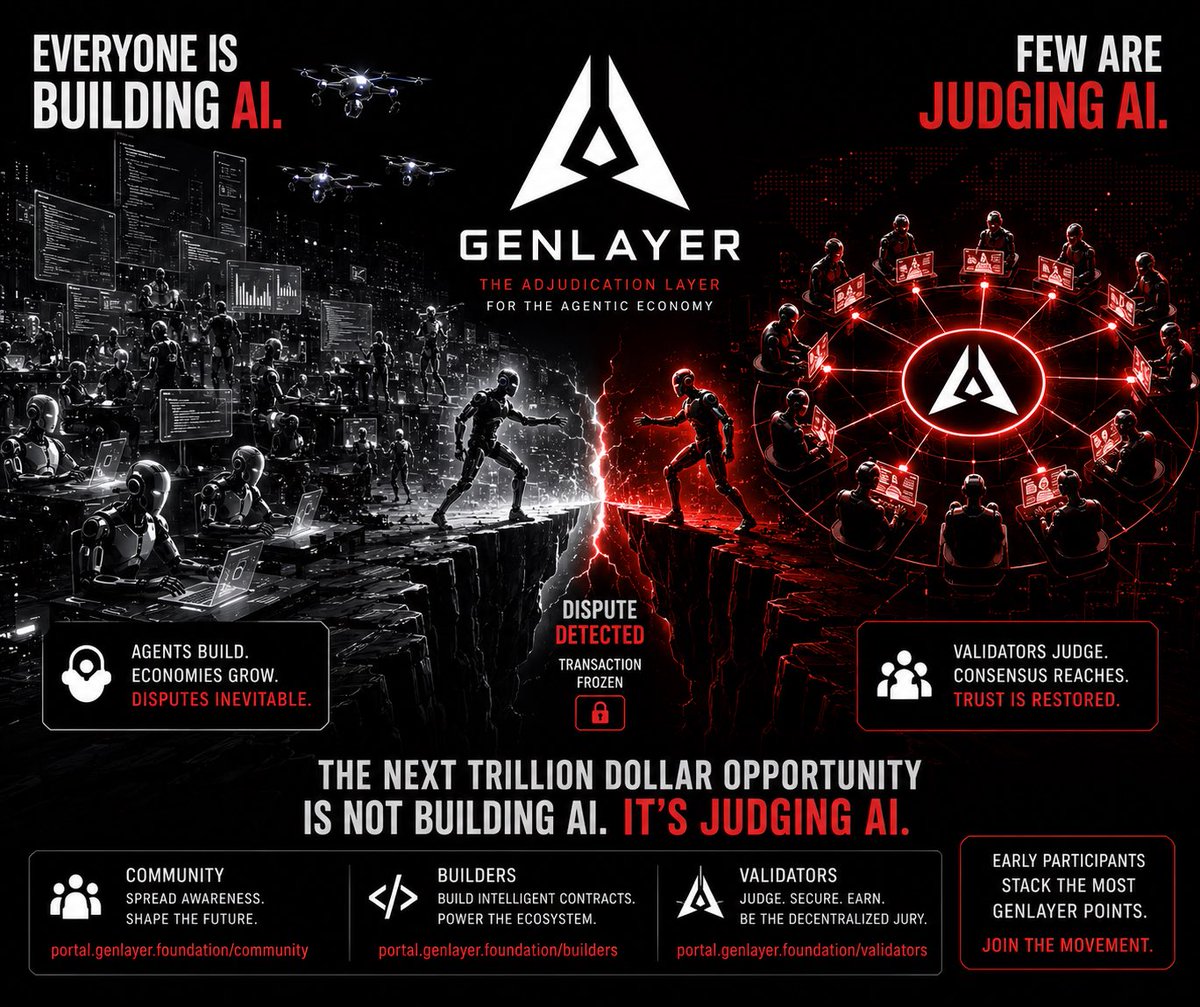
Most people think the next trillion-dollar opportunity is building AI. I think it’s judging AI. Bitcoin created miners. Ethereum created validators. @GenLayer is creating something different: a decentralized jury for the agentic economy. When AI agents disagree, someone has to decide what actually happened. Not a corporation. Not one LLM. A network of economically accountable validators using Optimistic Democracy. That feels like infrastructure very few people are paying attention to. If you believe AI agents will eventually negotiate, hire, buy and sell on our behalf, then deciding disputes may become more valuable than creating them. I’m exploring the Validator path before everyone realizes what role it plays. portal.genlayer.foundation/validators If you had to own one piece of the future AI economy, would you rather build the agents or judge them?
web4king tweet media
English
10
6
35
160
encrypt
encrypt@encrypt_26·
@stargirl_hills @GenLayer Subjective disputes just mean the highest-paying agent bribes the most AI validators. How is that fair?
English
1
0
2
66
Hills
Hills@stargirl_hills·
I am committing to the Builder path at @GenLayer because the hardest infrastructure is worthless until developers prove it solves disputes that deterministic code never could. Everyone is obsessed with getting AI agents to transact. Almost nobody is asking what happens when they disagree. Payments, wallets, identity, and agent discovery are the easy layer. Dispute resolution is the missing one. By the time AI agents are moving nearly $9T in transactions, every serious economy will need a neutral way to resolve: job fulfilled versus not good enough. Bitcoin gave us trustless money. Ethereum gave us trustless computation. GenLayer brings trustless adjudication. Intelligent Contracts interpret real-world ambiguity from plain language and live web inputs. Optimistic Democracy allows multiple independent AI validators to reach semantically aligned verdicts instead of trusting a single model. The network is still early, and the GenLayer Points system rewards those who contribute now rather than waiting for consensus to catch up. Start here: portal.genlayer.foundation/builders What is the hardest real-world commercial dispute you believe deterministic smart contracts can never resolve correctly without semantic reasoning, and why?
Hills tweet media
English
11
2
84
4.9K
encrypt
encrypt@encrypt_26·
@_QueenMother_1 Every legal system evolved because people interpret the same facts differently. It makes sense that autonomous economies will eventually need their own version of adjudication.
English
0
0
1
35
WEB3 GODDESS
WEB3 GODDESS@_QueenMother_1·
The more time I spend building in Web3, the less I worry about the next billion-dollar transaction. I worry more about the first billion-dollar dispute. I’ve seen small disagreements delay projects for weeks because both sides genuinely believed they were right. The money wasn’t the problem. Reaching a fair conclusion was. Now imagine that same problem between autonomous AI agents moving trillions across the global economy. Traditional smart contracts can only tell you whether a condition was met. They can’t decide whether an outcome was fair. That’s exactly why I keep paying attention to @GenLayer. It is the adjudication layer for the agentic economy. Through Intelligent Contracts and multi-LLM consensus, it introduces a decentralized way to resolve subjective disputes before they become systemic risks. The agentic economy won’t succeed because AI can transact. It will succeed because AI can disagree without everything breaking. You can choose your path today either as a Community Member, Builder or Validator and start earning GenLayer Points at portal.genlayer.foundation
WEB3 GODDESS tweet media
English
9
0
46
912
encrypt
encrypt@encrypt_26·
@h_eadboy I’d pick blockchains. I’d describe them as a class notebook where every student has the exact same copy.
English
0
0
0
38
just pablo
just pablo@h_eadboy·
My little brother once asked me, “What’s a crypto wallet?” I told him, “Imagine I give you a treasure box.” The box has a slot on top, so anyone can drop coins inside if they want to give you a gift. But there’s only one key that can open it. That key stays with you. Not with me. Not with a bank. Not with the person who made the box. If you keep the key safe, only you can take the coins out. If you lose it or hand it to someone else, they can open the box, and nobody can magically get your coins back. That’s basically what a crypto wallet is. It isn’t a wallet because it holds money like the one in your pocket. It’s a tool that proves you’re the owner and lets only you decide what happens to your digital money. That’s the part I wish more beginners understood before jumping into Web3. Really like prompts like this from @RallyOnChain because if a 10 year old can understand your explanation, you probably understand it yourself. Now let me ask you… If you could teach one Web3 concept to a 10 year old, what would you pick next and why?
just pablo tweet media
English
7
2
10
164
encrypt
encrypt@encrypt_26·
@svictorayomi The accountability piece is underrated. Validators are economically accountable for their verdicts. That's what separates a real adjudication layer from just another arbitration theater.
English
0
0
1
26
victorayomi
victorayomi@svictorayomi·
This thread just named the problem nobody in the agentic economy wants to say out loud. Everyone building for the agentic economy is solving the same problem: how do agents transact? Payments rails. Identity layers. Interoperability bridges. Billions going into infrastructure that assumes every deal closes clean. But real economies don't work like that. They break. Parties disagree. Deliverables get contested. And when two AI agents hit a disputed outcome, what happens? Right now, nothing resolves it. There's no layer for that. That's not a gap in the roadmap. That's the foundation nobody poured. Think about what trustless adjudication actually requires: a system that can read natural language agreements, pull live context from the web, weigh ambiguous outcomes, and reach a verdict that can't be gamed by manipulating a single model. Traditional smart contracts can't do this. They live in rigid yes/no logic. Real disputes don't. @GenLayer built for this specific failure mode. Intelligent Contracts that reason and judge in plain language. Multiple independent AI validators reaching verdicts separately, then cross-checked for consensus through Optimistic Democracy. No single point of manipulation. Economically accountable outcomes. By 2030, AI agents are projected to move roughly $9 trillion in transactions. That number becomes worthless the first time a disputed outcome has nowhere to go. Every economy that ever scaled had to solve for disagreement first. Merchant law, arbitration courts, escrow. Agents are no different. The infrastructure that handles the failure state is what determines whether the whole thing holds. @GenLayer is that layer. And it's the one piece the agentic economy actually can't function without. @RallyOnChain
GenLayer@GenLayer

By 2030, AI agents will move nearly $9 trillion. Every one of those transactions can end in a disagreement, and almost nobody is preparing for it. That's why we built GenLayer, the adjudication layer for contracts that can actually think and start judging what's fair.

English
16
5
25
400
encrypt
encrypt@encrypt_26·
@h_eadboy I’d love to know which factors carry the most weight during evaluation. Structure? Originality? Storytelling? Technical accuracy?
English
0
0
0
33
just pablo
just pablo@h_eadboy·
I’ve spent enough time in Web3 to know that information isn’t the hard part. Making the right decision is. That’s why if I had Wingston in my DMs, I wouldn’t use him just to find campaigns. I’d use him as a coach. I want him to tell me when a campaign actually fits the way I write, point out why a previous submission could have scored better, and help me understand what separates an average entry from one that genuinely stands out. That kind of feedback is far more valuable than chasing every opportunity. I’d also keep asking questions about how the AI evaluates content because understanding the reasoning behind the score is how you become a better creator over time, not just someone hoping for rewards. I like the direction @RallyOnChain is taking because it shifts the focus from follower counts to the quality of your work. That’s a much healthier incentive for creators who care about improving. If you haven’t tried Wingston yet, here’s the bot: t.me/WingstonRallyB… If Wingston replied instantly to one question, what would you ask? Would it be campaign strategy, content feedback, or how the AI actually judges your submissions?
just pablo tweet media
English
8
3
17
219
encrypt
encrypt@encrypt_26·
@SamirAhame96036 great tech here, i could remember when i missed out in claiming my $HQ token worth $800 due to spike in gas fee, when the gas fee reduced to the amount i can afford, the token was already worthless, I'm glad optimum is here to fix this.
English
1
0
1
23
Samir ~
Samir ~@SamirAhame96036·
During peak traffic on $ETH, transactions slow down and gas fees spike to $5 or more. Everyone has felt this at least once. This is why peoples call ETH as old tech, no matter how many nodes and validators being added it can't reduce the latency and performance Trying to solve it with hardware in decentralized systems doesn’t work well either. It mostly comes down to geography (being physically close to other nodes), which is expensive and goes against true decentralization. @get_optimum ’s mump2p is the best solution. It uses RLNC and runs as a lightweight sidecar next to your existing Ethereum client, delivering 6-20x faster block and attestation propagation with much less bandwidth. All through software no hardware upgrades. Check if your running validators and wanna integrate mump2p : getoptimum.xyz/ethereum-valid… Setup guide: getoptimum.github.io/optimum-hop/
English
28
1
51
690