Arvind Cavale

6.1K posts

Arvind Cavale banner
Arvind Cavale

Arvind Cavale

@endodocPA

Clinical Endocrinologist/Researcher, Educator, Small Business Owner, Taxpayer, Job Creator, Entrepreneur, Healer, Problem-solver

Katılım Eylül 2012
238 Takip Edilen418 Takipçiler
Arvind Cavale
Arvind Cavale@endodocPA·
@PtRightsAdvoc @nytopinion @EPotterMD Yet, Dr. Potter thinks that the PPACA was great! What does she not understand about this dreadful law? When most parts of a law create more harm than good, it is generally undesirable. It is the only thing preventing reemergence of pvt practice.
English

0
0
0
8
PatientRightsAdvocate.org
PatientRightsAdvocate.org@PtRightsAdvoc·
On @nytopinion, a doctor and former insurance executive discuss the biggest problem with our healthcare system: hidden prices. @EPotterMD: "Lack of transparency" is the biggest problem. “If we just had real-time market dynamics with transparency, I think we would have a healthier system."
English
1
0
2
156
Arvind Cavale
Arvind Cavale@endodocPA·
@mcuban The same Jeff system that punishes its employees w 3x copays for seeking care from indie docs. The system that buys naming rights to the Eagles practice facility just after laying off 700+ employees & declaring $109M loss. @DutchRojas
English
0
0
0
80
Arvind Cavale
Arvind Cavale@endodocPA·
@DutchRojas Foreign language to most physicians. How do you plan to educate them?
English
0
0
2
49
Dutch Rojas
Dutch Rojas@DutchRojas·
Every dollar a physician pays in malpractice, health benefits, workers comp, and property insurance is an operating expense today. It leaves and does not return. In a self-funded structure it becomes an asset. The math does not change. The destination does.
English
7
7
78
10.4K
Arvind Cavale
Arvind Cavale@endodocPA·
@RepJimmyPanetta You'll do us a big favor by creating site neutral Medicare payment and seriously examining the nonprofit status of massive hospital conglomerates. Thank you.
English
0
0
4
54
Rep. Jimmy Panetta
Rep. Jimmy Panetta@RepJimmyPanetta·
Across the country, private practices are being squeezed out by rising prices and depressed pay. To combat this worrying trend, I sponsored the Provider Reimbursement Stability Act, a bipartisan bill that will cap physician reimbursement cuts and provide greater budgeting clarity for physicians and their private practices. forbes.com/sites/richardm…
English
20
17
48
5.2K
Arvind Cavale
Arvind Cavale@endodocPA·
@mcuban Why do they alienate their longest serving, most trustworthy physicians? Why do they penalize their employees who seek care at lower cost, more efficient clinics? How do they show losses despite collecting 5x of Medicare?
English
0
0
0
37
Mark Cuban
Mark Cuban@mcuban·
Most hospitals don't know their costs. Things I've asked for that made them roll their eyes : A BOM for surgeries P&L for each insurance carrier P&L for Medicaid or Medicare business Why do they need consultants for everything. Why doesn't their CSuite know how to do any of it Why do they use GPOs when prices are insane Why do they work with carriers that underpay, late pay, deny everything, waste docs time with denial committees run by 97 yr old pediatricians. Why do they make no effort to sell direct to employers (excluding those on costpluswellness.com to avoid all the carrier abuse , and avoid being sub prime lenders for patient OOP Why do they abuse 340b Why do facilities fees exist Why do they abuse site neutrality Why do they abuse patients with charge master based bills Why do they not push for standard contract templates to reduce admin. Why do they accept so many different ins plans Anyone want to add more And for context, remember I think the biggest insurance companies are worse
Vexity@xVexity

@mcuban Because reimbursement is often set below cost. Medicare—especially Medicaid—pay fixed rates that frequently don’t cover staffing, infrastructure, and 24/7 care. Hospitals can’t refuse those patients so the gap gets made up elsewhere.

English
243
330
2.8K
339.7K
Arvind Cavale
Arvind Cavale@endodocPA·
@sallypipes @dcexaminer Closet to a quarter of family medicine residency slots went unfilled, because free students want to become primary care docs.
English
0
0
0
6
Sally Pipes
Sally Pipes@sallypipes·
Match Day reveals a harsh reality: Thousands of qualified medical graduates won't become practicing doctors this year — not because they failed, but because there aren't enough residency slots. America created its own doctor shortage. My latest in @dcexaminer: #google_vignette" target="_blank" rel="nofollow noopener">washingtonexaminer.com/restoring-amer…
English
1
0
3
112
Adrian Sosenko
Adrian Sosenko@DrDadBuilder·
After nearly 4 years working within a large healthcare system, I made the decision to take a different path. Today was DAY 1 of building something of my own. I decided to start my own private practice with one clear purpose: to put patients first always. Not driven by systems, quotas, or accepting burnout as the norm, but focused on doing what's right for each individual. My goal is simple: to provide high-quality urological care where patients feel heard, respected, and never rushed. Grateful for the journey so far and even more excited for what's ahead. #LebanonPA #centralPA #Urology #MedTwitter #MensHealth #PrivatePractice
Adrian Sosenko tweet mediaAdrian Sosenko tweet media
English
70
36
499
56.9K
Rishi Wadhera, MD MPP
Rishi Wadhera, MD MPP@rkwadhera·
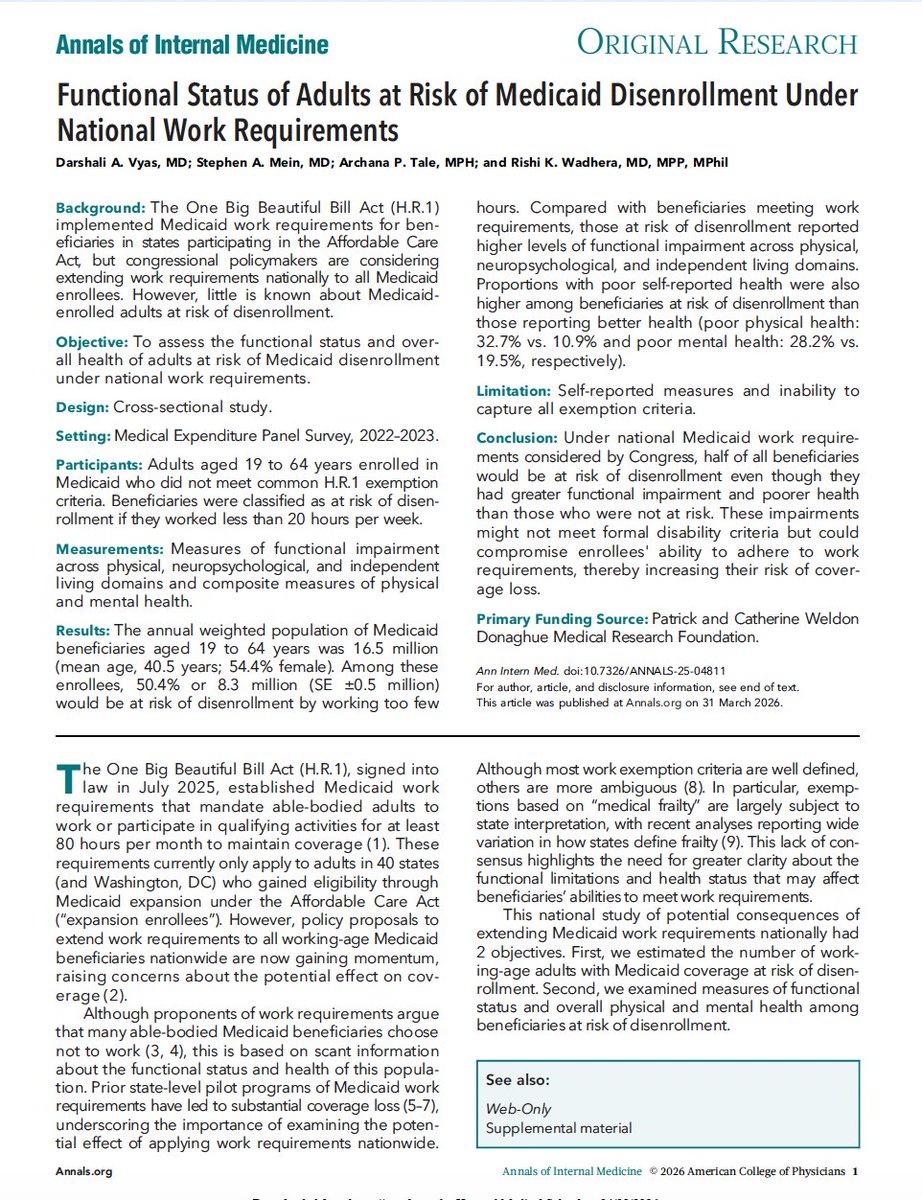
H.R. 1 imposes Medicaid work requirements in ACA expansion states, but there are proposals to extend them nationally Our @AnnalsofIM study: 8.3 million adults would be at risk of losing coverage - with high rates of poor health and functional impairment acpjournals.org/doi/10.7326/AN…
Rishi Wadhera, MD MPP tweet media
English
3
6
20
2.9K
Arvind Cavale
Arvind Cavale@endodocPA·
@mcuban The entire incentive is to perpetuate inefficiency and high costs.
English
0
0
0
6
Mark Cuban
Mark Cuban@mcuban·
Why aren’t any of these at risk hospitals publishing their full accounting so everyone can see where they spend their money ? All but one group of hospitals that I have looked at potentially investing in, spend so much on consultants and fees that it’s no wonder they are at risk Plus, I have NEVER seen an industry that is worse than hospitals when it comes to buying medications and items like implants, screws, other devices. They overpay for everything. And then when you show them how to save money, their “supply chain” employees resist any change. They are so set in their ways, it’s a shock more don’t go out of business. Prove me wrong.
NBC News@NBCNews

More than 400 hospitals across the U.S. are at high risk of closing or cutting services because of the Medicaid cuts in President Trump’s “big, beautiful bill,” according to an analysis from the progressive watchdog group Public Citizen. nbcnews.com/health/health-…

English
1.7K
3.6K
33.5K
2.5M
Arvind Cavale retweetledi
Senator Dave McCormick
Senator Dave McCormick@SenMcCormickPA·
Great to host @NIHDirector_Jay in Philly today at @PennMedicine. Pennsylvania is leading the way in lifesaving innovation through their CAR-T lab, creating jobs and giving patients real hope. I’m prepared to return to DC at a moment’s notice to end the Democrat DHS shutdown by fully funding DHS.
English
58
14
58
6K
Arvind Cavale retweetledi
Dutch Rojas
Dutch Rojas@DutchRojas·
18 seats on the Healthcare Advisory Committee. Selected from 400+ nominations. Sanford Health CEO. Cleveland Clinic CFO. Intermountain Health CSO. Availity CEO. Zero independent physicians. The committee will now advise on Medicare physician payment rates. The market structure here is not subtle. Full member breakdown, affiliations, and conflict documentation: hac.rojasreport.com
English
18
87
202
9K
Westby Fisher, MD
Westby Fisher, MD@doctorwes·
Not surprised. Look for even more monopolization of certification now that legal challenges have (so far) failed. 👇
bicoastal@annieinexile

@doctorwes @Allison_Dupont @jaygirimd @InfoNbpas many hospitals will affirm that they accept @InfoNbpas but others, like some major payers that @InfoNbpas has advertised as "accepting" and "recognizing" nbpas will not affirm this. and their credentialing systems will reject you, as I am now, unfortunately, experiencing.

English
3
0
4
831
Senator Dave McCormick
Senator Dave McCormick@SenMcCormickPA·
While I continue pushing to fully fund DHS and end this shutdown, I am proud to visit UPMC Mercy today with @NIHDirector_Jay. I invited @NIHDirector_Jay to PA because we are not just participating in the life sciences revolution; we are leading it. From vision restoration to advanced rehab, the work happening here is changing lives.
English
65
20
98
3.5K
Rishi Wadhera, MD MPP
Rishi Wadhera, MD MPP@rkwadhera·
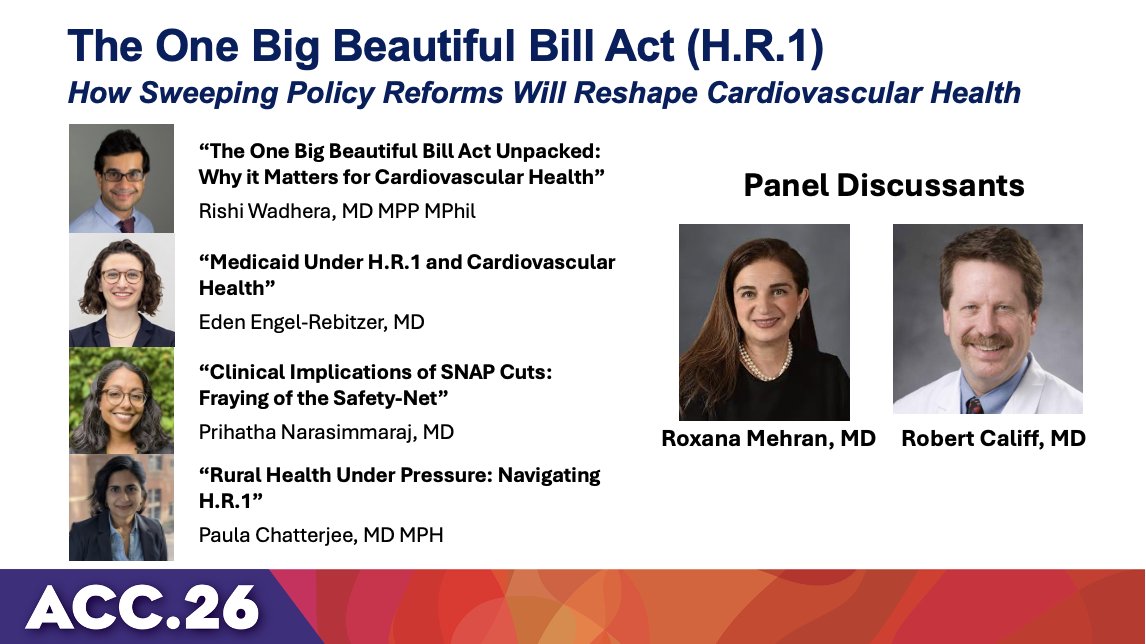
The One Big Beautiful Bill Act (H.R.1) could be the most consequential policy in a generation - w/ huge implications for cardiovascular patients Thrilled to have amazing speakers & incredible discussants @Drroxmehran @DrCaliff_FDA #ACC26 Come join us today at 8:30 AM, Room 352
Rishi Wadhera, MD MPP tweet media
English
1
7
30
2.4K
Arvind Cavale
Arvind Cavale@endodocPA·
@DutchRojas @AhmadRehanKhan All true statements. I believe that US grads will likely not fill those rural openings because those areas are economic deserts. Only IMGs can safely practice in those deserts because they don't carry the debt burden of US grads. My 32 yrs of observation...
English
0
0
1
48
Dutch Rojas
Dutch Rojas@DutchRojas·
Dr. Khan this has been one of the most good faith exchanges I have had on this platform and I appreciate it genuinely. You are right that the shortage is real. You are right that maldistribution is the more precise diagnosis. You are right that IMGs have served rural communities with distinction for decades and that contribution deserves acknowledgment without qualification. Here is what I would add in the same good faith spirit. The federal government repealed its own CON mandate in 1987 after concluding it failed every stated goal. The FTC and DOJ confirmed CON laws lead to higher costs not lower ones. 35 states kept the laws anyway. The Balanced Budget Act of 1997 froze residency positions at 1996 levels not because there were too many physicians but because incumbent interests benefited from constrained supply. Section 6001 buried a moratorium on physician-owned hospitals inside 2,700 pages of ACA legislation during a window nobody could challenge it. The debt architecture steers American graduates away from primary care and rural practice not by accident but by the predictable consequence of financial incentives nobody chose to fix. Every element of the shortage traces to a documented policy decision made by someone who benefited from the outcome. The IMG fills the gap the policy created. That is not an argument against IMGs. It is an argument that the gap should never have been created. Fix the policy and the shortage resolves itself. Leave the policy intact and the shortage is permanent by design.
English
1
5
44
4.5K
Dr Ahmad Rehan Khan
Dr Ahmad Rehan Khan@AhmadRehanKhan·
Anyone who casually claims “there is no physician shortage in the U.S.” is speaking from the comfort of a metropolitan bubble, not from the reality of rural America. Dr. Koka trained and practices in Philadelphia, a major metropolitan city with dense healthcare infrastructure. I, on the other hand, completed my residency in North Dakota, one of the most rural and underserved regions in the country. These are two completely different Americas when it comes to healthcare access. In large cities, access exists. In vast parts of the country, it simply does not. Entire regions are classified as physician deserts where there isn’t even a single psychiatrist or OB available. Patients wait 6 to 12 months just to see a primary care physician, a situation that would be unacceptable and almost unheard of in places like Philadelphia. So yes, the shortage is real. It’s not just about total numbers, it’s about severe maldistribution of physicians. The second claim, that International Medical Graduates don’t stay in rural areas, is equally flawed. IMGs routinely commit to underserved communities through waiver programs, serving at least three years, already more than what most U.S. graduates contribute in these areas. And many stay long term. Go to rural towns across Iowa, North Dakota, South Dakota, or Wisconsin, you will consistently find physicians, often IMGs, who have spent decades serving these communities. Names like Patel and Khan are not exceptions, they are the backbone of rural healthcare in America. Dismissing this reality isn’t just inaccurate, it reflects a disconnect from on-the-ground experience. And when such arguments repeatedly target IMGs, particularly certain groups, it raises serious concerns about bias, something that has no place in a profession that should be guided by data, fairness, and patient care above all else.
Anish Koka, MD@anish_koka

The fake narrative is that there are not enough people among the U.S. domestic population that can be doctors. Make US medical education a $400,000 , minimum of 11 year post high school journey that discriminates based on race (guess which ones) and yes.. you may have a problem. We also don’t have a physician shortage problem when we create a new cardiology fellowship yearly for some problem that affects 0.01% of the population. And please understand residency slots exist in many places to .. yes.. provide cheap labor to community hospitals who get paid ~ 2x by the U.S. taxpayer for each spot. Many of these residencies are essentially large feeder programs for hospitalists.. another specialty that didn’t really exist when I started training.

English
47
23
244
188.4K
Arvind Cavale
Arvind Cavale@endodocPA·
@NeilFlochMD Yet, many physicians are creating false divisiveness posting pictures of residency programs that match mostly international grads. It's very disturbing to read @x these days.
English
0
0
1
9
Neil Floch MD
Neil Floch MD@NeilFlochMD·
Physician unity has the potential to change healthcare. Divided- medicine will continue to fail. Together - we grow. There is no greater fear. No greater threat to “those who profit” in the current corrupt healthcare system than a united group of physicians.
Dutch Rojas@DutchRojas

I do not believe in accidents. The system does not need physicians to be wrong. While physicians argue about vaccines, APPs, RVUs, and IMGs, the architecture dismantling their profession operates without a single opponent in the room. Section 6001 sits untouched. CON laws protect incumbent monopolies in 35 states. Site-neutral payment dies in committee every session. Professional fees have been cut significantly over the last 20 years. The Ways and Means contribution tables get filed and forgotten. Energy and Commerce collected their cash. Meanwhile the health system have built a captive architecture around commercial insurance. The employed physicians generate commercial revenue that subsidizes the system. The system tells the physician they are a cost center. The physician believes it. The physician does not see the facility fee attached to every service they deliver. The physician does not see the commercial rate differential between the hospital outpatient department and what they would collect in independent practice. The physician sees only their salary and the number their administrator shows them. No hospital ownership and now the lobby is moving to ban ASCs entirely in select markets. Of course this is the last structural alternative to hospital employment for proceduralists who still want independence. Divided physicians are manageable physicians. United physicians are an existential threat to a $275 billion subsidy apparatus. Every distraction contains a genuine grievance. That is precisely what makes the distraction effective. You cannot dismiss a legitimate argument. You can only be consumed by it while the architecture calcifies around you. The hospital and insurance lobby does not need physicians defeated. It needs them occupied. As far as I can tell, it’s working…

English
5
3
17
1.4K
Arvind Cavale retweetledi
PA Medical Society
PA Medical Society@PAMEDSociety·
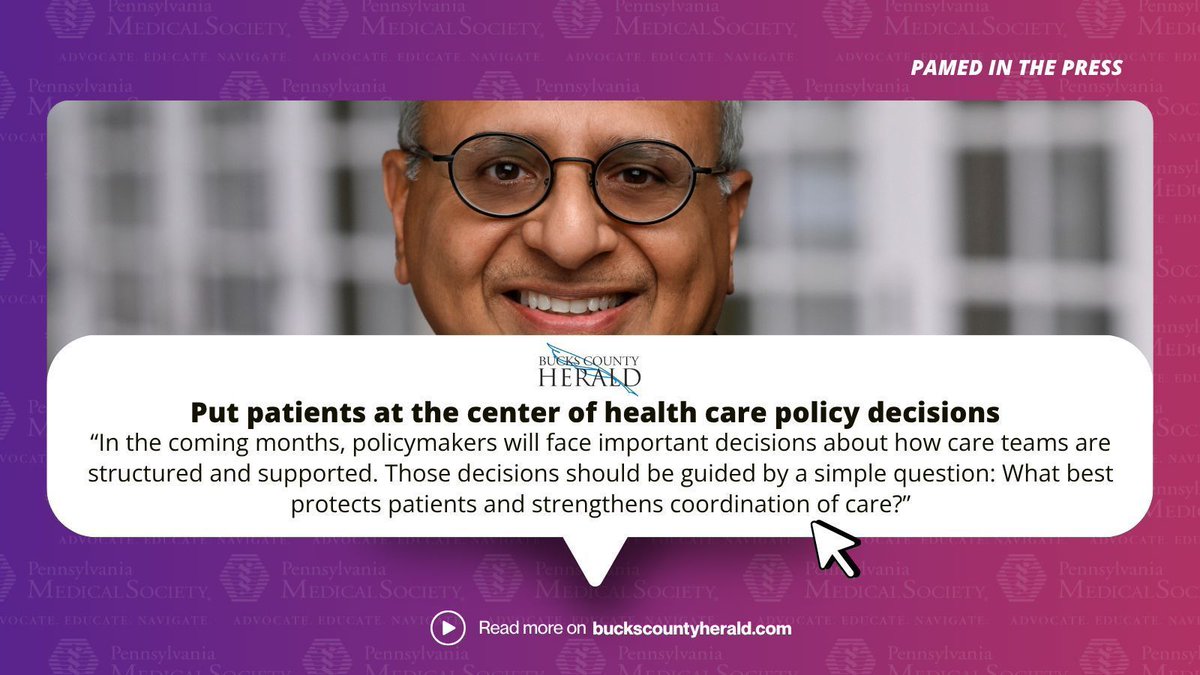
Protecting patients in Pennsylvania starts by listening to the physicians on the front lines of care. In a new letter to the editor, PAMED President Arvind R. Cavale, MD, FACE, FCPP, PCEO outlines how clear roles, strong communication, and physician-led, team-based care support safer, more effective care for patients. Read more: buff.ly/r7MrJm5
PA Medical Society tweet media
English
0
1
1
94
Arvind Cavale
Arvind Cavale@endodocPA·
@anish_koka Your words don't match facts. Which means that either you're ignorant or just creating things from imagination. Your pick! Either way, they make u look not very good or credible. Everybody has a choice. Looks like you've made yours. Choices have consequences.
English
1
0
3
1.1K
Anish Koka, MD
Anish Koka, MD@anish_koka·
My argument is that All physicians that are here IMGs and usmgs are negatively impacted by the further influx of physicians. It’s a bandaid that makes things worse in the long run. Importing a group (as nice and capable as they may be from whatever country) willing to do what US folks are unwilling to do means we don’t actually address structural problems within the US system. Your response to giving you something that actually happened in PA is to call me ignorant?
English
4
3
35
43.9K
Anish Koka, MD
Anish Koka, MD@anish_koka·
I know of a health system that eliminated all the local family doctors who used to admit/round on their patients in the hospital and replaced them with not-from-the-community hospitalists. Medical care has been transformed by the availability and supply of shift working hospitalists — and yet hospitals somehow still ran without them until very recently. Imagine if a large portion of the 60,000 hospitalists were instead staffing 1º care clinics ? We do not have a doctor shortage — we have a system that is working exactly as designed. And unless you cut off the cheap supply of non US Citizen labor that makes the system work, nothing will change.
Robert Berry, DO@txsportsdoc

If the large hospitals can replace American trained doctors with foreign trained,sponsored by hospitals, they can control their practice of medicine. Many states now don’t require passing USMLE or completion of a US residency. It’s a manufactured shortage. It’s also exploiting these foreign doctors. Americans need to be informed. When you go into a hospital, many of the Hospitalists are from this pool.

English
22
37
187
23.9K