Demain matin à 5h30, sortez dans le jardin. Sans téléphone, sans casque. Asseyez-vous. Écoutez dix minutes.
🌿 Ce que vous entendez n'est pas du bruit de fond — c'est un concert avec un ordre précis. Chaque espèce commence à chanter à un niveau de lumière différent. La séquence est la même chaque matin.
Le rougegorge familier (Erithacus rubecula) ouvre le chœur. Il commence quand le ciel est encore presque noir — jusqu'à quarante minutes avant l'aube. Phrases mélodie uses, fluides et variées, depuis la branche d'un arbre ou un arbuste bas. Si vous entendez un chant flûté et riche dans l'obscurité totale, c'est lui qui déclare son territoire avant tout le monde.
Le merle noir (Turdus merula) entre juste après, dans la semi-obscurité. Son chant est lent, riche et improvisé — phrases longues et musicales avec une qualité flûtée profonde depuis la cime d'un arbre ou une corniche. Le mâle chante depuis les points les plus hauts du jardin.
La grive musicienne (Turdus philomelos) arrive quand la lumière commence à grandir. Elle se distingue par une habitude unique : elle répète chaque phrase deux à quatre fois avant de passer à la suivante. Si vous entendez une phrase répétée avec insistance, c'est elle.
La mésange charbonnière (Parus major) entre quand le ciel est déjà clair. Son sifflement en deux notes — "ti-ti-ti" strident et régulier — s'installe depuis la même branche en boucle. Toujours la même structure, répétée avec confiance.
🐦 La raison de cet ordre est biologique. Chaque espèce a un seuil minimum de lumière pour démarrer — déterminé par la taille des yeux, la sensibilité rétinienne et l'habitat qu'elle préfère. Le chœur de l'aube est une horloge naturelle que vous pouvez lire sans regarder le ciel.
L'expérience dure dix minutes. Première espèce : obscurité. Deuxième : pénombre. Troisième : lumière diffuse. Quatrième : soleil à l'horizon. En dix minutes, votre jardin s'est présenté — sans avoir vu un seul oiseau.
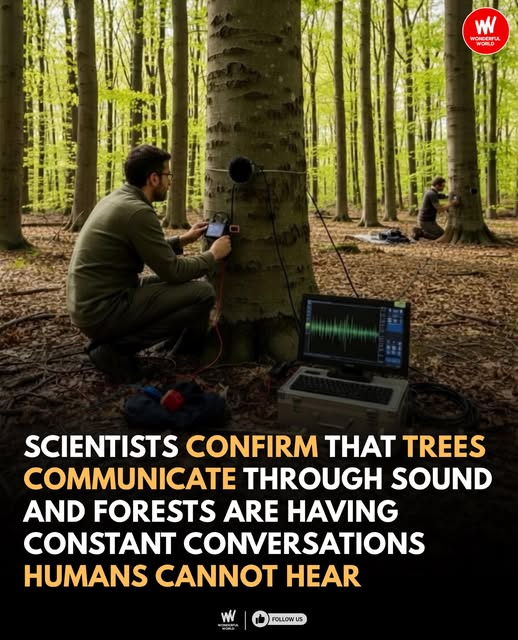
Scientists have confirmed something almost unbelievable… forests aren’t silent at all.
Researchers from the University of Florence discovered that trees communicate using ultrasonic sound pulses — frequencies so high (20–200 kHz) that humans can’t hear them.
In the forests of Casentino Forest, European beech trees under drought stress began emitting rapid ultrasonic “clicks.” These weren’t random noises — they were warnings.
And here’s the wild part…
Nearby trees heard the signal and reacted within hours.
Before experiencing any drought themselves, they started closing their stomata (tiny pores on leaves) to conserve water proving they received and acted on the warning.
Scientists traced the sound to tiny internal events called cavitation microscopic bubbles forming and collapsing inside the tree’s water transport system. These clicks travel through air and soil, reaching trees up to 50 meters away.
Before you buy a single bag of anything, grab a handful of soil from your garden and squeeze it.
If it crumbles apart immediately, you've got sand. If it holds its shape with a shiny surface, you've got clay. If it holds shape but breaks apart when you poke it, that's loam — and loam is what you're building toward.
That took five seconds. Here are three more tests that cost nothing.
🌱 The ribbon test:
Press a moist ball of soil between your thumb and finger into a flat ribbon. If it breaks before an inch — sandy. If it stretches past two inches without breaking — heavy clay. The longer the ribbon, the more clay you're working with.
The worm count:
Flip one full shovelful of soil and count the earthworms. Ten or more means the biology is working. Under five means the soil needs organic matter — compost, leaf mulch, or cover crops. Worms tell you what a lab test can't: whether anything is alive down there.
The jar test:
Fill a jar one-third with soil, add water, shake hard, and set it down. Sand drops to the bottom in a minute. Silt settles in a few hours. Clay stays cloudy for a full day. After 24 hours you can see the layers and roughly gauge your soil's composition without sending anything to a lab.
Every one of these tests points the same direction: add compost. Sand needs it for moisture retention. Clay needs it for drainage. Low worm counts need it for biology. Compost is the answer to almost everything these tests reveal.
Four tests. No kit. Your hands and a jar.
Wool is the only textile fibre that:
- Regulates body temperature in both directions: warm when cold, cooling when warm, through a moisture-wicking mechanism that no synthetic can replicate
- Is naturally flame-retardant without chemical treatment, which is why it is still the mandatory textile for aircraft seating and racing drivers' undergarments
- Absorbs up to 30% of its weight in moisture without feeling wet, then releases it gradually
- Is biodegradable in soil within months, leaving nitrogen as it goes: it is, technically, a slow-release fertiliser
- Grows back. Every year. Without harming the animal. The sheep, in fact, requires shearing. If you don't shear a sheep, it suffers. The shearing is not exploitation. The shearing is a welfare intervention.
What replaced wool in your outdoor gear, your base layers, your running kit, your ski socks?
Polyester. Which is a plastic. Which sheds microplastic fibres into waterways with every wash. Which does not biodegrade. Which cannot be made without petroleum. Which, when it reaches the end of its life, sits in a landfill or an ocean for five hundred years.
The sheep on the Brecon Beacons is producing a renewable, biodegradable, multifunctional technical fibre from grass and rain. No factory. No fossil fuel. No microplastics.
The sheep has been doing this for ten thousand years.
We replaced it with plastic and told ourselves it was progress.
Then told the sheep it was the problem.
Did You Know? 🎓
Pine Needles Hold Far More Vitamin C Than Most People Realize. 🌲🍋
Old Knowledge Like This Helped People Survive Long Before Modern Systems Existed. ⚡️
Lost Remedies Could Matter More Than Ever. ⚡️
📗 Be Prepared For Any Crisis
➡️ tinyurl.com/lostfrontier
Come for a walk with me..
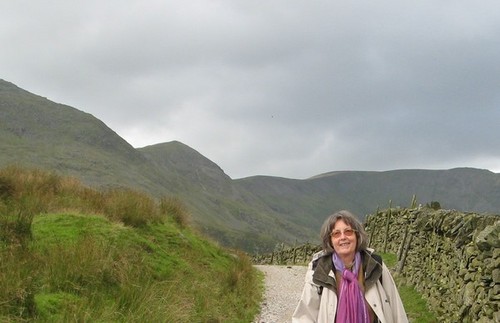
Most people will find this walk and view boring, but for me, it's one of the most beautiful places in the world... the Somerset Levels, large flat expanse of mainly open, damp countryside, few people, few buildings... just quietness and nature.. ❤️
Everyone needs to hear this...
Michael Caine on his defining philosophy for life:
Use the Difficulty
As a young actor, he was rehearsing a play when a chair got stuck in the door and blocked his path. He told the other actor he couldn't get by the chair to enter the scene.
The actor's response:
"Use the difficulty...if it's a comedy, fall over it, if it's a drama, pick it up and smash it."
This idea became a defining mantra for his life.
"There's never anything so bad that you cannot use that difficulty...if you can use it a quarter of one percent to your advantage, you're ahead, you didn't let it get you down."
I can't stop thinking about this...
How can you use the difficulty you're currently facing? How can you embrace the struggle? How can you find flow through the friction?
As with everything in life, control the controllable:
The difficulty is already there. You can't control it. But you can control how you react to it. You can control your response to it. You can control your attitude towards it.
Lesson: Difficulty is inevitable. Use it.
“Music is the arithmetic of sounds, just as optics is the geometry of light.” 🏛️📐
Join Donald Duck as he journeys to ancient Greece, where Pythagoras uncovers the hidden link between numbers and music. By dividing a string into simple fractions, he revealed the harmony of the octave—laying the groundwork for the musical scales we still use today.
A timeless reminder that music isn’t just art—it’s a universal language shaped by the logic of mathematics.
#pythagoras#musichistory#donaldduck#classicalmusic#musicmath
I think that in the discussion of natural problems we ought to begin not with the Scriptures, but with experiments, and demonstrations. - Galileo Galilei