Sabitlenmiş Tweet
Fabián Baptista
746 posts


Fabián Baptista
@fbaptista
CTO at @apptim_official. Co founder at @abstractaUS
Montevideo, Uruguay Katılım Şubat 2009
2.8K Takip Edilen4.1K Takipçiler
@PNCBank_Help Hello, I have my business account blocked, phone support is with high demand so I can't talk with anybody at the bank. We need a business representative phone number to call asap. Can you please provide me a business number to talk with somebody instead of automatic machine?
English

@Minucha01 @frascafrasca Yo estoy en la misma, y por ahora la respuesta q tengo es: experimenta sin parar nuevas herramientas y nuevas IAs, aprende mas rapido y mas autonomo, puede construir arriba de tecnologias y plataformas 10 veces mas rapido.
Español

@frascafrasca Y ahora que hace mi hijo programador junior que busca trabajo ? Terminó hace poco y realmente le gusta 🥺
Español

Desde hace un año que tengo varios proyectos de software que intento realizar usando IA.
Invariablemente, la IA encontraba un problema que no podía solucionar.
Entonces, esperaba unos meses a que saliera un mejor modelo y avanzaba un poco más.
Esta semana, luego de un año de
Español
Fabián Baptista retweetledi

En realidad es muy loco pensar que mañana la mayoría de los desarrolladores del mundo podrán trabajar de forma más eficiente que el día de hoy, por el simple hecho de que una IA se ha actualizado.
Diría que nunca habíamos vivido un progreso tecnológico con un ritmo de mejora tan rápido y que tuviera una aplicabilidad tan inmediata.
De una semana a otra, actualizas el modelo y pum, todo funciona mejor. Y así en muchísimos sectores.
Español
@frascafrasca Así es! Nuestra industria todavía está dormida. Muchos colegas me dicen “ahora cuando pase el humo/hype de la IA”. Es para analizar. Probaste v0? Recomiendo para arrancar a prototipos e iterar ideas en segundos. Si es algo “choto” puede ya quedar productivo
Español
Increíble.
Hace tiempo quería prototipar una app. Calculaba que llevaría unos 3 meses de trabajo y costaría entre 20 y 30.000 dólares.
La acabo de hacer con IA.
Llevó 12 horas y 17 dólares.
No 17000.
17 dólares.
Agarrense muy fuerte porque es inimaginable el impacto de esto.
Español
Fabián Baptista retweetledi

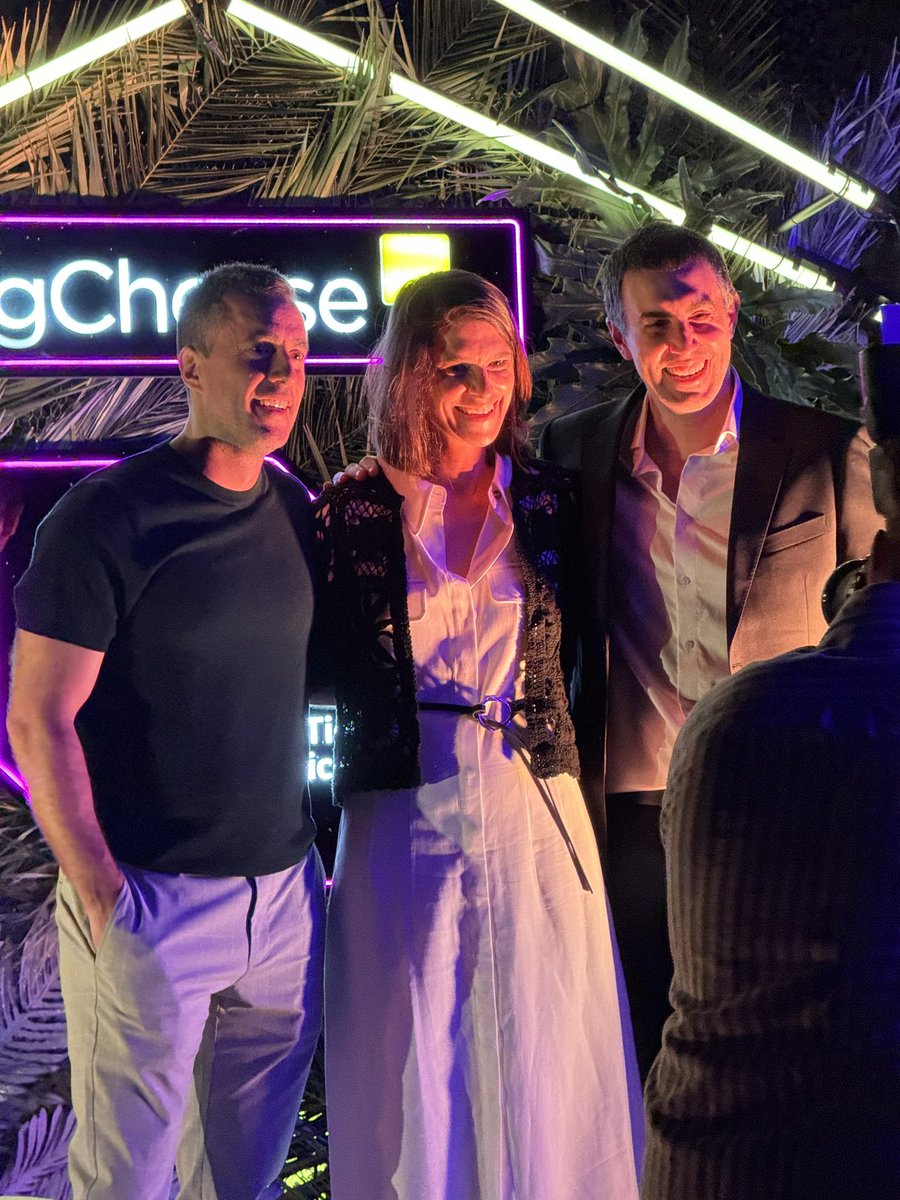
10 años de @BigCheeseUY , realmente una gran empresa de grandes personas en todo sentido @fpolcaro @sebagra @fermartneuro , felicidades !
Español
Fabián Baptista retweetledi

Had a blast at #CommunityOverCode in Denver! Reconnected with old friends, met new ones, and had great convos. Thanks to the organizers and everyone for an amazing event! Bonus: Loved the engaging talks and feedback on my Skywalking Copilot presentation!


English
Fabián Baptista retweetledi

Estamos a menos de una semana de este #webinar de @ChiletecOrg que contará con la participación de @fbaptista. Si te gusta la innovación y te interesan las nuevas tecnologías, este evento es para ti. En este hilo 👇 te dejamos la info completa y el link de registro
Abstracta Latam@AbstractaLatam
🚀 ¡Únete a este webinar de @ChiletecOrg y descubre casos de éxito implantando LLMs! 💡 En este evento, y de la mano de Fabián Baptista, podrás conocer distintas experiencias sobre en qué casos de uso se ha aplicado con éxito la nueva tecnología en distintas industrias.
Español
Fabián Baptista retweetledi

I stand corrected: GPT-4o does NOT natively process video stream. The blog says it only takes image, text, and audio. That's sad, but the principle I said still holds: the right way to make a video-native model efficient is to co-develop the streaming codec on edge device.
Gemini seems to treat video as first-class citizen. Let's see how Google I/O goes tomorrow.
Jim Fan@DrJimFan
I know your timeline is flooded now with word salads of "insane, HER, 10 features you missed, we're so back". Sit down. Chill.
English
Check out the latest article in my newsletter: ChatGPT has entered into a new level 🤯 linkedin.com/pulse/chatgpt-… via @LinkedIn
English

Fabián Baptista retweetledi

@AndrewYNg We developed and have been using github.com/abstracta/brow… to build copilots for these iterative workflows with users. We see a huge potential in implementing copilots that allow users to interact in more efficient ways with existing web apps.
English
@rabelenda @AndrewYNg Yes! Thanks @AndrewYNg for sharing this insight and Roger to connect it with this OSS contribution. 🙌🏽
English
I think AI agentic workflows will drive massive AI progress this year — perhaps even more than the next generation of foundation models. This is an important trend, and I urge everyone who works in AI to pay attention to it.
Today, we mostly use LLMs in zero-shot mode, prompting a model to generate final output token by token without revising its work. This is akin to asking someone to compose an essay from start to finish, typing straight through with no backspacing allowed, and expecting a high-quality result. Despite the difficulty, LLMs do amazingly well at this task!
With an agentic workflow, however, we can ask the LLM to iterate over a document many times. For example, it might take a sequence of steps such as:
- Plan an outline.
- Decide what, if any, web searches are needed to gather more information.
- Write a first draft.
- Read over the first draft to spot unjustified arguments or extraneous information.
- Revise the draft taking into account any weaknesses spotted.
- And so on.
This iterative process is critical for most human writers to write good text. With AI, such an iterative workflow yields much better results than writing in a single pass.
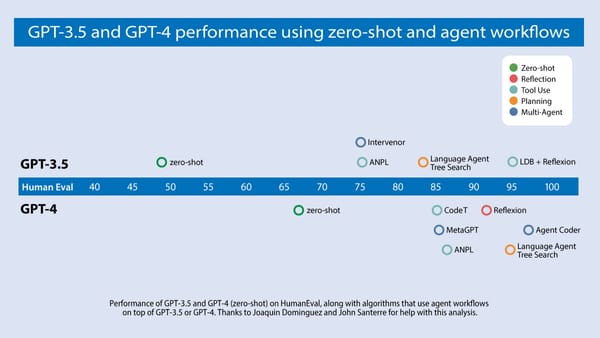
Devin’s splashy demo recently received a lot of social media buzz. My team has been closely following the evolution of AI that writes code. We analyzed results from a number of research teams, focusing on an algorithm’s ability to do well on the widely used HumanEval coding benchmark. You can see our findings in the diagram below.
GPT-3.5 (zero shot) was 48.1% correct. GPT-4 (zero shot) does better at 67.0%. However, the improvement from GPT-3.5 to GPT-4 is dwarfed by incorporating an iterative agent workflow. Indeed, wrapped in an agent loop, GPT-3.5 achieves up to 95.1%.
Open source agent tools and the academic literature on agents are proliferating, making this an exciting time but also a confusing one. To help put this work into perspective, I’d like to share a framework for categorizing design patterns for building agents. My team AI Fund is successfully using these patterns in many applications, and I hope you find them useful.
- Reflection: The LLM examines its own work to come up with ways to improve it.
- Tool use: The LLM is given tools such as web search, code execution, or any other function to help it gather information, take action, or process data.
- Planning: The LLM comes up with, and executes, a multistep plan to achieve a goal (for example, writing an outline for an essay, then doing online research, then writing a draft, and so on).
- Multi-agent collaboration: More than one AI agent work together, splitting up tasks and discussing and debating ideas, to come up with better solutions than a single agent would.
I’ll elaborate on these design patterns and offer suggested readings for each next week.
[Original text: deeplearning.ai/the-batch/issu…]
English

What is an AI product which doesn’t exist today but you wish did?
The more detailed the better 🧵👇🏻 I’ll start: AGI.
English
Fabián Baptista retweetledi

Fabián Baptista retweetledi
We have added support for the new Anthropic Claude 3 models. Evaluating assistants with various suppliers and various models is necessary in many projects for reasons of effectiveness and cost efficiency. #GeneXus genexus.com/en/products/ge… @Globant
English
@ealmeida Feliz cumple atrasado. Que la vida te regale una nueva gloria que añorar en los próximos años
Español
Gané la travesía "Trompas de Falopio" hace 57 años y 9 meses. Eran millones de participantes y llegué primero. Desde ese día vivo añorando glorias pasadas.
Español
Fabián Baptista retweetledi