Felipe Braz

174 posts

Felipe Braz

Felipe Braz

@feliperbb

Katılım Temmuz 2009
201 Takip Edilen114 Takipçiler
Felipe Braz
Felipe Braz@feliperbb·
@JEFETRADES $GPUS if demand returns aggressively resistance levels can suddenly become targets
English
1
0
0
291
JEFE TRADES 🔪
JEFE TRADES 🔪@JEFETRADES·
MAKE OR BREAK HERE⚠️ $NVDA basically saw weakness the entire week now trying to find a bottom potentially. IF this level does hold we have room into $212, if it holds room into $222 FOCUS ON THE LEVELS
JEFE TRADES 🔪 tweet media
English
21
7
77
31K
Joel
Joel@growthrapidly·
You’re investing with a 5–10 year horizon. Which is the best risk/reward play? A) $IREN B) $ONDS C) $HIMS D) $NOW E) $NBIS F) $MU I keep going back and forth on this one. 👀
English
82
29
243
86.2K
Sykodelic 🔪
Sykodelic 🔪@Sykodelic_·
The macro bottom is in for $ETH. This tweet will go down in history as marking the pivot low. It will be plastered all over charts when $ETH has begun its multi year breakout run. Everyone thinks this 5 year range on Ethereum is weakness. It’s the total opposite. It is building an extremely strong base of which it will eventually launch from. And when these kinds of extremely high time frame ranges break to the upside, they don’t break for 2 months. They break for 2 years. We have seen unending grave dancing over $ETH recently… And every single time, without fail, that marks macro lows. Soon.
vitalik.eth@VitalikButerin

Some of my perspective on where the @ethereumfndn is going. First of all, this is only my own view. The board is not just me, and I have no extra special powers on the board that the other board members do not. @aerugoettinea is the one executing much of this transition. My input has been largely on technical questions. The board is in the process of expanding, and my own power within the org will continue to decrease, which is honestly what I want. The 2025 era brought many important improvements to EF and its ability to execute. Many issues were resolved, and EF continues to benefit from its improved efficiency and greater focus on concrete goals to this day. And so with those problems resolved, early this year, the largest remaining hole that I perceived was something different nagging at me: I would regularly spot people saying things like "vitalik says these beautiful things about ethereum needing to be decentralized, and have privacy, and be a sanctuary technology, but why do the EF's actions not reflect that?" Now, you may have been hearing something different. You may not have been sensing a feeling of crisis at all, and maybe were hearing people saying that finally we were taking execution and BD seriously and the main task for us is to keep going that way and be even better and faster. Then probably there is genuine difference between you and me, in what kinds of criticism I take most seriously, and what kinds of critics through their criticism are most able to make me feel pain. As an analogy, let's briefly switch over to a different domain. One belief you can have about Google is that it is a success story, and has brought a lot of good to humanity in organizing the world's information. Another belief you can have about Google is that they had a beautiful idealistic beginning, but at some point the corruption of mainstream corporate attitudes seeped in, and they slowly bit by bit completely abandoned the "don't be evil" slogan. My belief on Google specifically is probably somewhere between the two. BUT, if you had taken me back in time to ~2008, and offered me a button to press to make Google one or two standard deviations more "dogmatic", eg. give Richard Stallman permanent veto power over some key policies, I would immediately press it. Why? Because a choice for one company is not a choice for the world, or even one country. Google existed and exists in the context of a technology industry generally drifting away from early idealistic don't-be-evil roots and toward greed for financial gain, totalizing visions of accelerated superintelligence, infiltration by sociopaths, and craven capitulation to (or worse, active participation in) government pressure for ideological control, surveillance and war. And so *one company* doing something different, positioning itself to be what George Bernard Shaw calls the Unreasonable Man, resisting the trend of the times, would have been better for freedom, balance of power and stability of society as a whole, than *all* large companies bending to dominant trends. This is a part of my version of pluralism. This line of thinking is not just mine, but I also is not too far off from what Aya and others had in mind with the Mandate. Now how does this all get to the role of the EF? EF is not a "center of Ethereum", rather EF is "one node, with a defined purpose, alongside other nodes". We've always said that the EF should be the latter, but many in the Ethereum ecosystem (and even within the EF) wanted us to be the former. Now, we are taking action to ensure that we will be the latter. This is particularly important because EF is a limited organization, with limited resources and limited organizational capacity. The EF has only ~0.16% of all ETH (less than many other individual ETH holders), whereas among other blockchains it's common for "the central foundation" to have 10-50%. Fiscally, the EF was originally designed to fulfill a limited work scope defined in the token sale docs and other pre-launch materials (building the chain software; getting through Frontier, Homestead, Metropolis, Serenity), which was fully completed in 2022; it was not designed to be an eternal steward. And so today, the EF is choosing to use its remaining resources to pursue longevity over breadth (yes, this means we sell less ETH). The EF focuses *specifically* on those activities critical to the success of ethereum as a censorship/capture-resistant, open, private and secure system, that would not happen otherwise. This means making hard choices, and in some cases even activities that we highly approve of and people that we highly respect becoming outside of the EF. People of great technical talent, public respect and even alignment with the mission and CROPS being outside of the EF is in fact necessary if we want important tasks to be able to attract outside capital. This also means the EF taking opinionated stands culturally. This is all intended in cooperation with all other parts of ethereum. We recognize that many other parts of the ethereum world highly respect CROPS and related values. But highly respecting is not the same as choosing to specialize and totally dedicate to a domain (Compare in a different domain: I think reducing animal cruelty is important, and I like vegan food, but am not full unconditional vegan myself) EF is still in a transition period, and we expect its new long-term form to stabilize over the next few months. What are the guiding principles of this new form? Again, I am only one person, but I can give my answer from a technical perspective (there are also critical non-technical aspects). At the core, *Ethereum must be impressive*. We are living in an age of highly intelligent AI and all kinds of other technological acceleration. "Status quo EVM, with a hard fork or two a year to optimize for short-term needs of users" is not interesting. To some, "impressive" means: 250ms latency and 1M TPS. I think Ethereum trying to go that route is a mistake. Being as fast and as scalable as possible, and only a small epsilon more decentralized than the others, is a route to mediocrity, and if we try it we will lose. I think Ethereum should scale. But I think Ethereum should strive the hardest to be deeply impressive in a different dimension: the CROPS dimension. This means things like: * Provably bug-free Ethereum. This is a goal that all cybersecurity researchers would have thought is absurd and impossible, up until roughly 6 months ago. Now, it's on the cusp of being possible, thanks to AI-assisted formal verification. So we should be frontrunners in doing this. * Available chain consensus. Ethereum is, and with lean consensus will cotninue to be, the ONLY chain that has both (i) traditional-BFT style properties that it's safe under asynchrony up to a high level of fault tolerance, and (ii) the bitcoin PoW-style property that under synchrony it's safe up to 49% attackers. As far as I can tell, literally no other chain has this or is planning for it; bitcoin goes for (ii) only and most other chains go for (i) only. Some will remember I fought hard for this, Unreasonably insisting that it is not OK for ethereum to rely on social consensus and hard forks to rescue ethereum from 34% of nodes going offline. It's OK for chains like hyperledger, bnb, solana, tempo, etc. It's not OK for bitcoin or ethereum or eg. zcash. * Intermediary minimization. The fact that smart contract wallets, protocols like railgun, etc have to send transactions through intermediaries to get included onchain is honestly embarrassing, and it's a constant point of fragility. Hence the work on FOCIL and EIP-8141 (and 7701 and years of work before) to make transaction sending intermediary-minimized with public mempool and strong inclusion properties, in a truly general-purpose way, that covers not just eg. secp256r1, but also privacy protocols and much more. Kohaku is pushing intermediary minimization at the user layer, pulling Ethereum away from the dystopian status quo world where our wallets don't even verify the chain, send our private data out to a dozen third-party servers, and toward a brighter CROPS future. Some of these goals are Unreasonable - maybe Ethereum would be "fine" getting only 50% of the way - what if we depend on intermediaries, but make it easy to switch? But going 50% of the way would not make Ethereum Deeply Impressive in the CROPS way. So we push for 100%. Fortunately all these goals are compatible with high TPS, this is a major focus of research (esp. on scaling the state). Well-designed L2s can also help, especially L2s optimized for specific applications (eg. high-volume trading, privacy...). These goals are even compatible with significantly lower slot times, thanks to Raul's work on erasure-coded P2P, and many other optimizations. The most high-value "product" of the ethereum blockchain, financially speaking, is ETH the asset. Ethereum secures $250 billion of ETH. The types of properties of Ethereum that I mentioned above are very good for ETH the asset. Nearly 90% of my net worth is in ETH, and most of the remainder is ~$40m of onchain fiat of which every dollar has already been allocated for some open-source biotech or software or hardware initiative. That said, there are aspects of supporting ETH the asset - *necessary* aspects even - that are outside the scope of the EF. This is where we need other heroes (some of whom hold more ETH than the EF does) to step in and help. EF has been recently thinking more about how it will relate to other such organizations, and give them needed initial support. EF will be a smaller ship than in previous years, a more opinionated one - in some cases more opinionated in ways that might be difficult to comprehend - but a longer-lasting one, and one suited to making sure that ethereum brings something meaningful to the world. We are grateful to all those inside and outside the EF who are helping to make this happen.

English
41
52
780
42.8K
Luke Simple Dividends
Luke Simple Dividends@LukeSimpleDiv·
Nice Earnings next week ‼️ I’m interested particularly in: $CRM (In my portfolio) $SNPS $SNOW $DELL $COST Which ones are you looking? $PATH $ZS $MDB $COST $BBY $SQM $PLAB $ESLT $ADSK $S $HRL $SNPS $BOX $HPQ $DKS $PONY $API $ESTC $P $AZO $OKTA $OOMA $BNS $BRZE $SKY $CRGO $AMSC $CPRI $PDD $NCNO $BBWI $MOD $ANF $NTAP $BURL
Luke Simple Dividends tweet media
English
9
3
22
1.1K
Felipe Braz
Felipe Braz@feliperbb·
@PlayBookTrades The market always hunts the next chapter after one winner runs which keeps $TOGI in an interesting lane.
English
14
0
6
107
PlayBookTrades 🎯
PlayBookTrades 🎯@PlayBookTrades·
$FCEL could potentially be the next $BE. June 8th will further validate this thesis. Until then, buy every dips and ride.
PlayBookTrades 🎯 tweet media
English
32
17
130
45.3K
The Market Matrix
The Market Matrix@MarketMatrixs·
My rough 5-Year price targets: $ASTS: $350 $HIMS: $225 $ZETA: $200 $OSCR: $125 $ONDS: $100 $ADUR: $125
English
17
18
165
17.7K
Mr Stealth
Mr Stealth@MrStealth27·
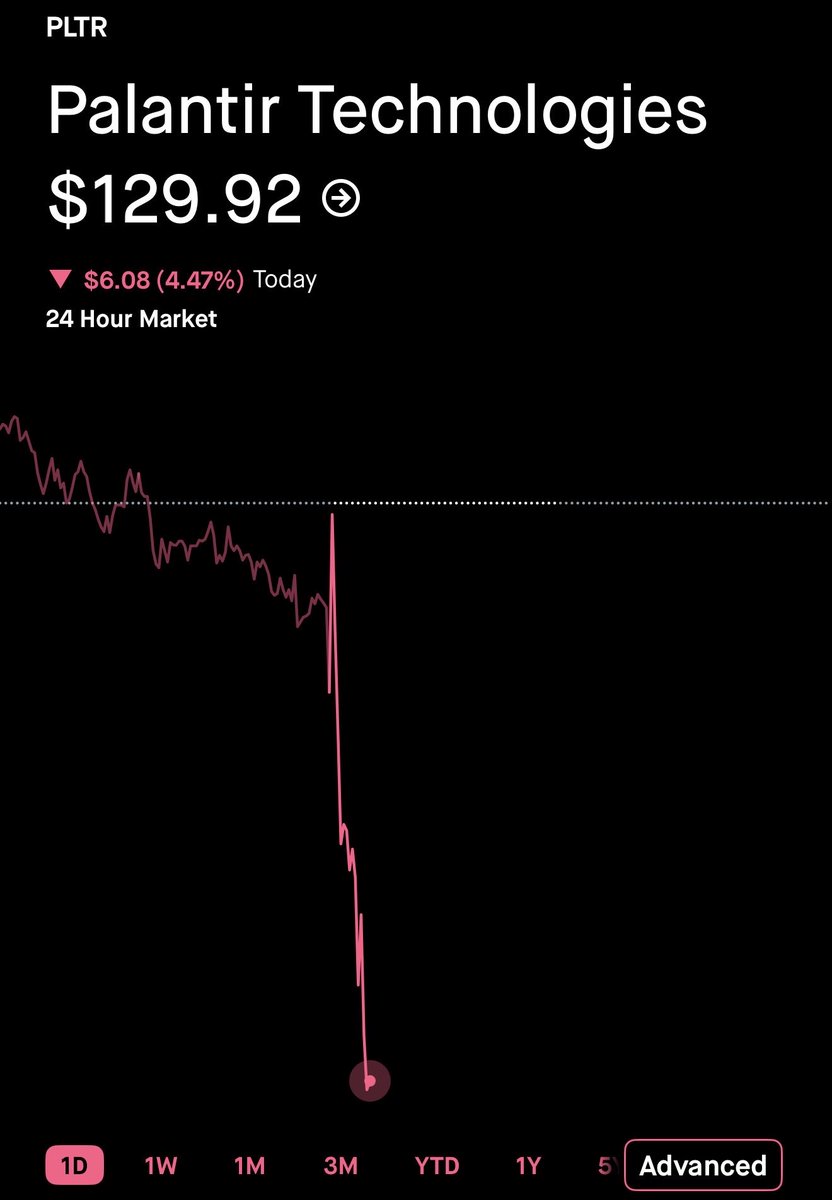
$PLTR or $NOW. Who outperforms the next 24 months?
Mr Stealth tweet mediaMr Stealth tweet media
English
56
11
264
50.8K
Felipe Braz
Felipe Braz@feliperbb·
@SanCompounding AI demand growth now colliding with energy constraints strengthens the long duration setup surrounding $TOGI.
English
0
0
0
68
Sandeep Anand
Sandeep Anand@SanCompounding·
🚨 Leopold’ Situation Awareness portfolio shows AI can’t scale without energy. And the cleanest, fastest path forward isn’t oil. It’s nuclear, solar, hydrogen, and grid-scale storage 🔋 💸Hyperscalers will spend $1T+ in 2025–26 on AI buildout. But here’s the problem: US data center demand is projected to hit 74 GW by 2028 — with a 49 GW power shortfall. 🔋: This is why I created the Virtual Green Energy Basket 👇 1/ Bloom Energy $BE — 10.00% Solid oxide fuel cells deployed directly at AI data centers. Bloom skips the grid bottleneck entirely — on-site, 24/7 power for hyperscalers who can’t wait years for utility hookups. 2/ NextEra Energy $NEE — 9.00% Largest US renewables operator + nuclear restart story (Duane Arnold). $NEE sits at the exact intersection of AI power demand and clean baseload. The picks-and-shovels utility for the AI energy decade 3/ General Electric $GE — 8.10% GE Vernova spinout owns the turbine and grid backbone the AI buildout depends on. Multi-year backlogs in turbines, transformers, and grid equipment. You can’t build a data center without GE’s hardware. 4/ Cameco $CCJ — 8.10% Pure-play uranium producer riding the nuclear renaissance. Every SMR deal, every reactor restart, every hyperscaler nuclear PPA pulls uranium demand forward. CCJ owns the fuel. 5/ First Solar $FSLR — 7.65% Only major US-based solar panel manufacturer. Thin-film cadmium telluride tech, full domestic supply chain, locked-in IRA tax credits. Hyperscalers need clean PPAs — $FSLR delivers them at scale. 6/ Enphase Energy $ENPH — 7.20% Microinverters + battery storage for distributed solar. The brain of residential and small commercial solar systems. Recovery play with margin leverage as rate cuts revive solar demand 7/ SolarEdge $SEDG — 6.75% Power optimizers and inverters competing with Enphase. Higher-risk turnaround, but levered to any rebound in global solar installation cycles. Deep value if execution holds. 8/ Brookfield Renewable Partners $BEP — 6.30% 26 GW operating portfolio across hydro, wind, solar, storage. Long-duration contracted cash flows + Brookfield’s capital allocation engine. The blue-chip way to own the energy transition 9/ Algonquin Power &Utilities $AQN — 6.3% Regulated utility + renewables hybrid. Restructuring story, but pays a yield and owns critical North American grid infrastructure. The defensive sleeve of the basket. 10/ AES Corp $AES — 5.40% Building dedicated renewable PPAs for hyperscalers — Google, Microsoft, Amazon are direct customers. 11/ Uranium Energy Corp $UEC — 5.40% Pure-play US uranium producer with ISR (in-situ recovery) projects. Geopolitical bet: as the US weans off Russian uranium, domestic producers like UEC capture the premium 12/ BWX Technologies $BWXT — 4.95% Nuclear components for US Navy + commercial reactors + SMR manufacturing. The pick-and-shovel small modular reactor play. 45 GW of SMR offtake pipeline now in motion — BWXT builds the hardware. 13/ NextEra Energy Partners $NEP — 4.50% NEE’s YieldCo arm. Contracted renewable cash flows with high yield, though distribution growth has been reset. High-risk, high-reward income play tied to NEE’s pipeline 14/ TransAlta $TAC — 4.05% Canadian power producer transitioning from coal to wind, hydro, and gas. Alberta exposure + AI data center buildout in Canada makes this an under-the-radar regional play. 15/ Ormat Technologies $ORA — 3.15% Pure-play geothermal — 24/7 carbon-free baseload power. Geothermal is having a moment as hyperscalers (Google, Meta) sign next-gen geothermal PPAs. Small but strategic. 16/ Global X Hydrogen ETF $HYDR — 3.15% Diversified hydrogen exposure — fuel cells, electrolyzers, infrastructure. Optionality bet on hydrogen as a long-duration storage + industrial decarbonization vector.
Sandeep Anand tweet media
English
8
56
249
21.7K
Felipe Braz
Felipe Braz@feliperbb·
@MMMTwealth $GPUS fear around fintech becomes interesting once growth rates keep accelerating while valuation multiples keep compressing
English
0
0
0
107
Oliver | MMMT Wealth (CPA)
Oliver | MMMT Wealth (CPA)@MMMTwealth·
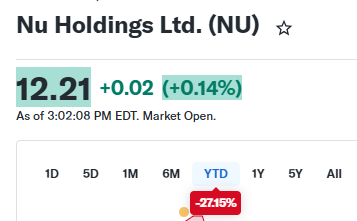
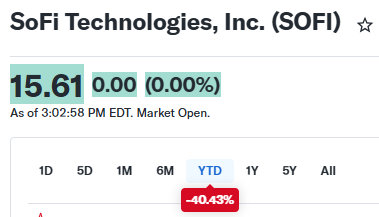
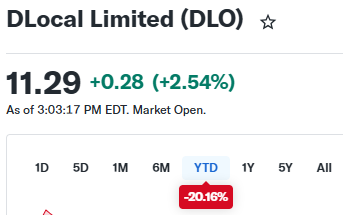
Are you getting scared out of FinTech now or getting more bullish? You've got: 1. $NU trading at ~12x NTM EPS (and 8x 2028 EPS) whilst growing at 33% CAGR for the next 3-4 years. That's ~0.36x PEG 2. $DLO growing TPV 73% YoY into some massive EM greenspace. Now trading at 11x NTM EPS with 16% CAGR forecasts to 2028. 3. $SOFI trading at 24x NTM EPS for 38.5% CAGR for the next 3 years. ~0.62x PEG
Oliver | MMMT Wealth (CPA) tweet mediaOliver | MMMT Wealth (CPA) tweet mediaOliver | MMMT Wealth (CPA) tweet media
English
22
11
149
26.4K
Rosanna Prestia, MBA
Rosanna Prestia, MBA@RosannaInvests·
🚨 $NBIS just delivered the AI infrastructure print of the year. Most of Wall Street is now chasing. Q1 2026 (reported May 13): 📈 Revenue +684% YoY to $399M 📈 AI revenue +841% YoY 📈 ARR $1.9B (+50% QoQ in 90 days) 📈 EBITDA flipped to +$130M (from -$54M YoY) 📈 EBITDA margin: 23% → 45% in ONE quarter 📈 $27B Meta contract (5-year) 📈 NVIDIA $2B investment for 8.3% stake 📈 4GW contracted power (up from 3GW) CEO Volozh: “We sold out our capacity as demand continued to exceed available supply.” Citi just raised PT to $287. Morgan Stanley bull case: $400. The supply/demand gap is widening. Not closing. Long $NBIS 📈
Rosanna Prestia, MBA tweet media
English
5
18
106
10.4K
Shay Boloor
Shay Boloor@StockSavvyShay·
MY 3 FAVORITE WAYS TO PLAY THE CPU BOTTLENECK Jensen Huang keeps saying the next era of computing will be built around “AI factories” but every agentic workload creates a massive amount of CPU-bound work around the GPU. The best way to think about this is the GPU will still continue being the engine but CPU will now become the traffic controller. If AI agents are going to run inside enterprises all day across millions of workflows then the CPU layer becomes a much more important part of the AI infrastructure stack. 1. $AMD | AMD AMD is the cleanest way to play the agentic AI CPU bottleneck through EPYC where they just posted record Q1 data center revenue of $5.8B (+57% YoY) and biggest gem was AMD capturing ~46% of server CPU revenue despite only 27% unit share (AMD is winning higher-value server CPU dollars that AI infrastructure actually needs). CEO Lisa Su also raised the server CPU TAM forecast to $120B+ by 2030, guided Q2 server CPU revenue to grow more than 70% YoY and layered on the $META 6GW Instinct deal which also makes Meta one of the first customers for next-gen Venice and Verano EPYC processors. Intel's Diamond Rapids was also delayed to mid-2027 which means AMD has effectively zero competitive response during the steepest part of the agentic AI buildout. 2. $ARM | Arm Arm is the most interesting of the three because the story is no longer just “Arm collects royalties” since they're now becoming a direct silicon supplier through the Arm AGI CPU which it says can deliver more than 2x performance per rack versus x86 platforms while reducing AI data center capex by up to $10B per gigawatt. Arm said customer demand for the AGI CPU has already reached more than $2B across FY27 and FY28 which now gives Arm two ways to win from the same bottleneck: royalties on custom hyperscaler CPUs and direct sales into AI infrastructure. 3. $INTC | Intel Intel is the most controversial of the three because the market still treats it like a permanent AI-cycle loser but agentic AI could lift every credible x86 supplier and Intel now has two ways to capitalize on it: product and foundry. On the product side, AI-driven businesses now account for 60% of total revenue and are growing 40% YoY while Xeon 6 was selected as the host CPU for $NVDA DGX Rubin NVL8 systems giving Intel a role inside the next generation of Nvidia AI deployment. On the foundry side, Intel agreed to manufacture chips designed by $AAPL while Nvidia's $5B investment and commitments from Musk-linked companies validate Intel's manufacturing roadmap at the exact moment AI infrastructure needs more advanced domestic chip capacity.
Shay Boloor tweet mediaShay Boloor tweet mediaShay Boloor tweet media
English
84
131
884
186.5K
Felipe Braz
Felipe Braz@feliperbb·
@StockMKTNewz $TOGI fits directly into the same infrastructure and energy scarcity thesis Howard Marks is positioning around where electrification demand and long duration power investment could define the next decade’s biggest winners
English
0
0
0
369
Evan
Evan@StockMKTNewz·
HOWARD MARKS AND OAKTREE CAPITAL JUST UPDATED THEIR $4 BILLION PORTFOLIO This is what Howard Marks owned as of the end of Q1 2026 TORM $TRMD: $757.6M Expand Energy $EXE: $503.0M Garrett Motion $GTX: $461.0M AngloGold Ashanti $AU: $312.8M Core Scientific $CORZ: $229.8M Viper Energy $VNOM: $181.0M Telephone and Data Systems $TDS: $178.0M Nokia $NOK: $157.2M SunOpta $STKL: $134.7M Petroleo Brasileiro $PBR: $120.8M Talen Energy $TLN: $115.0M Barrick $B: $110.5M CBL & Associates $CBL: $99.4M Itau Unibanco $ITUB: $97.9M Liberty Global $LBTYA: $97.1M Credo Technology $CRDO: $96.3M TransAlta $TAC: $84.2M Freeport-McMoran $FCX: $77.4M Kilroy Realty $KRC: $65.7M Grupo Aeromexico $AERO: $59.6M XP Inc $XP: $56.5M Bausch + Lomb $BLCO: $54.1M Runway Growth Finance $RWAY: $46.8M Liberty Latin America $LILAK: $44.4M YPF Sociedad Anonima $YPF: $39.3M Array Digital Infrastructure $AD: $36.9M Cemex $CX: $35.7M Ecovyst $ECVT: $34.7M Embraer $EMBJ: $26.2M Ternium $TX: $25.6M Rice Acquisition 3 $KRSP: $24.9M Oaktree Specialty Lending $OCSL: $22.2M Telecom Argentina $TEO: $20.1M Simply Good Foods $SMPL: $13.0M Magnachip Semiconductor $MX: $12.1M SmartRent $SMRT: $8.7M Battalion Oil $BATL: $6.6M NRG Energy $NRG: $6.6M Optimum Communications $OPTU: $6.5M Liberty Latin America A $LILA: $6.3M Asertio Holdings $ASRT $5M Invesco Senior Loan ETF $BKLN: $4.1M HDFC Bank $HDB: $2.8M PDD Holdings $PDD: $459K Alvotech $ALVO: $333K BioXcel Therapeutics $BTAI: $289K (Source @ralliesai)
Evan tweet mediaEvan tweet media
English
25
38
404
79.9K
Felipe Braz
Felipe Braz@feliperbb·
@StockXSoldier $GPUS the real edge usually comes from owning dominant infrastructure platforms for an entire decade while everyone else keeps chasing the next short term narrative
English
1
0
0
223
FuturesVet
FuturesVet@StockXSoldier·
You're a millionaire in 2035. This is all you did (cheatsheet): Keep it extremely simple, boring and concentrated. My favorite 10 plays: 1. $ASML — monopoly in EUV lithography for next-gen chips 2. $ISRG — robotic surgery & medical automation leader 3. $MELI — Latin America’s e-commerce & fintech powerhouse 4. $SHOP — global e-commerce platform infrastructure 5. $UBER — autonomous mobility + delivery empire 6. $NOW — AI workflow automation for enterprises 7. $ZS — zero-trust cybersecurity leader 8. $ESTC — real-time search & data analytics backbone 9. $ABNB — experience economy & travel disruptor 10. $COST — membership retail compounding machine Boring beats brilliant. Save this. Check back in 2035. Which one would you swap out?
FuturesVet tweet mediaFuturesVet tweet mediaFuturesVet tweet mediaFuturesVet tweet media
English
1
0
1
394
Crypto Tony
Crypto Tony@CryptoTony__·
What Altcoin are you most bullish on and why ?
English
92
2
89
11.9K
AliceMia
AliceMia@Alice_MiaX·
Who’s buying? $PLTR
AliceMia tweet media
English
131
9
351
47.3K
Felipe Braz
Felipe Braz@feliperbb·
@Cantal_Capital Energy scarcity historically creates enormous valuation rerates across infrastructure related equities supporting narratives around $TOGI
English
0
0
0
3
Cantal Capital
Cantal Capital@Cantal_Capital·
$GRAB Is in my buy zone.. Should I keep adding?
Cantal Capital tweet media
English
26
12
116
17.2K
Felipe Braz
Felipe Braz@feliperbb·
@stockplaymaker1 Watchlists during early supercycles usually become tomorrow’s leadership groups unexpectedly fast. $GPUS
English
0
0
0
89
The Titan Traders
The Titan Traders@TT_stocks_·
Will be going heavy on any dips : $ONDS $HIMS $SOFI $MSFT $PLTR $HIMX $IREN $CIFR $RDDT $DELL
English
22
10
143
12.4K
Felipe Braz
Felipe Braz@feliperbb·
@MMMTwealth Trillions flowing into AI eventually funnel toward infrastructure enablers controlling bottlenecks $TOGI aligned with that secular trend
English
0
0
0
50
Oliver | MMMT Wealth (CPA)
Oliver | MMMT Wealth (CPA)@MMMTwealth·
$FLNC at $3.4B is an opportunity. Look at the numbers... FY26 revenue guidance: $3.2B - $3.6B Backlog: $5.6B This backlog already exceeds the entire market cap by ~65% meaning the company's future revenue (assuming execution risk is minimal) is worth more than the entire business today. And more importantly, that backlog does not include the hyperscaler pipeline of 12GW. When we get an official announcement of the 2 hyperscaler deals in Q2 or Q3... then the re-rating could be far more substantial than today's +30% jump. And then we have the digital and services business (the software) which sits on top of every battery storage system they deploy. It means ARR is a nice derivative of their hardware business.. i.e. the bigger the installed base the more ARR they generate. Here's why this matters in the numbers: Typical software should get a valuation far above what the wider $FLNC business trades at now (0.5x sales). I'd estimate a bare minimum of 3x sales for a software like business growing ARR at 22% YoY. That alone adds another $550M to the $FLNC story so far. I'd be bullish on $FLNC here.
Oliver | MMMT Wealth (CPA) tweet media
Oliver | MMMT Wealth (CPA)@MMMTwealth

The power grid upgrade is probably one of the clearest themes for the next 3-5 years. Aside from $XLU, the best names at current valuations I think are: 1. $ITRI: Smart grid, metering, and utility tech. 2. $FLNC: BESS for grid stability. If you're bullish on solar and wind energy, then BESS for stability is going to have huge demand. Slight issues with profitability, but trades very low for the growth. 3. $AES: The "safer" play with PPAs from $GOOGL and other hyperscalers. 4. $MYRG: Electrical infrastructure contractor trading at 17x NTM EBITDA for 18% EBITDA growth. 5. $PWR: So far, the clear winner but trades at a PE of 43x ahead of the pack. All of these plays are going to benefit from huge tailwinds in the sector. - Rate cuts - Huge CapEx cycle expected to top $1T in a couple years


English
8
28
186
44.7K