Sandeep Anand
5.8K posts

@SanCompounding
Investing Enthusiast Podcast - https://t.co/Jeuq6KjyNd Author 👉 10X Stocks: How to Pick Multibaggers https://t.co/hirr8nbGb7 https://t.co/WbHavOrRT7


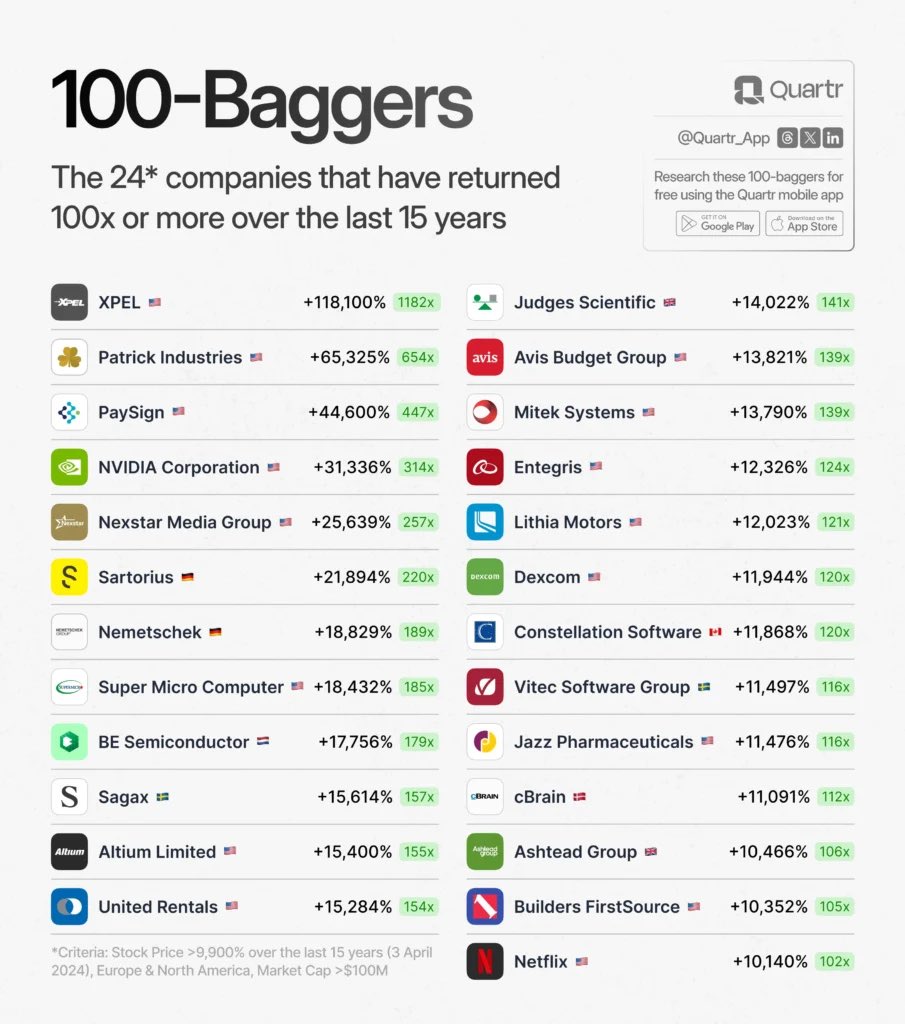
Seven lessons from Christopher Mayer's "100 Baggers." Still one of the best books ever written on long-term investing. 1. Time does the heavy lifting. On average, 100-baggers took 26 years to multiply a hundredfold. The S&P 500 itself became a 100-bagger from 1982. You don't need a magic stock. You need to stay invested. 2. Start small. The average 100-bagger had a market cap of $500 million when it started. It's easier to grow from small to large than from large to huge. 3. Skin in the game matters more than résumés. Founder-led companies whose managers think of shareholders as partners did most of the lifting on Mayer's list. 4. Big ponds grow big fish. A company can only be a 100-bagger if its market is large enough to absorb that growth. Niche dominance is good. Niche dominance in a huge category is great. 5. Pricing power is the cleanest sign of a quality business. If a company can raise prices without losing customers, almost everything else takes care of itself. 6. High returns on capital, reinvested. The real compounding engine is a business that earns 25% on every dollar it puts back to work, year after year. 7. The hardest part is sitting still. Even the best 100-baggers had 50% drawdowns multiple times along the way. The investors who got the full ride were the ones who refused to flinch. Read it. Once read. Read it again.


🇨🇳 🇺🇸 THIS MIGHT BE THE MOST CONSEQUENTIAL BUSINESS MEETING IN HISTORY. The CEOs on Air Force One with Trump are worth over $1 trillion combined. Things happening in Beijing right now that nobody is connecting:


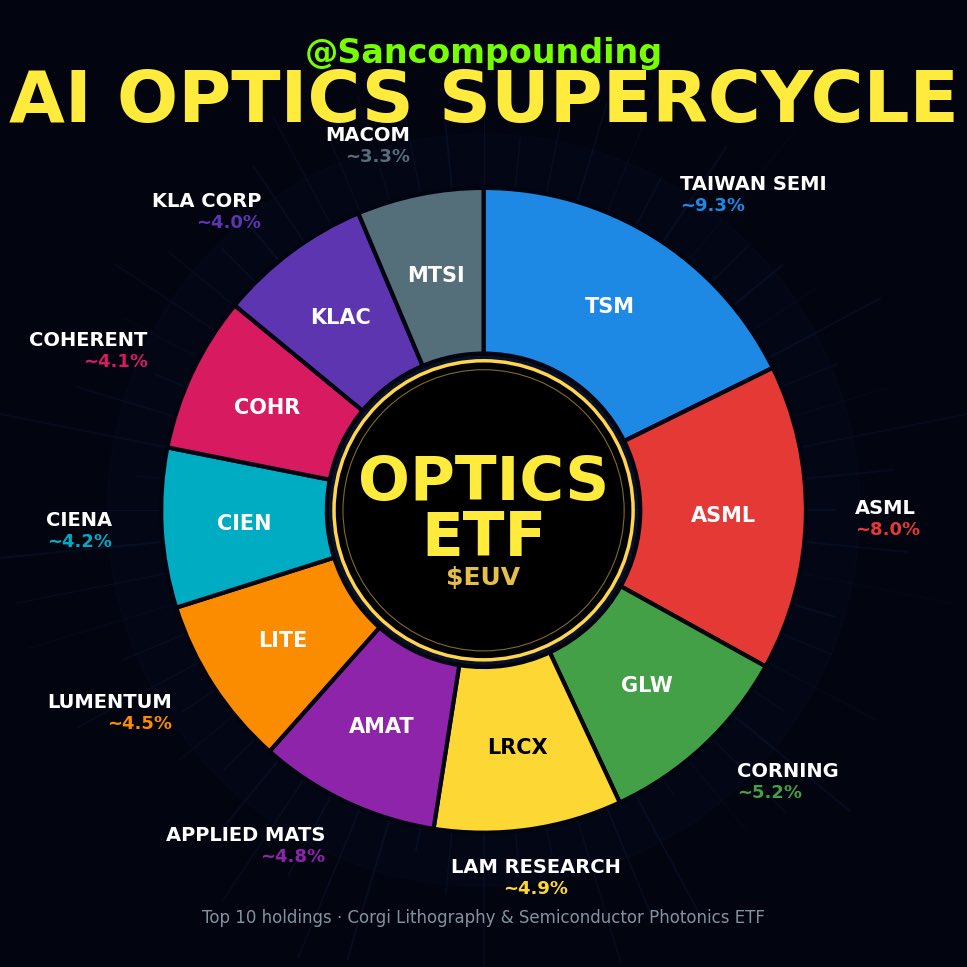
🚨 $EUV : Finally — The first U.S.-listed Optics ETF is here. Corgi Lithography & Semiconductor Photonics ETF — actively managed, 41 holdings, built to capture the photonics value chain powering AI infrastructure. The top 10 reads like a who’s who of the AI optical interconnect & EUV lithography stack: 1.$TSM — Taiwan Semiconductor — 9% 2.$ASML — ASML Holding — 8.04% 3.$GLW — Corning — 5.25% 4.$LRCX — Lam Research — 4.94% 5.$AMAT — Applied Materials — 4.76% 6.$LITE — Lumentum — 4.49% 7.$CIEN — Ciena — 4.20% 8.$COHR — Coherent — 4.11% 9.$KLAC — KLA Corp — 4.03% 10.$MTSI — MACOM — 3.33% The thesis in one line: every AI rack needs Optics and Laser !! – $ASML owns EUV. No EUV, no leading-edge AI chips. – $TSM is the foundry funnel — every NVIDIA, Broadcom & Marvell die runs through it. – $GLW, $LITE, $COHR, $CIEN, $MTSI = the optics & interconnect supercycle (CPO, 1.6T, silicon photonics) – $LRCX, $AMAT, $KLAC = the WFE picks-and-shovels behind every fab buildout Notable names further down the book: $NBIS (neocloud) $WOLF (SiC) $OUST (lidar) — broadening into adjacent photonics plays. After DRAM, optics is the obvious next supercycle to package 📈

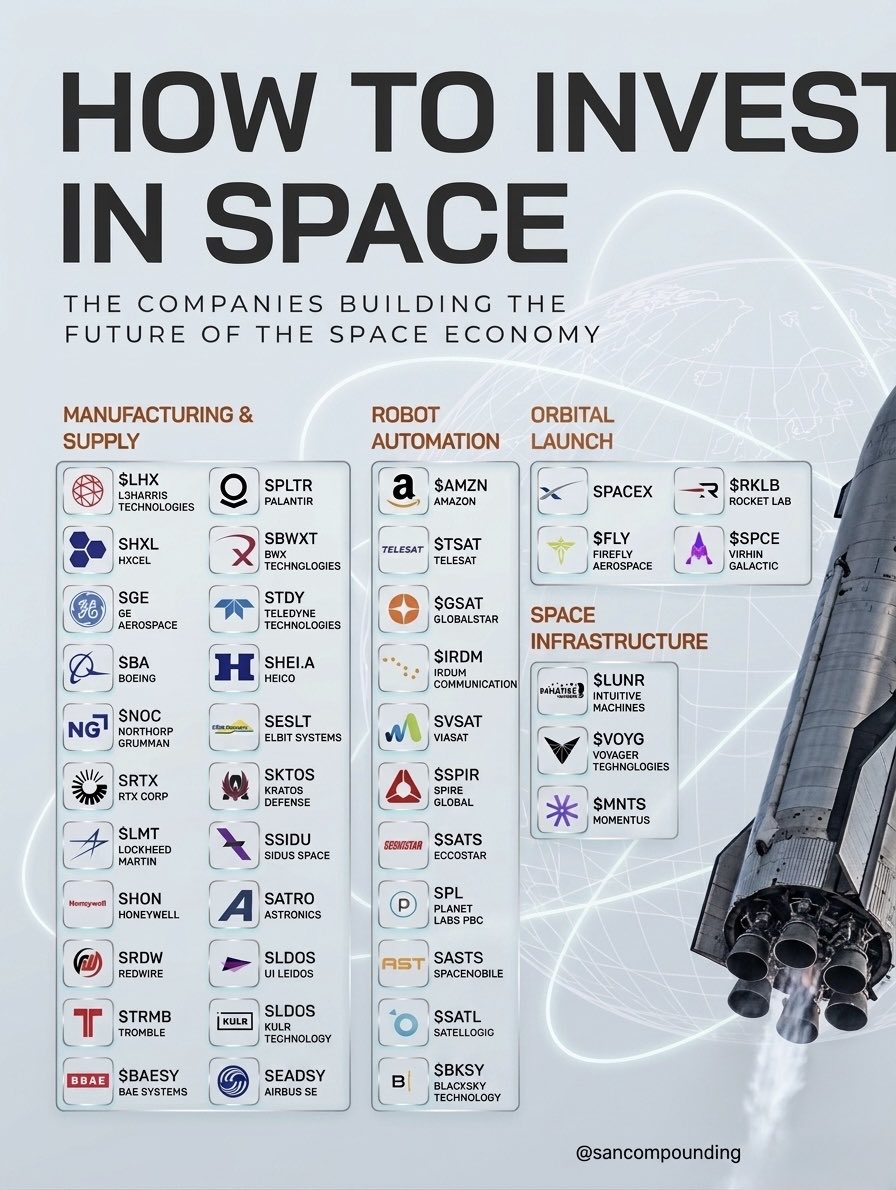
🚀 THE NEW SPACE RACE IS ABOUT DATA CENTER 📈THE ANTHROPIC × SpaceX SIGNAL: When Anthropic signs neocloud deals with Hut 8, Fluidstack, and CoreWeave — that’s terrestrial compute scaling. This is why every hyperscaler is moving up: ∙$AMZN → Project Kuiper ) ∙$GOOG → Starlink partnership + investments ∙$MSFT → Azure Space ∙Anthropic → infrastructure deals expanding into sovereign + edge compute When SpaceX launches Starlink Direct-to-Cell and starts deploying V3 satellites with 1Tbps capacity — that’s the network layer of AI being rebuilt above the atmosphere. The convergence is already happening: ∙Starshield (SpaceX’s classified gov division) is building dedicated DoD + intelligence constellations ∙Starlink is becoming the global low-latency backbone for AI inference at the edge ∙Lunar + LEO data centers are being prototyped (Lonestar, Axiom, Starcloud) — solar power is infinite in orbit, cooling is free in vacuum HOW THESE 35 COMPANIES FIT THE ECOSYSTEM : Think of the space economy as 5 layers stacked vertically — same logic as the AI stack: LAYER 1 — RAW MATERIALS & COMPONENTS (the “semis” of space) $HXL · $BWXT · $TDY · $HEI.A · $KULR · $ATRO · $RDW Carbon fiber, nuclear cores, sensors, batteries, composites. Without these, nothing flies. LAYER 2 — PRIMES & MANUFACTURERS (the + Foundry” layer) $LHX · $LMT · $NOC · $RTX · $BA · $GE · $HON · $ESLT · $BAESY · $EADSY Defense + aerospace giants that build the actual spacecraft, missiles, and satellite buses. Backlog, government cash flows. LAYER 3 — LAUNCH moving (payloads to orbit) SpaceX · $RKLB · $FLY · $SPCE The cost of access. SpaceX has collapsed $/kg by 20x. Rocket Lab is scaling Neutron. This is the enabling layer for everything above. LAYER 4 — DATA & CONNECTIVITY (the “cloud” layer) $AMZN · $IRDM · $GSAT · $VSAT · $TSAT · $SATS · $SPIR · $PL · $ASTS · $SATL · $BKSY Satellite networks. Earth observation. Direct-to-cell. This is the AWS of space — recurring revenue, subscription models, AI-ready data pipelines. LAYER 5 — APPLICATIONS (the “AI/SaaS” layer) $PLTR · $LDOS · $TRMB · $KTOS · $SIDU · $LUNR · $VOYG · $MNTS Mission software, geospatial intelligence, lunar infrastructure, in-space services. Where the margin lives.





🚀 Buying this AI basket like an ETF and forget next 2 years is a good idea 1 $MRVL $67B Optical Switch/Chips 2 $TSM $1.6T Fabless capacity 3 $CIEN $61B Optical Transceivers 4 $COHR $57B Optical Transceivers 5 $LITE $40B Optical Transceivers 6 $CRDO $19B Optical /AIBConnect 7 $DRAM NA Memory ETF 8 $AAOI $10B Optical Transceivers 9 $VIAV $8.3B Optics Test/MFG 10 $CRWV $53B Hyperscaler 11 $AVGO $1.7T ASIC Chips 12 $AXTI $3.5B Optical Materials 13 $NBIS $25B Neocloud 14 $ALAB $0.7B AI Interconnect 15 $NET $58B EDGE AI


🚀 Alibaba Group ( $BABA) Unveils 5nm XuanTie C950 AI Chip —This next-gen chip for agentic AI processor is built using open-source RISC-V chip architecture — billed as "the highest performing RISC-V CPU in the world" 👉 Key AI launches in just last 1 week: 🧠 Alibaba is accelerating in-house chip development through its T-Head semiconductor arm focusing on the 1. Zhenwu 810E chip series for AI training and inference 2. XuanTie series is focused on high-performance cloud systems and agentic AI. 3. Alibaba last week launched Wukong, its enterprise platform optimised for AI agent workflows, as companies and institutions throughout China adopt OpenClaw. 4. Wukong’s international equivalent Accio Work — 🤖 agentic AI platform can autonomously run complex business operations for small and medium-sized enterprises. 5. Siemens and Alibaba Group are expanding their collaboration in the field of industrial artificial intelligence and simulation. 📌 Partnership: ✅Siemens’ engineering simulation (CAE) solutions ✅ Alibaba Cloud’s powerful cloud infrastructure $BABA is my Top Pick — AI Stack Strength & Cheapest valuations ever !!


🚨THE $10 TRILLION BODY: Why Elon & Jensen Both Bet The House On Humanoids Elon says Optimus could generate up to $10 trillion in long-term revenue and roughly 80% of Tesla’s future value will come from the robot program . 🤖 Jensen calls it the “ChatGPT moment for robotics” $HUMN ETF is how you own the picks for Humsnoid and Robotics theme. Here’s TOP 7 👇 1. $TSLA — Tesla Inc. (8.64%) The flagship humanoid bet. Gen 3 Optimus is Tesla’s first design meant for mass production, with start of production planned before end of 2026 and eventual capacity of 1 million robots per year . Musk has called Optimus “the biggest product of all time” — a vertically integrated bet on labor itself. 2. 9880 HK — UBTech Robotics (7.57%) China’s humanoid champion and the only pure-play already deploying Walker S units inside factories for $BYD, Foxconn, and Geely. Strategic partnerships across the Chinese EV supply chain make UBTech the proxy for China’s state-backed humanoid push — the Optimus competitor Beijing is actively underwriting. 3. 277810 KS — Rainbow Robotics (4.64%) South Korea’s humanoid platform leader, with Samsung Electronics as its largest shareholder after a 2024 stake. Spun out of KAIST’s HUBO program, Rainbow is Samsung’s vehicle into bipedal robotics — fusing Korean precision manufacturing with the chaebol AI stack. 4. $NVDA — NVIDIA Corp (4.13%) The brain. Jensen’s Cosmos world-model platform, Isaac robotics stack, and Jetson Thor compute are the de facto OS for nearly every humanoid in this ETF. Jensen predicts NVIDIA will power a billion humanoid robots in the coming years — the ultimate arms-dealer trade. 5. 6324 JP — Harmonic Drive Systems (3.61%) The hidden monopoly. Harmonic Drive makes the precision strain-wave gear reducers inside virtually every humanoid joint — Optimus, Figure, Apptronik, 1X all source from this category. 14 actuators per robot × 1M robots = a violently asymmetric component story. 6. Robotis Ltd (3.43%) Korean specialist in Dynamixel smart actuators and OpenManipulator platforms — the open-source servo standard for research and industrial robotics. Niche but sticky: every university and humanoid startup builds prototypes on Robotis hardware before scaling to custom in-house actuators. 7. $XIACF - Xiaomi’s CyberOne V2 just hit a 90.2% success rate installing self-tapping nuts on a 76-second cycle time at its Beijing EV factory — the same “factory-first” playbook Xiaomi is the only Chinese consumer brand with the full stack (silicon → AI → hardware → distribution) to scale humanoids 📈


🚀 Buying this AI basket like an ETF and forget next 2 years is a good idea 1 $MRVL $67B Optical Switch/Chips 2 $TSM $1.6T Fabless capacity 3 $CIEN $61B Optical Transceivers 4 $COHR $57B Optical Transceivers 5 $LITE $40B Optical Transceivers 6 $CRDO $19B Optical /AIBConnect 7 $DRAM NA Memory ETF 8 $AAOI $10B Optical Transceivers 9 $VIAV $8.3B Optics Test/MFG 10 $CRWV $53B Hyperscaler 11 $AVGO $1.7T ASIC Chips 12 $AXTI $3.5B Optical Materials 13 $NBIS $25B Neocloud 14 $ALAB $0.7B AI Interconnect 15 $NET $58B EDGE AI