
Felix retweetledi
Felix
9.2K posts


Felix
@felixknox
Tech trailblazer: Web2+3, Ethereum, NFTs, DeFi, DeSci, health & performance enthusiast, psychedelic explorer. AI empowerment. Sharp, strong, health is wealth 🔥
Mountain peaks Katılım Şubat 2009
945 Takip Edilen1.6K Takipçiler

@justalexoki A cornerstone of happiness for me is discipline, it’s a great sprout from where happiness grows.
English

Someone should build a dashboard that predicts how many compute resources durable workflows will save.
Malte Ubl@cramforce
"use workflow" And your async await calls become durable. Supported everywhere TypeScript runs useworkflow.dev
English
A progression of templates.
Great showcase of Shopify's integration capabilities.
Not much innovation but an over-simplification.
Lovable@Lovable
Introducing the Lovable Shopify integration. Today, we're making it possible to build online stores by chatting with AI. To show how it works, we built and launched our first merch store:
English
Writers of such publications merely expose their own inability to take responsibility for their health, which is the ultimate driver of the greater good, and not doing so is a disrespect to the same community (family etc.). Classical pseudo-intellects that have given up or refuse to take responsibility.
Bryan Johansson merely exposes such.
Bryan Johnson@bryan_johnson
This author wants you to think that I'm morally inferior for caring about my health. He weaponizes religious moral frameworks to claim superiority. Let's break it down. 1. Title as judgement "A Sick Man in a Sick World" frames me not only as misguided but as pathological. 2. Health is redefined as illness. He writes: “If it is the case that we should primarily attend to our bodies when we experience disease, then Bryan Johnson is, contrary to his entire project, the sickest man alive.” He inverts here, declaring that attention to health is actually sickness. He crowns himself the authority of true health which is religious humility and communal belonging. 3. Borrowed authority He cites Gadamer, Barth, John Paul II and Berry who frame health as instrumental. Meaning that health is only valuable so long as it enables love, work and worship. He argues that my pursuit of health lacks moral justification because it's detached from "the highest vocations of love and worship". 4. Technocracy as sin. “Through an expenditure of millions of dollars, Johnson created his own video-game-like world in which he is the master of his life.” Here he casts my discipline and precision as hubris. He is the defender of an older and superior moral authority. 5. The sanctified threat In his closing line, he wishes me a "peaceful death" which is cloaked violence. In his moral world view, obedience is virtue and agency is arrogance.
English
Felix retweetledi
Yes, the goal of @paradigm and many other VCs is to suck as much value as possible from the Ethereum and broader ecosystem, while also adding value to the ecosystem in the service of maximizing their own gains. Paradigm is particular good at this. Subgoals include progressing the systems of the world towards rigorous decentralization, credibly neutrality, censorship resistance, and intrinsic privacy/confidentiality to the extent that such a world is more profitable -- and healthy in other ways -- for themselves and their investors.
As @fede_intern indicated, it is not news that Paradigm has been working to "own" Ethereum for years. That said, I don't believe there is reason for concern, and consider this kind of behavior natural and inevitable. And the gold rush of corpo-chains is validating for the traditional economy and signals our mainstreaming. Yes, I would prefer that Mallesh and Dankrad would focus their talent and energies fully on Ethereum. But both probably do need a fresh context to energize them, and since both are pure researchers, I expect they will continue to write papers and contribute broadly, as they indicated they would.
We need VCs for now because they represent a comfortable bridge for the world's capital to flow into our ecosystem. Very soon better, fairer, more broadly accessible onchain investment platforms with healthy tokenomics will mature sufficiently so that VCs will have no choice but to set up shop on these platforms, if they want to stay in the game. In bringing progressive decentralization to everything -- even up through layers of identity, reputation and governance -- we are on the precipice of totally changing the way the world works.
Ethereum will win -- already has won -- its niche: rigorously decentralized, credibly neutral digital asset settlement ledger infrastructure. It will establish itself as the world ledger, and then ethos/philosophy and economics will enable it to expand "up the stack" to become the world computer, as more apps get built and protocolized and tokenized. Corpo-chains will be important infrastructure built on top of neutral permissionless chains, just as SQL, No SQL, graph and vector DBs and many other kinds of database connect commercial endeavors to the internet and web. Next generation databases will validate, be verifiable, will be tamper-proof, will maintain an inspectable log of their history and they will all speak token -- the language of the decentralized economy. When all of this matures, the world will finally have a secure global information infrastructure.
Best wishes to Dankrad and Mallesh. They will always be friends and teammates.
David Hoffman@TrustlessState
English
@LefterisJP You simply highlighting a wallet:ux error nothing else.
Wallets have access to the necessary infrastructure to mitigate such issues completely.
Som nodes will be dependent on decisions stuck in delicate infrastructure.
English
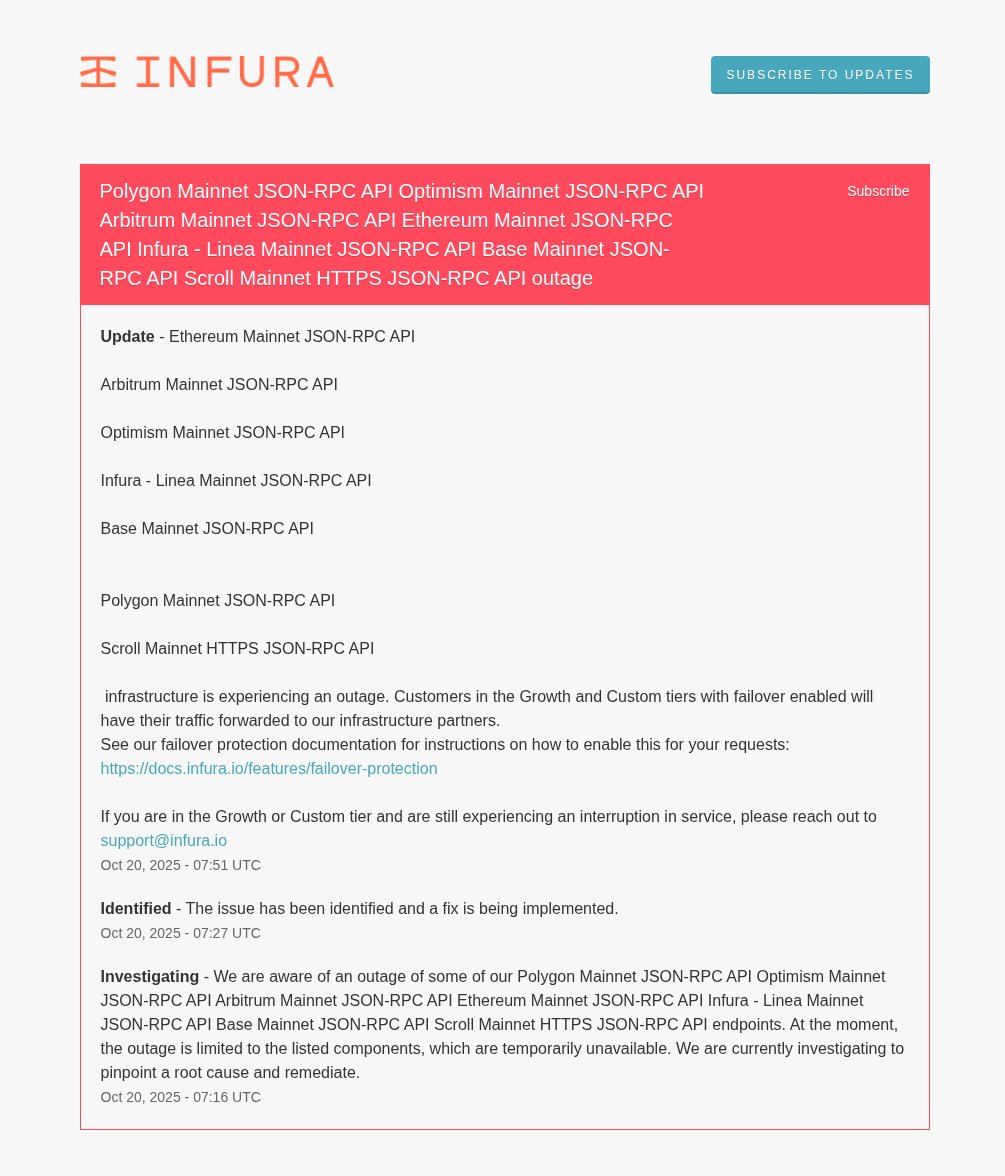
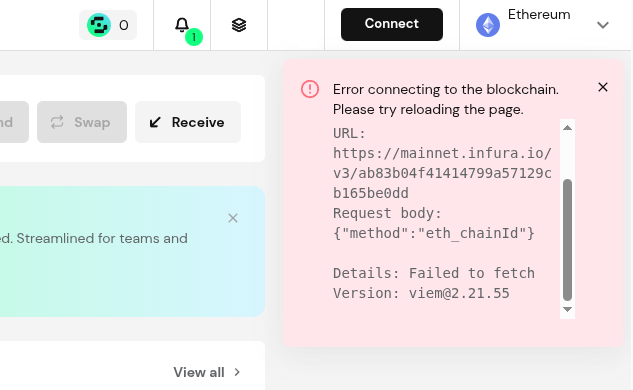
AWS is down and then the internet stops working.
But the blockchain, it never goe ... wait a minute. Scratch that.
This sector is a joke.
Everyone preaching decentralization and censorship resistance but in reality ... it's all 100% reliant on the cloud.
English
@trendingbitcoin From a central bank’s perspective, there is some rationale for excluding assets that could undermine their commitment to conservative values. However, her language is utterly disgraceful and an astonishingly unsophisticated way to express the principles of central banks.
English

🇪🇺 European Central Bank President says #Bitcoin will not be included in any EU central bank reserves.
"Reserves have to be liquid, reserves have to be secure, they have to be safe, and they should not be plagued by money laundering or other criminal activities." 👀
English





Ngl; this is quite impressive, staggering amount of work, components and examples.
Abraham John 🦄🦓@Abmankendrick
Web Designers and Developers, this might be the next level animation library 🤌 Bookmark it for later 💜
English

built an ai cursor that lives on my screen as a buddy + recommends me new stuff as i use my computer.
English
@shotgannoe @levelsio My ophthalmologist used to tell me eyes don’t have muscles and can’t be trained, clearly emphasizing on past tense here. She also sells glasses.
English


I'd go further and say actually regular glasses too
I never got glasses or lenses or Lasik and eye doctor says my eyes are fine
Even though if I do wear some friend's glasses everything is crispy 4K
But wearing those would make my eyes lazy and actually make my vision worse
⚡️🌞 Sol Brah 🌞🐬@SolBrah
It is true of the human body that what you don’t use, you lose. This goes for resilience too! - Always use sunglasses and your eyes become sensitive to light - Always wear jackets and coats, and your body becomes overly sensitive to cold Must intentionally harden yourself
English
Sprinting humbles you before it builds your aura of longevity.
Magnus Vigsø@MagnusVigso
Sprinting is king for living a longer life Sprinters have significantly longer telomeres than non-athletes.
English
The fact that this is called "Chat Control" is mind-blowing to me. It shows that the concept of control and its inherent dangers of misuse are simply not part of the equation for the people pushing such dystopian initiatives.
Keet@keet_io
They called it safety. It was surveillance all along. Chat Control is stalled, for now... Keet will continue to fight for your right to private communication. Always.
English
Reason I go listen to danish duo Bremer McCoy tonight (at Silent Green:Berlin), maximum neural activation.
Network Axis Group@NetAxisGroup
English
Felix retweetledi

i am once again begging you to start using app blockers
christian@cxgonzalez
can't believe i crushed 2000 pages of analytic philosophy in 6 months
English
@mspringut Blow my mind once, I’m amazed; blow it twice, I’m forever changed!
👏👋
English

Hello, new followers. We make sculptures with robots…and we’re making entire buildings soon.
English
@culturaltutor 👏👏 strong progression. Always appreciated your content, a breath of fresh air as it arrives.
English
I’ve made a short film.
Look at the things around you: doors, bins, staircases, furniture, railings, doorhandles, windows.
Do you like how they look, or not?
Modern design has become boring, but it doesn’t have to be this way.
The word “beautiful” is overused. We don’t need “beautiful” lamps, bus stops, and water fountains – we just need lamps, bus stops, and water fountains that are interesting, that actually mean something.
Or, at the very least, not boring.
Because the aesthetics of architecture and urban design aren’t just a bonus; they totally change how we think, feel, and behave.
Boring environments make us more stressed and less productive; they erode our sense of community; they make us sadder, less trusting, and lonelier.
A boring world is one where we spend even more time online and where our addictions are even harder to battle.
The Problem
There is global, widespread dissatisfaction with how the world looks. In this film, and the series it will lead to, we want to investigate that feeling and give it a voice.
The point isn’t that we should return to the past or get rid of modernism. It’s about learning from the past in order to improve the present, and about giving the public what they very clearly want, which isn’t the eradication of modernism but the co-existence of modernism AND traditionalism.
Just look where tourists go, where they take their photos, and that tells you everything you need to know about what most people find interesting or beautiful.
And look at where people go on holiday. It’s always to cities filled with old architecture and design, with churches and mosques and palaces, with charming little alleyways and stone staircases and wrought-iron railings.
Of the world’s fifty most visited buildings, only four were made in the 20th century, and they’re all museums or memorials.
There’s a reason why posts about this go viral online all the time. Regardless of why the change happened, it is clearly the case that we no longer make things how we used to.
People are rightly confused by the fact that old lamp posts (to take the example we focus on in the film) are usually so pretty, while modern ones are usually so boring.
Some people say this is just an example of survivorship bias… and they’re mostly correct. But that’s the whole point!
Saying old buildings are usually prettier than modern buildings is not to say that architecture used to be better, or that the past was better.
It is simply to say that certain kinds of buildings, because they have been preserved, are good examples of what people like most.
In which case... shouldn't we try to design at least some buildings in a way that we know people like?
A Unifying Cause
Everybody, from all sides of the political spectrum and all backgrounds, stands to benefit from a world that is designed more thoughtfully and imaginatively. The world could be such a colourful, meaningful, and thrilling place!
So this isn’t about left versus right or conservatism versus progressivism; it’s about making our world a more interesting and meaningful place to live in. This should be a unifying cause, because everybody loses out when our homes and cities are badly designed.
I want this film to unite people who think they’re on opposite sides, and to create a consensus that we need to change our approach to how we design our buildings and the objects – benches, bus stops, bins, lamp posts, aircon units – that fill our cities.
The Importance of Details
We are incredibly rich and have a sprawling choice of shows to stream, phones to buy, or shoes to wear… but everything feels more and more generic all the time.
If you want to understand a society, don’t listen to what it says about itself – look at what it creates. You can learn everything about the Victorians – the good and the bad – just by looking at their lamp posts.
And what do the ordinary details of the modern world say about us?
That we are technologically advanced, very efficient… and care more about making money, about making things as quickly and cheaply as possible, than making our world an enjoyable place to actually live in.
It’s important to learn about why and how things have changed, but that’s for another time. The first step is establishing that the public aren’t happy with modern architecture and design, and that something needs to be done.
But what we need isn’t a total revival of so-called ‘traditionalism’; the truth is that traditionalism and modernism can (and should) co-exist.
The trouble right now is that we only have one, and that people are tired of it.
The Power of Noticing
But this film (and the series it will, all being well, lead to) is about more than the specific argument it presents. Above all it’s about a way of seeing the world around us, a way of noticing and thinking.
“How you do anything is how you do everything.” That is probably true, and it also applies to whole societies, not just individuals; a single doorbell implies everything else about the whole socio-economic and political system that gave rise to its creation.
And, beyond being merely “useful”, the ability to notice details makes the world a richer place to live in, and life a richer thing to lead. This is what the film is about, more than anything: the power and joy of noticing.
A Bigger Project
This short film is just the beginning. We want to make a full series about the history of art and architecture, both for their own sake and also to see what we can learn about life in the twenty-first century and how to improve it. To keep updated you can join our email list over at our website, linked in the reply below.
Final Words
You can watch the film here on X, or over on YouTube, also linked in the reply below.
So… this is where the dream begins, the dream of a new series and the dream of a more charming, more interesting, more meaningful modern world.
Spread the word.
English