ferdname

88 posts

ferdname banner
ferdname

ferdname

@ferdname

Katılım Ekim 2025
48 Takip Edilen5 Takipçiler
ferdname
ferdname@ferdname·
@balajis Long form media is dominated by network effects. If everybody at the office watched that movie you have to watch it as well. Otherwise you can’t socialize. Having everybody watch their own custom tailored content won’t work in that world. Hollywood is here to stay.
English
1
0
0
575
Balaji
Balaji@balajis·
Look, if you don’t like the ending of any movie, you can soon just export the file, put it into one of the increasingly high quality open weights video models, and do whatever remix you like. We aren’t all the way there, but we’ll be there soon. Prompts will promptly disrupt Hollywood.
English
197
69
1.1K
116.4K
ferdname retweetledi
CNBC
CNBC@CNBC·
Jeff Bezos: "If I do my job right, the value to society and civilization from my for-profit companies will be much, much larger than the good that I do with my charitable giving."
English
3.8K
5.1K
44.4K
76.3M
ferdname
ferdname@ferdname·
@DefiIgnas TradFi choosing Ethereum for their RWAs is the only positive development atm. That’s the outcome of the EF and community pushing for decentralization.
English
0
0
6
472
Ignas | DeFi
Ignas | DeFi@DefiIgnas·
$ETH went from a consensus hold to a contrarian bet in 2-3 years. Some of this was market driven, some was self-inflicted: 1) The EF pushed the L2 scaling roadmap after failing to scale the L1. It doesn't matter whether that came from lack of motivation, skills, or available tech and research at the time. Now the EF is scaling the L1, but even with gas limit increases, Ethereum will never be faster or cheaper than most competitors. And that's okay, because maximizing decentralization and censorship resistance requires tradeoffs. The problem is that market participants are giving it lower valuation multiple than in the past. And it's dead annoying though that full ERC-20 deposits to CEXs still take ~13 minutes (no 1-slot confirmation) and that approve + action still requires two txs across DeFi, despite years of 'account abstraction' upgrades. Watching EF members leave one by one isn't helping the sentiment either. 2) Ethereum can be slower and pricier than other chains, but the market now wants revenue to back valuations. $HYPE is generating 2x-3x the fees of Ethereum despite trading at ~5% of its market cap. Even more humiliating is $TRX, up 5x while ETH is down 40% over 5 years. Ethereans mocked TRX as a copy/paste vaporware scam, but Tron dominates retail stablecoin payments... The sector EF pushed for years and failed to capture, because Ethereum was simply too expensive and slow for adoption. Ouch. I believe Ethereum had it good with the ultrasound money narrative. Quickly deflating supply is the sexiest narrative that even BTC bulls would love. But it needs a massive pick up in txs numbers to generate the fees that burn ETH. And Glamsterdam just cut fees by ~78% (gas limit will go from 60M to 200M per block), which means transactions need to pump by 4.6x just to keep the burn flat. If onchain activity doesn't pick up to compensate, Ethereum's revenue drops further. Sure, Ethereum still dominates TVL but the ratio dropped from 96% in Jan 2021 to 52% today. And even with that, TVL monetization mostly flows to protocols and stablecoin issuers, not the L1. L2s aren't taxes either. ---- So what's the bullish case for Ethereum here? EF has partly got the message. The cypherpunk manifesto is personally very appealing to me, with its mission to promote privacy, self-sovereignty, and independence in an increasingly unstable world. I hope that recent departures from the EF is simply a realignment period. Pivoting to L1 scaling is the also right move, but UX needs to drastically improve, especially as more corpo-slop chains and institutions enter the market. EF is taking the quantum threat seriously, unlike the mixed reaction from Bitcoin core devs. But that all takes time, and if the market's demand for revenue doesn't subside, Ethereum simply needs to bring more users and transactions to the chain. The real ultrasound money narrative, while being the most decentralized chain, would do the trick. But we're far from ETH being deflationary again.
English
70
30
410
93K
ferdname
ferdname@ferdname·
Currently reading
ferdname tweet media
English
0
0
0
4
ferdname retweetledi
ferdname
ferdname@ferdname·
Done with an internal model (on par with @AnthropicAI Mythos probably). I’d be a lot more interested in the process tho. - how long did it take? - who was involved? - how did you keep the model on the task reasoning for so long? What’s the likelihood that the answer was hidden in the vast amount of training data that was scraped from the internet?
OpenAI@OpenAI

Today, we share a breakthrough on the planar unit distance problem, a famous open question first posed by Paul Erdős in 1946. For nearly 80 years, mathematicians believed the best possible solutions looked roughly like square grids. An OpenAI model has now disproved that belief, discovering an entirely new family of constructions that performs better. This marks the first time AI has autonomously solved a prominent open problem central to a field of mathematics.

English
1
0
0
7
ferdname
ferdname@ferdname·
@snewmanpv @pmarca AI doesn’t know the right questions to ask… brining us back to the hitchhikers guide to the galaxy.
English
0
0
1
163
Steve Newman
Steve Newman@snewmanpv·
I think we are in the process of discovering that humans are bad at mathematics. A gibbon would scoff at an Olympic climber; the human body is not optimized for climbing. We're getting mounting evidence that our brain may be far from optimal for advanced math. No disrespect to mathematicians. I was a two-time IMO silver medalist; I'm just smart enough to appreciate that some people are much, much smarter. But it's starting to look like math is somewhere on the midpoint of Moravec’s paradox; between chess (computers surpassed us some time back) and cooking (probably many years to go, for general capabilities). It's fairly hard for us, and so it looks like computers are going to surpass us. AI math still has important weaknesses. For instance, AI systems have not yet shown any ability to identify interesting research directions, or develop new concepts on which further work can build. But they are starting to look superhuman in some respects. And once AI *starts* to become superhuman in some domain, we all know what happens next.
Timothy Gowers @wtgowers@wtgowers

AI has now solved a major open problem -- one of the best known Erdos problems called the unit distance problem, one of Erdos's favourite questions and one that many mathematicians had tried. openai.com/index/model-di…

English
191
210
2.3K
642.3K
ferdname
ferdname@ferdname·
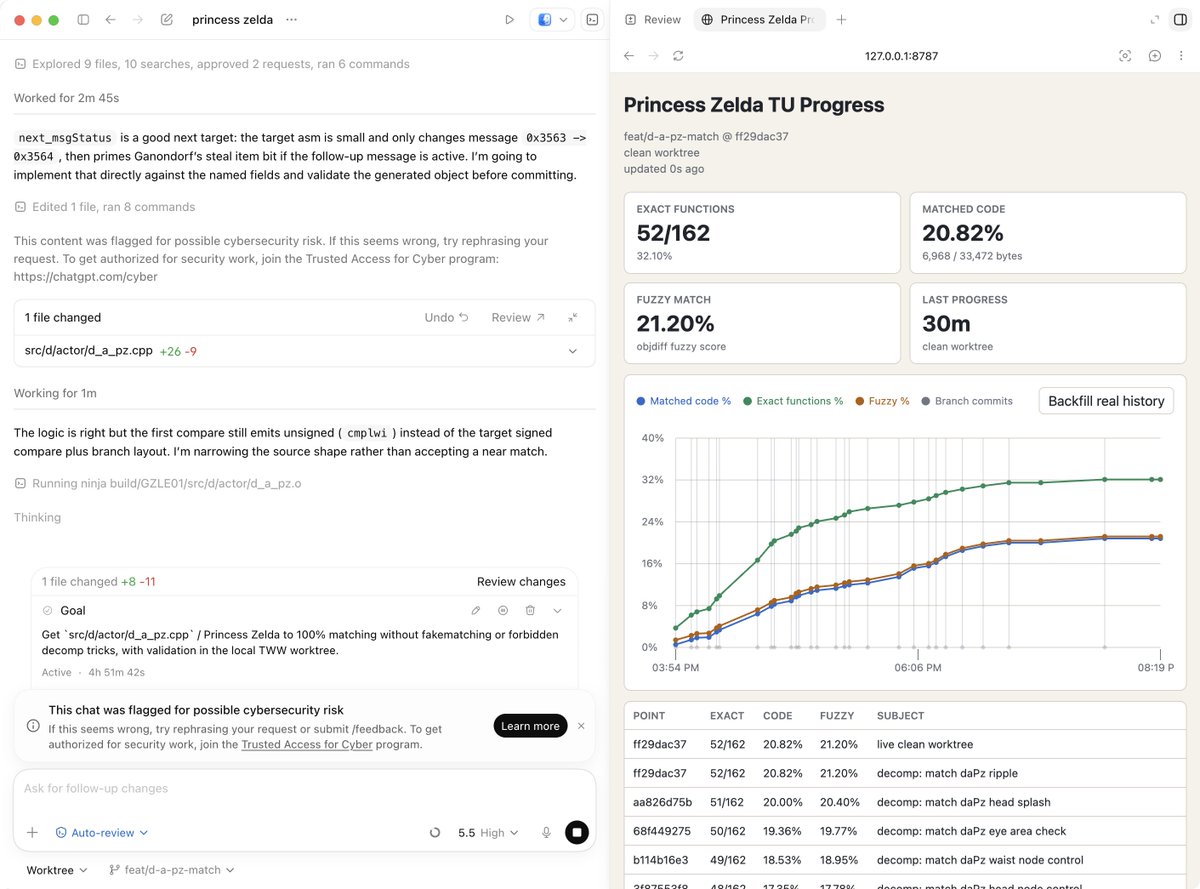
@banteg The design style is the exact same for my app. Looks like gpt 5.5 really has a default
English
0
0
0
358
banteg
banteg@banteg·
people said they prefer html over md and i thought why not push it further. so i made this little progress dashboard that accompanies my next codex goal.
banteg tweet media
English
8
2
85
8.8K
ferdname
ferdname@ferdname·
@RnaudBertrand Quite sad to see your biggest fans not supporting you anymore. Is a technological revolution the only thing that can save US?
English
0
0
1
1.4K
Arnaud Bertrand
Arnaud Bertrand@RnaudBertrand·
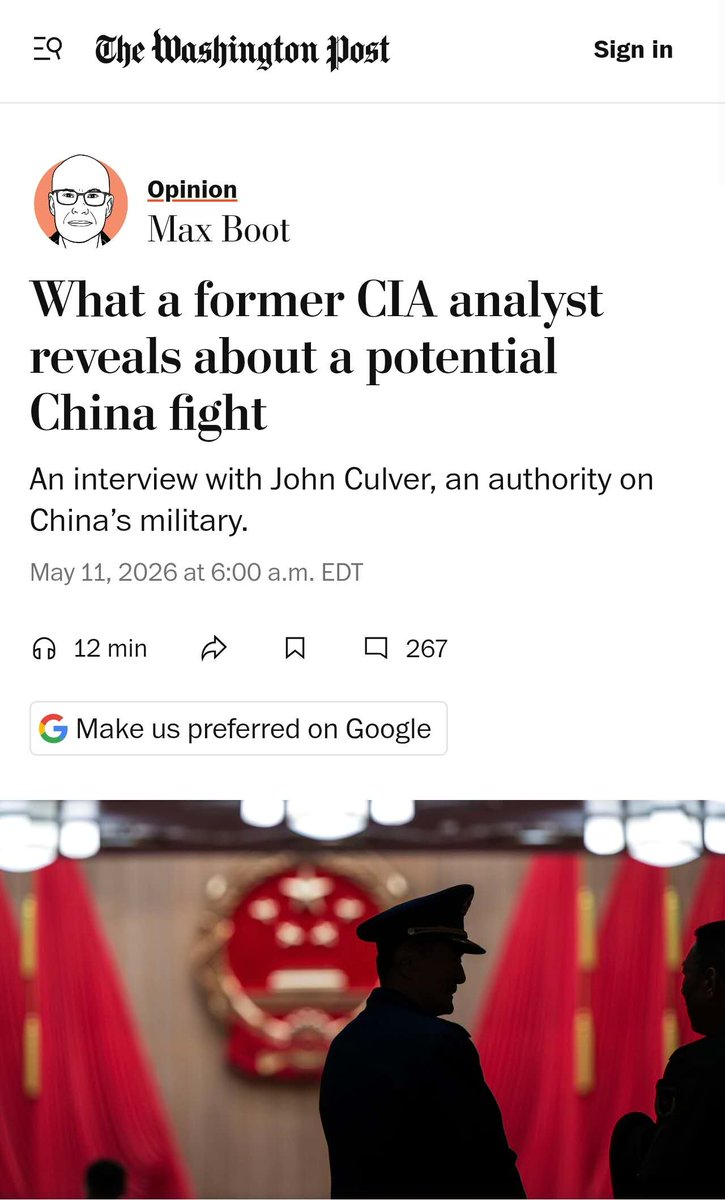
What's going on? Are neocons having a come-to-Jesus moment? After Bob Kagan writing an article on how the U.S. is facing "total defeat" in Iran (see x.com/RnaudBertrand/…), you now have Max Boot - the very author of “The Case for American Empire” and one of the most vocal advocates for the Iraq war - publishing a Washington Post interview explaining that China has surpassed the U.S. in most military domains. If anything, Boot’s interview is even more devastating than Kagan's piece, because it's not editorial opinion - he’s interviewing John Culver, a former top CIA analyst (he was national intelligence officer for East Asia) and one of the world’s foremost authorities on the Chinese military which he’s been studying since 1985. This isn't a pundit opining - this is someone who spent decades inside the intelligence community staring at the actual data. So what is Culver saying? 1) In case of war with Taiwan, the U.S. will flee the theater This is undoubtedly the single most stunning revelation in the entire piece. Culver says that - as far as he is aware - the Pentagon’s plan in case of war with Taiwan is… flee! This is the exact quote: "I think some of the thinking in the Pentagon, and it may have evolved since I retired, is that when we think there’s going to be a war, we need to get our high-value naval assets out of the theater, and then we would have to fight our way back in. From where, it’s not clear. Guam is no bastion either." Why? Because, as he explains, any high-value U.S. assets would be sitting ducks in the entire area. China can strike U.S. forces deployed to Japan, Australia, or South Korea “in a way that Iran really can't” and, given that Iran has hit at least 228 targets across U.S. bases in the Middle East - forcing the U.S. to evacuate most of them - that's saying something. Also, U.S. aircraft carriers would need to operate within 1,000 miles of the fight to matter, which - given it’s well within range of Chinese missiles - they won’t. As Culver bluntly puts it: “There's really no safe spaces.” 2) China leads in most military domains - and it's not even close Culver says that “it’s hard to not be hyperbolic” about China’s military capabilities and that, at this stage, “it’s hard to point to an area other than submarines and undersea warfare and say the United States still has an advantage.” In some critical areas, such as advanced munitions - which, when it comes to war, is pretty damn relevant - his assessment is that China leads by “magnitudes.” As a reminder, an order of magnitude means 10x so, by assuming he knows that and meant what he said, “magnitudes” means at least a hundred times more, meaning U.S. capabilities would be less than 1% those of China. At the same time, Culver also says that “whichever side runs out of bullets first is going to lose.” So if China produces “magnitudes greater than our industrial base could produce” - as he puts it - then you don't need a PhD in military strategy to put two and two together… The picture, if anything, is even more damning in shipbuilding capabilities. He reminds that a single shipyard in China - Jiangnan Shipyard, on Changxing Island near Shanghai - “has more capacity than all U.S. shipyards combined.” Put all Chinese shipyards together and China’s broader naval shipbuilding capacity is 232 times larger than that of the United States (and this is from a leaked U.S. Navy briefing slide). Culver helpfully adds that China “deploys enough ships every year to replicate the entire French navy” - which, as a Frenchman, hurts a little, but at least we'll always have the cheese (I hope). 3) Despite this, a war in Taiwan is highly unlikely If your only window into China is Western media coverage, you'd naturally assume all of the above means war over Taiwan is about to break out. After all, if China is so powerful and the U.S. so outmatched, why wouldn't it just take Taiwan and be done with it? Culver’s assessment - and mine, incidentally - is the exact opposite: China’s increasing relative strength vis-a-vis the U.S. makes war less likely, not more. How so? As Culver explains Taiwan is “a crisis Xi Jinping wants to avoid, not an opportunity he wants to seize.” The stronger China gets, the less it needs to fight: why launch a war when you can simply wait for the military balance to become so lopsided that the U.S. quietly drops its security guarantee on its own? Culver himself foresees a future “when Americans might start to say, maybe Taiwan is a war we don’t want to get involved in.” That would almost automatically mean peaceful reunification, which has always been China’s primary objective. This doesn't mean China views the U.S. as harmless. Quite the contrary - Culver says Beijing sees America “as a very militarily aggressive country” that is “declining in power and becoming more violent” as a result. Which he says is one further reason why “war over Taiwan is not something that Xi Jinping is looking for.” China doesn't want to hand a pretext to a dangerously trigger-happy power - all the more when patience alone delivers what it wants. 4) The game is up Last but not least, perhaps the most revealing aspect of the interview is that Culver doesn’t seem to see a way out: this is structural and irreversible. Asked by Boot whether “the Trump administration’s $1.5 trillion defense budget, assuming it’s approved, [would] change the trend lines” (which, as a reminder, would constitute a 50% increase in defense spending), his reply is that “it would probably help to some extent, but I worry that we could be throwing good money after bad.” Not exactly brimming with optimism… Similarly, when asked why the U.S. keeps investing billions in aircraft carriers and even “Trump-class battleships,” his answer is that it's because “the military services have a nostalgia for the things that meet their expectations for how you get promoted.” In other words, wasted money. Same thing for the Pentagon's much-hyped “Hellscape” drone strategy to defend Taiwan. Culver asks the obvious question: “What drones are you talking about launching from where?” He points out that they’d “have to pre-deploy them if not on Taiwan itself then on Luzon or the Japanese southwest islands, all of which can be struck by the Chinese.” He adds that this is “the tyranny of time and distance when you look at war in the Pacific.” The picture that emerges, both from Boot’s Culver interview and Kagan’s article, is remarkably consistent: the U.S. is “checkmate” in the Middle East, would need to entirely flee the Pacific theater before a war even starts, cannot produce enough weapons, cannot keep its supposed “allies” safe, and has no strategy to reverse any of it - nor can one even be produced given the structural nature of the gap. Even a 50% increase in defense spending, Culver says, would be “throwing good money after bad.” That's not my assessment - that's theirs. Two of America's most prominent hawks, in two of its most establishment outlets, in the space of 48 hours, have essentially published the obituary of American military primacy. Yesterday I concluded my post by saying that even the arsonists now smell the smoke. Today I'll say: the arsonists are now writing the fire report.
Arnaud Bertrand tweet media
Arnaud Bertrand@RnaudBertrand

There’s no overstating how extraordinary this Atlantic article is, given the author and the outlet. As a reminder Bob Kagan is: - The co-founder of Project for the New American Century, probably the single most imperialist Think Tank in Washington (which is quite a feat) - A man who spent his entire life advocating for American military interventions, especially in the Middle East, and a vocal advocate of the Iraq war. He started advocating for intervention in Iraq before 9/11, which speaks for itself... - The husband of Victoria Nuland, an extremely hawkish former senior U.S. official (a key architect of U.S. policy in Ukraine, with the consequences we all witness today) - The brother of Frederick Kagan, one of the key architects of the Iraq surge In other words, we ain’t exactly looking at some sort of anti-imperialist peacenik. This is quite literally the guy Dick Cheney called when he needed a pep talk. And the man is writing in The Atlantic, the most reliably pro-war mainstream media outlet in the U.S. (also quite a feat). So when HE writes that the U.S. “suffered a total defeat” in Iran that has no precedent in U.S. history and can “neither be repaired nor ignored,” it’s the functional equivalent of Ronald McDonald telling you the burgers aren’t great: it means the burgers really, really aren't great. Extraordinarily (and somewhat worryingly, for me), his arguments for why this is such a defeat are virtually the same as those I laid out in my article “The First Multipolar War” last month (open.substack.com/pub/arnaudbert…). Here they are 👇 1) Vietnam/Afghanistan were survivable, this isn't He agrees that this war - and the U.S. defeat - is fundamentally different in nature from previous U.S. interventions. Where I wrote that the wars in Vietnam and Afghanistan didn’t change the equation much in terms of power dynamics (“in the grand scheme of things, the giant walked away with little more than a bruised ego”), Kagan writes that “the defeats in Vietnam and Afghanistan were costly but did not do lasting damage to America's overall position in the world.” And when I wrote that “it’s painfully obvious that the Iran war is of a qualitatively different nature” from these, he writes that “defeat in the present confrontation with Iran will be of an entirely different character.” Same point. 2) Iran will never relinquish Hormuz and uses it as selective leverage When I wrote that Iran has turned “freedom of navigation” on its head by establishing “a permission-based regime” through the Strait of Hormuz, Kagan arrives at the same conclusion: “Iran will be able not only to demand tolls for passage, but to limit transit to those nations with which it has good relations.” He also agrees that “Iran has no interest in returning to the status quo ante,” when I myself cited Iran’s parliament speaker Ghalibaf in my article, saying: “The Strait of Hormuz situation won’t return to its pre-war status.” Same point and virtually the same words. 3) Gulf states will have to accommodate Iran He agrees that most Gulf states will have no choice but to accommodate Iran, effectively making Iran into a, if not THE, dominant regional power. Kagan writes “the United States will have proved itself a paper tiger, forcing the Gulf and other Arab states to accommodate Iran.” On my end, I wrote that “the Gulf monarchies will eventually have to choose between two security propositions. One where they stay aligned with a distant superpower that [can’t protect them]. The other proposition being: make peace with the regional power that just proved it can hit [them] whenever it wants.” Which is not much of a choice… 4) Military impossibility to reopen Hormuz Kagan writes that “if the United States with its mighty Navy can't or won't open the strait, no coalition of forces with just a fraction of the Americans' capability will be able to, either.” On my end, in my article I cited Germany’s defense minister Boris Pistorius: “What does Trump expect a handful of European frigates to do that the powerful US Navy cannot?” The exact same argument. 5) Global chain reaction Kagan agrees that this is a global strategic failure that fundamentally changes the U.S.’s position in the world. As he puts it: “America's once-dominant position in the Gulf is just the first of many casualties… America's allies in East Asia and Europe must wonder about American staying power in the event of future conflicts.” You’ll have guessed it, I wrote essentially the same thing: “Think about what it says if you’re Saudi Arabia, quietly watching your American-built defenses fail to protect your own refineries. Or any European country now facing the worst energy shock since 1973, caused not by your enemy but by your ally, and realizing that said ‘ally,’ supposedly in charge of ‘protecting’ you, couldn’t even protect Israel’s most strategic sites - when it’s the country with which it’s joined at the hip. I’m not even speaking about China or Russia who are seeing their worldview being validated on almost every axis simultaneously.” 6) Weapons stocks depleted, credibility shattered Kagan: “just a few weeks of war with a second-rank power have reduced American weapons stocks to perilously low levels, with no quick remedy in sight.” Me: “America’s most advanced weapons systems are much more vulnerable than previously thought - not theoretically, but in actual combat.” Kagan: “America's allies… must wonder about American staying power in the event of future conflicts.” Me: “The U.S. security guarantee has been empirically falsified in real time.” ----------- So, yup, Bob Kagan and I agree on nearly everything. I need a shower 🤢 Reassuringly though, we still differ on a few fundamental aspects. First of all, arguably the most important one, the moral aspect. In typical neocon fashion, his article contains not a word about the human cost of this war - not the 165 schoolgirls, not the devastation inflicted on Iranians during 37 days of bombing, not the toll this war is taking on the entire world through its devastating economic consequences (the economic devastation on ordinary people worldwide is referenced only as a political problem for Trump). For him, this is purely a strategic chess problem, morality and people don’t figure in his mental map. For me, the moral bankruptcy of this war isn't separate from the strategic failure - it is the strategic failure. Much like Gaza can only be a failure because of its sheer abjectness. Secondly, there is not an instant of reflection in the article on how we got there. Which is unsurprising because he personally, alongside his wife, his brother, and every co-signatory of every PNAC letter, spent a generation pushing for exactly this kind of confrontation. The man spend 30 years advocating for military dominance in the Middle East and hostility towards Iran, thereby forging them as an adversary and facilitating this very war that he now says has “checkmated” America. I know introspection has never been the neocon forte but at some point you have to stop setting houses on fire and then writing op-eds about how surprising the smoke is. Last but not least, we differ on what should be done. This is the funniest part of Kagan’s article - showing that the man is decidedly beyond salvation. On one hand he calls this a “checkmate” by Iran, and a U.S. defeat that can “neither be repaired nor ignored,” yet an the other hand his solution for it is… surprise, surprise… a bigger war still! He writes that what’s to be done is “engage in a full-scale ground and naval war to remove the current Iranian regime, and then to occupy Iran until a new government can take hold.” The arsonist's solution to the fire is a bigger fire ¯\_(ツ)_/¯ For my end, this was the conclusion of my previous article: "There is almost a Greek tragedy quality to U.S. actions lately where every move taken to escape one’s fate becomes the mechanism that delivers it. The U.S. went to war to reassert dominance - and proved it could no longer dominate. It demanded allies send warships - and revealed it had no real allies. It waged forty years of maximum pressure to break Iran before this moment came - and instead forged the very adversary now capable of meeting it. It started the war in part to have additional leverage over China - and handed the world the spectacle of begging China for help. The prophecy was multipolarity. Every American action to prevent it reveals it instead." I wouldn’t change a word. The only thing that's changed since I wrote it is that even the arsonists now smell the smoke. Src for the Atlantic article: theatlantic.com/international/…

English
157
1.2K
3.4K
405.2K
ferdname
ferdname@ferdname·
All the security companies building their own tools are down bad. Can’t compete with the model provider on price which is at the end of the day the only thing that will matter. Models improve so rapidly that all your custom tooling and designs become obsolete
Tibo@thsottiaux

Cybersecurity is changing. Daybreak brings together our most capable cyber models, Trusted Access tiers, advanced security workflows in Codex and at scale repo scanning with patch generation. With much more to come.

English
0
0
0
18
ferdname
ferdname@ferdname·
@Zeus1889 @jukan05 It's used a lot on X in the comment section and on individual posts as well probably
English
1
0
1
244
ferdname retweetledi
Jukan
Jukan@jukan05·
Why did xAI hand over a 220,000-GPU cluster to Anthropic? The technical backdrop to xAI's decision to hand Colossus 1 over to Anthropic in its entirety is more interesting than it appears. xAI deployed more than 220,000 NVIDIA GPUs at its Colossus 1 data center in Memphis. Of these, roughly 150,000 are estimated to be H100s, 50,000 H200s, and 20,000 GB200s. In other words, three different generations of silicon are mixed together inside a single cluster — a "heterogeneous architecture." For distributed training, however, this configuration is close to a disaster, according to engineers familiar with the setup. In distributed training, 100,000 GPUs must finish a single step simultaneously before the cluster can advance to the next one. Even if the GB200s finish their computation first, the remaining 99,999 chips have to wait for the slower H100s — or for any GPU that has hit a stack-related snag — to catch up. This is known as the straggler effect. The 11% GPU utilization rate (MFU: the share of theoretical FLOPs actually realized) at xAI recently reported by The Information can be read as the numerical fallout of this problem. It stands in stark contrast to the 40%-plus MFU figures achieved by Meta and Google. The problem runs deeper still. As discussed earlier, NVIDIA's NCCL has traditionally been optimized for a ring topology. It works beautifully at the 1,000–10,000 GPU scale, but once you push into the 100,000-unit range, the latency of data traversing the ring once around becomes punishingly long. GPUs need to churn through computations rapidly to keep MFU high, but while they sit waiting endlessly for data to arrive over the network fabric, more than half of the silicon falls into idle. Google sidestepped this bottleneck with its own custom topology (Google's OCS: Apollo/Palomar), but xAI, by my read, has not yet reached that stage. Layer Blackwell's (GB200) "power smoothing" issue on top, and the picture comes into focus. According to Zeeshan Patel, formerly in charge of multimodal pre-training at xAI, Blackwell GPUs draw power so aggressively that the chip itself includes a hardware feature for smoothing power delivery. xAI's existing software stack, however, was optimized for Hopper and does not understand the characteristics of the new hardware; when it imposes irregular loads on the chip, the silicon physically destructs — literally melts. That means the modeling stack must be rewritten from scratch, which in turn means scaling is far harder than most of us imagine. Pulling all of this together points to a single conclusion. xAI judged that training frontier models on Colossus 1 simply was not efficient enough to be worthwhile. It therefore moved its own training workloads wholesale onto Colossus 2, built as a 100% Blackwell homogeneous cluster. Colossus 1, on the other hand — whose mixed architecture is far less crippling for inference, which parallelizes more forgivingly — was leased in its entirety to an Anthropic that desperately needed inference capacity. Many observers point to what looks like a contradiction: Elon Musk poured enormous capital into building Colossus, only to hand the core asset over to a direct competitor in Anthropic. Others read it as xAI capitulating because it is a "middling frontier lab." But these are surface-level reads. Look at the numbers and a different picture emerges. xAI today holds roughly 550,000+ GPUs in total (on an H100-equivalent performance basis), and Colossus 1 (220,000 units) accounts for only about 40% of the total available capacity. Colossus 2 — built entirely on Blackwell — is already operational and continuing to expand. Elon kept the all-Blackwell homogeneous cluster (Colossus 2) for himself and leased out the older, mixed-generation Colossus 1. In other words, he handed the pain of rewriting the stack — the MFU-11% debacle — to Anthropic, while keeping his own focus on training the next generation of models. The real point, then, is this. Elon's objective appears to be positioning ahead of the SpaceXAI IPO at a $1.75 trillion valuation, currently floated for as early as June. The narrative SpaceXAI now needs is that xAI — long the "sore finger" — is not merely a research lab burning cash, but a business with a "neo-cloud" model in the mold of AWS, capable of leasing surplus assets at high yields. From a cost-of-capital perspective, an "AGI cash incinerator" is far less attractive to investors than a "data-center landlord generating cash." As noted above, the most important detail of the Colossus 1 lease is that it is for inference, not training. Unlike training, inference requires far less tightly synchronized inter-GPU communication. Even when the chips are heterogeneous, the workload parcels out cleanly across them in parallel. The straggler effect — the chief weakness of a mixed cluster — is essentially neutralized for inference workloads. Furthermore, with Anthropic occupying all 220,000 GPUs as a single tenant, the network-switch jitter (unanticipated latency) that arises under multi-tenancy disappears. The two sides' technical weaknesses end up complementing each other almost exactly. One insight follows. As a training cluster mixing H100/H200/GB200, Colossus 1 was an asset that could only deliver an MFU of 11%. The moment it was handed over to a single inference customer, however, that asset transformed into a cash-flow asset rented out at roughly $2.60 per GPU-hour (a weighted average of the lease rates across GPU types). For xAI, what was a "cluster from hell" for training has become a "golden goose" minting $5–6 billion in annual revenue when redeployed for inference. Elon's genius, I would argue, lies not in the model but in this asset-rotation structure. The weight of that $6 billion becomes clearer when set against xAI's income statement. Annualizing xAI's 1Q26 net loss yields roughly $6 billion in losses per year. The $5–6 billion in annual revenue generated by leasing Colossus 1 to Anthropic, in other words, almost perfectly hedges xAI's loss figure. This single deal effectively pulls xAI to break-even. Heading into the SpaceXAI IPO, this functions as a core line of financial defense. From a cost-of-capital standpoint, if the image shifts from "research lab burning cash" to "infrastructure tollgate stably printing $6 billion a year," the entire tone of the offering can change. (May 8, 2026, Mirae Asset Securities)
Jukan@jukan05

What the SpaceX–Anthropic Deal Means Two weeks ago, we published a note laying out what GPT-5.5's release implied. The conclusion was simple: whoever secures compute first, in greater volume, and with greater reliability ultimately takes the win. With OpenAI's 30GW roadmap dwarfing Anthropic's 7–8GW, we closed by arguing that the structural advantage on compute sat with OpenAI. Less than a fortnight later, that conclusion is being tested. On May 6, Anthropic signed a single-tenant lease for the entirety of Colossus 1 with SpaceXAI — the infrastructure subsidiary that consolidates Elon Musk's xAI and SpaceX. The asset carries more than 220,000 GPUs and 300MW of power, and crucially, is scheduled to come online within this month. It served as the capstone of Anthropic's April blitz, which added 13.8GW of cumulative capacity over the span of a single month. On headline numbers alone, OpenAI took more than a year to stack 18GW; Anthropic has put 13.8GW in the ground in thirty days. The takeaways break down into three. First, the compute pecking order has been redrawn again. Anthropic has now swept up the AWS expansion (5GW, with $100B+ in spend commitments over a decade), Google + Broadcom (3.5GW of TPU), Google Cloud (5GW alongside a $40B investment), and now SpaceXAI's Colossus 1 (0.3GW). Cumulative committed capacity, inclusive of pre-April allocations, sits at 14.8GW. This is still only half of OpenAI's 2030 target of 30GW, but the fact that the SpaceX lease will be live inside a month makes "deliverability" a qualitatively different proposition. Second, Elon Musk is the plaintiff in an active lawsuit against OpenAI — and at the same time, the supplier handing 220,000+ GPUs and 300MW of power, in one block, to OpenAI's most formidable competitor. The timing matters: the deal was struck in the middle of the Musk–Altman trial. We read this as a deliberate pincer with OpenAI in the middle. In the courtroom, Musk works to dismantle the moral legitimacy of OpenAI's leadership; in the market, he arms Anthropic to absorb OpenAI's revenue and user base. Third, the structure is financial-engineering perfection — a clean win-win for both sides. xAI can recognize $6B of annual revenue from a single contract, an amount that almost precisely offsets its Q1 2026 annualized net loss of $6B. It also accelerates the cleanup of SpaceXAI's pre-IPO balance sheet, with the entity now being floated at around $1.75T. Anthropic, on the other side, converts roughly $5B of spend into what it expects to be $15B of ARR via the coming inference-revenue surge. (Mirae Asset Securities, May 8, 2026)

English
202
517
4.2K
1.2M
ferdname
ferdname@ferdname·
@Joadys @jukan05 on par with GPT 5.5? I remember seeing a post from Elon that xAI is behind by 6-9 months atm
English
1
0
0
290
Joady
Joady@Joadys·
@ferdname @jukan05 The foreseeable future is the next month. They have already announced multiple models are in training and going to be released in the next one, two, and four weeks
English
1
0
1
435
ferdname
ferdname@ferdname·
@pmarca My mother always told me "You reap what you sow"
English
0
0
0
91
Teortaxes▶️ (DeepSeek 推特🐋铁粉 2023 – ∞)
@zephyr_z9 Ok, but there are two issues they seem correct about: that Musk wants to show a present-time profitability case for xAI to help the SpaceX IPO, and that Colossus 1 wasn't getting profitably utilized (but why though? You certainly can use it to inference GROK)
English
5
1
32
2.3K
Teortaxes▶️ (DeepSeek 推特🐋铁粉 2023 – ∞)
Very good thesis. Everything is about SpaceX.
Jukan@jukan05

Why did xAI hand over a 220,000-GPU cluster to Anthropic? The technical backdrop to xAI's decision to hand Colossus 1 over to Anthropic in its entirety is more interesting than it appears. xAI deployed more than 220,000 NVIDIA GPUs at its Colossus 1 data center in Memphis. Of these, roughly 150,000 are estimated to be H100s, 50,000 H200s, and 20,000 GB200s. In other words, three different generations of silicon are mixed together inside a single cluster — a "heterogeneous architecture." For distributed training, however, this configuration is close to a disaster, according to engineers familiar with the setup. In distributed training, 100,000 GPUs must finish a single step simultaneously before the cluster can advance to the next one. Even if the GB200s finish their computation first, the remaining 99,999 chips have to wait for the slower H100s — or for any GPU that has hit a stack-related snag — to catch up. This is known as the straggler effect. The 11% GPU utilization rate (MFU: the share of theoretical FLOPs actually realized) at xAI recently reported by The Information can be read as the numerical fallout of this problem. It stands in stark contrast to the 40%-plus MFU figures achieved by Meta and Google. The problem runs deeper still. As discussed earlier, NVIDIA's NCCL has traditionally been optimized for a ring topology. It works beautifully at the 1,000–10,000 GPU scale, but once you push into the 100,000-unit range, the latency of data traversing the ring once around becomes punishingly long. GPUs need to churn through computations rapidly to keep MFU high, but while they sit waiting endlessly for data to arrive over the network fabric, more than half of the silicon falls into idle. Google sidestepped this bottleneck with its own custom topology (Google's OCS: Apollo/Palomar), but xAI, by my read, has not yet reached that stage. Layer Blackwell's (GB200) "power smoothing" issue on top, and the picture comes into focus. According to Zeeshan Patel, formerly in charge of multimodal pre-training at xAI, Blackwell GPUs draw power so aggressively that the chip itself includes a hardware feature for smoothing power delivery. xAI's existing software stack, however, was optimized for Hopper and does not understand the characteristics of the new hardware; when it imposes irregular loads on the chip, the silicon physically destructs — literally melts. That means the modeling stack must be rewritten from scratch, which in turn means scaling is far harder than most of us imagine. Pulling all of this together points to a single conclusion. xAI judged that training frontier models on Colossus 1 simply was not efficient enough to be worthwhile. It therefore moved its own training workloads wholesale onto Colossus 2, built as a 100% Blackwell homogeneous cluster. Colossus 1, on the other hand — whose mixed architecture is far less crippling for inference, which parallelizes more forgivingly — was leased in its entirety to an Anthropic that desperately needed inference capacity. Many observers point to what looks like a contradiction: Elon Musk poured enormous capital into building Colossus, only to hand the core asset over to a direct competitor in Anthropic. Others read it as xAI capitulating because it is a "middling frontier lab." But these are surface-level reads. Look at the numbers and a different picture emerges. xAI today holds roughly 550,000+ GPUs in total (on an H100-equivalent performance basis), and Colossus 1 (220,000 units) accounts for only about 40% of the total available capacity. Colossus 2 — built entirely on Blackwell — is already operational and continuing to expand. Elon kept the all-Blackwell homogeneous cluster (Colossus 2) for himself and leased out the older, mixed-generation Colossus 1. In other words, he handed the pain of rewriting the stack — the MFU-11% debacle — to Anthropic, while keeping his own focus on training the next generation of models. The real point, then, is this. Elon's objective appears to be positioning ahead of the SpaceXAI IPO at a $1.75 trillion valuation, currently floated for as early as June. The narrative SpaceXAI now needs is that xAI — long the "sore finger" — is not merely a research lab burning cash, but a business with a "neo-cloud" model in the mold of AWS, capable of leasing surplus assets at high yields. From a cost-of-capital perspective, an "AGI cash incinerator" is far less attractive to investors than a "data-center landlord generating cash." As noted above, the most important detail of the Colossus 1 lease is that it is for inference, not training. Unlike training, inference requires far less tightly synchronized inter-GPU communication. Even when the chips are heterogeneous, the workload parcels out cleanly across them in parallel. The straggler effect — the chief weakness of a mixed cluster — is essentially neutralized for inference workloads. Furthermore, with Anthropic occupying all 220,000 GPUs as a single tenant, the network-switch jitter (unanticipated latency) that arises under multi-tenancy disappears. The two sides' technical weaknesses end up complementing each other almost exactly. One insight follows. As a training cluster mixing H100/H200/GB200, Colossus 1 was an asset that could only deliver an MFU of 11%. The moment it was handed over to a single inference customer, however, that asset transformed into a cash-flow asset rented out at roughly $2.60 per GPU-hour (a weighted average of the lease rates across GPU types). For xAI, what was a "cluster from hell" for training has become a "golden goose" minting $5–6 billion in annual revenue when redeployed for inference. Elon's genius, I would argue, lies not in the model but in this asset-rotation structure. The weight of that $6 billion becomes clearer when set against xAI's income statement. Annualizing xAI's 1Q26 net loss yields roughly $6 billion in losses per year. The $5–6 billion in annual revenue generated by leasing Colossus 1 to Anthropic, in other words, almost perfectly hedges xAI's loss figure. This single deal effectively pulls xAI to break-even. Heading into the SpaceXAI IPO, this functions as a core line of financial defense. From a cost-of-capital standpoint, if the image shifts from "research lab burning cash" to "infrastructure tollgate stably printing $6 billion a year," the entire tone of the offering can change. (May 8, 2026, Mirae Asset Securities)

English
4
1
161
32.6K