
Andreas Park

3.2K posts

Andreas Park banner
Andreas Park

Andreas Park

@financeUTM

Prof at UofT, definitely *not* running any WhatsApp or Telegram group on crypto.

Katılım Temmuz 2012
397 Takip Edilen1.1K Takipçiler
Sabitlenmiş Tweet
Andreas Park
Andreas Park@financeUTM·
It's that time again: no, I do not run any Telegram group, some criminals are impersonating me. Please don't add pain to injury by sending me angry emails. There's nothing I can do about these scammers. Block and report and be done with it.
English
6
1
15
0
Andreas Park
Andreas Park@financeUTM·
@cryptoeconprof *self-sovereignty” is such a nice word. Will have to use that going forward…
English
0
0
1
44
Fahad Saleh
Fahad Saleh@cryptoeconprof·
Dear academic economists: Please stop claiming that the goal of the blockchain community is to build a decentralized system for the sake of having a decentralized system. Decentralization has never been the goal although it may help to achieve the goal. EF lays out the goal clearly here: "Our ultimate goal is for Ethereum to pass the walkaway test: its protocol and core application layers become robust and trustless enough that they would continue to reliably function and evolve even if the Foundation and today's core developers disappeared tomorrow." Notably, centralization in aspects of the ecosystem (e.g., the builder market) does not imply that the system fails the walkaway test and therefore does not imply that blockchains are failing to achieve their intended goals. Observing centralization and declaring failure is a strawman, not a critique.
Ethereum Foundation@ethereumfndn

1/ The Mandate clearly states what must be protected: EF will, above all else, remain focused on an Ethereum that is censorship resistant, open source, private, and secure (CROPS), in the service of user self-sovereignty, resistant to extraction and with seamless UX. These are conditions that make Ethereum worth building, using, and defending. Read the full blog here: blog.ethereum.org/2026/03/13/ef-…

English
1
0
7
576
Andreas Park retweetledi
Fahad Saleh
Fahad Saleh@cryptoeconprof·
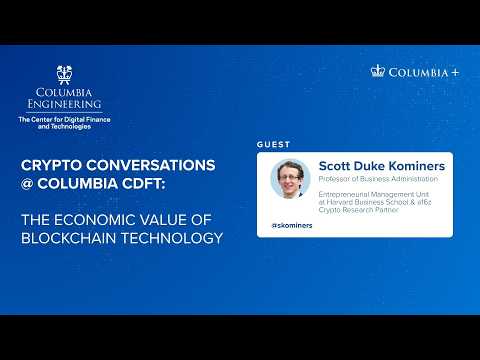
Blockchain and AI are complementary technologies. Specifically, AI agents need data to be useful, and a blockchain is an ideal backend to store that data. Why? Because a blockchain can serve as a common point of access for data while also giving users discretion over how that access is granted. This is important because right now your data is fragmented across many platforms, each with its own rules and each able to revoke access at any time. There's no unified way to let an agent work across your digital life and you have limited say in what agents can access. If the data is onchain, an agent could pull from one place and on your terms with no platform serving as a bottleneck. Of course, to make this work, we also need to resolve privacy issues, but that's very much part of the crypto roadmap @_julianma. @AgostinoCapponi, @skominers and I discussed this topic in some detail recently. Check out our conversation: youtube.com/watch?v=EJFxN_…
YouTube video
YouTube
English
2
6
8
621
Julian
Julian@_julianma·
Ethereum needs an Encrypted Mempool and it needs it fast. It's not just about stopping sandwiching. Encrypted mempools are how Ethereum matures its onchain markets. I just published a post on why Ethereum needs encrypted mempools. Here are the core arguments:
English
34
49
323
42K
Andreas Park retweetledi
Christian Catalini
Christian Catalini@ccatalini·
The internet made it free to watch. Finance kept it expensive to own. Billions of people follow markets from a phone, yet four billion adults cannot buy into them. Not because the system is hostile—because it is expensive. Modern finance can move $500 million domestically in seconds. It cannot serve a $50 investor at a profit. Compliance, custody, settlement: the entire machinery was built for institutional scale, and its costs do not scale down. The exclusion mechanism is not mysterious. To let someone buy $50 of stock, a traditional intermediary must still perform the full institutional dance: verify identity, screen sanctions, collect documents, arrange custody, connect to settlement, maintain records, assume regulatory liability. When the lifetime revenue on the account is measured in cents and the compliance burden in dollars, the math does not become inclusive just because people make grand speeches about an idealistic “Finternet”. Financial institutions do not hate small investors. Their unit economics do. So the system does the rational thing. It sets minimums. It geoblocks. It "de-risks." It politely informs vast populations that they may participate later—once they have more wealth, cleaner paperwork, or the good fortune to live in a friendlier jurisdiction. In roughly half the world’s countries, there is not even a liquid stock exchange. The financial system works well. It just does not work for most people. For decades, that was an inconvenience. In an economy approaching AGI, it becomes a structural crisis. Much of retail finance is rules-based and measurable: onboarding, document handling, customer support, suitability checks, reporting, reconciliation, basic portfolio construction. Those are exactly the tasks AI drives toward software-like marginal cost. The minimum economically viable account size should fall hard. A $50 account in Nairobi or Manila ought to become almost as cheap to serve as a $50,000 account in New York. But here the story takes a harder turn. AI also degrades the evidence that compliance depends on. Finance is not only an execution business. It is a verification business. The same tools that make forms cheaper to process make documents cheaper to fake. A scanned passport is no longer just identification—it is raw material for a generative model. A video selfie is no longer a liveness check—it is a challenge to the best deepfake generator on the market. AI makes the onboarding cheaper and the utility bill less believable. We call this the measurability gap: AI lowers the cost of executing tasks far faster than it lowers the cost of verifying whether those tasks were done honestly. In finance the gap bites immediately. You can automate the paperwork faster than you can believe the paperwork. A system that responds by layering ever-thicker checks on top of increasingly untrustworthy documents is not solving the problem. It is performing seriousness at rising cost. The resolution is architectural, and it comes from the part of crypto that never makes headlines. The useful insight is not that every asset should become a meme coin. It is that compliance and ownership can be made portable, programmable, and provable. In a better design, a trusted institution verifies a user once and issues a reusable digital credential. The user can then prove what regulators actually care about—residency, sanctions clearance, accredited status, eligibility—across compliant venues without handing over the same dossier every time. Zero-knowledge proofs are the technical mechanism. The plain-English version: stop making people reapply for the right to exist every time they want to buy an asset. But architecture is policy. If tokenization is sold to incumbents as private back-office software, they will do the obvious incumbent thing: lower their own costs, preserve the walls, keep the spread. The economics become transformative only when the base layer is open. Then portability is real. Users move assets between providers. Services unbundle. Intermediaries compete on price instead of living off network lock-in. That matters because traditional finance still extracts rent through closed networks. A simple equity trade can bounce through brokers, custodians, clearinghouses, transfer agents, and foreign-exchange layers—each adding cost, delay, and another chance to say no. On open rails, settlement moves from days to near-instant atomic exchange. Compliance is done once and reused. Minimums shrink from meaningful sums to the size of a mobile top-up. Recent estimates suggest tokenized equity trading could cut transaction costs by more than 30 percent. More important, it changes who counts as a customer. Finance starts to look less like a cartel of databases and more like the internet. The real test of the next financial system is not whether Wall Street can tokenize another product for institutions. It is whether a person with $50 in weekly savings can buy, hold, and sell a tiny slice of productive capital as easily as sending a message. Finance's last frontier is not payments. It is participation.
Christian Catalini tweet media
English
5
16
71
7.3K
Andreas Park
Andreas Park@financeUTM·
@alz_zyd_ Almost all uses of "profound" and "profoundly" are profoundly unnecessary.
English
0
0
7
562
alz
alz@alz_zyd_·
In the modern academic humanities, there are a bunch of words that sound cool but mean nothing, like "liminal". Like, if you say "Eataly lies in the liminal space between restaurant and grocery store", the word "liminal" literally means nothing, but sounds really cool
English
66
10
338
127.7K
Andreas Park
Andreas Park@financeUTM·
It's time for a big shoutout to @RefineInk. I've now used it for finalizing two papers, and it is phenomenal! For one paper, it caught a mathematical inconsistency that badly needed fixing, and it also forced us to think much harder about the narrative. Most certainly, it gave comments that many, many reviewers would make, and so I am very hoping that it saves us one round of reviews! Maybe the highest praise I can give: I got just as annoyed with refine's reviews as I would for any rejection reviews :-) So it totally works. Awesome job, @ben_golub, what a service to the research community!
English
0
11
41
13.3K
Andreas Park
Andreas Park@financeUTM·
Well, the really worrying issue is that this kind of thinking ends up in classrooms. But the bigger issue is that probably every parent in Canada who had kids in school in the last 10 years can come with a facepalm unbelievable story when it comes to their kids’ maths education. This asc prof may be at the extremest of extreme ends of the spectrum, but math education in Canada is in a terrible state. At UTM, we’ve quietly added mandatory numeracy classes to compensate for the deficient 12 year public school education. The long term damage is just mind blowing.
English
0
0
7
300
Kevin A. Bryan
Kevin A. Bryan@Afinetheorem·
Some of the strangest academic practices wind up in ed schools. Need to push back on this idea of "different ways of knowing": every normal country in the world teaches kids 5*7 by practice, identically. Insulting to think Pakistani, Québécois, or Ojibwe kids need unique lessons.
Anna Stokke@rastokke

If you think there aren't education academics saying foundational math isn't important, think again. This professor of education at SFU was willing to go on the record in the Vancouver Sun. Quote below👇vancouversun.com/news/canada-st…

English
10
10
145
14.4K
Andreas Park
Andreas Park@financeUTM·
@Afinetheorem Now do masters application reference letters, where our time doesn't matter either.
English
0
0
1
22
Kevin A. Bryan
Kevin A. Bryan@Afinetheorem·
Bureaucracy like this grows because it's in no one's career interest to watch and halt it. Folks deciding below are paid to avoid errors; your wasted time doesn't matter. Need a Chief Process Officer for every org, sole job is reducing time wasting bureaucracy, forms, processes!
Alex Tabarrok@ATabarrok

Whoever decided that a university speaker getting reimbursed for an Uber needs to complete the same supplier onboarding as a firm bidding on a $1M waste disposal contract: please rot in hell, with respect.

English
7
5
29
4.4K
Andreas Park
Andreas Park@financeUTM·
@BachmannRudi Aus dem gleichen Grund warum Banken keine schnelleren und besseren System haben: COBOL et al! Die Systeme basieren auf Code aus den 90ern, die Programmier sind lange in Rente, und kein Mensch traut sich, das anzufassen. 😁
Deutsch
0
0
1
44
Rudi Bachmann
Rudi Bachmann@BachmannRudi·
Berliner - legt mal eure Boulettenbrötchen weg und erklärt mir, warum die frühere Station “Mohrenstraße” physisch in vielen U-Bahnen umbenannt wurde, aber nicht bei den elektronischen Anzeigen, wo es ja wohl nur irgendeine Zeile in einem Softwareprogramm sein muss. Is dit Berlin?
Deutsch
23
3
117
14.7K
Kevin A. Bryan
Kevin A. Bryan@Afinetheorem·
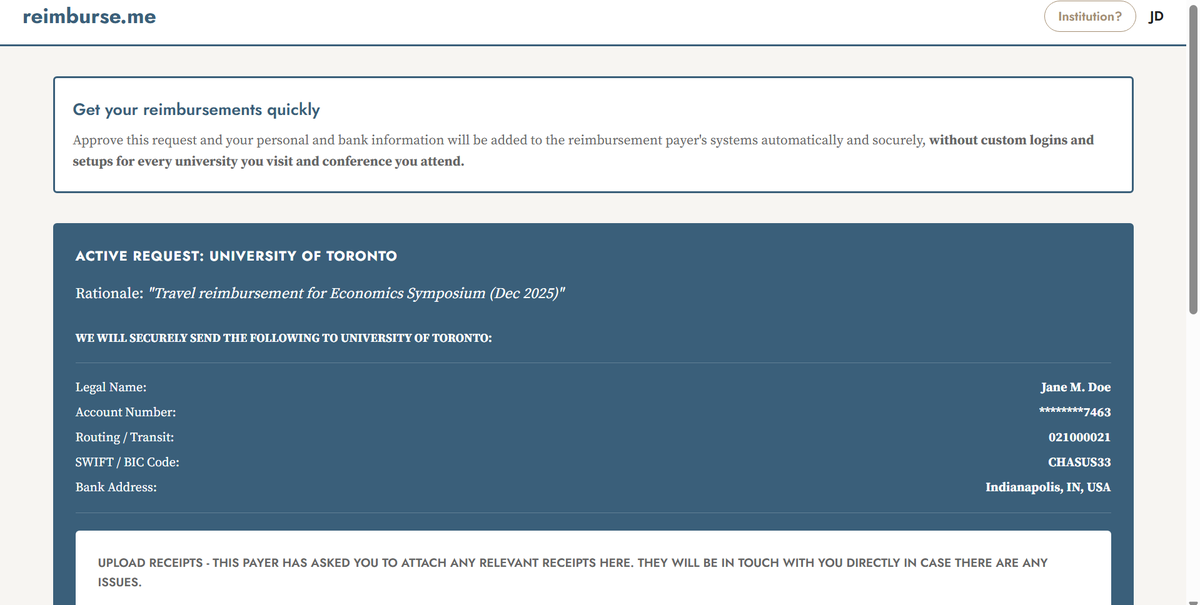
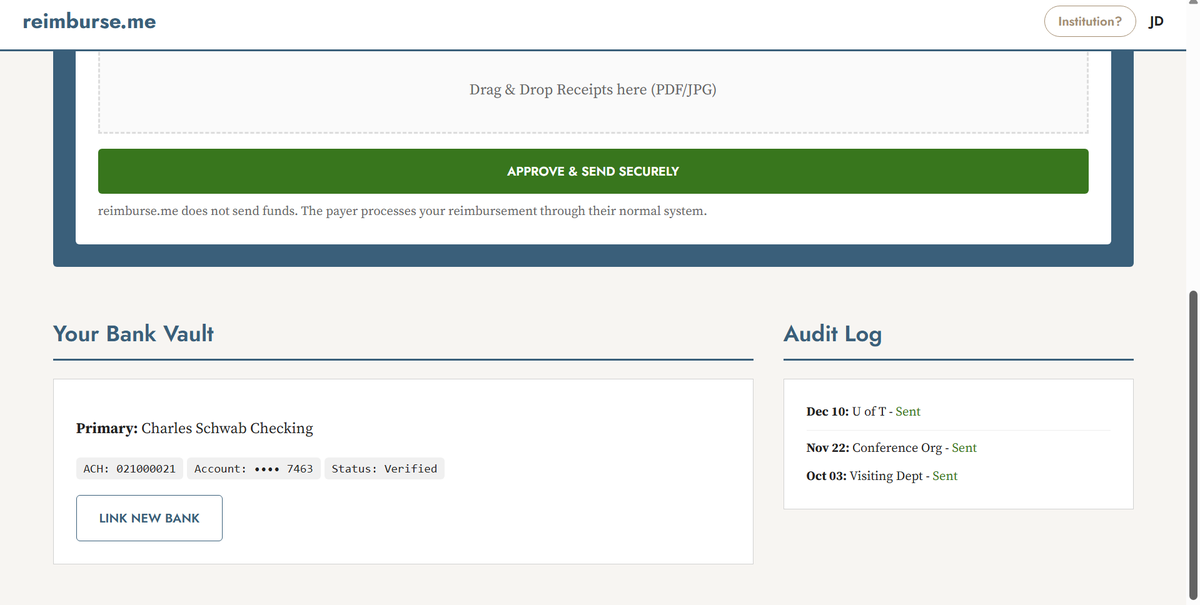
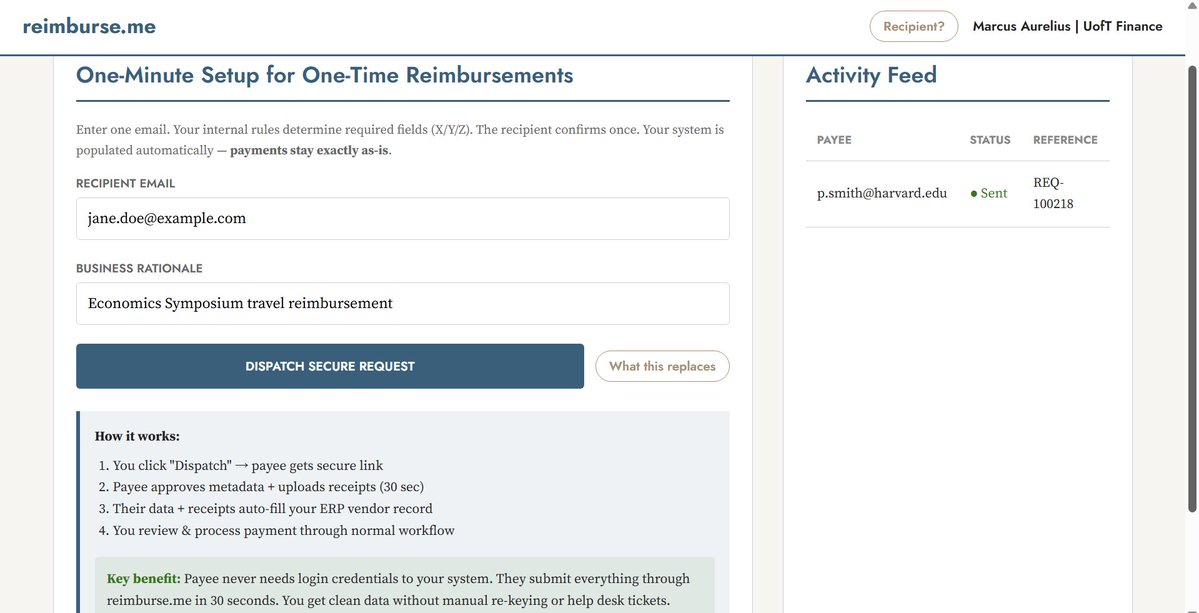
Just spent an hour filling out pdfs and receipt forms for a reimbursement, then emailing (!) my banking info. Payments friends (@harleyf?), why don't we have this? I add my bank info once, drag and drop receipts. Institution sends request. Info to ERP/payments automatically. 1/2
Kevin A. Bryan tweet mediaKevin A. Bryan tweet mediaKevin A. Bryan tweet mediaKevin A. Bryan tweet media
English
3
1
6
2.1K
Pontus Rendahl
Pontus Rendahl@pontus_rendahl·
Is there any point in students writing dissertations anymore? They will use AI, and codex or Claude code can generate a dissertation in 15 minutes. Maybe we should just get rid of it.
English
31
6
75
56.9K
Andreas Park
Andreas Park@financeUTM·
We write to be read, and speak to be listened to. Notation kills. It creates barriers, it makes reading and following harder. The general #1 rule is that for every symbol, subscript, superscript or bar or tilde that you introduce, you must pinch yourself hard three times. For seminar presentations, the punishment must be upgraded to hard slaps. For 15-20 minute conference presentations, a further pain-related upgrade is warranted (something something kick in the something something). In fact, all notation should be avoided in presentations. All. of .it. Try it -- other mathematical fields like CS manage to give great presentations often without any maths. The general rule #2 is that whenever possible (and it is usually possible), notation has a letter that is either a century-old convention or that aligns semantically with what it represents (like K for Das Kapital and C for Der Consum :-) ). The general rule #3 is that you must never, ever ever have sub- *and* super-indicies. Never ever have I seen an economics paper where such notation was necessary. The general rule #4 is that bars and tildes and hats are almost always either superfluous or unhelpful. Optima? Intersections? Thresholds? Give them an intuitive name or even write out a superscript. Rant over :-)
English
1
1
3
2.7K
Francisco Roldán
Francisco Roldán@fqroldan·
By far the most important comment I've gotten in referee reports (not joking). I think about it and re-implement it ~once per week.
Francisco Roldán tweet media
English
19
11
610
64.1K
Andreas Park
Andreas Park@financeUTM·
@joshgans I had my first Econometrica rejected from ReStud. Was too obvious.
English
0
0
0
162
Joshua Gans
Joshua Gans@joshgans·
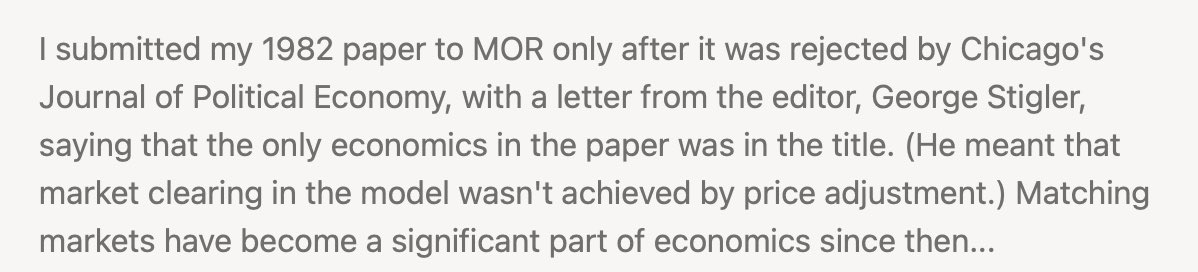
As I collect these stories, Al Roth’s Nobel prize winning paper (“The Economics of Matching: Stability and Incentives,” Mathematics of Operations Research 1982) was initially rejected by the JPE.
Joshua Gans tweet media
English
6
22
118
12.1K
Andreas Park
Andreas Park@financeUTM·
Totally agree. There are interesting mindsets in our field and some shakeup at the horizon. For instance, there’s a big group in theory that’s motivated by difficulty alone. When AI can draw upon the entire maths literature, solving a tech problem may get much easier. Another big camp is in the “more” camp who expect papers to do a lot. A bot can just draw upon the literature and run a thousand tests. May make p-hacking much less prevalent, too. Many, many in applied theory also have a strong preference for overly complex models. Because hard is good. Or, in your words, a very large part of the profession actually puts process over question and answer. The thing is: everyone in our world is pretty smart, but coming up with good questions and coming up with good answers often is a rare trait. Recognizing good questions and answers is also hard. So people use substitutes. I think that AI may take away the process signal for - when a bot does it, it’s no longer impressive. Literature filler papers will also become by far less valuable. Instead people need to come up with interesting questions - and more of them. This is going to get very interesting: there are some colleagues overflowing with ideas and just too little time to follow up. I’m excited to see what they can do.
English
0
0
1
127
Ben Golub
Ben Golub@ben_golub·
This is a hobby horse of mine: talking like AI is already taking away the best part of being a scientist is very close to saying that you care about the fun of the process for you more than what the rest of society thinks is the point of scientific work.
English
4
2
47
2.6K
Ben Golub
Ben Golub@ben_golub·
One possible answer is actually getting the answers, as well as building a mental map of what we know about a topic. Also steering resources to important questions. Basically what PI's already do in "big lab" fields
Misha Teplitskiy | Science of Science@MishaTeplitskiy

Academics trying to automate every step of research with LLMs is raising an interesting question: what do academics actually enjoy about research? Used to be people would say writing, reading, presenting, getting hands dirty in data... 1/2

English
7
4
88
11.4K