
IPFM
1.2K posts
IPFM
@fissilematerial
International Panel on Fissile Materials
Katılım Ocak 2010
385 Takip Edilen1.8K Takipçiler
IPFM retweetledi

Reality check for @NRCgov "approval" of the @TerraPower Natrium construction permit. Many difficult safety issues have been pushed off to the operating license phase. Case in point: the company just admitted that its fire hazards analysis and fire PRA are still in draft stage.
English
IPFM retweetledi
Those states that worried about existing stocks in fissile material cut-off treaty definitely had a point. France has enough material to go to the Cold War levels, i.e. double its arsenal. In fact, it has enough to go beyond that. Doesn't mean it will but still.
IPFM@fissilematerial
France can use its existing stock of fissile materials to produce new nuclear warheads fissilematerials.org/blog/2026/03/f…
English
France can use its existing stock of fissile materials to produce new nuclear warheads fissilematerials.org/blog/2026/03/f…
English
New provisional operation plan for Rokkasho fissilematerials.org/blog/2026/01/n… The plant is projected to begin operations in the second half of FY2027 by processing 70 MT of fuel and reach the 400 MT/y capacity in FY2030
English
Two companies, BWXT and Centrus, expand centrifuge development centers at Oak Ridge fissilematerials.org/blog/2026/01/t…
English
The talks are reportedly about "allowing Seoul to obtain uranium enrichment and spent fuel reprocessing capabilities" - Korea's chief negotiator on nuclear cooperation visited US for talks on enrichment, reprocessing koreatimes.co.kr/amp/foreignaff…
English
US Department of Energy awards $2.7 billion to three companies to expand domestic enrichment capacity fissilematerials.org/blog/2026/01/u…
English
Rosatom begins deployment of new-generation centrifuges at Seversk fissilematerials.org/blog/2025/12/r…
English
US Department of Energy makes plutonium available to industry fissilematerials.org/blog/2025/10/u…

English
IPFM retweetledi

The Government ordered suspension of key Energoatom managers and maintains communications with G7 (which is key for support). Prompt response gives some hope.
Dmitry Kovchegin@rusnucsecurity
Ukraine’s National Anti-Corruption Bureau suspects Energoatom’s director for physical protection and security in abusing funding for protection of nuclear power plants:( nabu.gov.ua/en/news/operat…
English
United States pledges support for enrichment, reprocessing, and naval reactors in South Korea fissilematerials.org/blog/2025/11/u…
English
IPFM retweetledi
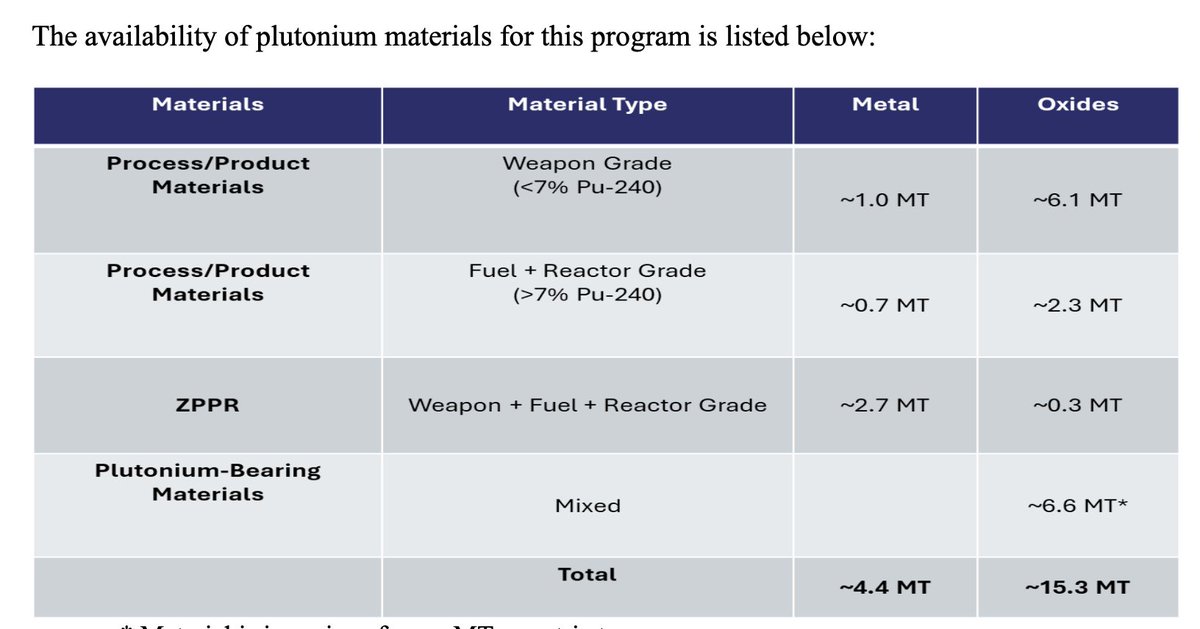
As long as we are on plutonium now, does this mean the U.S. now considers using WG-Pu in the civilian fuel cycle? "DOE is establishing a program for making surplus plutonium materials available to industry for
advanced nuclear technologies." fedconnect.net/FedConnect/def…
English
Russia withdraws from the Plutonium Management and Disposition Agreement fissilematerials.org/blog/2025/10/r… The commitment not to use PMDA plutonium for military purposes appears to remain in place
English
Enrichment plant in Rokkasho prepares to resume operations fissilematerials.org/blog/2025/10/e…
English
IPFM retweetledi
An interesting report by @TheGoodISIS. A few quick points. One is that while the 2018 RU-CN agreement directly deals with only the first CFR-600 reactor, Russia will supply fuel fabrication technology, presumably to be used in the second. So, it will also be obligated. 1/
Inst for Science@TheGoodISIS
🇨🇳NEW in-depth report on China’s plutonium production for nuclear weapons: While it remains unclear if China needs new plutonium, China does have the means to make more plutonium for nuclear weapons, a type of plutonium typically referred to as “weapon-grade.” We evaluated two of the most likely potential sources of weapon-grade plutonium: the twin civilian China Fast Reactors (CFR-600), and the old 821 Plant reactor that was built several decades ago as part of China’s military plutonium complex. China claims that the CFR-600s are strictly civilian reactors, and Russia has imposed explicitly peaceful use constraints on the first reactor, referred to as a demonstration reactor in the China/Russia agreement for cooperation. However, China’s lack of nuclear transparency and the less-than-watertight agreement with Russia on the first and especially the second CFR-600 reactor create significant doubt that China would currently refrain from secretly using one or both of these reactors to make weapon-grade plutonium for nuclear weapons. The military use of the weapon-grade plutonium produced in the CFR-600s would be an economical, efficient method to produce enough plutonium for hundreds of nuclear weapons. This plutonium is produced in the reactor’s “blanket,” a region surrounding the reactor core, as a byproduct of reactor operation. The blanket fuel is composed of uranium oxide, composed of almost exclusively uranium 238, of which a fraction becomes the desired plutonium 239 upon irradiation in the reactor. The blanket can be removed from the reactor core when it is lightly irradiated, making it relatively easy to chemically process and separate plutonium. Making this option even more attractive for China, the bulk of the blanket can not only be processed at a new Chinese reprocessing plant under construction in Gansu, but also at already existing reprocessing plant(s), designed to separate “reactor-grade” plutonium from highly irradiated enriched uranium oxide fuel discharged from pressurized water reactors (PWRs). Another potential source of plutonium for weapons is the 821 Plant reactor. While it is widely accepted that the 821 reactor at Guangyuan stopped producing plutonium for weapons by 1990, there are indications that the reactor was shut down but could be restarted. Contradicting this statement partially, some knowledgeable Western officials assessed that the reactor could have continued operating after 1990. Activity at the reactor site observed in optical and thermal imagery over the years indicates on-going maintenance activities to allow a restart, or even recent operation. Thermal activity indicates reactor operation, or another unexplained, nearly continuous heat source emanating from or near the reactor building, the former perhaps related to the irradiated graphite moderator. DOD projections assess that China is aiming for an arsenal of 1500 nuclear weapons. We tested whether China has enough weapon-grade plutonium in its existing stock, all produced prior to the early 1990s, when it ended such production, to make 1500 nuclear weapons. The calculations are complicated by several uncertainties, such as how much weapon-grade plutonium did China produce for nuclear weapons purposes, and how much plutonium on average is in Chinese nuclear weapons? Although our analysis shows that it is difficult to determine how far existing Chinese weapon-grade plutonium stocks can go in meeting China’s longer term needs to build a total of 1000 or 1500 nuclear weapons, it is likely that — if China wants to build more than 1000 nuclear weapons — it will need a new source of plutonium. The alternative for China is to revert to weapon-grade uranium instead, or better, to rely only on its current plutonium stock and limit the size of its nuclear arsenal. A CFR-600 can produce weapon-grade plutonium, estimated as 130 to 165 kilograms per year; the 821 Plant reactor could make 160 to 200 kilograms of weapon-grade plutonium per year. Just one of these new sources of plutonium would be enough to satisfy China’s projected plutonium requirements. One or two CFR-600s would be a better long-term (longer than a decade) source of plutonium for weapons from technical, economic, and convenience perspectives, and in fact allow an arsenal far greater than 1500 weapons. The challenges of operating the 821 reactor are assessed as more severe than harvesting weapon-grade plutonium from the blankets of the CFR-600. Nonetheless, China should be discouraged from misusing the CFR-600s for military purposes. China should be reminded that it is both a recipient and provider of civilian nuclear technology, with ambitions to export nuclear reactors all around the world. If it does not take its own peaceful constraints seriously; how can China expect countries that receive Chinese civil nuclear assistance to take them seriously? China’s use of a CFR-600 reactor for military purposes may fundamentally depend on whether Russia enforces the peaceful use restrictions in its nuclear cooperation agreements with China. But the Russian government, bogged down in its war in Ukraine and highly dependent on China for vital dual-use goods and oil sales, is currently unlikely to do so, although pressing them to do so would be advisable. A potential ally could be Russia’s nuclear industry, which is unlikely to have an interest in seeing breeder reactors militarized. It should be asked to use its leverage to dissuade China from doing so with the CFR-600 reactors. France and the United States may further be able to request that China provide assurances that it will not militarize a CFR-600 on the basis that the plutonium used to fuel the reactor in the future could have been produced in French-supplied pressurized water reactors (PWRs) or Chinese-built reactors containing French reactor technology. Westinghouse also provided China with PWRs, and the United States should seek assurance that any plutonium produced in these reactors, or reactors subsequently built containing Westinghouse reactor or fuel technologies, will not be used to fuel a CFR-600 with military purpose. Read the full report here: isis-online.org/isis-reports/c…
English
The 2016 decision fissilematerials.org/blog/2016/10/r… and its brief history thebulletin.org/2016/04/can-th… 2/2
English
Russian parliament is considering withdrawal from the Plutonium Management and Disposition Agreement (PMDA). Russia suspended the implementation of PMDA in 2016, but pledged not to use plutonium for military purposes. This pledge is expected to be removed. Links below 1/
English
IPFM retweetledi
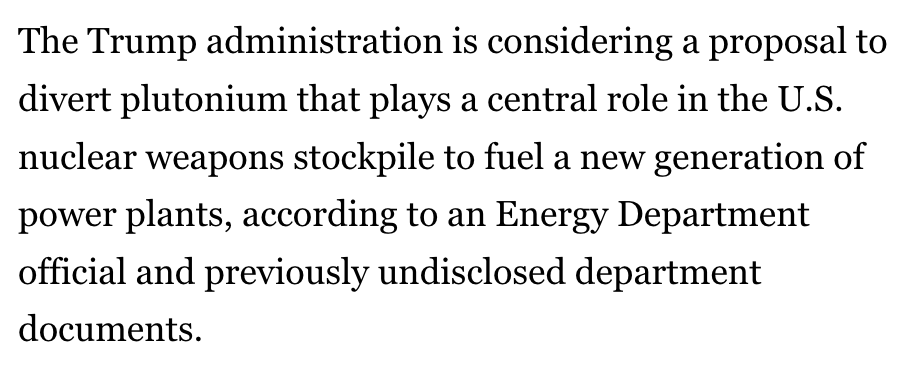
A somewhat confused piece in Politico re US plutonium by @zcolman. These 25 tonnes of plutonium in pits is the material identified as surplus 30 years ago, no way it "plays a central role in the US nuclear weapons stockpile" (pits are not "highly radioactive" by the way) 1/
English
"Foreign Minister Cho Hyun has told the U.S. energy secretary that Korea needs nuclear fuel reprocessing and enrichment for commercial purposes" koreatimes.co.kr/amp/foreignaff…
English