
Sabitlenmiş Tweet
Fjletona
35.5K posts


Fjletona
@fjletona
Si no quieres sufrir no ames, ¿pero si no amas para que quieres vivir? (San Agustín)
Mazatenango, Such Katılım Temmuz 2012
3.5K Takip Edilen470 Takipçiler

Fjletona retweetledi

🔍 Efecto de acoramidis sobre los eventos cardiovasculares recurrentes y acumulativos en la amiloidosis cardiaca
Luis Ruiz Guerrero @LRGuerr
¿Cuántos eventos cardiovasculares puede evitar acoramidis en la AC-ATTR a lo largo del tiempo? Lee el análisis completo aquí: cardioteca.com/blog-amiloidos…
❤️ Acoramidis redujo a la mitad el riesgo del compuesto de mortalidad cardiovascular u hospitalizaciones recurrentes a 30 meses (HR 0,51) frente a placebo en el ensayo ATTRibute-CM
📉 Se estiman 53 eventos evitados por cada 100 pacientes tratados a los 30 meses, con una separación de curvas visible ya desde el primer mes
⏱️ Aproximadamente el 19-22 % de los eventos ocurrieron en los primeros 6 meses, lo que refuerza la idea de la AC-ATTR como enfermedad tiempo-sensible y la urgencia del diagnóstico precoz
🏥 A los 42 meses, el tratamiento continuado con acoramidis se asoció con menor mortalidad cardiovascular frente a los pacientes que iniciaron el fármaco tardíamente, subrayando el valor del inicio temprano @fdefrutossemi
Español
Fjletona retweetledi


Fjletona retweetledi

El Dr. Martínez-González cuenta cómo, después de publicar un artículo científico sobre los perjuicios de las bebidas azucaradas, Coca-Cola intentó sobornarlos para tenerlos controlados.
Es algo que lleva ocurriendo desde hace décadas. Y hace no mucho salieron a la luz emails (Serodio et al., 2020) que prueban que Coca-Cola también pagó recientemente a científicos para minimizar la influencia de sus productos en la obesidad, así como sus esfuerzos para ocultar dicha financiación y para crear redes de conexión entre investigadores, responsables políticos y Coca-Cola.
Español
Fjletona retweetledi

Inflammatory Myopathies. NEJM
⏩5 major subtypes show distinct muscle, skin, lung, and systemic involvement.
⏩Myositis-specific autoantibodies now guide diagnosis, prognosis, and personalized treatment strategies.
⏩New targeted therapies
nejm.org/doi/full/10.10…


English
Fjletona retweetledi

Ophthopedia Update: Analysis of choroidal OCT intensity and profile changes in high myopia: correlation with visual impairment and identification of pathological myopia dlvr.it/TSXjWw #Ophthalmology #Ophthotwitter #BJO
English
Fjletona retweetledi
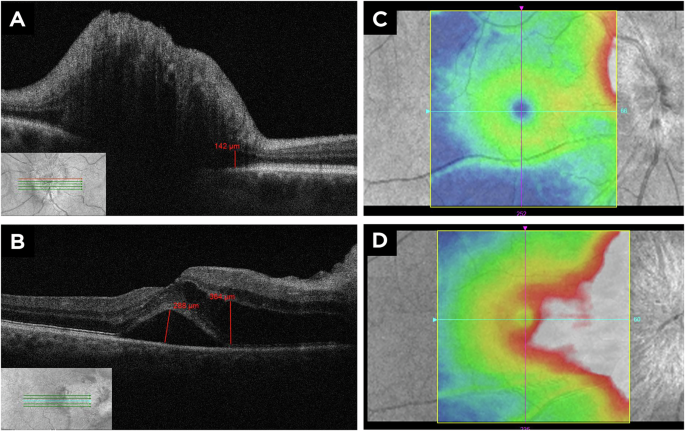
Ophthopedia Update: Prevalence of intraretinal and subretinal fluid in acute non-arteritic anterior ischemic optic neuropathy dlvr.it/TSY4tJ #Ophthalmology #Eye #Ophthotwitter
Română
Fjletona retweetledi

A Stanford neuroscientist published a paper a few years ago that quietly answered one of the oldest questions in human history, and almost nobody outside his field has heard of it.
The question is why we dream. Not what dreams mean. Why they exist at all. Why your brain spends a third of its sleep hallucinating images instead of just resting like every other organ in your body.
His name is David Eagleman.
He runs a lab at Stanford. The paper is called "The Defensive Activation Theory", and the moment you read it the explanation collapses every other theory you have ever been taught about dreams.
Freud said dreams were repressed desires. He was guessing. He had no brain scans. He had no electrodes. He had a couch and a notebook and a century of credibility that nobody has been able to fully scrub off the subject since.
Modern neuroscience replaced him with the memory "consolidation theory". The idea that dreams are your brain sorting through the day, filing things away, deciding what to keep. That story is partially true. Sleep does consolidate memory. But it does not explain the single strangest thing about dreams, which is that they are almost entirely visual.
You do not dream in pure sound. You do not dream in taste. You do not dream in smell. You dream in pictures. Vivid, detailed, often impossible pictures that activate the back of your brain so hard a scientist scanning you would think your eyes were wide open.
Eagleman started from one fact almost nobody outside neuroscience knows. The brain is territorial. Every region holds its turf through constant electrical activity. The moment a region goes quiet, its neighbors start invading. They take the silent territory and reassign it to themselves.
This is called "cortical takeover", and it is not slow. It is not a long process measured in years. In experiments where adults are blindfolded, the visual cortex starts processing touch and sound within an hour. One hour of darkness, and the territory is already being annexed.
In congenitally blind people, the visual cortex is fully repurposed. It runs language. It runs hearing. It runs touch. The hardware never went unused. It was just reassigned to whoever showed up first.
Now sit with the implication of that for a second.
Every night, when you close your eyes and fall asleep, the sun has set. The planet has rotated. The visual cortex, which takes up roughly a third of your entire cortex, is suddenly receiving zero input. For eight hours. Every single night. For your entire life. And evolution has shaped your brain inside a planet that has been spinning into darkness for billions of years.
If cortical takeover happens in an hour, the visual cortex should have been lost a long time ago. Stolen by hearing. Stolen by touch. Reassigned by morning. Humans should have evolved into a species whose vision works fine during the day and then degrades every time the sun goes down because the territory keeps getting renegotiated overnight.
But that did not happen. Vision works the moment you open your eyes. Which means something is defending the territory while you sleep.
Eagleman's claim is that dreams are that defense.
Every 90 minutes through the night, a precise burst of activity fires from the brainstem into the visual cortex. Pontine-geniculate-occipital waves. PGO for short. They are anatomically aimed. They are not general arousal.
They are a targeted volley of signal launched directly at the back of the brain where vision lives. The cortex lights up as if it is receiving real images, and you experience that artificial activation as a dream. The bizarre narrative your conscious mind invents around it later is just your brain trying to make sense of the noise.
The dream is not the point. The dream is the side effect. The point is keeping the territory occupied.
The evidence for this is the part that should haunt you.
Newborns spend roughly 50% of their sleep in REM. Adults spend twenty. Old adults spend fifteen. The amount of dreaming you do tracks almost perfectly with how plastic your brain is. Newborns have the most plastic brains on earth. Their visual cortex is in the highest danger of being overrun by neighboring senses while it develops.
So evolution gave them an enormous defense budget. As you age, your brain becomes less plastic, the takeover risk drops, and the defense system scales down accordingly.
Eagleman and his co-author ran the same correlation across twenty-five primate species. The more plastic a species' brain, the higher the proportion of REM sleep. The relationship held across the entire primate family tree. Plasticity and dreaming move together. They are two halves of the same evolutionary equation.
A species that ranks higher on flexibility and learning also dreams more. A species that is born ready to walk and survive dreams less. Plasticity is the asset. Dreaming is the insurance premium.
And the prediction the theory makes is the one that quietly closes the case.
Of all your senses, only one is disadvantaged by darkness. You can still hear in the dark. You can still feel in the dark. You can still smelll and taste in the dark. The only sense that depends on light is vision. Which is exactly the sense your dreams are made of. The defense system is targeted at the only territory that is actually vulnerable while you sleep.
Memory consolidation is real. Emotional processing is real. Your brain does do those things at night. But Eagleman's argument is that those functions piggyback on a much older system whose original job was simpler and more brutal. Keep the lights on inside the visual cortex while the planet is dark, or lose it.
For thousands of years, people have asked what dreams mean. Prophets wrote about them. Poets wrote about them. Freud built a discipline on them. None of them had access to the actual answer, which is that dreams may not mean anything in the symbolic sense at all.
They may be the visible flicker of a defense system running in the background, the way a screen saver protects a monitor by keeping the pixels moving even when nobody is looking.
The strangest thing about the theory is how cleanly it explains why dreams feel so real. Your visual cortex cannot tell the difference between a PGO wave and an actual photon. It is the same hardware lighting up the same way. The cortex does its job. It builds an image. Your conscious mind, half-awake, wraps a story around it and calls it a dream.
You are not seeing your subconscious tonight. You are watching your brain defend a piece of itself from being stolen.
Every animal that has ever closed its eyes on this planet has done the same thing.

English
Fjletona retweetledi

Niña de 7 años demuestra que no está terminado hasta que está terminado
Español
Fjletona retweetledi
El último bocado que le da padre a su hija antes de casarse…
Tradición china milenaria: 🙏🏼
Un lugar donde el arte y su cultura son milenarios…
Español
Fjletona retweetledi
🇺🇸 🇨🇳 El soldado chino se mantiene firme mientras el Air Force One ruge a solo metros de distancia.
Español
Fjletona retweetledi
Fjletona retweetledi
Cómo sacar un coche de un apuro cuando ambas ruedas traseras están atascadas sin pedir ayuda. ¡Todo conductor debe ver esto!
Español
Fjletona retweetledi
“Crucero”
De Crucero Abandonado a Mansión Oceánica de Lujo: La Increíble Transformación de un Barco de 99 Años
Español
Fjletona retweetledi
Primer tráiler de la serie derivada de ‘The Big Bang Theory’ titulada ‘STUART FAILS TO SAVE THE UNIVERSE’.
La serie sigue a Stuart, quien debe restaurar la realidad después de romper el nuevo dispositivo de Sheldon y Leonard y causar un Armagedón Multiversal.
Estreno el 23 de julio en HBO Max.
Español
Fjletona retweetledi
Se ha lanzado el primer tráiler de ‘COYOTE VS ACME’.
En cines el 28 de agosto.
Español
Fjletona retweetledi
Fjletona retweetledi

María es madre de toda la Iglesia, que puede dirigirse a Ella con filial confianza y con la certeza de que es escuchada, custodiada y amada. #AudienciaGeneral
Español
Fjletona retweetledi

El influencer católico Quique Mira reflexiona sobre el noviazgo bien vivido y el matrimonio fecundo
— @JAVIERNAVASPER
infocatolica.com/blog/caballero…
Español
Fjletona retweetledi
¿Qué mundo estamos dejando? Un mundo, por desgracia, deformado por las guerras y por las palabras de guerra. Se trata de una contaminación de la razón, que desde el plano geopolítico invade toda relación social. La simplificación que construye enemigos debe corregirse entonces, especialmente en las universidades, con el cuidado de la complejidad y el sabio ejercicio de la memoria.
Español
Fjletona retweetledi

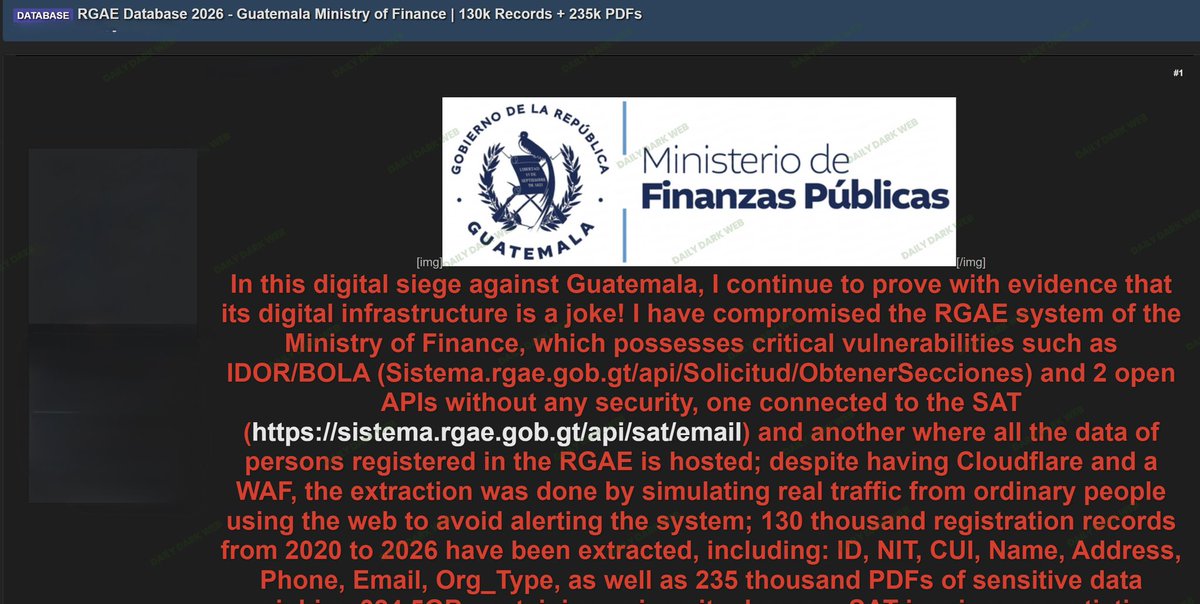
🇬🇹 A threat actor is claiming to have compromised Guatemala’s Ministry of Finance RGAE system and exfiltrated a large volume of sensitive records and documents.
According to the underground post, the actor alleges:
• exploitation of IDOR/BOLA vulnerabilities
• abuse of allegedly exposed APIs
• extraction of approximately 130,000 registration records
• access to roughly 235,000 PDF documents
• data spanning records from 2020–2026
The post specifically references:
• alleged insecure API endpoints
• weak authorization controls
• data extraction through “normal traffic simulation” techniques intended to avoid detection
• bypassing protections despite the presence of Cloudflare and WAF technologies
The actor claims the exposed information includes:
• national identification data
• tax identifiers (NIT/CUI)
• names and addresses
• phone numbers
• email addresses
• organization-related information
• associated PDF documents containing sensitive data
At this time:
• the authenticity of the claims has NOT been independently verified
• there is no official confirmation from Guatemalan authorities
• the exact scope and sensitivity of the alleged documents remain unclear
• the referenced vulnerabilities have not been validated independently
However, the terminology used in the post — particularly:
• IDOR (Insecure Direct Object Reference)
• BOLA (Broken Object Level Authorization)
aligns with common API security weaknesses frequently exploited in:
• government platforms
• citizen service portals
• registration systems
• financial administration platforms
API-focused attacks remain one of the fastest-growing risks because:
• APIs often expose direct object references
• authorization logic may be inconsistently enforced
• backend endpoints may trust client-side validation
• excessive data exposure can occur silently
• WAFs frequently fail to detect legitimate-looking authenticated requests
If authentic, exposure of ministry financial and registration systems could create risks involving:
• identity fraud
• tax-related scams
• social engineering campaigns
• document forgery
• targeted phishing
• business impersonation
• governmental fraud operations
• secondary attacks against associated agencies
The claim regarding “traffic simulation” is notable because modern attackers increasingly:
• mimic legitimate user behavior
• throttle extraction rates
• rotate sessions/IPs
• leverage authenticated workflows
• avoid noisy scanning patterns
• use API abuse instead of malware deployment
Organizations operating public-sector APIs should prioritize:
• strict object-level authorization checks
• API gateway monitoring
• rate limiting and anomaly detection
• token-scoped access control
• behavioral analytics
• continuous API inventory management
• sensitive document access auditing
• least-privilege API design
The presence of:
• detailed vulnerability references
• endpoint naming conventions
• record counts
• extraction methodology claims
may increase perceived credibility, but underground posts frequently exaggerate:
• access levels
• record volumes
• exploit sophistication
• operational impact
DDW is continuing to monitor:
• additional proof-of-compromise releases
• sample document disclosures
• replay or repost activity
• potential exploitation of the referenced endpoints
• official responses or mitigation efforts tied to the alleged breach
#Guatemala #CyberSecurity #ThreatIntelligence #DarkWeb #DataBreach #API #IDOR #BOLA #Government #CyberCrime #DDW #Intelligence
English