Isaac

559 posts

Isaac banner
Isaac

Isaac

@founder_talk

Turning ideas into reality through a new Latam Startup studio. Founder of Newbrain Ventures, Castleberry and Atomic Lab


Katılım Mart 2022
648 Takip Edilen43 Takipçiler
Isaac
Isaac@founder_talk·
@zackbshapiro I agree with most of it. I still think the brand still matters because companies aren’t just buying results they are also buying insurance.
English
0
0
0
114
Isaac
Isaac@founder_talk·
@paulg This from someone you know I’m assuming.
English
0
0
0
1
Paul Graham
Paul Graham@paulg·
I got a pointless email from someone. When I asked why he'd emailed me, he apologized and said that OpenClaw had sent it. That's a first. Wish it was the last, but it will presumably only become more common. Who knows how many other pointless emails I've already gotten this way?
English
231
61
2K
247.9K
Isaac
Isaac@founder_talk·
@hnshah It’s definitely a way of living.
English
0
0
1
10
Hiten Shah
Hiten Shah@hnshah·
Most people have no idea what it actually takes to be a founder. They talk about vision, grit, or passion. Those words are props. What you really sign up for is a life where every decision feels like it costs something real. You will spend years being misunderstood. By your team, your family, even the people you hire to help you. You will fail in public and still need to keep the energy up in private. Every founder lives with the weight of knowing that you can do everything right and still get crushed by luck, timing, or somebody else’s mistake. Founders aren’t braver than anyone else. They just get used to uncertainty, then stop waiting for clarity. Most of your wins won’t feel like wins at all. The first revenue will be too small. The first team will outgrow you or leave. The first product that feels right will barely matter to the market. You will doubt yourself in private, sometimes every week. The founders who last figure out how to keep moving while the ground shifts underneath them. Most outsiders want the founder badge but none of the scars. They want the upside, not the drag. The hardest part is sticking around after every plan gets blown up and you have to rebuild with less optimism and more scar tissue. What makes it work isn’t relentless hustle or some mythical trait. It’s learning to make peace with constant discomfort, and then making decisions anyway. If you need constant reassurance, you’ll give up before the real work begins. If you want everyone to like you, you’ll never make the calls that matter. If you can’t handle months where nothing feels certain, this life will eat you alive. But if you can hold your own in chaos, get better at being wrong, and still want to show up and try again, you just might have a shot at building something that matters. That’s what it actually takes. And nobody cares until you make it work.
English
210
366
2.3K
303.9K
Isaac
Isaac@founder_talk·
@sam_allsopp_ Eventually the stress does come down. You learn what can kill you and you learn to trust your skills.
English
0
0
1
28
Isaac
Isaac@founder_talk·
@TheLaurenChen It comes down to education. Education is the main lever that needs to be pulled and unfortunately third world countries did and still don’t have the structure, systems and incentives in place to truly educate the population.
English
0
0
1
2
Lauren Chen
Lauren Chen@TheLaurenChen·
People often say that the developing world is poor because the Western world colonized them and stole their resources. The truth, however, is that over the past century, the developing world has, for the most part, shown that they are completely incapable of harnessing their own resources. They are not poor because we stole from them. They are poor because they do not know how to run and administer their own countries, resources be damned. Take Venezuela. The world's largest oil reserves mean nothing if you have a corrupt communist as your leader. People will actually be starving and trying to eat zoo animals while you sit on trillions of dollars in resources! Africa is another example. Europeans left behind farmland, trains, roads, and mines in Africa. What happened to it all? It's not that all of a sudden, the Africans started running things like anti-colonialist activists had envisioned at the time. No, no. All the infrastructure fell into disrepair and/or was stripped down and looted. They were literally handed fully functioning, completed supply chains for resource extraction, and basically unlimited wealth, but they couldn't manage the simple upkeep. Now, the defense for Africa might be that "The Europeans didn't teach the Africans how to manage any of this! It's not the Africans' fault they couldn't run it independently! They were never trained!" But my brother in Christ, the Europeans DID try to train locals for management! Obviously it would have been easier to have at least some locals in administration, rather than having to import an ENTIRE workforce, but efforts to find African talent were largely unsuccessful. Don't believe me? Just look at the different outcomes in Hong Kong and Singapore when compared to Africa. In East Asia, Europeans often did work with locals in administrative and management capacities. When colonialism ended, Hong Kong and Singapore were able to manage themselves. Not the case with Africa. Now, none of this is to say that colonialism is good. People have the right to self-rule and seld-determination. However, the idea that colonialism and resources extraction are responsible for the developing world's ongoing poverty? That is quite simply a crock of shit.
Vicente Leal 🇨🇺🇨🇺🇨🇺🇨🇺🇨🇺🇨🇺@Vicente73977721

500 años de saqueo en una imagen:

English
7K
10K
51.6K
29.2M
Isaac
Isaac@founder_talk·
@gregoryblotnick Also why in conversation with a friend it’s best to mention what’s on your mind and not save it for later. More will come later.
English
0
0
1
34
Gregory Blotnick
Gregory Blotnick@gregoryblotnick·
damned if this isn't true soon as you save something in your drafts to work on later, its dead. lost the emotion. just delete it
Gregory Blotnick tweet media
English
1
2
23
3.5K
Isaac
Isaac@founder_talk·
@qualityequities You could’ve been describing Buffett and I couldn’t tell the difference.
English
1
0
0
338
Quality Equities
Quality Equities@qualityequities·
I love Warren Buffett. I love Charlie Munger. But Dev Kantesaria might be my favorite. Dev (Valley Forge Capital Management) invests by owning a very small number of exceptionally high‑quality companies that can compound earnings for many years with relatively low business risk. He looks for dominant, capital‑light businesses with durable competitive advantages, strong organic growth, and real pricing power, so they can raise prices faster than inflation without losing customers. Instead of diversifying widely, he usually holds 8–12 stocks and concentrates in the few he understands best, viewing risk as the chance of permanent capital loss rather than share price volatility. He avoids capital‑intensive, highly cyclical, commodity‑driven, or binary‑outcome businesses, and is skeptical of “cheap” low‑quality stocks or fast‑moving tech where the competitive position is unclear. His approach is to think like a long‑term owner, focus on where earnings will be 5–10 years out, and use periods of market pessimism about quality names as opportunities to buy more at attractive valuations. Who's your favorite?
Quality Equities tweet media
English
22
60
558
70.9K
Isaac
Isaac@founder_talk·
@dharmesh And it’s not just about focus and maintenance which are enough by themselves, but about new features, integrations and price! x.com/founder_talk/s…
Isaac@founder_talk

@HarryStebbings @jonsidd I think this overlooks maintenance, uptime, infrastructure costs, api access, documentation, new feature development, advantages of scale (like data) and not to mention the focus of the business. It will certainly be doable, but at what cost? I don’t just mean monetary cost.

English
0
0
0
8
dharmesh
dharmesh@dharmesh·
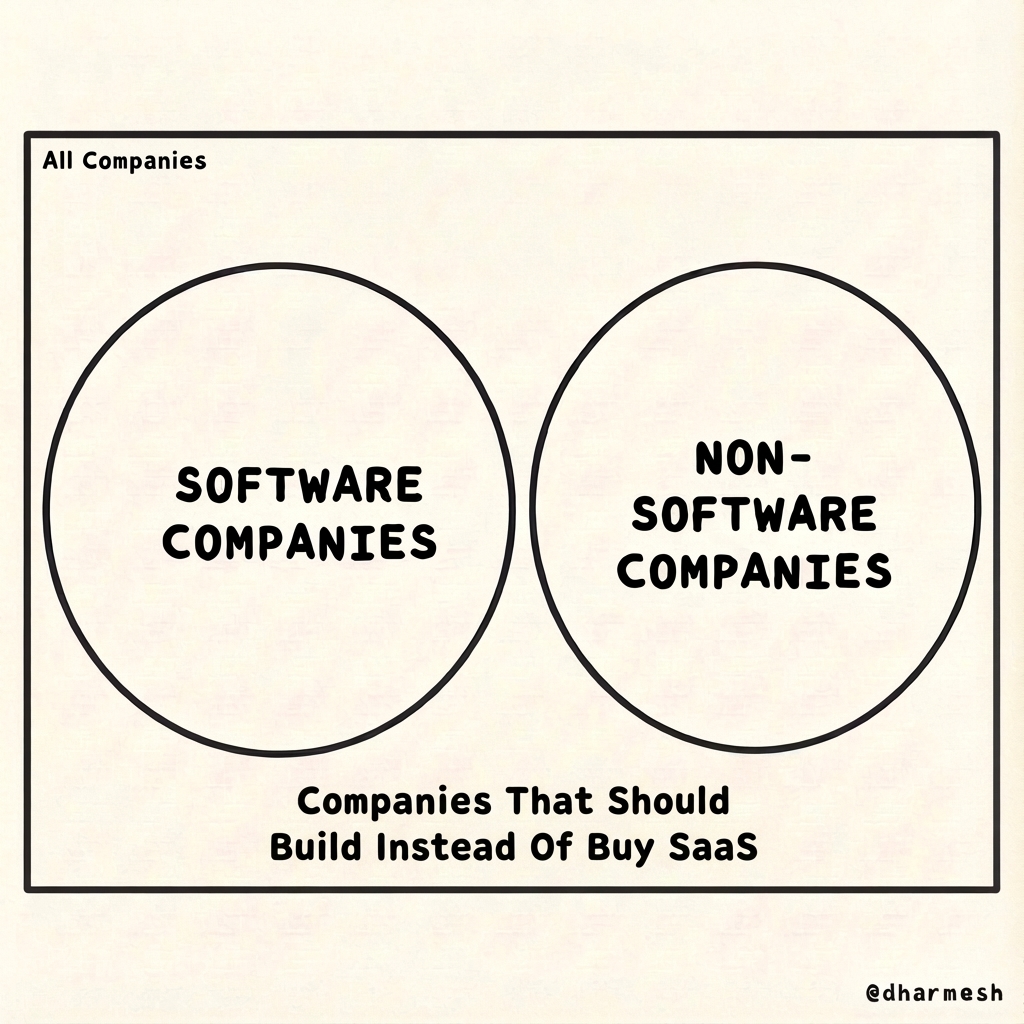
"Why should companies pay for SaaS (HR/CRM/ERP/etc.) when they could just vibe code them?" I get variations of this question or comment with some regularity (granted, it's sometimes just me talking to myself). Here are some biased (but hopefully, well-considered) thoughts: 1) I am a big proponent and user of vibe coding (what I call "agentic coding"). I do it every day, 7 days a week, including Sundays. It's amazing. 2) My company, HubSpot is a software company. We have hundreds of professional engineers -- just about all of them use AI for product development too. They are brilliant and know how to build production-grade products. 3) Even with this powerful army of talent, the number of internal, core SaaS applications that we have replaced with a vibe-coded variant is exactly ZERO. The number of applications we plan to replace is also exactly ZERO. 4) It's not the absence of talent that keeps us from rolling our own SaaS apps, it's the presence of focus. It would be silly to try and replace our HR, team collaboration, expense tracking and 100+ other SaaS apps we use when we can just buy them. Just doesn't make sense. 5) That's us -- as a software company at some scale. If you're a non-software company it makes even less sense for you. Doesn't matter how good the AI coding tools get. Let's say you *could* vibe code a replacement for that SaaS app you're using, who's going to maintain it? Who's going to keep up with industry trends? What are you going to do when the 20-something genius that vibe coded it over a weekend leaves the company? Who do you call when there's a major bug? 6) If you're a Fortune 500 company at some scale, perhaps you could pull this off for some discrete use cases and the tradeoffs are worth it. You have an IT/Engineering department that is larger than the population of some countries. You can take on the pain in return for the positives. For the millions of others, my advice is: Spend every calorie possible on creating value for your customers.
dharmesh tweet media
English
225
199
1.4K
218.2K
Ejaz Karim
Ejaz Karim@ejazkarimhunzai·
@founder_talk @HarryStebbings @jonsidd It only makes sense if a company is paying maybe $1000s monthly but as you said managing and ensuring uptime is bit overlooked and also third party integrations are key in today’s SaaS and doing all integration (or making exact copy of existing workflows) is hard.
English
1
0
2
35
Isaac
Isaac@founder_talk·
@girdley I’ve had a similar experience. Made me diversify even more.
English
0
0
1
49
Michael Girdley
Michael Girdley@girdley·
ChatGPT is so bad now. It can't even follow instructions, the UI takes forever to respond, and spends most of its time confused. I didn't expect LLMs to be able to take such a big step back. But here we are.
English
618
118
2.2K
214.3K
Isaac
Isaac@founder_talk·
@itsjoaki The consensus is to ship fast. But I would argue it’s contextual. How many competitors exist? How complex is the product? How fully functional does it need to be for the clients to get real value out of it? You can’t answer without context. There are no rules in business.
English
0
0
1
12
Joaki
Joaki@itsjoaki·
Ship an ugly product fast, or a beautiful product late? What’s your pick?
English
806
19
653
90.2K
Martin Tobias (Pre-Seed VC)
Martin Tobias (Pre-Seed VC)@MartinGTobias·
my thesis on AI: AI is not eating SaaS ($300B), it is eating the $4.5T labor that runs SaaS. We are in the infra build-out phase of AI, with Infra taking 90% of the spend, but AI apps will be 3-5X larger than infra (just like SaaS is 3x cloud infra).
English
55
62
680
53.2K
Isaac
Isaac@founder_talk·
@yishan For some applications sure. But I would argue most applications require specific UX/UI, workflows, data and sources that make it hard for foundational model providers to cover every niche.
English
0
0
0
4
Yishan
Yishan@yishan·
My AI investment thesis is that every AI application startup is likely to be crushed by rapid expansion of the foundational model providers. App functionality will be added to the foundational models' offerings, because the big players aren't slow incumbents (it is wrong to apply the analogy of "fast startup, slow incumbent" here), they are just big. Far more so than with any other prior new technology, there is a massive and fast-moving wave that obsoletes every new app almost as fast as it can be invented. There is almost no time to build a company and scale it. There are two ways AI application startup founders can make money: - Make a flash-in-the-pan app that generates a ton of cash and bank the cash (my estimate is that you have about 12-18 months cashflow generation) - Make a good enough app that you get acquired by one of the big players for sufficient equity The situation is highly unstable - we don't know if it's going to crash or go to the moon but both scenarios make it very unlikely that any AI application startup will independently become a generational supercompany (baseline odds are low to begin with). The best odds are finding an application niche in a highly specialized field with extremely unique and specific data barriers, ideally ones relating to real atoms (hardware or world-related) data and not software/finance.
English
1K
1.5K
13.5K
20.7M
Isaac
Isaac@founder_talk·
@_Investinq They’ve also had increasing competition from local shops.
English
0
0
0
26
StockMarket.News
StockMarket.News@_Investinq·
One of the least talked about problems is Starbucks business model is that for years, the company was built on a formula that made perfect sense, fill every corner of every major city with cozy cafes where people could work, and socialize. That model thrived when office towers were full, commutes were daily, and the morning latte was part of the routine but that world doesn’t exist anymore. Remote work blew a hole straight through Starbucks foundation. The weekday rush that once powered its busiest and most profitable stores has vanished. Downtown locations that used to print money are closing at alarming rates. A third of LA’s recent store closures were downtown and the same trend is showing up in Chicago, New York, and Seattle. These stores were the core of Starbucks’ business model: high margin, repeat customers who showed up like clockwork. Now Starbucks is stuck between two worlds. It isn’t a fast cheap drive-thru brand like Dutch Bros or Dunkin, and it isn’t the cozy café experience it once was. It optimized itself for speed and mobile orders, but in doing so, stripped away the soul of the experience. Walking into many stores today feels transactional, order, grab, go. The coffee is the same, but the connection is gone and trying to bring that atmosphere back while maintaining efficiency is nearly impossible. You can’t rebuild community culture through an app. That’s what makes the chart so telling. The share of customers staying in Starbucks for 10 minutes or more has been falling for over a year. Even after Brian Niccol stepped in as CEO, the number barely budged. It climbed for a moment, then dropped right back to where it was around 30%. Staying matters because that’s where Starbucks entire business model makes money. The longer a customer stays, the more likely they are to buy a second drink, grab a snack, or come back later in the week. Now, Starbucks is spending millions remodeling stores, refreshing menus, and running marketing pushes, but none of it’s translating into people actually staying. The cafés are emptier, the energy is gone, and the chart captures exactly that.
StockMarket.News tweet media
English
219
66
1.1K
3.7M
Isaac retweetledi
Olivia Says
Olivia Says@OliviaSays_ai·
⭐Big news - Tomorrow we’re launching OneClickLead on Product Hunt. If you care about B2B growth or lead generation, we’d love your support 🙌. oneclicklead.newbrainventures.com
English
1
1
4
75
Earth
Earth@earthcurated·
Post a picture YOU took. Just a pic. No description.
Earth tweet media
English
17.8K
6K
79.7K
10.9M
Giuliano
Giuliano@Giuliano_Mana·
Poor Charlie's Almanack changed my life. It's the book that has influenced me the most. These are some of Munger's ideas and how I applied them:
Giuliano tweet media
English
19
93
908
86.2K
Isaac
Isaac@founder_talk·
@businessbarista I think it’s too similar to what exists and therefore harder to get outsized returns. Ai first is not enough of a moat.
English
0
0
1
80
Alex Lieberman
Alex Lieberman@businessbarista·
I'm considering buying up hundreds of dev shops. Here's the thesis: 1) 3rd party engineering is a massive market. $1.67 trillion & estimated to be $6.34 trillion by 2033. 2) Most dev shops do not deliver a six-star experience. It's usually some combo of sub-par engineering talent, sub-par customer success, and great margins because of labor market arbitrage (read: off-shore talent). 3) Most dev shops are not AI-first. Engineers haven't refined their AI workflows. No strong opinions on AI-friendly tech stacks. And no incentive to change, because of the business model (read: $ for hours). 4) But...many dev shops have a great list of logos, 12+ month contracts, and offer a must-have service for tech-first or tech-adjacent businesses. 5) We have a proven machine @tenex_labs to deliver truly worldclass AI engineering-as-a-service. All of our engineers are ex-founders, maximize their AI workflows, and are paid based on output, not hours. 6) Said differently, I think there's a massive arbitrage for us. Effectively buy client lists, deliver a far better & faster experience, improve customer satisfaction, and grow contract sizes. All because of the talent we've attracted, their compensation model, and how well they leverage AI in their work. Tell me why I'm crazy or why I shouldn't do this.
English
55
1
155
34.7K
Ashwinn
Ashwinn@Shwinnabego·
how does anyone bootstrap a food or bev cpg brand? math doesn't math
English
95
3
161
102.6K