

David ⛓️ From Fed to Chain
190 posts

David ⛓️ From Fed to Chain
@fromfedtochain
🎙 Host of From Fed to Chain 🚀 Building Zap Pilot — Your DeFi, On Autopilot Simplifying crypto investing for everyone EN / 中文 / 日本語
Katılım Eylül 2018
151 Takip Edilen58 Takipçiler

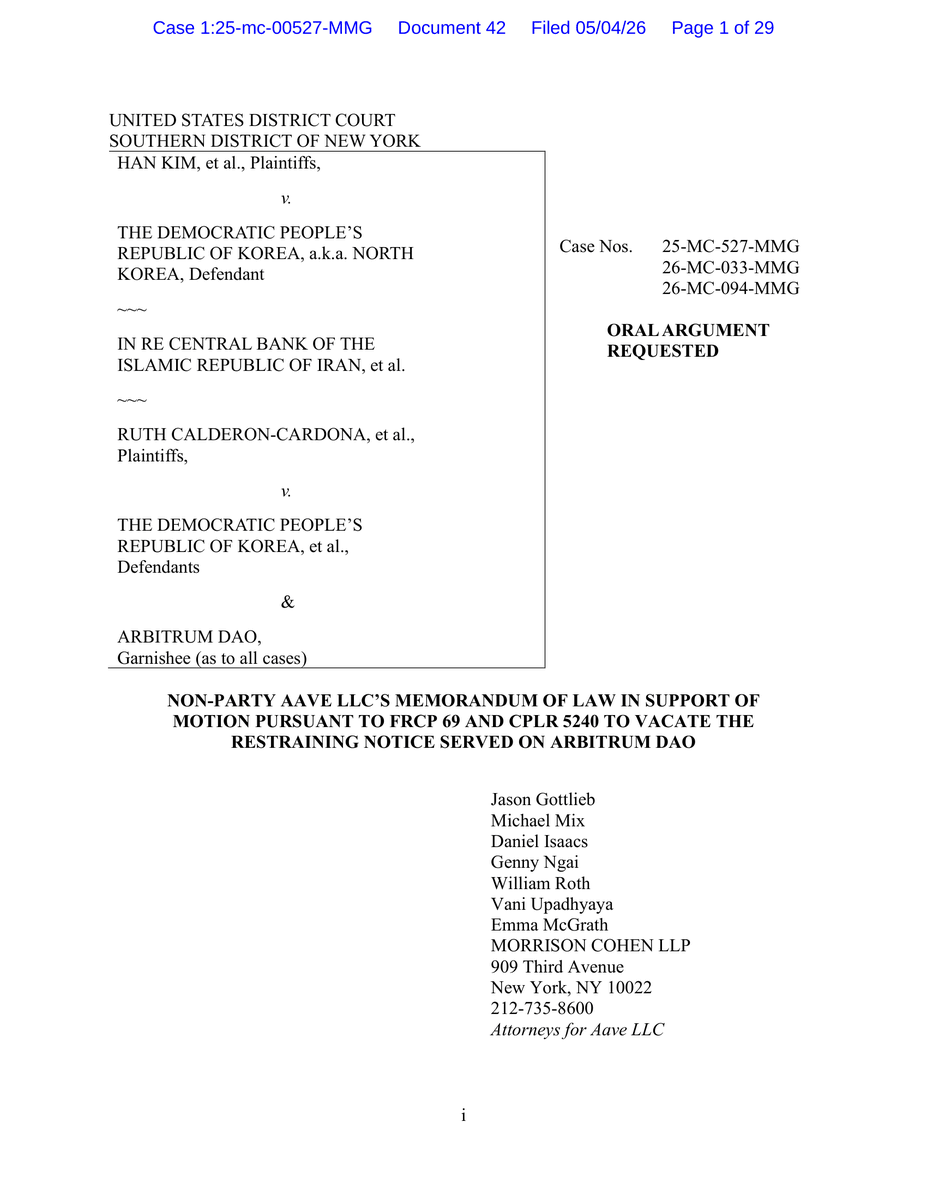
Aave LLC has filed an emergency motion to vacate a restraining notice served on Arbitrum DAO on May 1, 2026 that attempts to seize approximately $71 million in ETH belonging to victims of the April 18 exploit.
A thief does not gain lawful ownership of stolen property simply by taking it, and the law is clear on this. Those assets were recovered to be returned to users victimized in the April 18, 2026 exploit. Freezing them harms the very people this recovery effort is designed to protect.
We’ve asked the court for an expedited hearing and a temporary vacatur, and we are continuing to work alongside the Arbitrum community and DeFi United to make affected users whole.
English
@y_cryptoanalyst 你說的只對一半啊,就是因為 layer2 的交易量越來越大讓 layer2 越來越貴,所以才需要 dencun 把資料寫到 blob 來省錢。比主網低1~2個數量級和 layer2 gas fee 越來越貴這兩件事情不衝突 ref: researchblog.coinshares.com/understanding-…
中文

@fromfedtochain Dencun 升级前L2 的gas 费已经很低了,比主网低1-2个数量级。
升级的目的是为了扩宽车道,支持更高性能要求的高频交易等场景。
中文
Deutsch
Deutsch

The Sats are flowing... but not forever! 🚰⏳
We're giving away free Bitcoin directly to your @TetherWallet. Catch the drop before the tap runs dry:
💧 Tag @btc in a post
💧 Add your @ tether.me wallet handle
Get your free Sats now! ⚡️
English
Deutsch
Deutsch

The @btc Faucet is officially LIVE! 🚰⚡️
We want to help everyone experience self-custodial Bitcoin. Claiming your free Sats is easy:
Download the tether.me app, then reply to this tweet, making sure to tag @btc AND include your @tether.me username.
We will instantly drop a lightning-fast fraction of Bitcoin straight to your Tether Wallet. Stack 'em while the faucet is running! 👇
English


很多人还没意识到,@aave 现在的情况有多糟
所有核心市场的利用率都已经打满到 100%,其中包括被卡住的 30 亿 USDT 和 20 亿 USDC
这意味着你根本提不出自己的钱
下面详细说说,事情为什么会变成这样,又是怎么一步步走到这一步的
当 rsETH 被利用,AAVE 出现坏账之后,Justin Sun、MEXC 交易所,还有其他鲸鱼用户,第一时间就从 AAVE 里撤走了数十亿美元
这一下直接抽干了 ETH、USDT、USDC 等核心市场里原本就有限的流动性。先跑的人跑掉了,慢一步的人直接被困住
最开始是 ETH 市场先打到 100% 利用率,也就是你已经没法从 AAVE 提出 ETH
更糟的是,这还意味着一旦 ETH 价格下跌或者闪崩,协议连 ETH 清算都处理不了。ETH 卖不出去,债务就没法靠清算来覆盖
也就是说,只要这些市场继续卡死,AAVE 继续扩大坏账的风险就会越来越高
不过,ETH 存款用户至少还能在 Uniswap 之类的聚合器上,以小幅折价卖掉 aETHwETH 代币。这算是 AAVE 上 ETH 存款人最后一扇还能走的门
但 USDT 和 USDC 的存款人就没这么幸运了,他们是真的被锁死了
因为过去 24 小时里,AAVE 已经流失了超过 60 亿美元的流动性。鲸鱼大额撤资之后,USDT 和 USDC 也双双冲到 100% 利用率
这些市场现在同样陷入卡死,资金被锁在里面。恐慌正在扩散,人在绝境时,往往会开始用极端手段自救
有些用户选择拿被锁住的 USDT 或 USDC 去抵押借款,再从其他市场撤出去,即便要承受 10% 到 25% 的损失也认了,对应大概是 90% 到 75% 的 LTV。说白了,就是拿锁死的 USDT 或 USDC 去借 GHO、DAI、USDe 之类的资产,然后想办法撤离
但随着越来越多流动性从 AAVE 流出,更多市场也会冲到 100% 利用率,然后因为流动性太低被锁死卡住
这场连锁反应,正在快速蔓延到几乎所有还能动的市场
好在今天加密市场整体波动还算平,清算压力暂时不算特别大。可一旦行情变了,AAVE 里现在有数十亿美元的稳定币和其他资产被锁着,连清算都执行不了,那就等于更多坏账会继续砸出来
如果那些被困住的用户,或者同样卡在里面的相关协议,急需这笔钱去避免爆仓,或者维持某些关键功能,那他们现在是真的麻烦大了
更别提,现在也没人愿意往这些市场里继续存钱或者补流动性。毕竟谁都不想把自己的 ETH、BTC、USDC、USDT 扔进去以后,不知道要被卡多久
只要市场里稍微出现一点可提的流动性,就会立刻被机器人抢光。就在我写这段话的时候,我看到 USDC 市场里刚冒出来的 25 万流动性,几秒钟就被抽干
然后还有坏账这个问题
AAVE 因 rsETH 事件已经背上了超过 2 亿美元坏账,这东西现在就像一颗烫手山芋,谁都不知道最后到底由谁来埋单
如果你还没把资产从 AAVE 里拿出来,你就有可能要以某种形式分摊这笔账。拿不到自己的钱,本身就是风险的一部分
传染风险也非常高
很多协议和应用的收益机制本来就是建立在 AAVE 之上的。现在这些协议和它们的用户也一起被困住了,哪怕他们自己什么都没做错,也可能被迫吞下坏账
10 月 10 日那次是中心化交易所引发的暴跌,而这一次,是一次规模离谱的 DeFi 风控失效
AAVE 根本就不该把 rsETH 作为抵押品上线,至少不该把规模放大到几亿美元这种程度,让黑客可以靠假抵押物借走超过 2 亿美元的 ETH
现在还有传言说,rsETH 能被 AAVE 上线,是因为某个服务提供方存在利益冲突和游说行为。要是这事是真的,那 AAVE 的治理结构就是一次重大失灵,当然,这种事也不算新鲜
负责管理 rsETH 的 @KelpDAO 团队现在也面临一个很难的决定,这次 2 亿美元漏洞造成的损失,到底该由谁来承担。AAVE 用户。L2 上的 rsETH 用户。还是所有受影响的人一起被统一削减资产来填坑
AAVE 团队他们现在手里的问题很大,因为整个协议都处在风险里
市场对 AAVE 的 TVL 正在以数十亿美元的速度流失,甚至把所有核心市场都抽到了 100% 利用率
也许接下来会有一些行业里的关键角色出手补流动性,帮 AAVE 稳住市场,避免事情继续恶化
谁知道呢,最近都成黑客提款机了,不玩了

中文

一个内部消息
鹅厂今年给员工配了差不多22万元/人的token套餐
包括:
700刀的Cursor额度,
700刀的Claude Internal额度,
1000刀的CodeBuddy额度,
120刀的OpenClaw额度,
120刀的Knot 额度,
无限的GLM模型额度...
真是壕无人性……
中文
ETHGas is introducing the Open Gas Initiative, letting protocols incentivize their users to grow onchain adoption while ending gas fees anxiety for good.
@aave @Morpho @Uniswap are you in? 👀
Join Open Gas: ethgas.com/open-gas/
x.com/ethgasofficial…
ETHGAS@ETHGasOfficial
Introducing the Open Gas Initiative - a way for protocols to subsidize gas for users, zero-code, for a seamless, frictionless onchain experience. With OG cohort: @eigencloud, @ether_fi, @pendle_fi, @Velvet_Capital. 👇
English
@BitcoinCom @freedomfactory @_dsencil Ethereum’s biggest advantage is its unstoppable network effect.
It isn’t just a smart-contract chain — it’s the settlement layer the entire crypto economy aligns around.
Every upgrade compounds this lead, which is something no newcomer can replicate.
English

We're giving away a dGEN1 @freedomfactory today at OffChain Tokyo! 🇯🇵📱
To enter:
1️⃣ Come to the event
2️⃣ @_dsencil will ask a question at the event
3️⃣Comment on this post with your answer
4️⃣ The best comment wins!
Sign up for the event here :👇
luma.com/rvl4n7on?tk=W9…

English
When robots start hiring each other: How EIP-8004 builds trust infrastructure for the AI agent economy
Check it out & let us know your thoughts! apps.apple.com/jp/app/from-fe…
Seventeenth-century Amsterdam merchants faced a dilemma: how to conduct business with distant merchants they had never met? Their solution was to invent letters of credit and clearinghouses—using paper and banks as intermediaries to establish trust. Over three centuries later, AI agents (autonomous agents, software programs that can make decisions and perform tasks independently) face the same problem: how to build trust and collaborate with other agents without human oversight?
Ethereum's EIP-8004 (Ethereum Improvement Proposal 8004, a set of technical standards that enable AI agents to verify each other's identities and reputations) was created to address this problem. If Ethereum established a decentralized trust layer for financial transactions, then EIP-8004 establishes a decentralized trust layer for collaboration between AI agents.
Imagine this scenario: A purchasing agent at a factory in Shenzhen urgently needs to order parts. It discovers a supplier agent in Guangzhou on the blockchain, but the two parties have never dealt with each other before. How can they be sure that the other party won't just take the deposit and disappear? How can they verify the authenticity of their claim of a "98% on-time delivery rate"? Without the guarantee of a centralized platform like Taobao or Uber, how can this transaction proceed?
First, how do traditional trust mechanisms typically work?
In the Web2 era, trust issues are resolved by platform companies. Taobao has a seller rating system, Uber has driver star ratings, LinkedIn has work history verification, and Airbnb has a host reputation score. These systems work well, but they all share one common characteristic: they are highly centralized. The platform controls all data, sets the rating rules, and decides who can list and who cannot.
More importantly, these reputation scores are not transferable. The five stars you've accumulated on Taobao are completely insignificant on eBay. Your five-star Uber review means nothing to Lyft. Every time you switch platforms, you have to build your reputation from scratch. This is already a hassle for human users, and it's an even greater bottleneck for AI agents—they need to frequently switch and collaborate across countless different protocols and organizations, leaving them with no time to slowly build trust.
In the blockchain space, early attempts to solve the identity problem involved using Decentralized Identifiers (DIDs) or Verifiable Credentials (digital certificates issued by an authoritative authority). However, these solutions are like issuing a passport to a robot—they prove who you are, but not whether you're trustworthy. A newly registered agent might have a perfect DID, but without any transaction history. How can other agents decide whether to work with it?
Traditional API authentication systems (Application Programming Interface authentication, a mechanism for software to verify identity with each other) face similar problems. They verify the identity of the developer, not the runtime behavior of the agent. An API key could be resold or stolen, or the agent's code could be maliciously modified after authentication. This static authentication cannot meet the dynamic trust requirements of a decentralized environment.
Simply put, traditional solutions are either overly dependent on centralized platforms or only provide "proof of identity" rather than "proof of trust." This is like a bank looking at your ID card but not checking your credit history—a completely unfeasible approach in the real world.
Second, why is EIP-8004's approach better? **
The core innovation of EIP-8004 lies in the design of a three-tiered registry architecture, like a decentralized "Zhima Credit" system for AI agents. These three tiers are:
**Identity Registry**: This first tier assigns each agent a unique blockchain address, much like an ID number. However, it surpasses traditional IDs in that it also includes an "agent profile," which records basic information about the agent: what they do, who runs them, and the trust model they use. Crucially, this information is stored on-chain, accessible to anyone but impossible to tamper with.
Reputation Registry: This second layer records the interactions and reviews between agents. It's similar to Taobao's buyer reviews, but with one key difference: these reviews are decentralized; no single platform can delete or modify them. A more clever design utilizes "pre-authorized feedback references," a lightweight review reference mechanism that avoids storing large amounts of data on-chain. This allows for minimal information to be stored on-chain, while the bulk of the details are stored off-chain, saving costs and maintaining flexibility.
Critically, reviews aren't simply ratings. The system allows for multi-dimensional evaluations: punctuality, technical skills, communication quality, and so on. Different application scenarios prioritize different dimensions. A logistics agent might care about punctuality, while a data analytics agent might be more concerned with accuracy.
Validation Registry: This is the third and most powerful layer. It supports multiple verification methods:
- Stake-based Validation: Agents stake a certain amount of tokens, which can be confiscated if they misbehave. This is a classic application of cryptoeconomics—making the cost of misconduct higher than the benefits. It's like a Taobao seller's security deposit, but fully automated, requiring no customer service intervention.
- Trusted Execution Environment (TEE) Attestations: Special hardware chips (such as Intel SGX or ARM TrustZone) are used to prove that the agent is actually executing the code it claims to be and has not been tampered with. This is like giving an agent a transparent safe; outsiders can't see the details inside, but they can confirm that they haven't cheated.
- **Zero-knowledge proofs**: Agents can prove "I completed a certain task" or "I followed a certain rule" without revealing specific details. For example, they can prove "I never leak user information" without making all their operation logs public.
The beauty of the three-layer design lies in their complementary nature. The identity layer addresses "Who are you?", the reputation layer answers "What have you done in the past?", and the verification layer ensures "You are telling the truth now." Just like applying for a credit card requires an ID (identity), bank statements (reputation), and proof of income (verification); none of them can be missing.
More importantly, this system is composable. Different projects can implement their own reputation algorithms and verification mechanisms, and as long as they adhere to the interface standards of EIP-8004, they will be compatible with each other. This is like the standardization of USB ports—you can plug in any standard-compliant device without worrying about incompatibility. A DeFi project might require agents to stake ETH, a supply chain project might prioritize TEE proofs, and a data market might require zero-knowledge proofs. Standardized interfaces allow each ecosystem to tailor its trust model.
The economic impact of this design is profound. It enables "permissionless collaboration"—any agent can discover other agents, assess their trustworthiness, and collaborate directly, without the need for approval from a centralized platform. This breaks the moat of platform economics, unleashing network effects from the platforms themselves and transforming them into public good for the entire ecosystem.
Imagine the new business models this will spawn: a translation agent could instantly hire a grammar checker and a cultural consultant to collaborate on a task. These three parties have never collaborated before, but they can establish temporary trust based on on-chain reputation. A DeFi arbitrage bot could form a temporary alliance with other bots, sharing order flow and automatically splitting profits. This kind of "flash partnership," which in traditional businesses requires signing contracts, negotiating terms, and going through legal procedures, now only takes seconds through smart contract execution.
**Third, why haven't most people adopted this approach yet? **
Despite its ingenious design, EIP-8004 suffers from a classic "chicken and egg" problem. Newly registered agents lack a track record of credibility, and other agents are reluctant to collaborate with them. Without collaboration, they can never build credibility. This is like a newly opened Taobao store with no reviews, which discourages buyers from placing orders, ultimately leading to a failure to accumulate ratings.
A possible solution is to introduce a "reputation initialization mechanism": agents can accumulate initial points by completing low-risk tasks, or creators can provide initial credibility by staking tokens. Some projects may offer "starter missions"—basic interactions similar to the "Starter Village" missions in games, which are low-risk but can build reputation.
Technical complexity is also a major hurdle. For developers, understanding the operational logic of a three-tiered registry, designing appropriate reputation algorithms, and integrating TEEs or zero-knowledge proofs are non-trivial engineering tasks. The current lack of easy-to-use development tools and SDKs discourages most developers. The ecosystem needs to provide more tutorials, reference implementations, and out-of-the-box solutions.
The risk of standards fragmentation is also very real. If different projects implement incompatible versions, the interoperability benefits of EIP-8004 will be lost, and we will return to a state of isolated, independent development. This will require a coordinated community effort—just as the browser wars ultimately converged on web standards, it will take time for a proxy trust system to reach consensus. On-chain costs are another practical issue. Frequent reputation updates, if all on-chain, would be prohibitively expensive on the Ethereum mainnet. The solution is to use Layer 2 [second-layer scaling solutions such as Optimism or Arbitrum, which can significantly reduce transaction fees] or off-chain aggregation [collecting large numbers of reviews off-chain and submitting them in batches on-chain]. However, this introduces new technical complexities.
The most profound barriers may be cultural and psychological. Businesses are accustomed to controllable systems, and suddenly having to transfer trust mechanisms to the open and transparent blockchain requires a mindset shift. "Will our business secrets be leaked?" "What if our agents are maliciously evaluated?" "Who will arbitrate disputes?" These questions all have technical solutions (selective disclosure, reputational weight, decentralized arbitration), but convincing traditional businesses to adopt them will take time and require successful case studies.
Regulatory uncertainty is also a practical consideration. If AI agents' autonomous decisions go awry, who is responsible? How can agents in cross-border transactions comply with the laws of different jurisdictions? These legal questions remain unclear, making businesses extremely cautious when adopting them.
But I believe the more fundamental issue is that we haven't truly entered the era of the "agent economy." Today's AI agents are mostly auxiliary tools that require human oversight and approval. Only when agents truly begin to autonomously perform complex tasks and frequently collaborate with other agents will trust infrastructure like EIP-8004 demonstrate its irreplaceable value.
Just as infrastructure like DNS (Domain Name System) and SSL (Secure Sockets Layer) may seem boring in the early days of the internet, e-commerce today would be impossible without them. EIP-8004 plays a similar role—not as a flashy application, but as a foundation that makes future applications possible.
When AI agents truly begin managing investment portfolios, coordinating supply chains, optimizing energy use, and even participating in DAO governance, they will need a reliable way to identify, evaluate, and collaborate with each other. By then, standards like EIP-8004 will have evolved from "interesting technical proposals" to "indispensable infrastructure." The seeds we sow today will blossom and bear fruit in the future proxy economy.
Perhaps the real question isn't "Why isn't it being used yet?" but "Will we be ready when it's truly needed?" The value of EIP-8004 may only be fully understood when the proxy economy truly takes off.
English
Last week I ran into a serious issue with @CelerNetwork cross-chain bridge.
My ETH deposit to an @ether_fi AA wallet failed, and support initially claimed:
“The contract cannot receive ETH, funds are locked forever.”
This is NOT true.
I tested the same AA wallet:
• Sending native ETH works
• Contract automatically wraps ETH → WETH internally
So the “cannot receive ETH” explanation was wrong.
The real cause?
@CelerNetwork later admitted:
The gas parameter (nativeTokenGas) in the relay config was too low.
It failed because extra gas is needed for WETH deposit + transfer.
After fixing the gas config, the transaction went through.
Why this matters:
• Support left me hanging for days, no updates
• Initial explanation was misleading
• If I wasn’t a developer, my funds would be stuck and I’d have no idea why
We’re building the next-gen financial infrastructure. This level of service kills trust.
To @CelerNetwork team:
• Improve support transparency
• Automatic Revert & Refund: If a cross-chain transaction fails, the bridge should automatically revert and return the funds to the sender (minus the gas fee). This is a basic safety feature — users’ funds should never be stuck in limbo, requiring them to be engineers just to recover their own money.
This shouldn’t require hours of back-and-forth to resolve.
If we want mass adoption, reliability + UX must improve across the entire stack.
Otherwise, non-technical users will simply give up the first time something breaks.
we need to raise the bar for the whole ecosystem.
Finance won’t go mainstream with “funds stuck, sorry” errors.

English
We just launched our From Fed to Chain iOS app! 📲✨
Bringing you insights from Wall Street to Web3, straight to your phone.
Check it out & let us know your thoughts!
apps.apple.com/jp/app/from-fe…

English
Message: Token exchange failed: .
Error code explanation: 500 - Server got itself in trouble.
Error logging in: login_with_chatgpt subprocess failed:
any ideas?
English

📣 We shipped major improvements to the Codex CLI today
GPT-5, with usage included in your ChatGPT Plan (no API key needed)
Upgraded prompt, harness, approvals & sandboxing logic... you name it
Get the latest:
1. `npm install -g @openai/codex` -> v0.16+
2. `codex login`
English
Here's my ticket for metamask's false deceptive alert. After 10 times ticket created and still unsolved. Was brutally closed by Allen and Sam in support team. Here's the context:
```
Hi Allen
Thanks again for your continued responses.
However, I’m still puzzled and honestly concerned that Zap Pilot’s dust-swap transactions are being flagged as deceptive. As previously explained, the user signs a clear batch transaction that swaps minor token balances (“dust”) into ETH, and the output ETH is returned directly to the user’s own wallet. There’s no redirection of funds, hidden fees, or third-party contract traps—just a straightforward swap with expected slippage.
Given that, I’m struggling to understand the criteria under which this is being categorized as a “scam.” Could you please clarify what exact heuristics or flags are triggering this classification?
More importantly, what concrete steps can we take together to fix this mislabeling? We’re happy to provide any technical details, simulate the flows, or even hop on a call if needed. Our team is standing by to resolve this, but we need your help to move this forward instead of staying in a loop.
Looking forward to your guidance so we can get this properly resolved.
Here's the preview and its corresponding
1. txn: basescan.org//tx/0x96a4d0c4…
2. here's the report issue link: …aid-false-positive-portal.metamask.io/?data=H4sIAAAA…
Best,
David
```
looking forward to hear back from you
English

We are continuing to receive reports of email phishing campaigns asking users to "verify" their wallet to comply with KYC regulations, along with other types of "verification mandates". These emails are SCAMS! MetaMask wallets are NOT ASSOCIATED with user email addresses!
English