

English
Bruce
146 posts

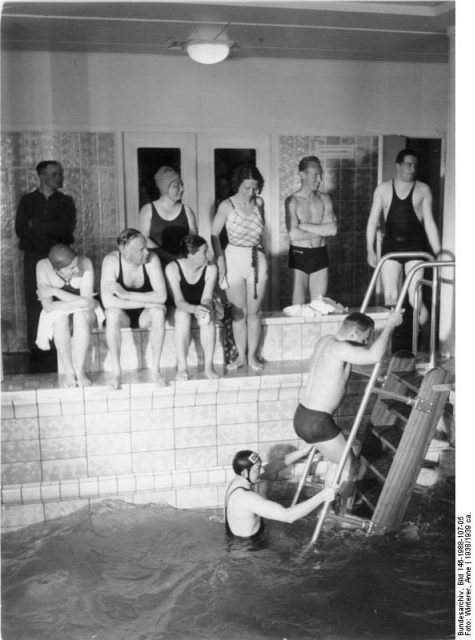
Launching of Wilhelm Gustloff, Slip VII of Blohm und Voss shipyard, Hamburg, Germany, 5 May 1937 She was named after Wilhelm Gustloff, the leader of the Swiss Nazi Party who had been assassinated in 1936. The ship was christened by his widow, Hedwig Gustloff, with Adolf Hitler himself in attendance at the launch ceremony. Built for the Nazi "Strength Through Joy" (Kraft durch Freude, or KdF) program, she was designed as a purpose-built cruise liner intended to provide subsidized leisure travel to ordinary German workers as part of the regime's efforts to win popular support. At roughly 25,000 gross register tons and over 200 meters long, she could carry around 1,500 passengers in a deliberately classless single-class configuration, where every cabin was above the waterline and of similar quality, reflecting the propaganda image of a "people's cruise ship." She made her maiden voyage in 1938 and operated cruises to destinations like Madeira, Norway, and Italy, and also served briefly as a polling station for Austrian and German expatriates voting on the Anschluss. When World War II began in September 1939, her cruise career ended. She was converted first into a hospital ship, and then in 1940 became a stationary barracks and accommodation ship for U-boat trainees at Gotenhafen (today Gdynia, Poland), where she remained for over four years. Her fate is what made her historically infamous. On January 30, 1945, as the Red Army advanced into East Prussia, the Gustloff was pressed into service for Operation Hannibal, the massive German naval evacuation of civilians, wounded soldiers, and military personnel from the eastern Baltic. Designed for about 1,900 people, she sailed from Gotenhafen catastrophically overloaded, with estimates of those aboard generally ranging from about 10,000 to 10,600, the vast majority of them refugees, including thousands of children. That night, in icy Baltic waters off the Pomeranian coast, she was struck by three torpedoes from the Soviet submarine S-13, commanded by Alexander Marinesko. She sank in under an hour. Because of the freezing temperatures, the chaos, the overcrowding, and a shortage of usable lifeboats (some were frozen in their davits), only around 1,000 people survived. The death toll, generally estimated at roughly 9,000, makes the sinking of the Wilhelm Gustloff the largest loss of life on a single ship in maritime history, far exceeding the Titanic and the Lusitania combined. Despite this, the disaster was barely acknowledged for decades. The Nazi regime suppressed news of it to avoid damaging morale, the Soviets had little interest in publicizing the deaths of German civilians, and postwar Germany was reluctant to dwell on stories that could be seen as casting Germans primarily as victims. The wreck lies at a depth of about 44 meters in the Baltic and is officially designated a war grave by the Polish government. The sinking gained wider international attention through works like Günter Grass's 2002 novella Crabwalk (Im Krebsgang), which examined how the memory of the disaster had been buried in postwar German consciousness.








Hungary two weeks after the election - updated list: 1. the first LGBTQ flag was hoisted in Budapest. 2. „Rainbow TV“ is launching to indoctrinate children. 3. The veto on the €90M to Ukraine was lifted 4. Appointed LGBTQ activist as Minister of Education to „reform“ the education system. This is for all those who said: „Peter Magyar really tricked the EU, he is further right than Orban“ I told you he was a globalist sell-out. hungarytoday.hu/peter-magyar-h…


May God save Japan.

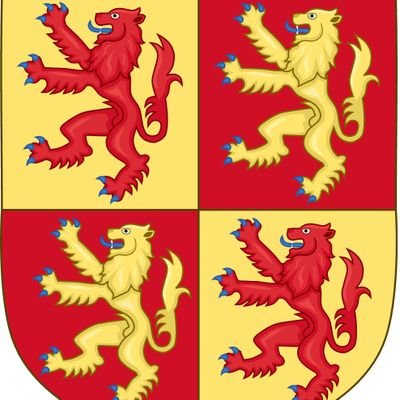
I love Wales, as you know. I'm terrified that Plaid will get into power.

