Lionel T Gwicho

2.5K posts

Lionel T Gwicho banner
Lionel T Gwicho

Lionel T Gwicho

@gclionel

Christian Witness, Author and Healthy Relationships Advocate, U’nique, I love my country, proudly 🇿🇼

Harare, Zimbabwe Katılım Mart 2021
431 Takip Edilen110 Takipçiler
Hon Minister Torerayi Moyo
From 2027, Zimbabwe will require every school without exception to register its learners for ZIMSEC examinations. The era of parallel foreign examination systems operating outside our national framework is over. It's mandatory for all students to write ZIMSEC. However, schools wishing to offer both ZIMSEC and Cambridge should apply for permission to do so provided there is justification for it. This is not an attack on academic excellence. We are not banning Cambridge examinations .This is an assertion of national sovereignty over our own Education System. Zimbabwe's children deserve to be assessed on a common, uniform standard one that this government controls, benchmarks, and continuously improves. For too long, a two-tier system has told some children that their futures are validated in Cambridge and told others that ZIMSEC is somehow second best. That ends now. Private institutions operating on Zimbabwean soil have a clear directive: align with the national framework. This is not negotiable. Government policy is unambiguous comply or fall out of step with the direction this Republic is moving. We are building one education system. One standard. One Zimbabwe. Every child regardless of the school they attend or the uniform they wear deserves equal recognition under a national framework that belongs to all of us.All School Kids are the same.
English
384
42
144
82.1K
Lionel T Gwicho
Lionel T Gwicho@gclionel·
@TembaMliswa It’s a daily thing here in Zimbabwe and you are busy poking fun another country’s police force. Inga unoti they listen to you here, clean up our country first including the likes of you.
English
0
0
0
8
Sabhuku Temba P. Mliswa
Sabhuku Temba P. Mliswa@TembaMliswa·
On my way from an exciting holiday in Zambia I had an unpleasant experience with a Zambian Police Assistant Inspector along the Chirundu Highway who wanted to robe us in broad daylight. He flagged us down 15 km from the border and without explaining any charge demanded that we turn the car back and drive to Lusaka. We asked what the issue was but he couldn't explain and yet demanded 1000 Kwacha if he would leave us. We refused, gave him my passport and will be making a formal charge against him to Zambia Police Service. It's shocking how corruption is eroding public services to this shocking point in our countries. @DailyNationZM @QfmZambia @zadama24 @Zambia_Reports @ZambianObserver @ZP_service @PoliceZamb61410
English
466
53
337
111.7K
Fran Auerbach
Fran Auerbach@franauerbach·
@SenWarren @PrinceScrapbook This whole ballroom thing is obscene. Taking taxpayer’ monies to build a ballroom instead of funding important government agencies and programs is beyond the pale.
English
375
0
25
5.6K
Elizabeth Warren
Elizabeth Warren@SenWarren·
Right now, I'm BLOCKING a Republican bill to build Donald Trump's ballroom. Instead of rubber-stamping Trump’s gold-encrusted ballroom, Congress must lower costs for American families. twitter.com/i/broadcasts/1…
English
16.8K
6K
24.7K
542.3K
Lionel T Gwicho
Lionel T Gwicho@gclionel·
@RepSaraJacobs Did you get the part where he said “the most insightful President”? If not you may not be the mentally stable Congresswoman.
English
0
0
0
3
Congresswoman Sara Jacobs
Congresswoman Sara Jacobs@RepSaraJacobs·
I asked Secretary Hegseth a straightforward, yes or no question today: Is Donald Trump mentally stable enough to be Commander in Chief? He didn't say yes. And that speaks volumes.
English
22K
10.2K
49.7K
2M
Ted Lieu
Ted Lieu@tedlieu·
This is one of the stupidest DOJ cases in history. Southern Poverty Law Center wasn’t paying the Klan, they were paying informants to who were helping to take down the Klan. Unless you believe white supremacists all of a sudden took over SPLC, this entire case makes no sense.
FBI Director Kash Patel@FBIDirectorKash

The money doesn’t lie. The evidence shows the charity who supposedly fought the Klan - FUNDED the Klan. The charity who supposedly fought Neo-nazis - FUNDED Neo-nazis. The SPLC engaged in a massive fraud operation to deceive their donors, funded the very hate groups they claim to oppose, and then hid their operations from the public through shell companies and fake entities. This @FBI and @DAGToddBlanche won’t let them get away with it any longer.

English
10.2K
4.3K
16.5K
1.1M
Lionel T Gwicho
Lionel T Gwicho@gclionel·
@ProfJNMoyo After all that gibberish, is it not a limit defined by length (time) and terms (number/cycles)? Usade kutamba with words. You are becoming a national risk.
English
0
0
0
4
Prof Jonathan Moyo
Prof Jonathan Moyo@ProfJNMoyo·
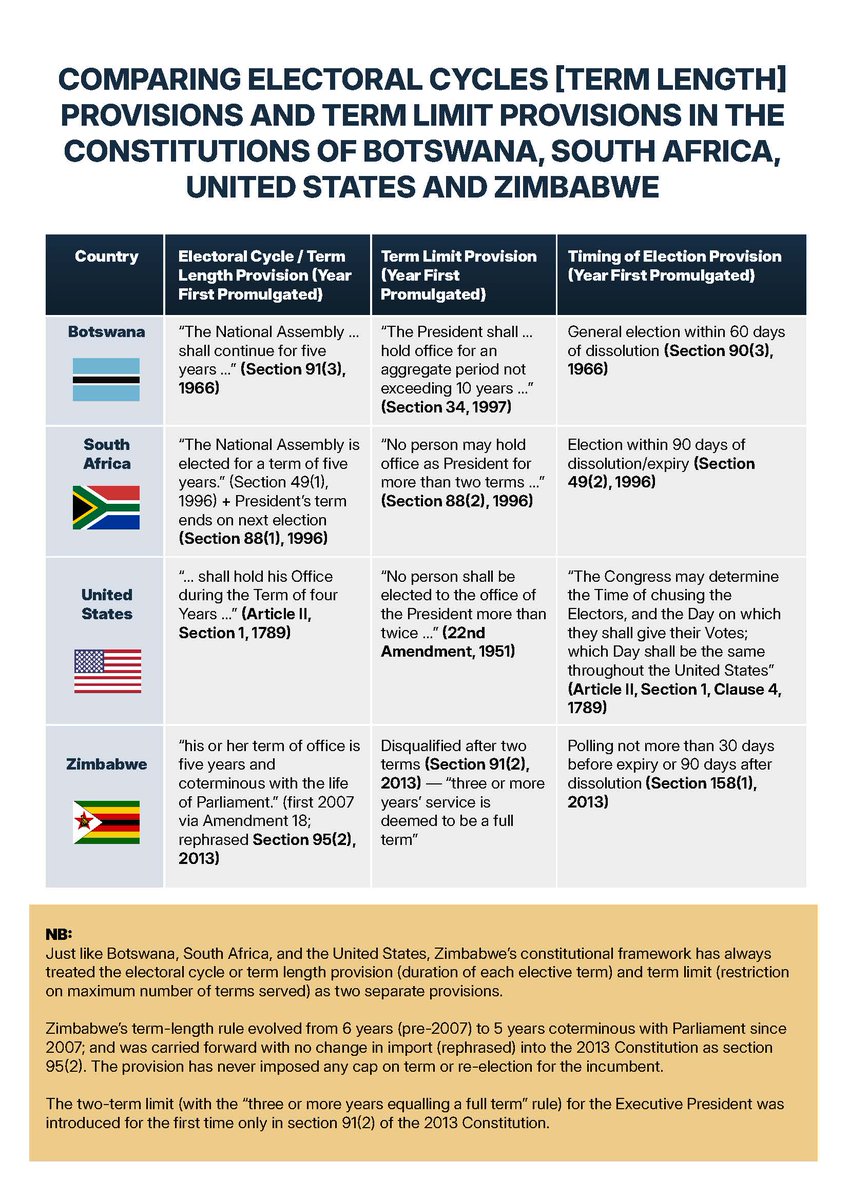
Debunking a Persistent and Dangerous Myth: Zimbabwe’s Constitution Contains Only One Presidential Term Limit Provision: In the intense public debate over the Constitution of Zimbabwe (Amendment No. 3) Bill, an utterly false claim is being repeated relentlessly and without a single shred of evidence: that the Constitution contains two separate presidential term limit provisions—sections 91(2) and 95(2)(b). This assertion is not merely incorrect; it is constitutionally impossible. No constitution anywhere in the world has ever created two distinct term limit provisions for the presidency. Section 95(2)(b) is not—and, according to the Constitution’s own crystal-clear definition in section 328(1), read with section 328(7), cannot possibly be—a term limit provision. A genuine presidential term limit provision restricts the total or maximum length of time any individual may hold or occupy the Office of President. Section 95(2)(b) does nothing of the sort. It simply defines the length of each presidential term as five years, running coterminous with the life of Parliament. In straightforward language, section 95(2)(b) regulates the office itself, not the person who holds it, and says absolutely nothing about how many terms or the length of time any one individual may serve. The Constitution of Zimbabwe (2013) contains only one term limit provision: Section 91(2). This clause is unequivocal and ironclad. It prohibits any person from serving more than two terms as President, with the vital safeguard that three or more years in office counts as a full term. It is only this single provision—and this provision alone—that actually limits the total time any individual can occupy the highest office in the land. Nothing illuminates this fundamental distinction more powerfully than comparative constitutional analysis—the gold standard for both public education and responsible policymaking. As the ancient wisdom has it, there is truly nothing new under the sun. A careful examination of proven global practice, vividly illustrated in the attached infographics, reveals three clear and time-tested approaches that nations around the world have taken when designing presidential term rules: Case 1 – Term length only (unlimited re-election permitted) Constitutions in this category have a single provision that simply defines the length of each presidential term, leaving the number of terms entirely open. This constitutional model operated successfully for decades—for example—in Botswana (31 years, 1966–1997), the United States (163 years, 1789–1951), and Zimbabwe itself (23 years, 1987–2013). Case 2 – Two separate provisions Here constitutions have two separate provisions: one that sets the length of each presidential term; and a second, entirely distinct clause that limits the total time any person may serve as President. This is precisely the framework that has—for example—operated in Botswana since 1997, South Africa since 1996, the United States since 1951, and Zimbabwe since 2013. The first infographic displays this clear separation of the two provisions across all the four countries. Case 3 – Combined in one elegant clause Constitutions in this category have a single constitutional provision that seamlessly merges both term limit concepts—defining term length while simultaneously imposing the limit. This approach has—for example— stood the test of time in Argentina (since 1994), Chile (since 1980), France (since 1958), Mexico (since 1917), the Philippines (since 1987), and South Korea (since 1987), as shown in the second infographic. The historical record is especially telling. Botswana introduced its separate term limit provision only after 31 years of independence, the United States after 163 years, and Zimbabwe after more than two decades of operating under a pure term-length provision. South Africa, by contrast, enshrined both provisions, separately, from the very first day of its democratic Constitution in 1996. These facts drive home an irrefutable truth: a provision that merely defines the length of a term has never been—and can never be—a term limit provision. The distinction is not a technicality; it is the bedrock of constitutional integrity. Recognising it clearly ensures that public discourse and debate on constitutional amendments is anchored in facts, logic, and proven international best practice, rather than convenient fiction to advance nefarious political agendas. Zimbabwe and Zimbabweans deserve nothing less!
Prof Jonathan Moyo tweet mediaProf Jonathan Moyo tweet media
English
177
127
130
60.9K
Nick Mangwana
Nick Mangwana@nickmangwana·
MAPHISA This is a Rural Laboratory in Maphisa. A Legacy of the Independence Commemoration being conducted there. A child in rural areas should have the same opportunities as the one in urban areas. That’s leaving no one and no place behind. This is the ideal promoted by President @edmnangagwa. @SiceloSTEMLADY
English
21
10
26
4K
Lionel T Gwicho
Lionel T Gwicho@gclionel·
@nickmangwana @Jamwanda2 Since you are at it, please compare everything like currency strength, industrialization, healthcare etc and come up with the final result. We expect some fireworks 🎇.
English
0
0
0
7
Nick Mangwana
Nick Mangwana@nickmangwana·
35 out of 56 Commonwealth countries do not directly elect their head of government. That’s 63%.  We may not be in the Commonwealth, but most of its members are our development peers—so on democratic governance, that’s a useful benchmark. Worth asking: how do we compare? #CAB3
Nick Mangwana tweet media
English
323
10
31
27.7K
Lionel T Gwicho
Lionel T Gwicho@gclionel·
@jussy85 @matigary ZHCR Act First Sch Sec 6(7) …, failing which anything authorised or required to be done by the Commission shall be decided by a majority vote of the members at the meeting.
English
0
0
0
7
mmatigari
mmatigari@matigary·
I have been trying to understand the Jessie Majome issue in the midst of highly politicized discourse. My finding is as follows: •The ZHRC must have a quorum of at least 5 commissioners for major decisions and reports to be validly issued. The last report issued by the commission had no such quorum. This matter has since been addressed with many commissioners being sworn in yesterday to take charge of the affairs of the commission. I am curious to find out why the last report was issued without a quorum. Does anyone know?
mmatigari tweet media
English
65
15
38
41.9K
Lionel T Gwicho
Lionel T Gwicho@gclionel·
@dereckgoto @enkudheni Simple questions, if the Parliamentarians are not elected by merit or they cheated the ballot, are they mandated to make our laws? So everyone should shy away and accept a complete rundown by the “elected” who are abusing our votes? Should we keep quiet?
English
0
0
0
5
Dereck Goto
Dereck Goto@dereckgoto·
Dear Zimbabwe Council of Churches, You have no business opposing Amendment Bill No. 3. None whatsoever. Your interference in constitutional affairs is a brazen affront to Zimbabwe's democratic order. Stay in your lane. Your mandate is souls, not legislation. Constitutional revisions are routine across the globe - from the United States to South Africa. Zimbabwe is no exception, nor should it be. The usual suspects will argue that ZCC members, as Zimbabwean citizens, retain the right to participate in constitutional processes. Granted. But there is a profound difference between individual civic engagement and an ecclesiastical institution formally mobilising its religious authority against a legislative instrument. Your members may engage as private citizens through appropriate civic channels - that is their constitutional right. However, the ZCC did not speak as concerned citizens. It spoke as a Council of Churches, wielding its institutional authority to oppose a parliamentary process. That is not civic participation. That is an unambiguous overreach. Scripture itself forecloses your position. Romans 13:1 commands: "Let every soul be subject unto the higher powers, for there is no power but of God." First Peter 2:13-14 further instructs submission to every human institution established by law. And Christ Himself settled this matter with finality: "Render unto Caesar what is Caesar's, and unto God what is God's" (Matthew 22:21). Parliament was constitutionally mandated to debate and enact laws - not you. If you crave political influence, resign your collars and contest an election. Be accountable to the electorate as politicians are. Your current posturing blurs the sacred line between faith and politics, divides congregations, and wholesale abandons your spiritual calling. Pray. Serve. Unite. Leave constitutional matters to those elected and mandated to handle them. I thank you.
Dereck Goto tweet media
English
260
37
50
12.6K
Nick Mangwana
Nick Mangwana@nickmangwana·
Certain responses to specific reassignments reveal underlying political commitments.
English
37
3
7
15.1K
Lionel T Gwicho
Lionel T Gwicho@gclionel·
@Rizvana_Raza Useless PhDs. Deals aren’t lead by educationists. That’s not a university campus.
English
0
0
0
29
Lionel T Gwicho
Lionel T Gwicho@gclionel·
@Jamwanda2 You are on futile efforts of explaining everything. You may need to officialize this handle so that you can represent your department fully, this sniper hideout won’t help. You can be SACKED and hired on another job.
English
0
0
0
6
Jamwanda
Jamwanda@Jamwanda2·
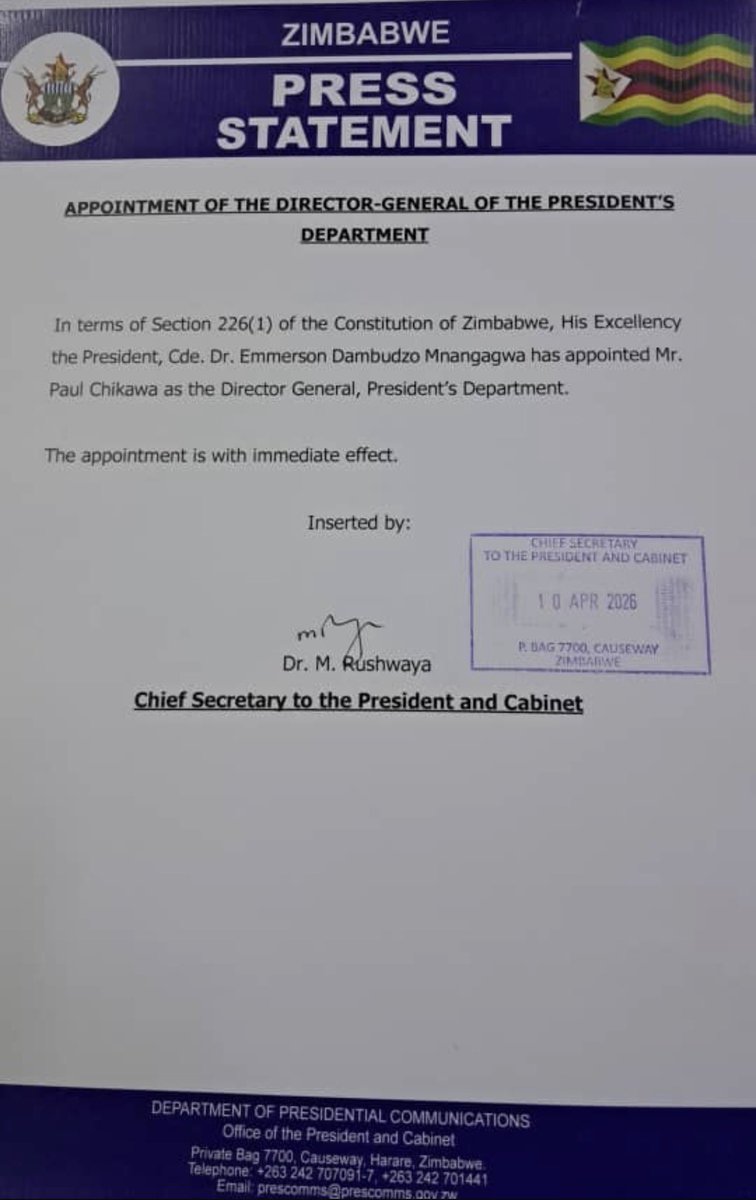
DO WE KNOW WHAT SACKING MEANS?: The Statement released by the Chief Secretary to the President and Cabinet deliberately spoke of APPOINTMENT of a Director-General in the President’s Department. I did not concern itself with the predecessor Director-General. How Online Smart Alecs arrive at SACKING boggles the mind. To SACK means to remove from EMPLOYMENT. We saw the same madness when Ambassador Moyo was replaced by the immediate past DG Mangwanya. Hysterical claims with no basis in fact. A few months later, the former DG Moyo got appointed our Ambassador to UAE. With that chastising misreading, we repeat the same hysterical madness yet again??? Madununu!!!!
English
28
5
65
35.5K
Retired Lt General Winston Sigauke Mapuranga
I have held my tongue on certain matters for longer than was perhaps wise. The soldier in me respects institutional process. The patriot in me respects the office of the President, even when I have reservations about the decisions made from within it. But there are moments when silence becomes dereliction. When the pattern becomes too clear, too deliberate, and too consequential for any honest voice to remain quiet about it. This is one of those moments. The appointment of Mr. Paul Chikawa as Director General of the President's Department issued with immediate effect, signed by Chief Secretary Dr. M. Rushwaya, stamped 10 April 2026 is not an isolated administrative decision. It is the latest move in a carefully choreographed institutional chess game whose ultimate objective has nothing to do with efficient governance and everything to do with one thing, I will prove that assertion. Not with speculation. With pattern analysis the same kind of pattern analysis that military intelligence trains you to apply when the enemy's intentions are not stated but their movements tell the full story. Every significant reshuffle, every strategic appointment, every institutional restructuring under the Second Republic follows a consistent logic when you step back far enough to see the full picture. Who gets placed in positions of proximity to the President? Loyalists. Personal appointments. Men and women whose primary qualification is not institutional excellence but personal fealty to Emmerson Mnangagwa specifically not to ZANU-PF, not to the Constitution, not to the Zimbabwean state, but to the individual who currently occupies Munhumutapa. Who gets systematically edged away from the levers of real institutional power? Who finds their portfolio narrowed, their allies repositioned, their operational space quietly compressed? The answer, consistently and without exception, is those associated with or loyal to Vice President Constantino Chiwenga. The Director General of the President's Department is not a ceremonial position. It is a position of profound institutional significance controlling information flows, managing access, shaping the administrative architecture that surrounds presidential decision-making. Placing a personal loyalist in that position, with immediate effect and without public consultation, is not routine administration. It is a strategic entrenchment. Constitutional Amendment Bill No. 3 with the directness that it deserves and that the public debate around it has so far largely avoided. CAB3 is being presented as a governance reform. A modernisation of Zimbabwe's constitutional architecture. A rational adjustment of the relationship between the executive and the legislature. It is none of those things. CAB3 is, at its core, a personal attack on General Constantino Chiwenga. It is constitutional engineering designed with a single primary objective to construct an electoral pathway to the presidency that General Chiwenga cannot navigate and that Mnangagwa's network can control. Think carefully about what a parliamentary selection model actually means in Zimbabwe's specific political context. It means that the presidency is no longer decided by the Zimbabwean people in a direct popular vote where General Chiwenga's national name recognition, his cross-provincial appeal, his deep institutional credibility, and his genuine popularity particularly in Matabeleland would make him a formidable candidate by any honest assessment.
Retired Lt General Winston Sigauke Mapuranga tweet mediaRetired Lt General Winston Sigauke Mapuranga tweet mediaRetired Lt General Winston Sigauke Mapuranga tweet media
English
23
44
134
36.5K
Lionel T Gwicho
Lionel T Gwicho@gclionel·
@hazelwekwagondo @adv_fulcrum What’s the interpretation of removal? If someone is reassigned, do they remain in their office? Are these Commissions established with the same statutes with same objectives? Let’s have your submissions, the one that can interpret Statutory law.
English
0
0
0
41
hazel
hazel@hazelwekwagondo·
Dear @adv_fulcrum, do not embarrass yourself by failing to grasp this trivial legal issue. I’m beginning to question whether you actually passed your Statutory Interpretation module in law school. For the record, Ms. Jessie Majome was reassigned and was not removed. Section 237(3), which you are citing, applies when a member of an Independent Commission is removed from office. In this case, President @edmnangagwa, as the Executive and the Appointing Authority in terms of s 202(1)(b), decided to redeploy Ms. Majome to another government task, which is totally different from being removed. Your claims are baseless and reflect your lack of understanding of the basic rules of statutory interpretation.
Thabani Mpofu@adv_fulcrum

A member of an Independent Commission, such as the Zimbabwe Human Rights Commission, can only be removed from office under section 237(2) of the Constitution of Zimbabwe. Section 237(3) expressly provides that the procedure for removing a judge also applies to members of an Independent Commission; accordingly, a tribunal must be appointed on the recommendation of the Judicial Service Commission and the member must be found guilty of misconduct before removal. Reassigning Jessie Majome to the Public Service Commission therefore constitutes removal from office and is unconstitutional. Reliance on section 202(1)(b) is unavailing: that provision does not affect the security of tenure enjoyed by Majome is of no application to the situation at hand, and the attempt effectively seeks to demote her from Chairperson of an Independent Commission to an ordinary commissioner of the PSC. We cannot sit idly by while such serious violations occur. The Department of Justice has failed in its duties, with potentially grave consequences.

English
98
9
16
27.2K
Lionel T Gwicho
Lionel T Gwicho@gclionel·
@Sentletse @Jewels_MsJay Empty post. It show lack of understanding of simple issues at play and assuming PhDs make people smarter on every subject.
English
0
0
0
3
Sentletse 🇿🇦🇷🇺🇵🇸🇱🇧
Iran’s delegation to the Islamabad Talks is made up of four men with doctorates: - Dr. Ghalibaf (Speaker of Parliament) - Dr. Araghchi (Foreign Minister) - Dr. Ahmadian (Secretary of the Defense Council) - Dr. Hemmati (Central Bank Governor) The US delegation is made up JD Vance, a failed author, Steve Witkoff, Trump’s gold buddy and Jared Kushner, Trump’s son-in-law. None of them have the technical range to negotiate complex nuclear issues.
Sentletse 🇿🇦🇷🇺🇵🇸🇱🇧 tweet mediaSentletse 🇿🇦🇷🇺🇵🇸🇱🇧 tweet mediaSentletse 🇿🇦🇷🇺🇵🇸🇱🇧 tweet mediaSentletse 🇿🇦🇷🇺🇵🇸🇱🇧 tweet media
English
3.6K
13.5K
41.9K
1.5M