George Davis

708 posts

George Davis

George Davis

@georgebdavis

CEO @frame_ai & CMU PhD helping machines understand and assist conversations between real people. Let's make systems and businesses as human(e) as possible.

Manhattan, NY Katılım Aralık 2010
322 Takip Edilen256 Takipçiler
Sabitlenmiş Tweet
George Davis
George Davis@georgebdavis·
Let's spend less time working and talking about AI, and a lot more more on IA and II: @mijordan3/artificial-intelligence-the-revolution-hasnt-happened-yet-5e1d5812e1e7" target="_blank" rel="nofollow noopener">medium.com/@mijordan3/art…
English
0
0
0
0
George Davis
George Davis@georgebdavis·
@__paleologo The weak points are (a) mobile access and (b) deep research flows. There are workarounds to do these in CLI, but you can also get it all done within Goog ecosystem by using Gemini on mobile, NotebookLLM for research, and CLI for long-lived projects.
English
0
0
1
24
George Davis
George Davis@georgebdavis·
@__paleologo Being accustomed to organizing ideas, you're going to find Claude Code (or Cursor, or Gemini CLI) SO much more powerful than the consumer Agents -- even for non-coding tasks. Organize projects for different aspects of your life and have the "coding" agent help maintain notes.
English
1
0
0
34
Gappy (Giuseppe Paleologo)
Gappy (Giuseppe Paleologo)@__paleologo·
Advice needed. At home, I am currently paying for ChatGPT and Gemini. I really want/need to get Claude Code, and I feel returns on investment on a 3rd service are decreasing, even negative (too much context-switching). I already never use nanobanana etc. What should I drop? ChatGPT or Gemini? I have come to really like Gemini, and am inclined to keep it. Or are there compelling reasons to keep all of them?
English
110
1
180
83.4K
George Davis
George Davis@georgebdavis·
@mattturck AI is also helping us discover that the human processes were all duct tape and chicken wire as well !
English
0
0
0
10
Matt Turck
Matt Turck@mattturck·
Dominant narrative: “AI is a relentless machine that’s going to crush us” AI researchers: “our models are basically experimental ideas, held together by duct tape, and we don’t understand how some of it actually works, but it seems to be improving”
English
16
5
131
16K
Tim Urban
Tim Urban@waitbutwhy·
I keep being recommended Godel, Escher, Bach, so I finally bought it. Now I have it. Do I actually have to read this thing or can I just have it be an impressive addition to my bookshelf?
English
283
21
1.7K
146.7K
Auren Hoffman
Auren Hoffman@auren·
netflix, spotify, amazon etc have years (if not decades) of preference data, but the recommendations are remarkably bad. why are they so bad?
English
193
14
600
60K
Andrej Karpathy
Andrej Karpathy@karpathy·
Every company needs a DM POC - someone high up who you can just DM the most obvious things and who shortcuts the PM hierarchy.
English
221
167
3.5K
564.3K
Matt Turck
Matt Turck@mattturck·
AI leaders in the US 🇺🇸 Yann LeCun, b. France 🇫🇷 Ilya Sutskever, b. Russia 🇷🇺 Andrej Karpathy, b. Slovakia 🇸🇰 Fei-Fei Li, b. China 🇨🇳 Mira Murati, b. Albania 🇦🇱 Mustafa Suleyman, b. UK 🇬🇧 Andrew Ng, b. UK 🇬🇧 Much of Meta’s MSL: 🇨🇳 Elon? 🇿🇦 etc. $100k for an H-1B? 😡
Indonesia
37
39
374
115.8K
Gappy (Giuseppe Paleologo)
Gappy (Giuseppe Paleologo)@__paleologo·
Here is Kumonga, just before Zilla reduces him to a pulp. Kumonga understands NOTHING about art and architecture.
Gappy (Giuseppe Paleologo) tweet media
English
1
0
11
4.9K
Gappy (Giuseppe Paleologo)
Gappy (Giuseppe Paleologo)@__paleologo·
Technical note writing while watching "Godzilla x Kong" on the side. It's upsetting that Godzilla--a good guy after all--destroys Sant' Ignazio, Piazza Navona, the Colosseum and the Altare della Patria in the first 20 minutes. Couldn't they have destroyed NYC as usual?
English
4
0
19
7.2K
Ryan Petersen
Ryan Petersen@typesfast·
@paulg Well he dropped out to help his family escape from Pol Pot’s regime in Cambodia so yeah
English
8
1
301
19.2K
Paul Graham
Paul Graham@paulg·
Don't drop out of college to start or work for a startup. There will be other (and probably better) startup opportunities, but you can't get your college years back.
English
590
866
13.2K
1.9M
George Davis
George Davis@georgebdavis·
@mattturck It's like your cell - cost of last year's inference goes down, cost of this year's goes up. Great if you need "good enough", expensive if you need a competitive experience.
English
0
0
0
38
Matt Turck
Matt Turck@mattturck·
Yes, the cost of inference keeps dropping, but as of right now, seeing a lot of AI startups (of the kind that run LLMs all day as a core part of their product) at 50%-ish gross margins, not 80% like SaaS companies.
English
19
6
93
11.6K
George Davis
George Davis@georgebdavis·
@nathanmcahill @AndrewYNg Fair, but a connected economy gave us tools to expect more of industry and lift all boats (even slowly). A disconnected economy will involve more exploitation in more places, with less visibility and less recourse.
English
0
0
1
21
E=NC^2
E=NC^2@eeqnc2·
@AndrewYNg Not disagreeing with you, but I also think about the fact that the reason those shoes are $25 is because we look the other way while Nike has slaves make them in Vietnam.
English
9
0
8
4.7K
Andrew Ng
Andrew Ng@AndrewYNg·
I am so sorry that the U.S. is letting down our friends and allies. Broad tariffs, implemented not just against adversaries but also steadfast allies, will damage the livelihoods of billions of people, create inflation, make the world more fragmented, and leave the U.S. and the world poorer. AI isn’t the solution to everything, but even amidst this challenging environment, I hope our community can hold together, keep building friendships across borders, keep sharing ideas, and keep supporting each other. Much has been written about why high, widespread taxes on imports are harmful. In this letter, I’d like to focus on its possible effects on AI. One silver lining of the new tariffs is that they focus on physical imports, rather than digital goods and services, including intellectual property (IP) such as AI research inventions and software. IP is difficult to tax, because each piece of IP is unique and thus hard to value, and it moves across borders with little friction via the internet. Many international AI teams collaborate across borders and timezones, and software, including specifically open source software, is an important mechanism for sharing ideas. I hope that this free flow of ideas remains unhampered, even if the flow of physical goods is. However, AI relies on hardware, and tariffs will slow down AI progress by restricting access to it. Even though a last-minute exception was made for semiconductors, taxing imports of solar panels, wind turbines, and other power-generation and -distribution equipment will diminish the ability to provide power to U.S. data centers. Taxing imports of servers, cooling hardware, networking hardware, and the like will also make it more expensive to build data centers. And taxing consumer electronics, like laptops and phones, will make it harder for citizens to learn and use AI. With regard to data-center buildouts, another silver lining is that, with the rise of generative AI, data gravity has decreased because compute processing costs are much greater than transmission costs, meaning it’s more feasible to place data centers anywhere in the world rather than only in close proximity to end-users. Even though many places do not have enough trained technicians to build and operate data centers, I expect tariffs will encourage data centers to be built around the world, creating more job opportunities globally. Finally, tariffs will create increased pressure for domestic manufacturing, which might create very mild tailwinds for robotics and industrial automation. As U.S. Vice President J.D. Vance pointed out in 2017, the U.S. should focus on automation (and education) rather than on tariffs. But the U.S. does not have the personnel — or know-how, or supply chain — to manufacture many of the goods that it currently counts on allies to make. Robotics can be helpful for addressing a small part of this large set of challenges. Generative AI’s rate of progress in robotics is also significantly slower than in processing text, visual data, audio, and reasoning. So while the tariffs could create tailwinds for AI-enabled robotics, I expect this effect to be small. My 4-year-old son had been complaining for a couple of weeks that his shoes were a tight fit — he was proud that he’s growing! So last Sunday, we went shoe shopping. His new shoes cost $25, and while checking out, I paused and reflected on how lucky I am to be able to afford them. But I also thought about the many families living paycheck-to-paycheck, and for whom tariffs leading to shoes at $40 a pair would mean they let their kids wear ill-fitting shoes longer. I also thought about people I’ve met in clothing manufacturing plants in Asia and Latin America, for whom reduced demand would mean less work and less money to take home to their own kids. I don’t know what will happen next with the U.S. tariffs, and plenty of international trade will happen with or without U.S. involvement. I hope we can return to a world of vibrant global trade with strong, rules-based, U.S. participation. Until then, let’s all of us in AI keep nurturing our international friendships, keep up the digital flow of ideas — including specifically open source software — and keep supporting each other. Let’s all do what we can to keep the world as connected as we are able. [I had written this letter before the 90 day pause on the tariffs, but am sharing this here since many of the points are still relevant depends on what happens next.] Original text: deeplearning.ai/the-batch/issu…
English
190
355
2.9K
335.2K
George Davis
George Davis@georgebdavis·
@mattturck New from the party of anti-globalist, anti-immigrant, and anti-elite: a luxury immigration package for the global elite!
English
1
0
1
33
Matt Turck
Matt Turck@mattturck·
Give me your tired, your poor, your huddled masses and whoever has a spare $5M
English
7
3
60
5.8K
George Davis
George Davis@georgebdavis·
@zacharylipton I'm impressed at how Microsoft has played both sides of this wave -- driving high-parameter obsession by funding OpenAI, while releasing awesome research on distilling, quantization and small models in general.
English
0
0
0
32
George Davis
George Davis@georgebdavis·
💯 - capital seeks narratives where it is the driver of impact, and that back-propagates into science and engineering communities. The upshot is when it shakes us out of local minima, like ignoring deep nets. Knowing when the narrative has reached diminishing (or negative) returns is hard, like sizing any gradient step.
English
1
0
1
132
Zachary Lipton
Zachary Lipton@zacharylipton·
There’s a weird cancer of thought in how ppl talk about parameter count and compute spend as metrics to maximize.
English
4
1
29
3.9K
George Davis
George Davis@georgebdavis·
@largedatabank Love this - any hot takes on what makes this problem different with CockroachDB architecture?
English
1
0
0
33
George Davis
George Davis@georgebdavis·
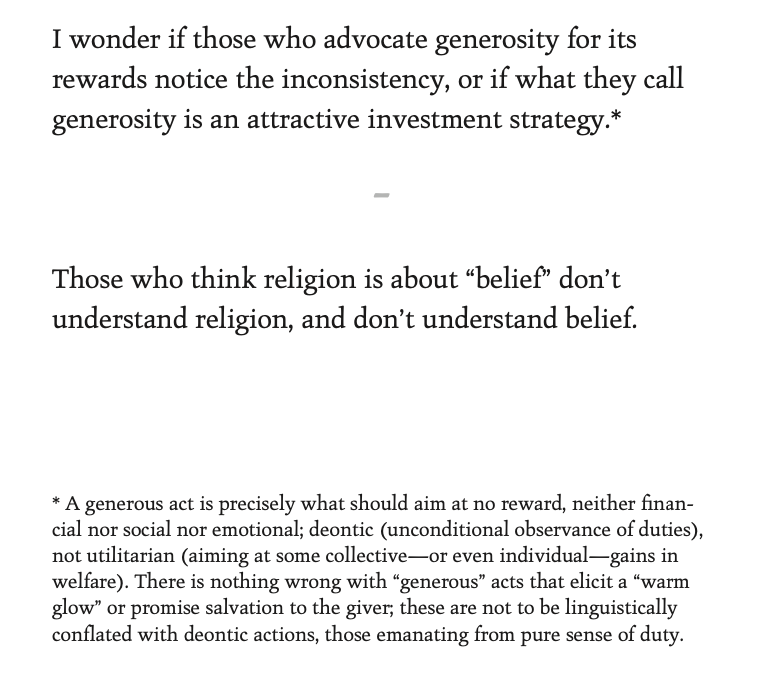
@nntaleb Duty seems to me as hard to purify as altruism. How would you differentiate deontic actions from seeking a pleasure in the fulfillment of duty, or avoidance of the pain felt in dishonor?
English
0
0
0
93
George Davis
George Davis@georgebdavis·
@mimurchison Even anthropocentric intelligence should be considered in a task-specific and context specific way. Highly recommend Gould's Mismeasure of Man on that score (and possibly a source of ideas about how we will screw up evaluating AI)
English
1
0
1
26
Mike Murchison
Mike Murchison@mimurchison·
The fact that LLMs are poor at some basic tasks (for humans) is an important reminder that intelligence is best evaluated on a task-specific basis. It’s only when we drop our anthropocentric view of intelligence that things like being able to code an entire app in seconds and simultaneously not being able to count letters in a word is not actually weird.
English
3
0
13
1.3K
George Davis
George Davis@georgebdavis·
@dauber Reminds me of the y2k masterpiece Romeo Must Die . If you want ownership in an NFL team, you need to make sure Jet Li falls in love with your daughter and protects critical transactions from Triad interference.
English
0
0
0
48
George Davis
George Davis@georgebdavis·
@mattturck That's why real VCs go to sleep at midnight in Paris and wake up at 7a Tokyo time for meditation and workout before the opening bell.
English
0
0
1
298
Matt Turck
Matt Turck@mattturck·
People say it’s easy to be a VC but have you ever tried going to sleep being an Olympics expert and waking up needing to provide thought leadership on the Japanese carry trade on Twitter
English
16
31
465
46.7K