George Lin

2.7K posts

George Lin banner
George Lin

George Lin

@georgehrlin

Feed is a list of interesting things to read (and reminders) for myself. Living, striving, walking my path.

Toronto, ON, Canada Katılım Kasım 2009
654 Takip Edilen39 Takipçiler
George Lin retweetledi
Xiuyu Li
Xiuyu Li@sheriyuo·
其实以字节为例,看看 Seed 校招/社招的岗位,你就能知道工业界要什么方向:seed.bytedance.com/zh/seedearlyca… LLM 所有的主流方向目前都不怎么天坑 - Foundation:训练(pretrain、RL)、推理(链路、算子、分布式)、数据(核心科技)、Infra(最吃资历) - AGI:多模态、语音、具身、Agent - 业务:AI 搜推(最热门的方向)、ToC 本科无算法、算法无本科,但是本科开始做 MLsys/数据 这一大类还是熬的出来 - 如果你想早点套现,读个研究生做 AI 搜推/基模是最吃香的 一些适合去学术界的方向 - 安全(攻防、差分隐私)、可解释性、传统 ML/RL - 传统 CV - Theory 剩下的方向本人就不太了解了,比如 AI4Sci
紫云@dviolettchan

现在有人觉得 CS 可能是天坑,但 AI 不是天坑,我觉得这种说法部分正确。 AI 也要分清 LLM 和非 LLM,做 LLM 也要分工业界 care 的东西和工业界不 care 的东西。1% vs 99% 的分化在算法岗位上依然存在。 AI 是个很大的 topic,很多细分方向一样找不到工作。

中文
27
70
677
119.9K
George Lin retweetledi
Chris Lee
Chris Lee@cglee·
We are pluribus
Elias Al@iam_elias1

A researcher spent two years documenting what AI is doing to the way humans think. His conclusion fits in one sentence. AI is standardizing human thought. Across societies. Across cultures. Across generations. Simultaneously. At a scale no technology in history has ever achieved. The paper is called "The Impact of Artificial Intelligence on Human Thought." Published July 2025 on arXiv. Written by independent researcher Rénald Gesnot, categorized under Computers & Society and Human-Computer Interaction. It is not a benchmark paper. It is not a capability paper. It is something rarer — a systematic analysis of what happens to human cognition, creativity, and intellectual diversity when billions of people outsource their thinking to the same machine. Here is the mechanism the researcher describes. When you ask an AI a question, you get an answer shaped by the model's training data, its fine-tuning, its alignment process, and the preferences of the company that built it. That answer is not neutral. It reflects a specific set of values, framings, and assumptions. Usually Western. Usually English-dominant. Usually optimized for engagement and approval. When 500 million people ask the same AI similar questions and receive similar answers, those answers become reference points. People quote them. Build on them. Argue from them. The diversity of starting points — different cultures, different intellectual traditions, different ways of framing problems — begins to compress. The researcher describes this as cognitive standardization. Not censorship. Not propaganda. Something subtler and harder to reverse. A gravitational pull toward the outputs of a small number of models, trained by a small number of companies, reflecting a small number of worldviews. The paper also documents algorithmic manipulation — AI systems that exploit cognitive biases to influence behavior. The way recommendation algorithms produce filter bubbles. The way AI-generated content exploits confirmation bias. The way personalization systems learn what you already believe and feed it back to you amplified. And then the creativity question — the one nobody wants to answer directly. When AI can produce a poem, an essay, a business plan, or a research summary in seconds — and when that output is often indistinguishable from or preferred over human-generated content — what happens to the human practice of creating those things? Not the output. The practice. The struggle. The failure. The slow development of a personal voice through years of imperfect attempts. The researcher argues that cognitive offloading — delegating thinking tasks to AI — does not merely save time. It atrophies the mental capacity that the offloaded task was building. Microsoft and Carnegie Mellon found this empirically in 2025: higher AI trust correlates directly with measurably lower critical thinking. The researcher provides the theoretical framework for why. The paper ends with a question the researcher admits he cannot answer. Once a generation grows up with AI as the default thinking partner — once the habit of outsourcing cognition is formed before the habit of independent thought is developed — what does intellectual autonomy even mean? And is it already too late to find out? Source: Gesnot, R. · "The Impact of Artificial Intelligence on Human Thought" · arXiv:2508.16628 · arxiv.org/abs/2508.16628 · July 2025

English
1
1
1
275
George Lin retweetledi
Morris
Morris@Morris_LT·
多培养自己别人抢不走的东西:才华,见识,阅历,身材,眼界,认知。
中文
8
67
610
22K
George Lin retweetledi
Rob Henderson
Rob Henderson@robkhenderson·
Rob Henderson tweet media
ZXX
1
51
453
10.8K
George Lin retweetledi
Athenaeum Book Club
Athenaeum Book Club@athenaeumbc·
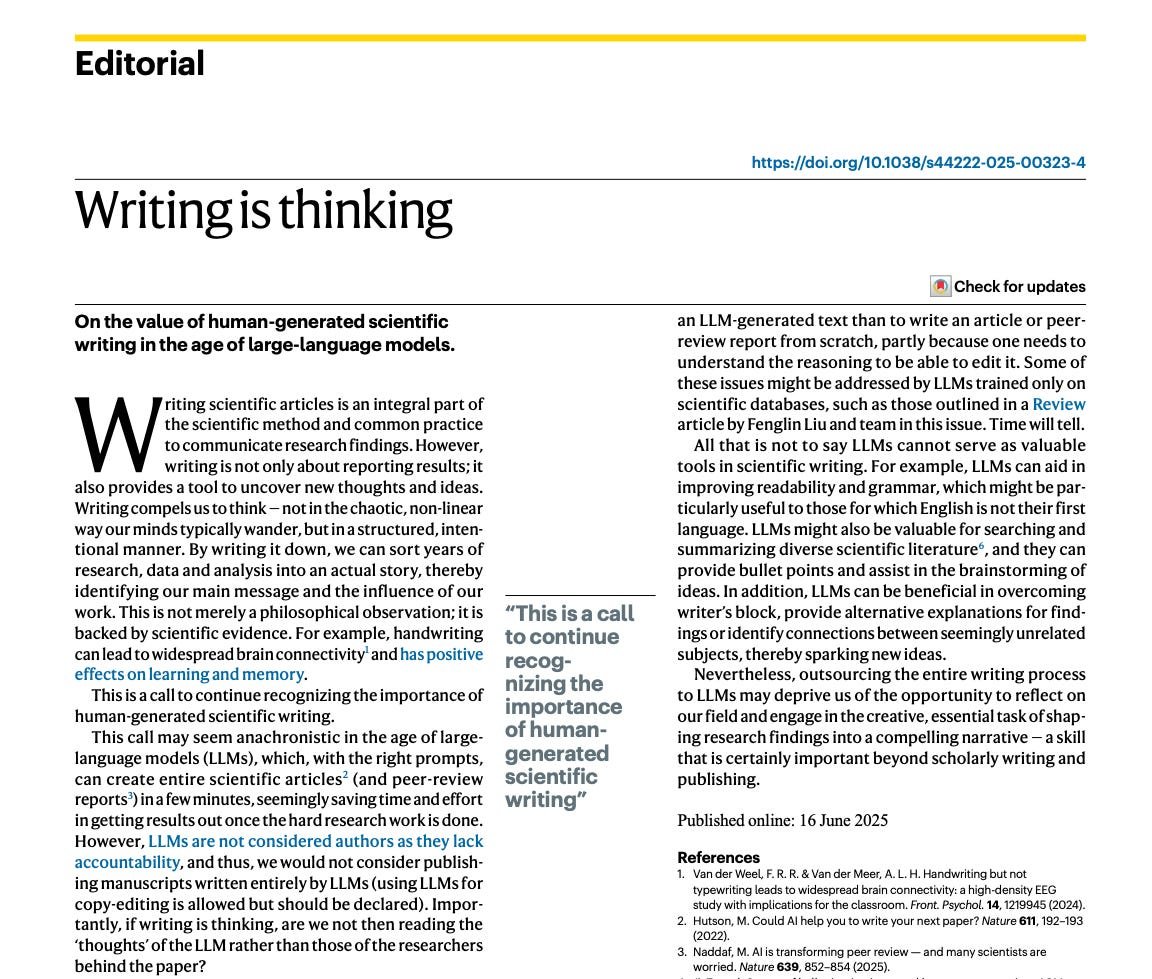
So it turns out that writing is thinking. It's the same process. "Writing compels us to think — not in the chaotic, non-linear way our minds typically wander, but in a structured, intentional manner." Outsourcing writing to LLMs is THE SAME THING as outsourcing thinking.
Athenaeum Book Club tweet media
English
185
1.5K
5.7K
212.3K
George Lin retweetledi
章工
章工@435hz·
人生的核心,其实是做好两件事:驯服大脑、照顾好身体。 身体是行动载体,健康是所有可能性的前提; 大脑是你的操作系统,不受控制的思绪会制造痛苦。 身体与大脑相互影响:健康的身体支撑清晰的思维,平静的思维呵护身体。 照顾身心,拥有行动的能量、判断的平静和专注的清晰,其他欲望与焦虑只是噪音。
中文
3
9
93
4K
George Lin retweetledi
Rob Henderson
Rob Henderson@robkhenderson·
Rob Henderson tweet media
ZXX
2
15
201
6K
George Lin retweetledi
章工
章工@435hz·
人生要走到下一个阶段,被新的挑战和憧憬占有,才能真的把过去很在乎的东西放下。 只有主动走进人生下一个篇章,被更宏大的目标吸引走,被更棘手的难题折磨得没空回头看,被更惊喜更贵重的成就感砸得飘飘然的时候,那些彻夜难眠的旧事自然而然放下了。大步流星往前走的时候,丢掉些旧行李是正常的事。
中文
26
16
167
6.8K
George Lin retweetledi
少个分号
少个分号@shaogefenhao·
多年外企经历路过:背单词和语法确实是错误的,语言学习是体育训练而不是数学推理,等推出来了人都说完了。 正确做法大量语料泡耳朵、磨嘴皮子,脸皮薄害怕说错,就喝点酒。 语法只是语言规律,而不是法律。 单词只有在场景下才有意义。
Stanley@Stanleysobest

一个暴论: 背单词和学语法是废物。 直接沉浸式硬用:刷剧、打游戏、跟老外对骂。 一个月顶过去十年。

中文
2
10
64
4.1K
George Lin retweetledi
章工
章工@435hz·
终身学习应当成为普通人的一个习惯。 学习的本质从来都是自学。一切高效的成长,都源于主动向顶尖者借鉴、主动打磨自身能力。 学习并不是天生的天赋,如同锻炼大脑肌肉一样,可通过刻意训练不断强化的能力。
中文
7
15
115
5K
George Lin retweetledi
Morris
Morris@Morris_LT·
找到自己的热爱是每个人必须完成的使命。不要再用“我还没有财务自由,寻找热爱太奢侈”当借口了。有没有可能你之所以没有财务自由,恰恰就是因为没有找到热爱?想要实现财务自由,就意味着你必须在某个领域做到顶尖水平,而要做到这一点,就需要真正热爱它,否则很难与那些投入全部精力的人竞争。在热爱的事情里,人会自然进入高投入状态,如果不喜欢,就很难持续输出能量与专注力。即使真的财务自由了,也不意味着就不需要热爱。很多人以为有钱之后只要吃喝玩乐就够了,但这种状态很快就会带来空虚。消费和娱乐只能提供短暂刺激,真正持久的满足感与成就感,始终来自通过热爱的工作创造价值、完成让自己自豪的成果。所以,通往财务自由的第一步,恰恰是找到那个即使在财务自由之后你依然愿意每天去做的事情,也就是找到真正的热爱。这从来不是奢侈品,而是必选项。
中文
14
14
85
6.5K
George Lin retweetledi
卢尔辰
卢尔辰@erchenlu1·
大多数人为什么一直普通?因为“合群”来得太快了。 你和大家一样说话、一样消费、一样抱怨、一样选择,很快就能被接纳。 但真正想变厉害,往往要先经历很长一段没人理解的时间。 所以很多人最后选择了更容易的那条路:先合群,先舒服,先不被笑。问题是,普通行为很快给你安全感,卓越行为很晚才给你回报。
Raj Shamani@rajshamani

The reason most people stay average is because average behaviour gets you social acceptance much earlier than exceptional behaviour gets you results.

中文
3
9
63
5.5K
George Lin retweetledi
Morris
Morris@Morris_LT·
在1930年,罗素曾说:人长期处于紧张和焦虑之中,连休息都变得困难,最终走向身心枯竭,甚至失去繁衍的意愿。一百年过去,这种状态在今天几乎原样重现,主要体现在四点: 第一,失去了真正放松的能力。学习、工作、甚至娱乐都变成任务,连休息都会产生负罪感,大脑长期处于紧绷状态。 第二,竞争的驱动力不是生存,而是恐惧。人们害怕的不是吃不饱,而是被比较、被落下、被否定,于是把面子竞争当成生存危机。 第三,一切都被工具化。社交、兴趣、甚至家庭,都被当作实现其他目标的手段,人不再为“本身的意义”而行动。 第四,高压环境触发生物性的“自我保护”。当资源焦虑和精神压力过高时,人会本能地减少甚至放弃繁衍。
中文
7
46
296
21.4K
George Lin retweetledi
木子不写代码
木子不写代码@ai_muzi·
爆肝制作,全网最全最细Codex 零基础保姆教程!👇👇 这一期视频跟完,保证让你成为Codex专家! 从安装、界面、权限, 到 Skills / Plugins, 到做网站、PPT、Excel、部署和自动化, 一路讲到浏览器和电脑自动操控! 视频我精剪过,零废话,不会浪费你一秒的时间! 时间戳: 00:00 开场 00:36 Codex对比ClaudeCode 02:07 安装 02:27 项目与聊天 04:37 多任务并行 06:27 权限系统 08:15 Skills和Plugin 10:53 文档,表格和PPT 13:23 自动化 15:22 AI编程:个人网站 19:16 操作电脑/浏览器 21:36 结尾总结
中文
103
725
3.5K
286.7K
George Lin retweetledi
Rob Henderson
Rob Henderson@robkhenderson·
Available now. I was honored to write the foreword for the 25th anniversary edition of Life at the Bottom: The Worldview That Makes the Underclass by Theodore Dalrymple. As you can probably tell from the title, the book is about life at the bottom of society. Not just in terms of money but in terms of behavior, values, and daily choices. Drawing on his many years working as a doctor with prison inmates and patients in low-income neighborhoods, Theodore Dalrymple describes how violence, addiction, broken families, and despair are sustained not only by material hardship but by ideas that excuse bad behavior and reject personal responsibility. Dalrymple challenges a comforting story. Many people believe poverty is mainly about a lack of resources or unfair systems. This book argues that culture and norms matter just as much, sometimes more. When society stops expecting discipline, self-control, and accountability, the people who most need those guardrails suffer the most. I read the original version of Life at the Bottom about a decade ago when I was in college. One of the most important books I’ve ever read. Writing this foreword for the 25th anniversary edition feels like coming full circle. First living the world Dalrymple describes, then discovering his work in college, and now helping to bring it to new readers. Strongly recommended. It is available today. Get your copy here: us.amazon.com/Life-Bottom-Wo…
Rob Henderson tweet media
English
37
167
1K
120.9K
George Lin retweetledi
纽约博叔
纽约博叔@druncle·
放弃普林斯顿去州立大学,表面上看是省了学费,实际上是放弃了最稀缺的社会资源。 名校和普通院校的差距,绝不仅仅是课程内容。顶级大公司的校招名单(Target School)是极其残酷的,很多高薪职位的简历库压根就不会对普通州立大学开放。州立大学省下的那点学费,在顶级名校毕业生起薪的量级面前,其实并不具备长期的财务优势。 ​ ​在美国,本科学历的含金量远超研究生。对于二代移民来说,如果本科毕业无法直接进入高薪行业而必须通过读研来“镀金”,某种程度上反映了本科阶段竞争力的不足。 哈佛本科学历史的毕业生能进华尔街做交易员,是因为名校的录取通知书本身就是一种高智商和综合素质的强背书。研究生录取的筛选逻辑与本科完全不同,在就业市场上,雇主更看重你 18 岁时展现出的原始竞争力。 ​大学不只是上课和考试,更重要的是平台提供的非对称信息。名校内部的精英俱乐部和社团与头部行业有着极深的利益绑定。这种行业脉络和校友资源,是普通州立大学无论如何努力都无法触及的。 教育的本质是认知的跃迁和圈层的准入,如果只盯着学费这本小账,那就是典型的用战术上的勤俭掩盖了战略上的短视。
Nancy@Nancyxps

信不信由你,我有个朋友,她儿子拿到了Princeton University的录取,但最后还是选择了Stony Brook University。理由很简单——就在家门口,能省下一大笔开支。 更难得的是,他反过来安慰母亲:“本科四年去哪读其实差别没那么大,等读研的时候,再去更好的学校也不迟。” 我一直认为:一个人的未来,真的不取决于你进了哪所大学,而在于你对自己有没有清醒的认知,以及那种不依赖外界标签的自信。 学校只是平台,不是答案。真正拉开差距的,从来都是人本身。

Manhattan, NY 🇺🇸 中文
98
18
172
79.5K
George Lin retweetledi
Rob Henderson
Rob Henderson@robkhenderson·
Just don't use these findings as an excuse. As a kid I scored 84 on the verbal section of an IQ test, graduated from HS with a 2.2 GPA, got arrested, did a stint in rehab, graduated from college at age 28, and now I'm a world famous author who travels in economy plus. Dream.
Nicholas Decker@captgouda24

Sort of a profoundly pessimistic paper. Basically, everyone gets sorted into what they’re gonna do early in life, and this is in fact completely correct and accurate, if you were going to be successful you’d’ve shown promise earlier.

English
35
40
1.1K
97.8K