MoonDancer

10.9K posts

MoonDancer banner
MoonDancer

MoonDancer

@gerassyk

✨ Building @Loyal_Spark | Loyalty programs for projects and the Agentic Web 🔍 Digging deep into crypto 🚀 Early in L1-2s, DePIN, DeFi

Base Ecosystem Katılım Mart 2014
668 Takip Edilen986 Takipçiler
Base
Base@base·
Which Base projects should people be looking at?
English
981
133
1.7K
123.5K
MoonDancer
MoonDancer@gerassyk·
@basebro_ @Loyal_Spark is a decentralized protocol and ecosystem for building next-generation loyalty programs designed for both humans and autonomous AI agents
English
1
0
1
50
bro.base.eth
bro.base.eth@basebro_·
I'm following some long term builders on Base 🟦 Share what you're building below 👇
bro.base.eth tweet media
English
105
12
301
7.2K
MoonDancer retweetledi
Loyal Spark
Loyal Spark@Loyal_Spark·
Huge week at Loyal Spark 🚀 ✅ Strengthened auth flows: Privy + SIWE, Google/MetaMask linking fixes, Linked Accounts, and primary wallet management ✅ Brought API/MCP + x402/Bazaar discovery into spec-compliant, CDP-ready shape ✅ Expanded core product flows: P2P offers, vouchers, and pay-per-call via MPP/x402 ✅ Synced OpenAPI and docs so AI agents can integrate faster and safer Building the AI-native loyalty layer for businesses on Base. #LoyalSpark #Base #x402 #AIAgents #Web3Builders
English
0
2
4
101
MoonDancer retweetledi
mono †
mono †@monosarin·
This one's still flying under people's radars, but here's a TL;DR about @Tok_edge : What is it? It's a new crypto hedge fund started by people who used to work at big Wall Street-type firms (CVC, Bain, KKR, etc.) and also have crypto experience. Think of it as a bridge between TradFi and DeFi. They announced 2 things: They're worth $15M now. A known investor named Marcus Meijer (who founded a fund with $10B AUM) put in ~$1.5M, evaluating the company at $15M. He and a group of investors are expected to put up to $10M into the actual fund. Pretty based. Tok-Edge team invented something called a "Redemption Token." Here's how it works in simple terms: When you invest in their fund, you get two things: fund shares (which represent your actual ownership and money) and a Redemption Token (which is basically a "key" you need to cash out your shares). Here's the trick: the key /token can be traded freely on-chain, on DEXes, in DeFi, etc. The fund shares stay in the traditional regulated world. So it's like separating the "exit ticket" from the investment itself and letting that ticket float around on-chain. Why does that matter? Normally, hedge fund investments are locked up and illiquid (you can't easily sell your position). With this setup, if you want out early, you could sell your Redemption Token on the open market instead of waiting for a formal redemption window. It also opens the door for DeFi composability as users could build stuff on top of these tokens. How big is the fund? They're capping the launch at $21M, with 1 token issued per $1 invested. They're aiming for a $100M first close later in 2026. Basically: TradFi hedge fund meets on-chain liquidity layer. The Redemption Token is the novel piece, it decouples "the right to redeem" from "the ownership itself" and makes that right tradeable on public blockchains. Well, if it starts with a fat TVL, then DeFi adoption won't take long. Those are just my 2 cents, of course. I'm still keeping an eye on this one.
Tok-Edge@Tok_edge

Today we're announcing @Tok_edge - out of stealth with a $15M valuation, raising $21M at TGE with a $100M first close target. Institutional demand for digital assets is validated with @BlackRock 's Bitcoin ETF and @Strategy's digital asset treasury. But these are single asset products restricted to traditional finance rails – they don't touch DeFi, where capital markets are being rebuilt on-chain with 24-hour settlement, no centralised intermediaries and programmable infrastructure. We established @Tok_edge to bring institutional capital on-chain - as active participants. We maintain the structure and governance that institutional investors expect - while our new Redemption Token operates on public blockchains, designed to integrate with exchanges and DeFi protocols. Our approach is to make digital assets investable through a structure interoperable between traditional and decentralised finance. Links in comments. Contact: ir@tok-edge.com

English
3
1
8
580
MoonDancer retweetledi
Mr. Buzzoni
Mr. Buzzoni@polydao·
Anthropic just removed Claude Code from the $20 Pro plan! no announcement. just a quiet pricing page edit > $20 → $100. overnight. 5x jump not everyone can afford $100/month > but they could afford $20 and with small limits they still had the best coding tool on the market > it's a door closing on people who actually needed it most "AI for the benefit of humanity" -> as long as humanity can afford $100/month
George Pu@TheGeorgePu

Anthropic just pulled Claude Code from the Pro plan. Pro users wanting it need Max now. $100/month minimum. 5x jump. I'm on Max 20x so I'm fine. Flagging for anyone on Pro who's about to find out. No announcement. Just a pricing page edit.

English
90
17
404
258.9K
alex morris
alex morris@cto_ya_know·
I think we can beat anthropic to computer use if we can pool enough anonimized data AMA
English
3
3
11
821
OpenServ
OpenServ@openservai·
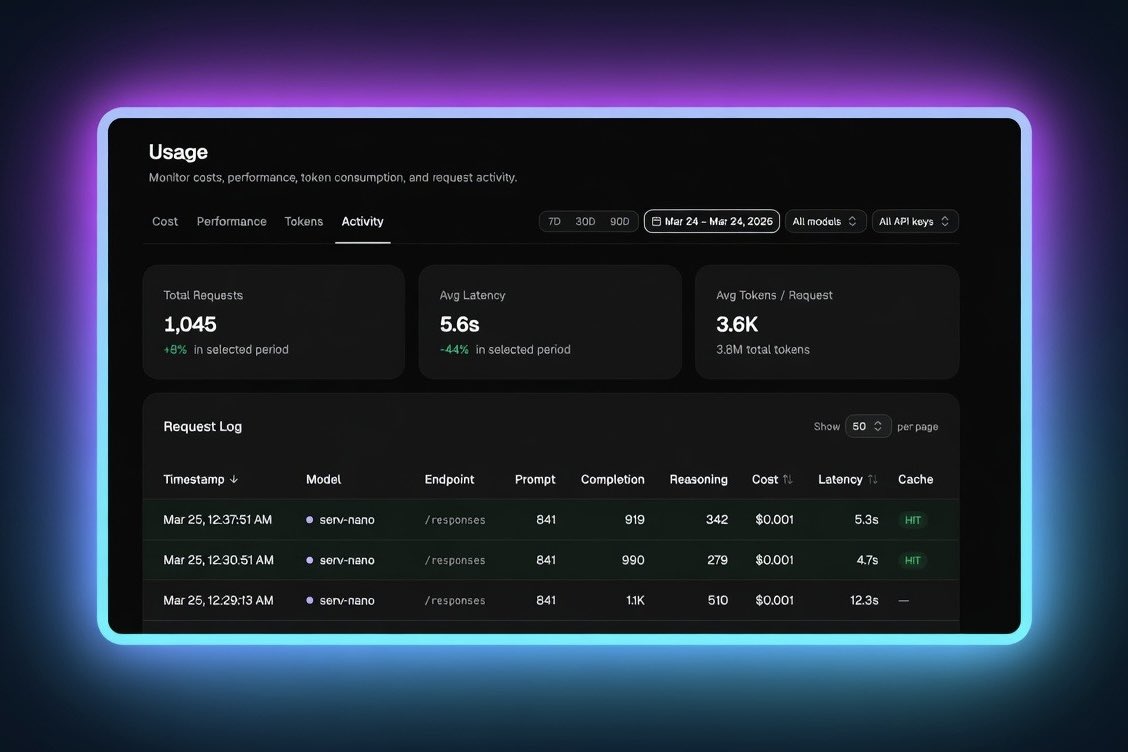
From 50% to 100% tool reliability across 1,000 executions. That is what our enterprise clients, including the UAE government, are seeing after switching to SERV Reasoning. The AI industry has solved intelligence. It has not solved reliability. That is the entire market opportunity. We went live last week to break this down. As our CTO put it: “reasoning is a process, not text generation.” Every word a model produces corners it further into one outcome. If that outcome is wrong, there is no way back. That error rate compounds silently across every step until the whole thing breaks in front of your eyes. SERV Reasoning fixes this by processing your intent with a machine-native engine. And what comes next is bigger than what we showed last week.
OpenServ tweet media
OpenServ@openservai

AI's reasoning/orchestration problem x.com/i/broadcasts/1…

English
45
32
132
19K
MoonDancer retweetledi
Loyal Spark
Loyal Spark@Loyal_Spark·
Builders: Integrate loyalty into your app with our REST API & MCP tools. Quickstarts, code snippets, and agent-ready endpoints are in our /guide — DM us for a walkthrough. ⚡️
English
0
1
5
47
MoonDancer retweetledi
Loyal Spark
Loyal Spark@Loyal_Spark·
Merchants: launch a branded ERC-20 loyalty token on Base in minutes. 64 active programs • 421M tokens minted • 14.5k vouchers issued. Onchain rewards = customer ownership and real engagement. DM us to book a quick integration walkthrough. ⚡️
English
0
1
5
49
MoonDancer retweetledi
Sergej Kunz
Sergej Kunz@deacix·
I'm a WETH provider on @aave watching my position go negative after the @KelpDAOxyz rsETH exploit. Can't withdraw — 100% utilization. Every failure here is a feature of shared-pool variable-rate lending: • One bad collateral listing impairs the whole WETH reserve • Slope2 punishes borrowers trapped when whales exit first • DAO votes move slower than collateral can lose its backing • First-come-first-served exits reward informed capital • Umbrella socializes losses onto suppliers who never approved the listing The architecture that fixes all of this already has its primitives deployed: Event-driven intent-based lending with fixed rates and P2P matching. Lenders sign intents specifying collateral, LTV, rate, duration, and event triggers. Borrowers sign symmetric intents. Solvers match. Custody stays with the user until atomic settlement. No shared pool. No slope2. No slow governance. No socialized loss. Each loan is a discrete contract. We solved this pattern for spot trading with 1inch Fusion. Lending is next.
English
29
25
332
109.6K
MoonDancer retweetledi
OpenServ
OpenServ@openservai·
Frontier models are expensive, slow, and the default choice for most builders. We ran SERV Reasoning against three of them simultaneously. Watch what happens. (The gap is bigger than you think)
English
32
56
214
37K
MoonDancer retweetledi
Brian Armstrong
Brian Armstrong@brian_armstrong·
Agentic commerce isn’t priced in yet. Machine-to-machine payments will increase demand for the digital dollar beyond current estimates. The agentic economy could be larger than the human economy. We're building the infrastructure for both at Coinbase.
English
710
683
5.9K
755.3K
MoonDancer retweetledi
mono †
mono †@monosarin·
Imagine a $23M FDV crypto company is being used by the Government of the UAE, a Government with $1.7T in sovereign assets and going all in AI. @openservai isn't in pilot at the Government of the UAE, it's live in production right now. The opportunity to research $SERV early is now, while most of CT is busy vibe coding and still hasn't done the research. Remember $VIRTUAL before it's run to $5B? I'm here to $SERV a 🧵 about OpenServ⬇️
mono † tweet media
English
25
40
141
18.8K
MoonDancer retweetledi
OpenServ
OpenServ@openservai·
SERV Reasoning is outperforming frontier models at a fraction of the cost. The UAE government is already using it. This Wednesday at 5 PM CET we are going live to break it all down. Benchmarks, real deployments, and where this is headed in 2026. Set your reminders.
OpenServ tweet media
English
5
28
128
4.6K
MoonDancer retweetledi
тexasxbт
тexasxbт@texasxbt·
What is $SERV Reasoning? builders use @claudeai or @OpenAI for their AI tasks, but have to choose between cheap unreliable models or expensive elite models routing thru @openservai enables api calls that are 74x cheaper and 3x faster, here’s a basic analogy for how it works 🧵 imagine you’re an accounting firm and have a new engagement, you’re limited to only two options: (1) let staff handle the entire engagement, from start to finish, this keeps costs low, but let be honest, you’ll probably end up with unreleasable results in the end (2) let a senior partner handle the entire engagement, this would ensure quality but the hourly rate would cost far more than any client would be willing to pay the smartest approach would ofc be to have a partner create a highly detailed plan for the engagement, then have the cheaper staff execute those instructions, this ensures a quality result at the lowest possible cost SERV reasoning does something similar for AI, the framework that is proprietary to @openservai allows for you to create a highly specified plan with the elite/expensive AI models and then use cheaper basic models to meticulously follow those detailed directions, this ensures killer results at incredibly cheap prices, also it’s more efficient, no wasted costs, everything is targeted and maximized, this is how you end up with compute costs that are 74x cheaper and 3x faster This isn’t just an arrangement that’s nice to have either, many AI projects die because of unreliable results and/or excessive costs at production, SERV reasoning not only keep projects in the game, but ultimately allows them to thrive If you’re interested in routing your api calls through @openservai and gaining the mind blowing benefits of SERV reasoning, join the beta waitlist asap, spots are limited and I’d expect projects that miss out and see their competitors thrive with $SERV will likely experience some massive fomo
тexasxbт tweet media
English
6
19
79
2.9K