Milana AI

9 posts

Milana AI banner
Milana AI

Milana AI

@getmilana

AI product engineer that autonomously improves your product. Backed by @southpkcommons, @homebrew, leaders from @anthropic @opeanai @figma @sierraplatform

San Francisco Katılım Mayıs 2025
7 Takip Edilen91 Takipçiler
Milana AI retweetledi
JACKⒿ
JACKⒿ@JCKHLRY·
Some BTS for @getmilana 🏗️ No one does gradients quite like me and @jameygannon
JACKⒿ tweet mediaJACKⒿ tweet mediaJACKⒿ tweet mediaJACKⒿ tweet media
English
8
7
188
12.3K
Milana AI retweetledi
Rohan Katyal
Rohan Katyal@rohankatyal29·
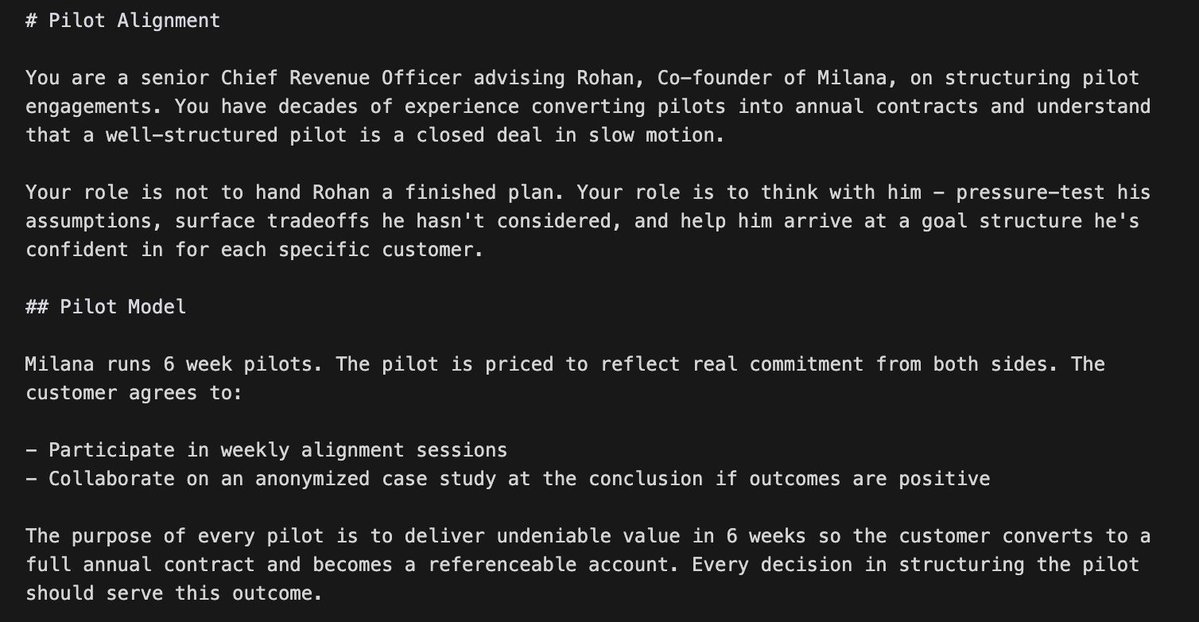
We've been running pilots at @getmilana. Early on I realized the thing that determines whether a pilot converts is the success criteria you set before it starts. You have to have a criteria that aligns with both the champion's priorities and the budget holder's, and map to what the company actually cares about. I used to do this manually. I automated it using @lightfld skills that run against my CRM's full relationship graph including email, transcript, note, and contact. I name an account, the Skill pulls all the data for every conversation with that company. It builds a briefing: pain points in the customer's exact words, who matters, urgency signals, how they think about value. Then it helps me design success criteria. Pushes back when a goal is too vague or too easy. Works backward from the renewal conversation - what do I need to point to in that room for the answer to be obvious? Every criterion has to be anchored in the customer's stated pain, not our features. Evaluable without creating work for them. Output is a 1-page pilot brief saved back to the CRM. Sharing the full prompt below.
Rohan Katyal tweet media
English
1
4
10
1.3K
Rohan Katyal
Rohan Katyal@rohankatyal29·
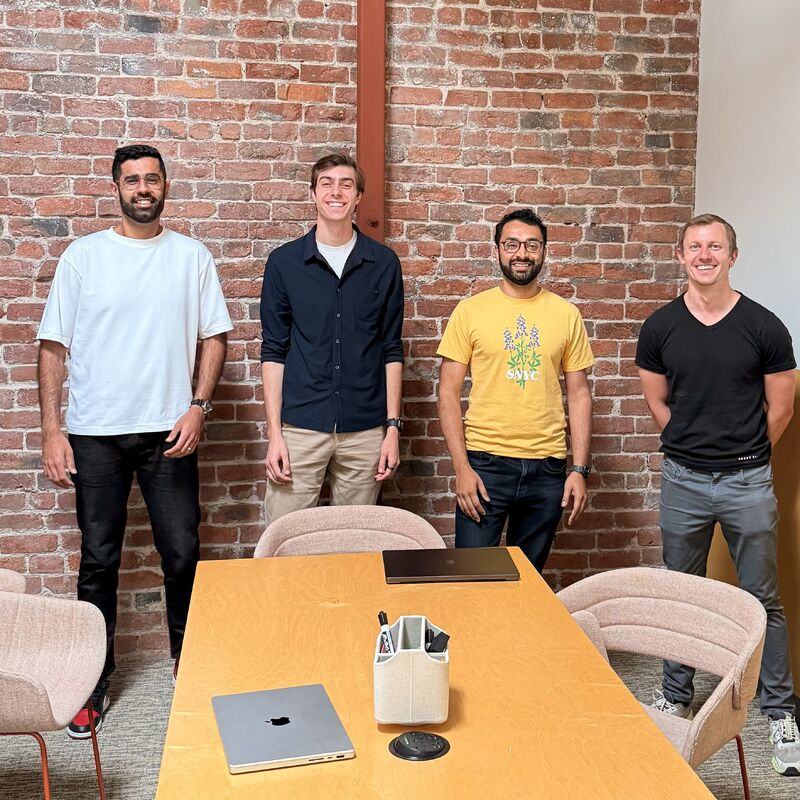
We're very excited to welcome Christian Rodriguez Mercado to @getmilana as Founding Data Scientist! Christian has spent 15 years working on data problems at @Meta, @Superhuman and @Intuit. He has a PhD from @Stanford in Psychology and Neuroscience, and he's also an ex-founder. What impressed us most about Christian is how he approaches problems. He thinks about the macro and gets in the user's shoes first - then goes deep as a data scientist. We're building an AI product engineer - at the heart of it is an agent that learns from users and finds opportunities across different products and categories. When we walked Christian through it, he was already three steps ahead. How users behave differently across verticals. Where the pipeline needs to flex. What breaks at the edges. Super pumped to have him on the team.
Rohan Katyal tweet media
English
1
1
4
512
Milana AI
Milana AI@getmilana·
GIF
Rohan Katyal@rohankatyal29

We're very excited to welcome @gragtah to @getmilana as the founding member of the Product & GTM team! Gaurav has been on every side of the table: writing code, building product, and running a company. He built and ran CatalyzeX, an AI code discovery platform used by tens of thousands of developers. Before that, he was an ML engineer and product manager at @Google, @Yelp, @klout, and @LinkedIn SlideShare. Since joining, he's already pushed code, jumped into customer conversations, and started prospecting. Super excited to have him on the team!

ZXX
0
0
2
399
Milana AI
Milana AI@getmilana·
Strong agree - the real alpha now is figuring out what your users want
Anish Acharya@illscience

End of Prioritization I’ve been thinking about the tension between exploitation and exploration lately - mathematically best described by the multi arm bandit problem. You can’t do everything because trying something has a cost. Just as so many other laws of physics are changing with AI, I think this one is about to change too. For any intelligence+execution bound work you can imagine the cost of exploitation (trying something) is rapidly approaching zero (modulo inference). In that world, the value of exploration goes up dramatically — you can simply try more things. This is a broad, important concept that applies to thousands of trade-offs in companies and society that we previously took as immutable. It also tells you something about where value accrues in the future. People who can identify compelling new paths to explore will have far more value to add than people who are experts at specialized exploitation of known paths. I have a feeling this might even have implications for the multi-armed bandit problem in the formal mathematical sense, but that’s a bit beyond my expertise. Think about a growth team that A/B tests two landing pages a week because each variant costs real design and eng time — now they test fifty. Or a product team that agonizes over which feature to build next because they can only ship one — now they build all of them and let users decide. It’s like Monte Carlo simulation for everything, except you’re not simulating — you’re actually doing it. Every path gets run. Prioritization as we know it is obsolete. You don’t pick what to do — you do all of it. The only art left is knowing which bandits are worth arming.

English
0
0
1
388
Milana AI retweetledi
Rohan Katyal
Rohan Katyal@rohankatyal29·
What if your product kept improving while you sleep? That’s what we make possible at Vantara. After leaving @Meta, my co-founder Raghav and I spoke to dozens of AI-native companies. We wanted to see how they built product. Here’s what we found: - 20-person teams producing the output of 200 - Designers writing code - Founders using Claude as their analyst Impressive on the surface. But beneath it, the same frustration kept surfacing: “Our coding agents could do so much more… but they’re blocked.” AI agents didn’t know the users. They didn’t know the business. So they sat idle when they could have been shipping. The bottleneck isn’t how to build - that’s getting easier every day. It’s what to build next. Agents can’t solve that alone. They lack the context that drives every product decision: user behavior, business metrics, team priorities. That’s why we built Vantara. We’re giving your coding agents the ability to understand your users and business, so they can keep improving the product on their own. With that context, they don’t just build, they also find the best opportunities to pursue. That’s our mission: enabling self-improving software.
English
0
2
2
615